1P5 regular Eric Sammons was recently named the Editor-in-Chief of Crisis Magazine. Today, he has a piece there looking at the demographic shift that has happened over the past year when it comes to Mass attendance, and it’s about what you’d expect:
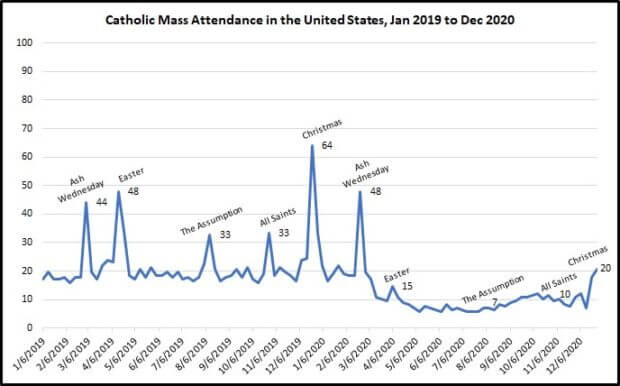
Faithful Catholics in America have long lamented the dreadful Mass attendance numbers of the past half century. In 1970, 55% of American Catholics attended Mass; by 2019, that number had dropped to little over 20%. It’s clear that most self-identifying Catholics don’t think it’s obligatory, or even beneficial, to participate in the “source and summit” of the Catholic Faith on a regular basis. Going into 2020, however, who knew that we’d soon be looking at that 20% attendance with nostalgia.
The Center for Applied Research in the Apostolate recently released its figures regarding Mass attendance in 2020. It’s as bad as you suspect. Starting in March (ahem), the percentage of Catholics attending Mass plummeted from its already-pathetic 20% to around 5%.
Sammons points out that even after many dioceses re-opened, Mass attendance only came back up to “about 10% by the end of the year.” He continues:
As I’ve detailed elsewhere, the Catholic Church in America was facing a demographic collapse before the Age of Covid. Since 2000, the number of infant baptisms—one of the best indicators of the health of the Church—has plummeted more than 40% after it had remained relatively steady from 1975-2000. And there were no signs that this trend was reversing before 2020. Now add to that the following realities: (1) our bishops, whether intentionally or unintentionally, have signaled to the world that attending Mass is “non-essential;” (2) lifelong Mass-going habits have now been broken; and (3) many parishes are so vigorous in their COVID-19-restrictions that they’ve become less welcoming than an East German Stasi house call. Add it all up, and you’ve got a recipe for empty churches.
Eric’s got some ideas about why this has happened, what might be able to be done, and the harsh reality ahead. I recommend you read the rest of his piece for his analysis.
Now, there are no doubt a number of at-risk people still staying home as COVID numbers peaked again this month. They may well return when the coast is clear – which, according to some reports, may not be for another year, even with the highly-controversial vaccine.
As I wrote last September, fewer people at Mass means fewer people giving money, which means parish closures. Dioceses are not going to be able to sustain all their properties, and with a huge drop in attendance, they’re not going to be able to justify trying.
Traditional parishes will likely see a continued surge, which they’ve experienced during the pandemic. People who want to still receive Communion on the tongue, or deal with less restrictive health measures, have found something of a haven at TLM parishes, which were already exploding with double digit growth BEFORE the lockdowns.
Which means, hopefully, that some traditional parishes will be able to reap the benefit of church closings and get into properties that will fit their ever-growing congregations.
Even so, the contraction of the post-conciliar Church has accelerated during the pandemic, and there’s little hope that with the habit of massgoing broken for cultural Catholics, we’ll see a significant return overall.
One way or another, the makeup of the Church is changing. It’ll be very interesting to see where things are at this time in 2022.
Steve Skojec is the Founding Publisher of OnePeterFive.com. He received his BA in Communications and Theology from Franciscan University of Steubenville in 2001. His commentary has appeared in The New York Times, USA Today, The Washington Post, The Washington Times, Crisis Magazine, EWTN, Huffington Post Live, The Fox News Channel, Foreign Policy, and the BBC. Steve and his wife Jamie have eight children. You can find more of his writing at his Substack, The Skojec File.
Sign up to receive new OnePeterFive articles daily
Cookie Consent
We use cookies to improve your experience on our site. By using our site, you consent to cookies.
This website uses cookies
Websites store cookies to enhance functionality and personalise your experience. You can manage your preferences, but blocking some cookies may impact site performance and services.
Essential cookies enable basic functions and are necessary for the proper function of the website.
Name
Description
Duration
Cookie Preferences
This cookie is used to store the user's cookie consent preferences.