
Lost Feasts and Principles from the Pre-1955 Roman Missal
Part I – The Roman Calendar in 1954: The Last Year of Wholeness
Part II – The Vigil of the Epiphany: the Forgotten Gateway to Christ’s Manifestation
Part IV – The Vigils of the Apostles: Apostolic Watchfulness and Penitential Preparation
Part V – The 1955 Holy Week Reform: a Summary
Part VI – The Pre-55 Paschal Feast of St. Joseph
Part VII — The Suppression of “Duplicate Feasts”: When Memory (and Miracles) Were Suppressed
Part VIII — The Octave of Corpus Christi and the Sacred Heart: When Time Itself Was Shortened
Part X — The Finding of the Relics of St. Stephen: Martyrdom and Easter Glory United
Part XI – Ember Days: Pre-55, 1962, and Today
Part XII — The Octaves: Eight Days of Grace — A Theology of Liturgical Fullness
Among the most revealing losses in the twentieth-century reform of the Roman calendar was the suppression of nearly all traditional octaves. The loss was not simply numerical. It was theological, devotional, and formative. An octave is not merely a repeated feast, nor is it a sentimental prolongation of celebration. It is the Church’s way of teaching that the greatest mysteries cannot be exhausted in a single day.
The traditional Roman Rite knew how to dwell. It did not hurry from one mystery to the next as though the calendar were a crowded schedule in need of efficiency. Rather, it lingered over the Nativity, the Epiphany, Easter, Pentecost, Corpus Christi, the Ascension, the Sacred Heart, the Immaculate Conception, the Assumption, All Saints, and other great feasts. Through octaves, the Church taught that certain mysteries are so rich that they must be entered, contemplated, repeated, and lived for eight days.
The mid-century reforms gravely weakened this structure. In 1955, under Pope Pius XII, the decree Cum nostra hac aetate retained only the Octaves of Christmas, Easter, and Pentecost, suppressing all others in both the universal and particular calendars.[1] What had once been a rich architecture of prolonged feasting was reduced to three remaining examples. Later, in the post-conciliar calendar, even the Octave of Pentecost disappeared, leaving only Christmas and Easter.[2]
This change deserves careful attention because octaves express one of the deepest instincts of Catholic worship: grace fills time.
What an Octave Expressed
An octave extends a feast across eight days. The feast itself is the first day; the eighth day is the octave day; the intervening days are days within the octave. In some octaves, the Mass and Office of the feast are repeated, either wholly or in part. In others, the octave is commemorated alongside occurring feasts. The details varied according to rank and rubric, but the underlying principle remained the same: the mystery was too important to vanish after twenty-four hours.
The symbolism of the eighth day is ancient. In Scripture, the eighth day is associated with circumcision, purification, sacrifice, and completion. The Old Testament Feast of Tabernacles was followed by a solemn eighth day. In Christian theology, the eighth day came to signify the new creation, the day beyond the seven-day cycle of the old world. Sunday itself, the day of the Resurrection, is both the first day and the eighth day: the beginning of the new creation in Christ.
The Catholic Encyclopedia notes that Easter and Pentecost received octaves in the fourth century, possibly connected at first with the baptismal life of the neophytes, who remained in a kind of joyful retreat until the following Sunday. From there, the octave naturally became a liturgical conclusion to the seven festal days that followed the great feast. Over time, the practice expanded to other solemnities.[3]
This development was not accidental. The Church discovered in the octave a liturgical form capable of expressing fullness. The octave did not merely repeat a feast. It surrounded the faithful with it.
The Pre-1955 Structure of Octaves
Before the 1955 reform, the Roman calendar distinguished several kinds of octaves. The most important were the privileged octaves. The first rank belonged to Easter and Pentecost. These were so privileged that no feast could be celebrated during them, and even commemorations were highly restricted in the early days of the octave. The second rank belonged to Epiphany and Corpus Christi. The third rank belonged to Christmas, the Ascension, and the Sacred Heart.[4]
There were also common octaves, including those of the Immaculate Conception, the Assumption, the Nativity of St. John the Baptist, St. Joseph, Sts. Peter and Paul, and All Saints, along with certain local octaves for patrons, churches, dioceses, and religious orders. Finally, there were simple octaves, such as those of St. Stephen, St. John the Evangelist, the Holy Innocents, St. Lawrence, and the Nativity of the Blessed Virgin Mary.[5]
This hierarchy of octaves taught doctrine through rank and repetition. Easter and Pentecost stood above all. Epiphany and Corpus Christi received especially strong prolongation. Christmas, the Ascension, and the Sacred Heart possessed their own extended dignity. Marian feasts, apostolic feasts, patronal feasts, and martyr feasts were woven into the calendar with their own forms of prolongation.
To modern eyes this may seem complex. But complexity is not the same as confusion. The older system reflected a subtle theological grammar. It taught Catholics not only which mysteries mattered, but how they related to one another. A privileged octave did not teach the same thing as a common octave. An octave day did not function in the same way as a commemoration. The calendar possessed gradation, memory, and depth.
The 1955 Suppression
The 1955 decree Cum nostra hac aetate changed this dramatically. Its rubric on octaves stated: “Only the octaves of Easter, Christmas and Pentecost are celebrated; all others occurring either in the universal or in particular calendars are suppressed.”[6] The decree further specified how the remaining octaves were to be handled. The days within the Easter and Pentecost octaves were raised to the double rite and given precedence over all feasts, while the Christmas octave was retained “as at present.”[7]
This was one of the most sweeping calendar changes of the pre-conciliar period. The Octaves of Epiphany, Ascension, Corpus Christi, and the Sacred Heart disappeared. So did the Octaves of the Immaculate Conception, Assumption, St. John the Baptist, Sts. Peter and Paul, All Saints, St. Stephen, St. John the Evangelist, the Holy Innocents, St. Lawrence, the Nativity of Our Lady, and local octaves of patrons and churches.[8]
The reform did not deny the doctrines associated with these feasts. Epiphany remained. Corpus Christi remained. The Ascension remained. The Sacred Heart remained. But the Church’s liturgical dwelling within these mysteries was curtailed. The faithful still saw the feast but no longer entered its extended house.
The change also altered the texture of the calendar. The days after Epiphany became ferias connected only residually with the feast. The days after the Ascension became ferias of Paschaltide rather than days within the Ascension octave. The days after Corpus Christi and the Sacred Heart became ordinary ferias. The liturgical afterglow was replaced by a rapid return to the ordinary flow of time.
The Octave of Epiphany
The suppression of the Epiphany Octave was especially damaging. Epiphany is among the most ancient and theologically rich feasts of the Christian year. In the Roman tradition it commemorates the manifestation of Christ to the Gentiles in the adoration of the Magi, while also preserving the wider mystery of His Baptism in the Jordan and the miracle at Cana.
Before 1955, the Epiphany unfolded over eight days. The octave culminated on January 13, the Octave Day of the Epiphany, which especially emphasized the Baptism of Our Lord. This was a profound liturgical arrangement. The Church did not isolate the Magi, the Jordan, and Cana as unrelated scenes. She contemplated them as manifestations of the same divine Lord.
After the suppression of the octave, January 13 became the Commemoration of the Baptism of Our Lord. Something remained, but the structure was weakened. The Baptism was no longer the octave day of a great Epiphany cycle but a separate commemoration in a simplified calendar.[9]
The theological effect was subtle but real. The older calendar surrounded the faithful with manifestation. For eight days Christ was shown forth: to the nations, in the waters, and through His first miracle. The newer arrangement preserved parts of the content while diminishing the unity of the mystery.
The Octave of Corpus Christi
The Octave of Corpus Christi is another major example. Corpus Christi is the Church’s great public feast of the Real Presence. It is not only a feast of Eucharistic doctrine but a feast of Eucharistic triumph. For centuries, it extended across eight days, allowing processions, adoration, Benediction, and repeated liturgical contemplation of the Blessed Sacrament.[10]
Its suppression did not merely shorten a celebration. It weakened the liturgical foundation upon which the Feast of the Sacred Heart rested. Our Lord asked St. Margaret Mary that the Feast of His Sacred Heart be celebrated on the Friday after the Octave of Corpus Christi. The placement is deeply Eucharistic. After the Church had spent eight days adoring Christ in the Blessed Sacrament, she turned to honor the Heart from which that sacramental gift flows.[11]
Without the Corpus Christi Octave, this sequence becomes harder to perceive. The Sacred Heart remains after Corpus Christi, but the octave that once prepared for it is gone. What was once eight days of Eucharistic contemplation followed by the feast of the Heart of Jesus becomes, in practice, a much thinner connection.
The older calendar taught by sequence. It did not merely say that the Sacred Heart and the Eucharist are connected; it made the faithful live that connection in time.
The Octave of the Ascension
The Octave of the Ascension also deserves attention. Ascension Thursday marks the fortieth day after Easter, when Our Lord ascended into Heaven and took His place at the right hand of the Father. Yet the mystery does not end with His departure. The days following the Ascension are days of waiting, prayer, and expectation before Pentecost.
The old Ascension Octave preserved this sacred interval. It allowed the Church to remain with the mystery of Christ’s glorified humanity entering Heaven while preparing for the descent of the Holy Ghost. The octave helped form a bridge between Ascension and Pentecost. It gave liturgical shape to the apostolic waiting in the Cenacle.
When the Ascension Octave was suppressed, this bridge was weakened. The days after Ascension remained within Paschaltide, but they no longer bore the same octave character. The calendar moved more quickly from one point to the next. The lingering contemplation of the Ascended Lord gave way to a thinner sequence of ferial days before Pentecost.
Here again, nothing doctrinal was formally denied. But a way of inhabiting doctrine was lost.
Marian and Sanctoral Octaves
The suppression of common and simple octaves also changed the Church’s memory of Our Lady and the saints. The Immaculate Conception and Assumption once had octaves. These feasts did not merely appear for a day and vanish. Their mysteries continued to echo through the following week.
The Octave of All Saints similarly prolonged the Church’s contemplation of the Church Triumphant. It allowed the faithful to dwell on the glory of the saints, not as an isolated November observance but as an extended celebration of heavenly victory. Likewise, the octaves of Sts. Peter and Paul, St. John the Baptist, St. Lawrence, St. Stephen, St. John the Evangelist, and the Holy Innocents showed that the saints were not decorative additions to the calendar. They were pillars of Catholic memory.
The simple octaves of the Christmas companions are especially revealing. St. Stephen, St. John, and the Holy Innocents already stand immediately around the crib of Christ. Their octave days extended their presence into the Christmas cycle. In the older Roman calendar, Christmas was not surrounded by vague seasonal sentiment but by martyrs, apostles, virgins, and confessors. The Church’s memory was specific and embodied.
The 1955 suppression left the principal feasts but removed their prolongation. The saints remained, but their liturgical resonance diminished.
Octaves and the Sanctification of Time
The deepest issue is the sanctification of time. The traditional Roman calendar was not designed merely to assign commemorations to dates. It shaped time itself. Vigils prepared. Feasts celebrated. Octaves prolonged. Ember Days sanctified the seasons. Rogation Days blessed the fields. Commemorations kept secondary memories present even when another feast took precedence.
In this structure, time was not empty. It was layered with grace.
Octaves are among the clearest examples of this principle. They show that the Church does not treat mysteries as information to be delivered once. She treats them as realities into which the faithful must be drawn. Just as the soul must return again and again to prayer, so the liturgy returns again and again to the same mystery until it penetrates the Catholic imagination.
Modern man prizes efficiency. He wants compression, clarity, and speed. But the liturgy is not a machine for efficient religious messaging. It is the Church’s public worship of God, and worship requires time. To pray well is often to linger. To celebrate well is to remain. To contemplate well is to repeat.
The old octaves trained Catholics in this. They taught that grace is not consumed quickly. It is received, pondered, and allowed to bear fruit.
Pentecost: The Last Lost Octave
The Octave of Pentecost survived the 1955 reform, but only for a time. In the post-conciliar Roman calendar, it too was removed. The result is striking. In the 1962 Missal, the week after Pentecost remains red, filled with the mystery of the Holy Ghost. In the modern Roman calendar, the Monday after Pentecost returns to Ordinary Time.
This is one of the most jarring examples of liturgical compression. Pentecost, which completes the Paschal cycle and manifests the birth of the Church, once filled an octave comparable in dignity to Easter. Its disappearance from the modern calendar leaves the faithful with the impression that the descent of the Holy Ghost is celebrated and then immediately left behind.
The older practice knew better. The Holy Ghost is not an appendix to Easter. Pentecost is not a closing ceremony. It is a mystery so great that the Church once gave it eight days of solemn contemplation.
What Was Lost
When the octaves were suppressed, Catholics lost more than extra Mass formularies. They lost a habit of prolonged attention. They lost the experience of dwelling within Epiphany, Corpus Christi, the Ascension, the Sacred Heart, the Marian feasts, All Saints, and the feasts of great saints. They lost a hierarchy of liturgical time in which some mysteries were allowed to expand because their greatness demanded it.
This loss also changed devotional life. Public Corpus Christi processions became less naturally connected to an octave. The Sacred Heart was less visibly rooted in Eucharistic adoration. The Ascension no longer unfolded as a sustained preparation for Pentecost. Marian solemnities became more isolated. All Saints no longer cast its light over an entire week.
A Catholic may still believe all the doctrines. But the calendar no longer teaches them with the same force. The old octaves were not clutter. They were pedagogy. They were not needless repetition. They were contemplation. They were not inefficiency. They were love taking time.
Conclusion
The suppression of the octaves in 1955 stands among the most consequential changes to the traditional Roman calendar. It marked a decisive move away from liturgical fullness toward simplification. Only Christmas, Easter, and Pentecost were retained; later, even Pentecost would disappear from the modern calendar’s octave structure.
The older Roman Rite understood that the great mysteries of salvation should not be rushed. Epiphany needed time. Corpus Christi needed time. The Ascension needed time. The Sacred Heart needed time. Our Lady’s mysteries needed time. The saints needed time.
To recover the spirit of the octaves is to recover a Catholic sense of time as something filled with grace. Even where the law no longer requires their observance, the faithful can still mark them devotionally by praying the traditional Mass texts, attending Mass where possible, making visits to the Blessed Sacrament, praying the traditional Divine Office, or simply continuing the feast in the home.
For the Church once taught by lingering. She gave her children not only feast days, but days after the feast. She knew that the mysteries of God are too great for one day alone.
And she gave us eight.
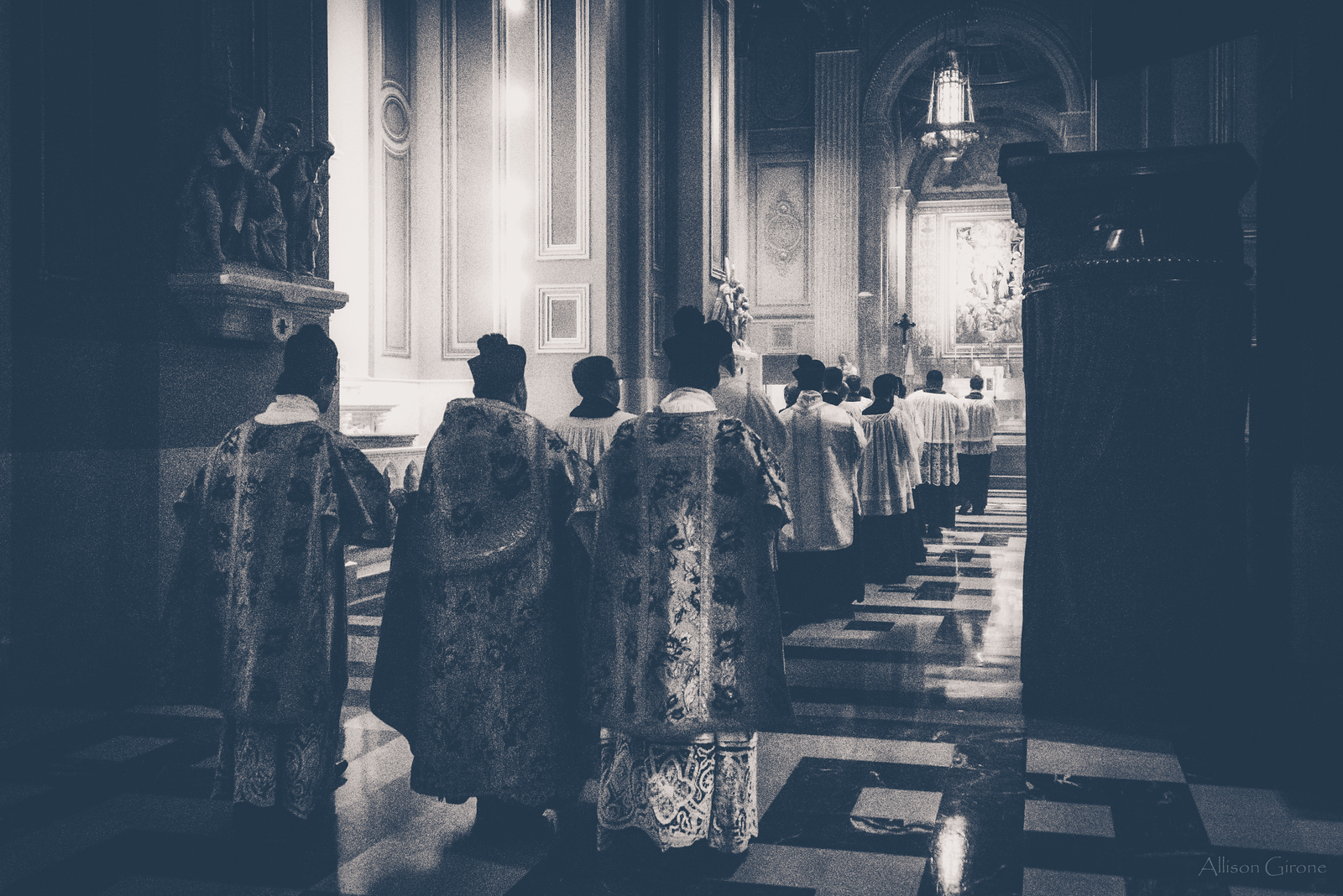
Photo by Allison Girone.
[1] Sacred Congregation of Rites, Cum nostra hac aetate (March 23, 1955), Title II, “Changes in the Calendar,” section c, “Octaves,” accessed via https://www.romanitaspress.com/cum-nostra-hac-aetate.
[2] Shawn Tribe, “Two Reforms Associated with Pentecost: The Vigil and the Octave,” New Liturgical Movement (May 30, 2009), accessed via https://www.newliturgicalmovement.org/2009/05/two-reforms-associated-with-pentecost.html.
[3] Fernand Cabrol, “Octave,” The Catholic Encyclopedia, vol. 11 (New York: Robert Appleton Company, 1911), accessed via https://www.newadvent.org/cathen/11204a.htm.
[4] Nicholas Morlin, “A Brief Comparison of the Rubrics and Ceremonies of the Roman Missals in Force in 1954 and 1962,” section 1.4, accessed via https://cdn.restorethe54.com/media/pdf/a-brief-comparison-of-the-rubrics-and-ceremonies-of-the-roman-missals-in-force-in-1954-1962.pdf.
[5] Ibid.
[6] Sacred Congregation of Rites, Cum nostra hac aetate, Title II, section c.
[7] Ibid.
[8] Morlin, “A Brief Comparison,” section 1.4.
[9] Ibid.
[10] Matthew Plese, “Octave Day of Corpus Christi,” A Catholic Life (June 27, 2019), accessed via https://acatholiclife.blogspot.com/2019/06/octave-day-of-corpus-christi.html.
[11] Matthew Plese, “Solemnity of the Sacred Heart of Jesus,” A Catholic Life (June 23, 2006), accessed via http://acatholiclife.blogspot.com/2006/06/solemnity-of-sacred-heart-of-jesus.html.