
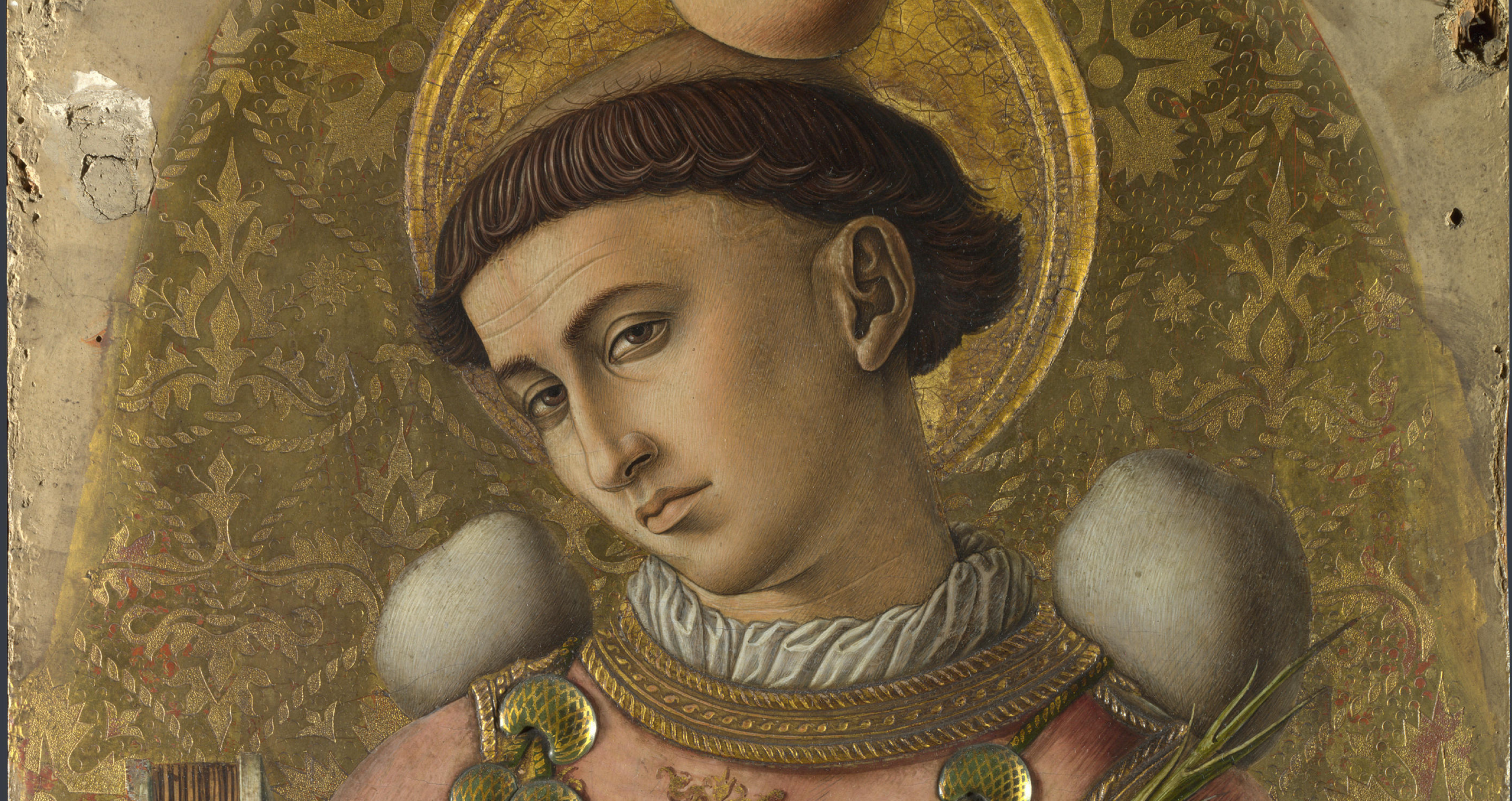
Above: Saint Stephen the Martyr by Carlo Crivelli.
Lost Feasts and Principles from the Pre-1955 Roman Missal
Part I – The Roman Calendar in 1954: The Last Year of Wholeness
Part II – The Vigil of the Epiphany: the Forgotten Gateway to Christ’s Manifestation
Part IV – The Vigils of the Apostles: Apostolic Watchfulness and Penitential Preparation
Part V – The 1955 Holy Week Reform: a Summary
Part VI – The Pre-55 Paschal Feast of St. Joseph
Part VII — The Suppression of “Duplicate Feasts”: When Memory (and Miracles) Were Suppressed
Part VIII — The Octave of Corpus Christi and the Sacred Heart: When Time Itself Was Shortened
Part X — The Finding of the Relics of St. Stephen: Martyrdom and Easter Glory United
Among the feasts removed from the Roman calendar in 1960 was one that preserved a vivid and deeply Catholic memory: the Finding of the Relics of St. Stephen Protomartyr, formerly kept on August 3. To modern eyes, it may appear redundant. After all, St. Stephen already possesses a principal feast on December 26, immediately after Christmas. But the older Roman calendar did not regard such repetition as needless duplication. Rather, it understood that the saints can be contemplated under more than one aspect, and that the Church’s memory is enriched when she returns to them in different seasons and under different mysteries.
The December feast of St. Stephen honors his martyrdom. The August feast commemorated the discovery of his sacred relics. One looks to his death; the other to the glory manifested through his body centuries later. One belongs to the Christmas court of Christ the newborn King; the other shines with the paschal logic of relics, resurrection, and the victory of grace over death. Together, the two feasts proclaimed a truth increasingly obscured by modern simplification: martyrdom is not only a past act of heroic witness, but a continuing source of life in the Church.
St. Stephen: First Martyr and Witness of Christ
St. Stephen holds a unique place in Christian memory. He is the Protomartyr, the first to shed his blood for Christ after the Ascension. Chosen among the seven deacons in the Acts of the Apostles, he preached with wisdom and power, bore witness before the Sanhedrin, and sealed his testimony with his blood. As stones fell upon him, he prayed in imitation of his Lord: “Lord, lay not this sin to their charge.” His martyrdom is inseparable from the Church’s earliest proclamation of Christ crucified and risen.
For this reason, the Church placed his principal feast on December 26, immediately after Christmas. The juxtaposition is striking. On Christmas Day, the Church adores the newborn Christ; the next day, she honors the first disciple to die for Him. The Infant in the manger is already the King of martyrs, and Stephen stands as the first courtier of that King, offering the first red witness to the mystery of the Incarnation.
Yet the Church did not confine Stephen’s memory to Christmastide. She also preserved another feast, far removed from December, in the warmth of summer: the Finding of his Relics. This second feast did not repeat December 26. It completed it. It showed that the body broken by martyrdom had not been forgotten by God.
The Discovery of the Relics
According to ancient tradition, the relics of St. Stephen were discovered in the early fifth century near Jerusalem, at Caphargamala, after they had long lain hidden. The account centers on a priest named Lucian, to whom Gamaliel appeared in a series of visions. Gamaliel, the teacher of St. Paul and the one who had counseled caution toward the Apostles in the Acts of the Apostles, revealed the location of the bodies of St. Stephen, Nicodemus, Gamaliel himself, and Abibas, the son of Gamaliel. The revelation was brought to the attention of John, Bishop of Jerusalem, and the relics were solemnly uncovered and translated with honor.[1]
The Roman Martyrology commemorated this finding on August 3, recalling not merely an archaeological discovery, but an act of divine providence. The bodies of the saints had been hidden but not lost. The Church had suffered persecution, but the memory of her martyrs had not perished. God Himself, according to the tradition, restored Stephen to the Church’s visible veneration.
This is a distinctly Catholic instinct. The bodies of the saints are not treated as discarded remains. They are temples once inhabited by grace, instruments of heroic virtue, and pledges of resurrection. The discovery of St. Stephen’s relics therefore represented more than the recovery of bones. It was a manifestation of the communion between the Church militant and the Church triumphant.
Relics and the Glory of the Resurrection
The feast of the Finding of St. Stephen’s Relics reveals a theological principle often neglected today: the cult of relics is profoundly paschal. The Church honors relics because the body is destined for resurrection. The saint’s body, sanctified by grace and often marked by suffering, already points forward to the glory promised at the end of time.
This is why the August feast belongs so naturally to the broader mystery of Easter glory, even though it does not fall within Eastertide itself. St. Stephen’s body, once battered by stones, is found and honored by the Church. What had been cast down in humiliation is raised up in veneration. The martyr’s body becomes a sign that death does not have the final word.
The logic is the same as the Easter proclamation: Christ is risen, and those who belong to Him shall rise. The relics of the martyrs are not morbid reminders of death but pledges of victory. They proclaim that grace has touched matter, that the body matters, and that sanctity leaves traces in history.
St. Augustine, who witnessed the spread of devotion to St. Stephen’s relics in North Africa, repeatedly testified to the miracles associated with them. In The City of God, he records healings wrought through Stephen’s intercession and observes that he could not recount all the miracles known to him.[2] Such testimony shows how widespread and powerful the cult of St. Stephen became after the discovery and distribution of his relics. The finding of his body did not merely add a historical note to his biography; it renewed his presence in the devotional life of the Church.
Why the Feast Mattered
The August feast taught several truths at once. It taught that martyrs continue to live in Christ. It taught that their bodies are worthy of honor. It taught that relics are not superstitious objects but sacramental signs of God’s power working through His saints. And it taught that the Church’s memory is not abstract but embodied.
This last point is especially important. Modern Christians are often tempted to spiritualize sanctity, reducing saints to moral examples or inspirational figures. The traditional calendar resisted this tendency. It remembered where saints died, where they were buried, where their relics were found, where they appeared, and where God worked miracles through them. The saints were not vague ideals. They were historical persons whose sanctity entered time, place, and matter.
The Finding of St. Stephen’s relics belonged to this embodied memory. It reminded the faithful that the first martyr did not vanish into the past. He remained with the Church, interceding, healing, and bearing witness through the very relics that God allowed to be rediscovered.
A Feast Removed as a “Duplicate”
In the 1960 reform of the General Roman Calendar under Pope John XXIII, the Feast of the Finding of the Relics of St. Stephen was removed. It was treated as a duplication of St. Stephen’s principal feast on December 26.[3] As we have said, this was consistent with a broader tendency in the 1960 reform to remove secondary commemorations of saints already honored elsewhere.
But the term “duplicate” is misleading. December 26 and August 3 commemorated different things. The first honored Stephen’s martyrdom; the second honored the providential discovery of his relics and the miracles associated with them. The former teaches witness unto death; the latter teaches the glory of the body sanctified by martyrdom.
To remove the August feast was not merely to eliminate repetition. It was to suppress a chapter of the Church’s memory concerning relics, miracles, and the continuing power of martyrdom.
Martyrdom, Relics, and Catholic Memory
The older calendar understood that Catholic memory is cumulative. It does not remember once and move on. It returns, deepens, and contemplates again. This is why St. Stephen could be honored at Christmas for his death and in August for the finding of his relics. The two feasts did not compete; they interpreted one another.
At Christmas, Stephen shows what the Incarnation demands: total fidelity to Christ. In August, Stephen shows what the Resurrection promises: the vindication of the body and the triumph of grace. The martyr who died praying for his enemies lives on in the Church’s veneration, and even his relics become instruments of divine mercy.
This connection also helps us understand the Church’s veneration of relics more broadly. Relics are not a medieval curiosity or a devotional excess. They are an expression of the Catholic doctrine of the body. The body is not a shell to be discarded but a participant in holiness. The hand that gave alms, the lips that confessed Christ, the knees that bent in prayer, the body that endured torture for the Faith—all are destined for glory.
The feast of August 3 taught this annually. Its removal deprived the faithful of a recurring catechesis on one of the most incarnational aspects of Catholic devotion.
The Protestant Challenge and the Catholic Response
The importance of this feast becomes even clearer in light of the Protestant rejection of relics. The early Protestants frequently attacked the veneration of relics as corruption, superstition, or medieval invention. In response, Catholic tradition appealed not only to medieval practice but to Scripture, the Fathers, and the lived experience of the Church.
The relics of St. Stephen were especially important in this regard because St. Augustine himself testified to miracles associated with them. His witness provided patristic confirmation that the veneration of relics was not a late corruption but a practice rooted in the Church’s ancient life. The traditional Roman Breviary preserved this memory, allowing the Church to answer error not merely through argument, but through liturgical proclamation.[4]
Here again we see why the suppression of such feasts matters. The calendar was once a defender of Catholic doctrine. It placed before the faithful, year after year, the historical and theological evidence for practices such as the veneration of relics. When feasts like the Finding of St. Stephen’s Relics disappear, the doctrines remain, but one of their annual liturgical witnesses is silenced.
What Was Lost
The suppression of the Finding of St. Stephen’s Relics did not deny the doctrine of relics. It did not diminish St. Stephen’s sanctity. It did not forbid devotion to him. But it did remove from the universal calendar a feast that had taught Catholics how martyrdom, relics, miracles, and resurrection belong together.
The loss was therefore subtle but real. Catholics continued to celebrate St. Stephen on December 26, but they no longer annually encountered the Church’s memory of his relics. They no longer heard, in the cycle of the year, the story of Lucian, Gamaliel, Nicodemus, Abibas, and the miraculous discovery near Jerusalem. They no longer received the same liturgical reminder that God glorifies the bodies of His saints and works through them for the good of the faithful.
A simpler calendar is easier to manage. But it is not always better at preserving memory.
Conclusion
The Finding of the Relics of St. Stephen was more than a secondary commemoration. It was a feast of Catholic realism. It proclaimed that martyrdom does not end in death, that the bodies of the saints are precious, and that the glory of the Resurrection already shines through the relics of those who died in Christ.
Its removal in 1960 reflects the broader pattern examined throughout this series: the reduction of liturgical memory in the name of simplification. The older Roman calendar did not hesitate to return to the saints under different aspects because it understood that love remembers deeply. It remembered Stephen at Christmas as the first martyr; it remembered him in August as the saint whose relics bore witness to the power of the risen Christ.
To recover this feast, even devotionally, is to recover a deeply Catholic sense of the body, the saints, and the communion that unites heaven and earth. The stones that killed Stephen did not silence him. Through his relics, his intercession, and the Church’s memory, the Protomartyr continued to preach the Resurrection.
And that is why August 3 once mattered.
[1] The Roman Martyrology commemorates on August 3 the finding of the relics of St. Stephen, together with those of Sts. Gamaliel, Nicodemus, and Abibas. See “Nicodemus,” The Catholic Encyclopedia (1913), accessed via https://www.newadvent.org/cathen/11066b.htm; “Feast of the Finding of St. Stephen’s Relics,” A Catholic Life (August 3, 2013), accessed via https://acatholiclife.blogspot.com/2013/08/feast-of-finding-of-st-stephens-relics.html.
[2] St. Augustine, The City of God, Book XXII, chapter 8; see also Gregory DiPippo, “The Finding of St Stephen the First Martyr,” New Liturgical Movement (August 3, 2019), accessed via https://www.newliturgicalmovement.org/2019/08/the-finding-of-st-stephen-first-martyr.html.
[3] General Roman Calendar of 1960; “General Roman Calendar of 1960,” accessed via https://en.wikipedia.org/wiki/General_Roman_Calendar_of_1960; “Feast of the Finding of St. Stephen’s Relics,” A Catholic Life (August 3, 2013), accessed via https://acatholiclife.blogspot.com/2013/08/feast-of-finding-of-st-stephens-relics.html.
[4] DiPippo, “The Finding of St Stephen the First Martyr,” New Liturgical Movement (August 3, 2019), accessed via https://www.newliturgicalmovement.org/2019/08/the-finding-of-st-stephen-first-martyr.html.