
Part I – The Roman Calendar in 1954: The Last Year of Wholeness
Part II – The Vigil of the Epiphany: the Forgotten Gateway to Christ’s Manifestation
Part IV – The Vigils of the Apostles: Apostolic Watchfulness and Penitential Preparation
Part V – The 1955 Holy Week Reform: a Summary
Part VI – The Pre-55 Paschal Feast of St. Joseph
Part VII — The Suppression of “Duplicate Feasts”: When Memory (and Miracles) Were Suppressed
Part VIII — The Octave of Corpus Christi and the Sacred Heart: When Time Itself Was Shortened
Among the many losses of the twentieth-century liturgical reforms, few are as theologically revealing as the disappearance of the Octave of Corpus Christi. What once stood as a prolonged, radiant celebration of the Holy Eucharist has been reduced to a single day, with consequences that extend far beyond mere ceremonial length. The suppression of this octave did not simply shorten a feast—it altered the Church’s lived experience of one of her greatest mysteries and disrupted the very framework within which another devotion, the Sacred Heart of Jesus, was meant to be understood.
To appreciate what was lost, we must first recall how the Church once celebrated Corpus Christi—not as a moment, but as a sustained immersion in Eucharistic glory.
Corpus Christi: A Feast Extended in Time
The Feast of Corpus Christi, instituted in the thirteenth century and extended to the universal Church by Pope Urban IV, was from its earliest days marked by extraordinary solemnity. Unlike many feasts that remained confined to a single day, Corpus Christi was given an octave, extending its celebration across eight days. This octave allowed the Church to linger over the mystery of Christ’s Real Presence in the Blessed Sacrament.
Throughout the octave, the Mass and Divine Office returned again and again to the same Eucharistic themes: the Bread of Life, the Sacrifice of the New Covenant, and the abiding presence of Christ among His people. Far from being repetitive in a negative sense, this repetition formed the faithful. It allowed the mystery to penetrate deeply into the soul through sustained contemplation. As Dom Prosper Guéranger writes in The Liturgical Year:
The mystery of the Eucharist is too great to be celebrated in a single day. The Church, therefore, prolongs her joy and her gratitude by an octave, during which she continues to offer to her divine Spouse the homage of her love.
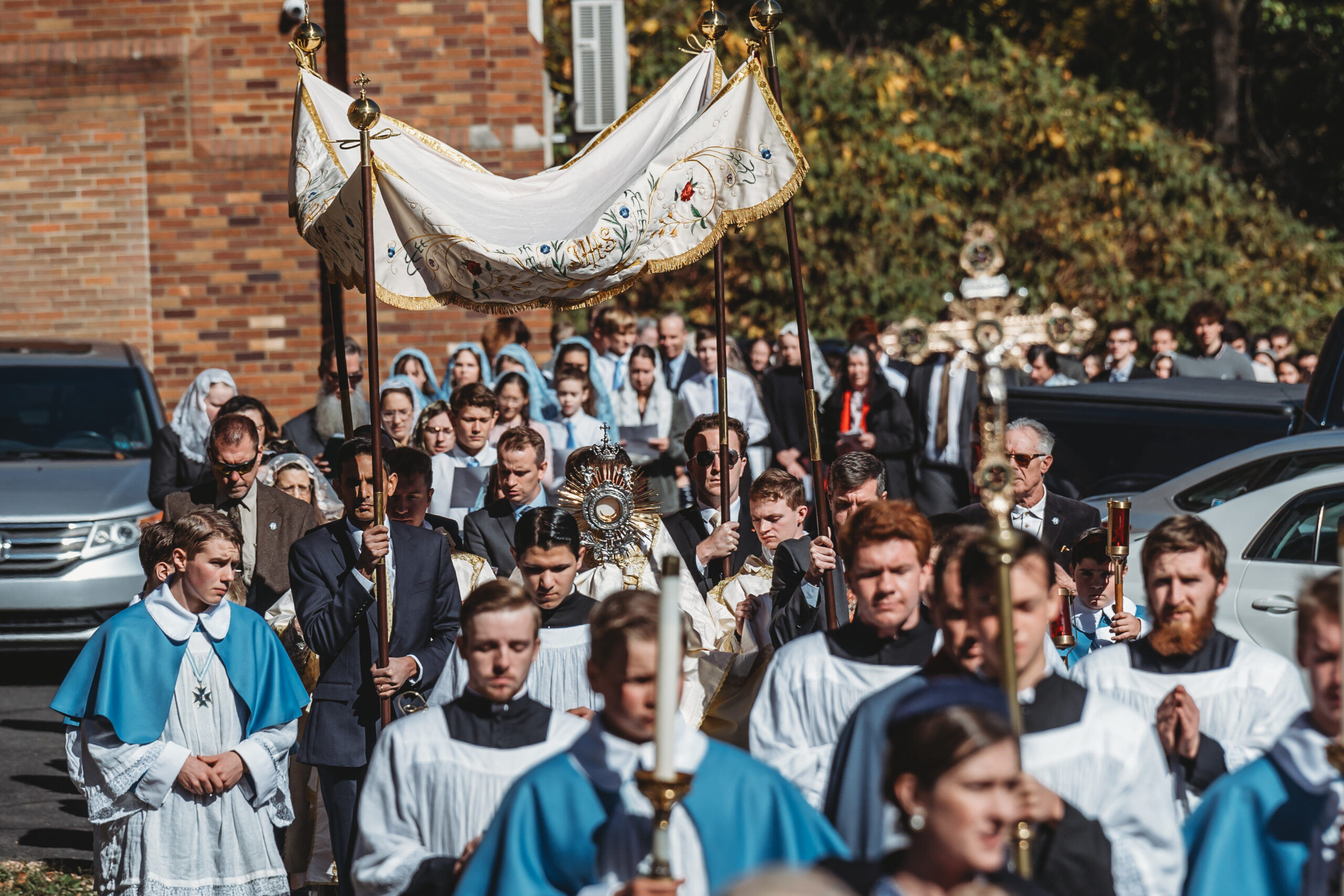
In addition to the liturgical texts, the octave was marked by public processions, Eucharistic adoration, and Benediction, often repeated on multiple days. In Catholic societies, the octave of Corpus Christi transformed entire cities and villages into places of Eucharistic homage. Streets were adorned, altars erected, and the Blessed Sacrament carried in solemn procession as the faithful publicly professed their belief in the Real Presence.
This was not merely a feast—it was a Eucharistic season within the liturgical year.
The Octave as Eucharistic Formation
The octave of Corpus Christi served a deeply pedagogical purpose. The Church did not assume that one day was sufficient to form her children in so great a mystery. The Eucharist is not merely a doctrine to be understood intellectually; it is a reality to be adored, received, and contemplated.
By extending the feast across eight days, the Church provided a liturgical environment in which the faithful could grow in Eucharistic devotion. The repetition of the same Mass texts, the recurrence of processions, and the continued emphasis on the Real Presence formed a kind of spiritual immersion. Guéranger captures this beautifully when he writes:
The faithful are not satisfied with a passing glance at this divine mystery. They desire to remain in its presence, to contemplate it, and to express their adoration in prolonged acts of love.
This is characteristic of the traditional Roman Rite. Great mysteries were not compressed – they were expanded. The faithful were not hurried from one theme to another but invited to dwell within the mystery until it shaped their hearts and minds.
The Sacred Heart and the Octave of Corpus Christi
The theological significance of the octave becomes even clearer when we consider the Feast of the Sacred Heart of Jesus.
According to the revelations received by St. Margaret Mary Alacoque in the seventeenth century, Our Lord explicitly requested that a feast in honor of His Sacred Heart be celebrated on the Friday after the Octave of Corpus Christi. This request is profoundly significant. It places the devotion to the Sacred Heart directly within the liturgical context of the Eucharist.
The Heart of Jesus is not an abstract symbol. It is the Heart that loved unto death, the Heart that instituted the Eucharist, and the Heart that remains present in the Blessed Sacrament. By situating the feast after the octave of Corpus Christi, the Church expressed a clear theological connection: the Eucharist is the sacramental expression of the love of the Sacred Heart. Guéranger himself draws this connection:
The Heart of Jesus is the source of that infinite love which has given us the Eucharist. It is there that we must seek the explanation of this ineffable gift.
In the traditional calendar, this relationship was not merely conceptual – it was experiential. The faithful would spend eight days immersed in Eucharistic worship, and only then, having contemplated Christ’s presence and sacrifice, would they celebrate the Feast of His Sacred Heart. And Christ Himself asked for the placement of this feast precisely in the liturgical life of the Church after the Octave of Corpus Christi.
The sequence itself was a form of theological instruction. The octave prepared the soul to understand the Sacred Heart not sentimentally, but Eucharistically.
What Happens When the Octave Disappears
With the suppression of the octave of Corpus Christi in the twentieth century, this liturgical preparation vanished. The Feast of the Sacred Heart remains in the calendar, still celebrated on the Friday after Corpus Christi, but the context that once gave it depth has been removed.
What was once eight days of Eucharistic contemplation followed by the feast of the Sacred Heart has become a single Eucharistic feast followed shortly by the Sacred Heart. The theological connection still exists, but it is no longer lived in the same way.
Without the octave, the faithful are not given the same prolonged exposure to the mystery of the Eucharist. The Sacred Heart can more easily be misunderstood as a primarily emotional or devotional symbol, detached from its Eucharistic foundation. The older liturgical structure, by contrast, ensured that devotion to the Sacred Heart was firmly rooted in the reality of Christ’s sacramental presence.
The Loss of Eucharistic Culture
The disappearance of the octave also contributed to the decline of what might be called Eucharistic culture. In the traditional Catholic world, Corpus Christi was not confined to the sanctuary. It extended into the streets, into homes, and into the daily life of the faithful. Dom Guéranger describes this public witness vividly:
The procession of Corpus Christi is the triumph of our divine King. He goes forth from His sanctuary to bless the people, and the people, in return, proclaim His sovereign dominion.
Processions during the octave were not rare or exceptional – they were expected. Benediction of the Blessed Sacrament was a regular feature of the octave. The faithful were repeatedly reminded, through sight and sound, that Christ truly dwelt among them. And they were enriched with indulgences dating back to both Pope Martin V and Pope Eugene IV.
When the octave was removed, these practices did not disappear overnight, but they gradually declined. Without the liturgical framework to sustain them, they became optional, occasional, or altogether absent. The Eucharist remained doctrinally central, but its presence in the public and devotional life of the Church diminished.
Octaves and the Sanctification of Time
The octave of Corpus Christi also illustrates a broader principle: the traditional Roman Rite sanctified time by expansion, not compression. Important mysteries were given space to unfold. The faithful were drawn into them gradually, through repetition and prolonged celebration. Guéranger emphasizes this principle throughout his work: “The Church sanctifies time by surrounding the great mysteries with days of preparation and days of prolongation, so that the faithful may enter more deeply into their meaning.”
The suppression of octaves reflects a different approach – one that prioritizes simplicity and efficiency. Yet the cost of this simplification is the loss of depth. When time is compressed, formation is weakened. The liturgy no longer surrounds the faithful with a mystery; it presents it briefly before moving on.
Conclusion
The disappearance of the Octave of Corpus Christi is not merely a question of liturgical history. It is a window into how the Church once understood the relationship between time, devotion, and doctrine.
By extending the celebration of the Eucharist across eight days, the Church formed her children in the reality of Christ’s presence. By placing the Feast of the Sacred Heart immediately after that octave, she taught that the Eucharist is the supreme expression of the love of Christ’s Heart. When the octave was removed, that structure was weakened. The connection remains in theory, but it is less deeply experienced.
To recover something of what was lost, Catholics today can make a conscious effort to observe the octave privately – to spend additional days in Eucharistic adoration, to pray the traditional texts, and to prepare intentionally for the Feast of the Sacred Heart.
For in the older liturgical order, the Church did not merely teach that Christ is present in the Eucharist. She gave her children time – an entire octave – to learn how to adore Him.