
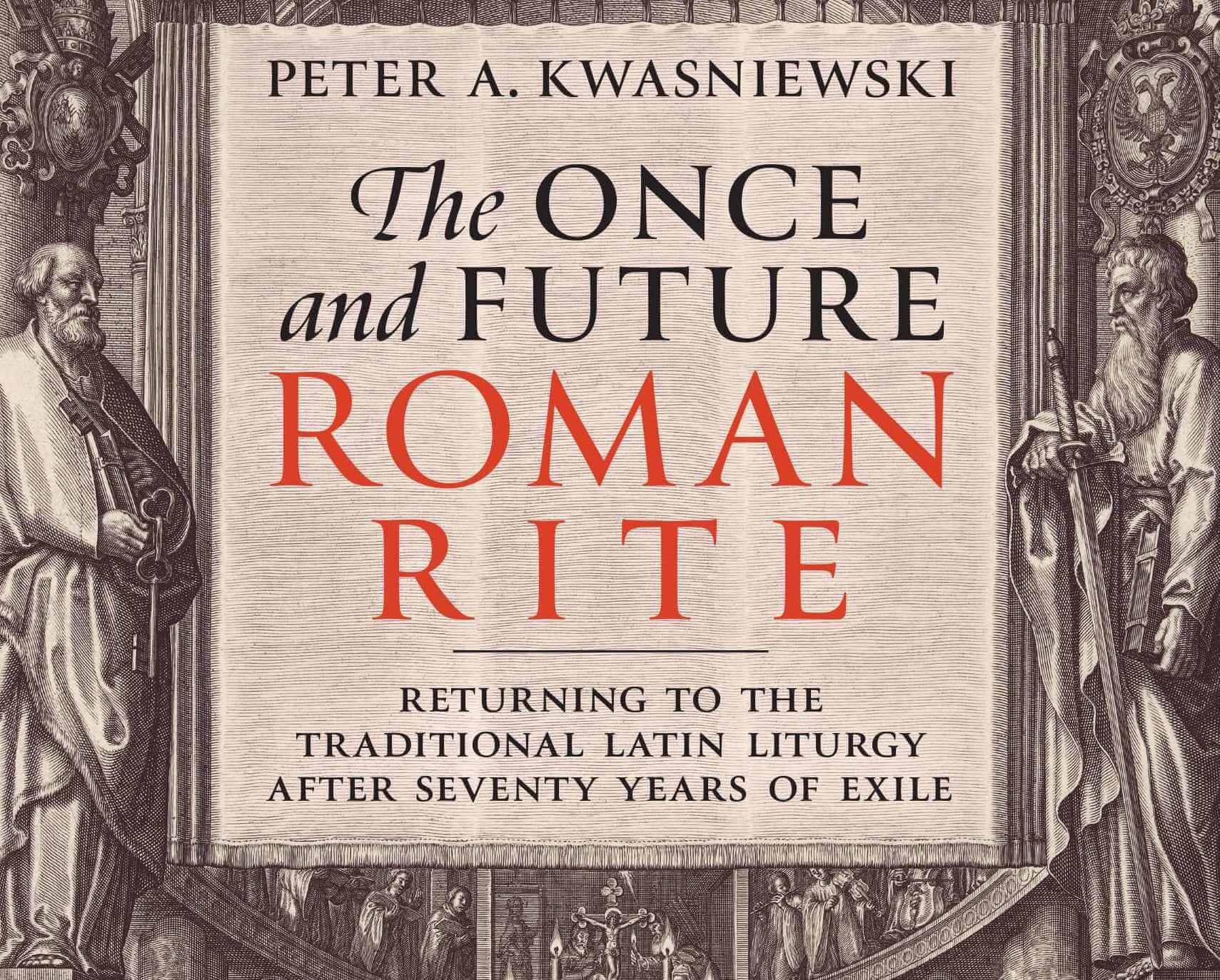
Above: Contributing editor Dr. Peter Kwasniewski wrote this text against the Bablyonian Captivity of the Roman Rite, which includes the 55 reform.
Lost Feasts and Principles from the Pre-1955 Roman Missal
Part I – The Roman Calendar in 1954: The Last Year of Wholeness
Part II – The Vigil of the Epiphany: the Forgotten Gateway to Christ’s Manifestation
Part IV – The Vigils of the Apostles: Apostolic Watchfulness and Penitential Preparation
Part V — Holy Week: From Organic Inheritance to Experimental Reconstruction
Introduction: Holy Week as the Heart of the Roman Rite
Holy Week has always stood at the very heart of the Roman Rite. It is not merely a sequence of solemn commemorations, but the Church’s most intense and demanding liturgical expression of the Paschal Mystery. Through its ceremonies, chants, readings, and ritual silences, the Church historically taught the faithful how to accompany Christ from His royal entry into Jerusalem, through His Passion and death, and finally to the triumph of His Resurrection. These rites were not hastily assembled nor frequently altered; rather, they developed gradually over many centuries, absorbing ancient Roman, Gallican, and Frankish elements, until they reached a mature and stable form substantially fixed by the Missal of St. Pius V and preserved with remarkable continuity until the middle of the twentieth century.
As Dr. Peter A. Kwasniewski observes, by the early modern period the Roman Rite—including Holy Week—had reached a state of liturgical maturity in which nothing essential required alteration. Subsequent changes, when they occurred, were matters of minor adjustment rather than structural redesign.[1] It is therefore historically striking that Holy Week became the first portion of the Roman Rite to undergo extensive revision in the 1950s. Beginning with the experimental Easter Vigil of 1951 and culminating in the promulgation of revised Holy Week rites in 1955, ceremonies that had endured for centuries were altered in ways previously unknown in the history of the Roman liturgy. Holy Week thus became the testing ground for a new liturgical methodology—one that would later be applied far beyond it. This article will not cover all the changes, but will serve as an introduction to the overall issue.
Palm Sunday: Recasting the Threshold of the Passion
Palm Sunday traditionally functioned as the solemn gateway into Holy Week. Its pre-1955 rites formed one of the most complex and symbolically rich ceremonies of the Roman Rite. The blessing of palms itself resembled a quasi-Mass, complete with an Epistle, Gospel, Preface, and Sanctus, underscoring that Christ’s triumphal entry into Jerusalem was already sacrificial in character. The procession that followed was not merely commemorative, but juridical and royal, presenting Christ as King before He would be judged and condemned.
The 1955 reforms substantially dismantled this structure. The elaborate blessing of palms was drastically shortened, its readings reduced, and its ceremonial weight diminished. Prayers that explicitly framed the procession as an act of public witness before persecution were suppressed, and the ritual dialogue at the church door—symbolizing Christ’s entrance into Jerusalem and His rejection by the city—was eliminated or muted. According to the Latin Mass Society Australia’s detailed comparison, the reform altered not merely the length but the internal logic of the rite.[2]
Dr. Kwasniewski identifies Palm Sunday as one of the days that underwent “alterations on a scale unprecedented in Western ecclesiastical history.”[3] What was lost was not simply ceremonial fullness, but coherence. The faithful were no longer led step by step from acclamation to condemnation through ritual action. The threshold into Holy Week was flattened, weakening the Roman Rite’s traditional pedagogy at the very moment it mattered most.
Holy Monday through Spy Wednesday: Specific Suppressions in the Pian Reform
While Palm Sunday and the Triduum saw the most dramatic revisions, the 1955 Holy Week reform did not leave Holy Monday, Holy Tuesday, and Holy Wednesday untouched. The changes here are fewer, but they are revealing, because they demonstrate a willingness to suppress inherited texts even where no practical necessity demanded it.
On Holy Monday, the traditional Mass included the orations Against the persecutors of the Church and For the Pope. In the Pian reform, both prayers were suppressed, removing explicit intercessions that had long contextualized the Passion within the Church’s own suffering and hierarchical unity.[4]
On Holy Tuesday, the traditional Passion reading according to St. Mark began with Mark 14:1–31, including the Institution narrative. In the Pian reform, this entire section was suppressed, and the Passion no longer began at the same point in the Gospel.
Similarly, on Holy Wednesday, the traditional Passion according to St. Luke began with Luke 22:1–39, likewise including the Institution narrative. In the Pian reform, this section was also suppressed, truncating the proclamation of the Passion on that day.
These are not stylistic edits but concrete excisions: prayers removed, Gospel passages omitted. Even before the Triduum begins, the reform’s method is already visible – tightening the inherited sequence by subtraction rather than preserving the Church’s long-standing narrative approach to the Passion.
Holy Thursday: Altering the Shape of the Sacred Triduum
Holy Thursday traditionally held together several mysteries at once: the institution of the Holy Eucharist, the institution of the priesthood, the beginning of the Passion, and Christ’s commandment of charity. The pre-1955 rites expressed this unity through a dense ceremonial structure, prolonged silence after Mass, and the solemn translation of the Blessed Sacrament to the altar of repose. The stripping of the altars that followed was not merely functional but profoundly symbolic, inaugurating the desolation of the Passion.
The 1955 reforms altered both the structure and ceremonial flow of Holy Thursday. Prayers and gestures associated with the translation of the Blessed Sacrament were shortened or suppressed, and the stripping of the altars was rendered more perfunctory.[5] While the mysteries commemorated on Holy Thursday remained intact, the ritual language that bound them together was loosened. Holy Thursday became less a prolonged threshold into the Passion and more a discrete liturgical event, anticipating a broader trend toward compartmentalization within the Triduum. Gone among them was the beautiful example of the consecrated host, carried in a veiled ciborium, to the altar of repose in representation of the soul of Christ leaving the Last Supper and journeying to the Garden of Gethsemane. Seemingly small changes affect piety, devotion, and belief among the faithful.
Good Friday: From Liturgical Austerity to Reconfiguration
Good Friday stood apart in the Roman Rite for its unparalleled austerity. There was no Mass, no consecration, and no ornamentation beyond what was strictly necessary. The Passion according to St. John, the solemn intercessory prayers, and the veneration of the Cross unfolded with grave restraint. Silence itself functioned as a liturgical language.
The 1955 reforms reconfigured this day in significant ways. The ordering and emphasis of the rites were altered, changing how the faithful encountered the Passion liturgically. Certain elements were repositioned or abbreviated, modifying the balance between proclamation, prayer, and symbolic action.[6]
Dr. Kwasniewski notes that the traditional Good Friday liturgy communicated theology primarily through symbolic austerity rather than explanation.[7] The reform did not deny the doctrine of the Cross, but it shifted the manner of its presentation. The Roman Rite’s instinct for letting silence preach was weakened in favor of immediacy and clarity. And the political pressures of the mid-twentieth century drastically altered the Church’s prayer for the Jews several times.[8]
Holy Saturday and the Easter Vigil: Experimentation as Precedent
The most consequential changes of Holy Week occurred on Holy Saturday. Its extended prophecies, gradual kindling of light, Litany of the Saints, and first Mass of Easter formed a coherent ascent from death to life.
In 1951, an experimental version of the Easter Vigil was introduced; in 1955, revised rites were promulgated universally. Dr. Kwasniewski observes that Holy Week was brought before the Pian Commission in what effectively became a prototype for later reforming bodies, including the Consilium.[9] The changes were systemic, not incremental.
The revised Vigil differed substantially from its predecessor in structure, pacing, and ritual logic.[10] What had once been the organic culmination of Holy Week became the first major laboratory for liturgical experimentation. The Roman Rite crossed a methodological threshold here—one that would shape subsequent reforms.
Conclusion: Holy Week as a Turning Point
The Holy Week reforms of the 1950s marked a decisive turning point in the history of the Roman Rite. For the first time, rites that had developed organically over centuries were subjected to a methodology that favored reconstruction over inheritance and experimentation over continuity. While the doctrines commemorated during Holy Week remained intact, the ritual language by which those doctrines were conveyed was fundamentally altered. Those wanting to dive into the details of these changes should consult the many resources available at Pre1955holyweek.com.
Holy Week thus became the crucible in which a new approach to liturgy was forged. The changes introduced between 1951 and 1955 did not remain isolated; they established assumptions and methods that would later be expanded and intensified. To study what was changed—and how—is therefore not an exercise in nostalgia, but an essential task for understanding how the Roman Rite moved from organic development to deliberate redesign.
[1] Dr. Peter A. Kwasniewski, The Once and Future Roman Rite: Returning to the Traditional Latin Liturgy After Seventy Years of Exile (TAN Books, 2022), pp. 340–343.
[2] Latin Mass Society Australia, “A Brief Comparison of the Traditional Roman & Pian Holy Week Ceremonies” (PDF), accessed via https://www.pre1955holyweek.com/_files/ugd/01715a_6c2cf3f1fade421cbf60f455e0620208.pdf
[3] Kwasniewski, op. cit., 341.
[4] Latin Mass Society Australia, op. cit.
[5] Ibid.
[6] Ibid.
[7] Kwasniewski, op. cit., 344–345.
[8] See Matthew Plese, “Liturgical Prayers Concerning the Jews,” A Catholic Life (April 8, 2020).
[9] Kwasniewski, op. cit., 341.
[10] Latin Mass Society Australia, op. cit.