
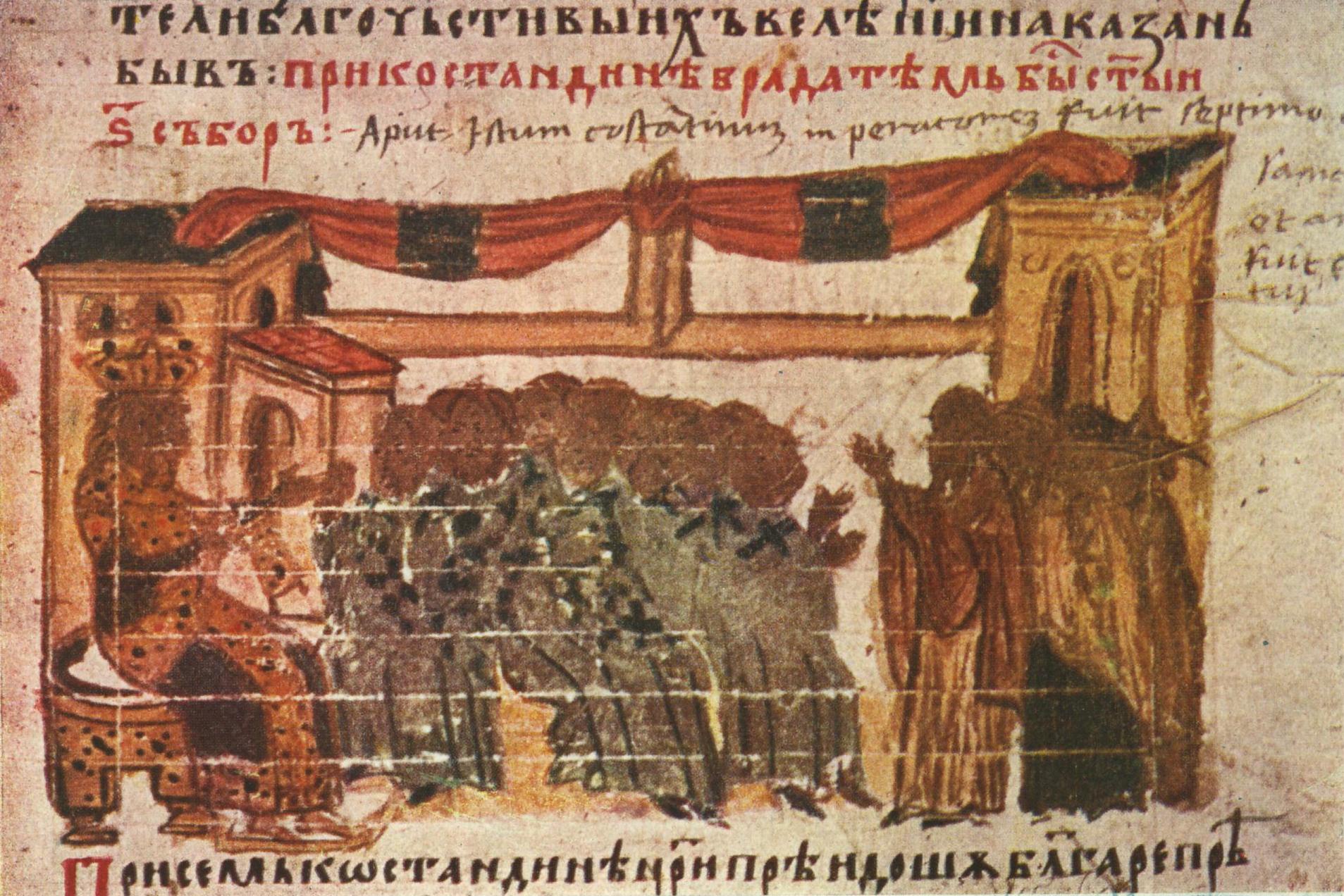
Above: 14th century depiction of the Sixth Ecumenical Council.
Lost Feasts and Principles from the Pre-1955 Roman Missal
Part I – The Roman Calendar in 1954: The Last Year of Wholeness
Part II – The Vigil of the Epiphany: the Forgotten Gateway to Christ’s Manifestation
Part IV – The Vigils of the Apostles: Apostolic Watchfulness and Penitential Preparation
Part V – The 1955 Holy Week Reform: a Summary
Part VI – The Pre-55 Paschal Feast of St. Joseph
Part VII — The Suppression of “Duplicate Feasts”: When Memory (and Miracles) Were Suppressed
Part VIII — The Octave of Corpus Christi and the Sacred Heart: When Time Itself Was Shortened
Part IX — Feasts Lost to Duplication: St. Leo II, St. Anacletus, and the Vanishing of “Double Feasts”
In an earlier installment of this series, we examined several early-May feasts suppressed in the twentieth-century reforms because they were regarded as “duplicates”: the Finding of the Holy Cross, St. John Before the Latin Gate, and the Apparition of St. Michael. Each of those feasts preserved a distinct historical memory even though the saint or mystery in question was honored elsewhere in the calendar. The Finding of the Cross was not the same event as its Exaltation; St. John’s miraculous preservation from boiling oil was not the same mystery as his principal feast within the Christmas octave; and the apparition of St. Michael at Mount Gargano was not the same as the dedication feast of September 29. The older Roman calendar had no difficulty returning to the same saint or mystery under a different aspect, because liturgical repetition was understood as a deepening of memory rather than as an unnecessary redundancy.
The reform of the calendar promulgated under Pope John XXIII in 1960 moved decisively in another direction. Among its changes was the removal of several feasts judged to duplicate another celebration already found in the year: the Chair of St. Peter at Rome, St. John Before the Latin Gate, the Apparition of St. Michael, St. Peter’s Chains, the Finding of the Body of St. Stephen, and the Finding of the Holy Cross. At the same time, the reform eliminated or merged other feasts that were not all “duplicates” in precisely the same sense, including St. Anacletus on July 13 and St. Leo II on July 3. The result was a calendar leaner in structure but also thinner in historical memory.[1]
It is important at the outset to avoid confusion. These so-called “duplicate feasts” are not the same thing as Double Feasts, the older liturgical rank that existed before the 1960 reform replaced the traditional classifications of Doubles, Semidoubles, and Simples with feasts of the I, II, and III class. The issue here is not the rank of a feast, but the modern reforming judgment that certain saints or mysteries should appear only once in the universal calendar unless there were a compelling reason to do otherwise. The older Roman instinct had been quite different. It was not embarrassed by multiple commemorations. It saw in them the Church’s desire to remember fully.
St. Anacletus: When a True Duplication Was Corrected
Of the feasts removed in 1960, the case of St. Anacletus is the one most easily defended on strictly historical grounds. Before the reform, the traditional Roman calendar observed Ss. Cletus and Marcellinus on April 26 and St. Anacletus, Pope and Martyr on July 13. The difficulty is that Cletus and Anacletus are now generally recognized to be two forms of the name of the same early pope, the second successor of St. Peter after St. Linus. The confusion arose from ancient lists that treated the names separately, although writers such as St. Irenaeus, Eusebius, St. Augustine, and Optatus used the names as referring to one person. The Catholic Encyclopedia notes plainly that “Cletus” is only another form of “Anacletus.”[2]
Thus, unlike the Finding of the Holy Cross or St. John Before the Latin Gate, the July 13 feast of St. Anacletus truly did duplicate a saint already commemorated elsewhere. Pope John XXIII’s 1960 reform retained the April 26 feast and removed July 13 from the universal calendar. A 1961 instruction of the Congregation of Rites further specified that the feast of “St. Anacletus,” wherever celebrated locally, was to be transferred to April 26 under the name “St. Cletus.”[3]
Even here, however, the reform illustrates a broader shift in liturgical mentality. The older calendar had preserved the effects of a long-standing historical tradition, even after scholarship had largely clarified the identity of Cletus and Anacletus. The newer approach preferred historical consolidation and calendar efficiency. In this particular case, the correction may be understandable. But once the principle of simplification became dominant, it was applied not only to actual duplications, but also to observances that had preserved distinct historical memories for centuries.
St. Leo II: A Saint Who Was Not Duplicated, but Displaced
The disappearance of Pope St. Leo II reveals the more troubling side of this reforming logic. St. Leo II was not a duplicate feast at all. He was a seventh-century pope, remembered for confirming the decrees of the Sixth Ecumenical Council and for defending the purity of the apostolic faith against Monothelitism. In the pre-1955 calendar, his feast was kept on July 3. He was not commemorated elsewhere in the universal calendar under another title, nor was his cult a historical confusion requiring correction. He simply disappeared as the result of another calendrical rearrangement.[4]
The sequence is instructive. In the older Roman calendar, June 28 had long been occupied by St. Leo II, with the Vigil of Ss. Peter and Paul commemorated. In 1921, when St. Irenaeus was added to the universal calendar, St. Leo II was moved from June 28 to July 3, while St. Irenaeus received June 28 and the vigil continued as a commemoration. Then, in the 1960 reform, St. Irenaeus was moved from June 28 to July 3 so that the Vigil of Ss. Peter and Paul could occupy June 28 alone. St. Leo II, already displaced once, was now removed altogether.[5]
The irony is difficult to miss. The same reform that abolished most other vigils—including the ancient vigils of nearly all the Apostles, of the Epiphany, and of All Saints—preserved the Vigil of Ss. Peter and Paul by eliminating a pope from the calendar who had himself defended the integrity of Catholic doctrine. One need not deny that the vigil of the Princes of the Apostles deserved special honor in order to observe that the method employed was strikingly different from the older calendar’s tendency to accommodate layered memories through commemorations rather than suppressions. The traditional calendar had known how to keep St. Leo II, St. Irenaeus, and the vigil all in relation to one another. The reformed calendar solved the problem by removing one of them.
This is precisely why the language of “duplication” does not fully explain what occurred in 1960. Some feasts were removed because reformers judged them to duplicate another feast. Some, like St. Anacletus, were merged because modern historical judgment identified two names as one saint. But others, like St. Leo II, were lost because the calendar was being reorganized according to a new preference for simplification, and smaller feasts were increasingly treated as movable or expendable pieces within the larger structure.
What the Older Calendar Preserved
The pre-1955 calendar was often crowded, but its very density testified to the Church’s memory. It was not a system designed chiefly for administrative neatness. It was a treasury of historical associations, local Roman traditions, papal anniversaries, relics, apparitions, translations, and victories of grace. The Church did not ask whether a saint had already been honored once and therefore required no further remembrance. Rather, when history, devotion, or doctrine offered a new reason for gratitude, the calendar could receive another feast.
This principle is visible throughout the old Roman year. St. Peter was honored not only with St. Paul on June 29, but also for his chains on August 1 and for his Roman chair on January 18. St. Stephen was honored not only on December 26, but also in August for the finding of his relics. St. Agnes was remembered both for her martyrdom and for her apparition to her grieving parents. The Cross was celebrated in its discovery and in its exaltation. These feasts were not careless repetitions. They were liturgical acts of love. The Church returned to what she loved because each return revealed another facet of the mystery.
In Part VII, we saw how the suppression of the early-May feasts diminished the Church’s public remembrance of the Cross, the Apostle John, and St. Michael. The July examples of St. Anacletus and St. Leo II show that the same reforming spirit reached still further. In one case, the calendar corrected a genuine historical duplication. In the other, it erased a saint not because he duplicated anyone, but because the new order had less room for inherited complexity.
The Cost of a Simpler Calendar
The defenders of simplification might reply that no doctrine was denied when these feasts were removed. This is true. Catholics remain free to venerate St. Leo II, St. Cletus, St. Michael, St. John, St. Stephen, and the Holy Cross. A priest may still offer votive Masses in honor of many saints no longer found on the universal calendar. The question, however, is not only what remains possible, but what the Church chooses to place before the faithful year after year in her public prayer.
Liturgical memory is formative precisely because it is repetitive. A feast annually observed becomes part of a Catholic’s imagination. A feast removed from the calendar does not become impossible to know, but it becomes far easier to forget. How many Catholics today know that the Church once celebrated St. John’s miraculous preservation from boiling oil? How many know of St. Leo II at all? How many realize that the early Roman calendar remembered St. Peter, St. Stephen, the Holy Cross, and St. Michael under more than one title because the Church wanted more than one aspect of their history preserved?
A calendar simplified too severely may become easier to navigate, but it also becomes less capable of carrying the full weight of inherited memory. The pre-1955 Roman calendar was not merely a roster of saints. It was a map of Christian history. When portions of that map disappear, the destination may remain the same, but fewer roads are left by which the faithful can reach it.
Conclusion
The removal of so-called “duplicate feasts” in the 1960 reform cannot be judged by a single example. In the case of St. Anacletus, the reform corrected a genuine historical duplication born of ancient confusion between two forms of the same name. In the case of St. Leo II, however, no such duplication existed. A saint was simply displaced and then lost as the calendar was streamlined according to newer principles.
Taken together with the suppressions already considered in May—the Finding of the Holy Cross, St. John Before the Latin Gate, and the Apparition of St. Michael—these changes reveal a broader transformation in how the calendar was understood. The older Roman Rite prized accumulated memory; the newer reforms increasingly prized reduction, consolidation, and clarity. One approach was comfortable with the fullness of remembrance. The other feared repetition as excess.
The recovery of these lost feasts is not a demand that every historical commemoration be restored without discrimination. It is, rather, a plea to recognize what the older calendar knew instinctively: sacred memory is not preserved by efficiency alone. The Church teaches not only by what she says once, but by what she lovingly returns to again and again.
[1] General Roman Calendar of 1960, summary of deletions and calendar changes; see also Matthew Plese, “St. Leo II,” A Catholic Life (July 3, 2017); Matthew Plese, “Pope St. Anacletus,” A Catholic Life (August 8, 2006).
[2] “Pope St. Cletus,” The Catholic Encyclopedia (1913).
[3] “Today’s Saints: Pope St Anacletus, Martyr,” The Brighton Oratory (July 13, 2012), citing the February 14, 1961 Instruction of the Congregation of Rites.
[4] Matthew Plese, “St. Leo II,” loc. cit.
[5] Gregory DiPippo, “Kicking St Irenaeus Around,” New Liturgical Movement (June 28, 2016), accessed via https://www.newliturgicalmovement.org/2016/06/kicking-st-irenaeus-around.html