
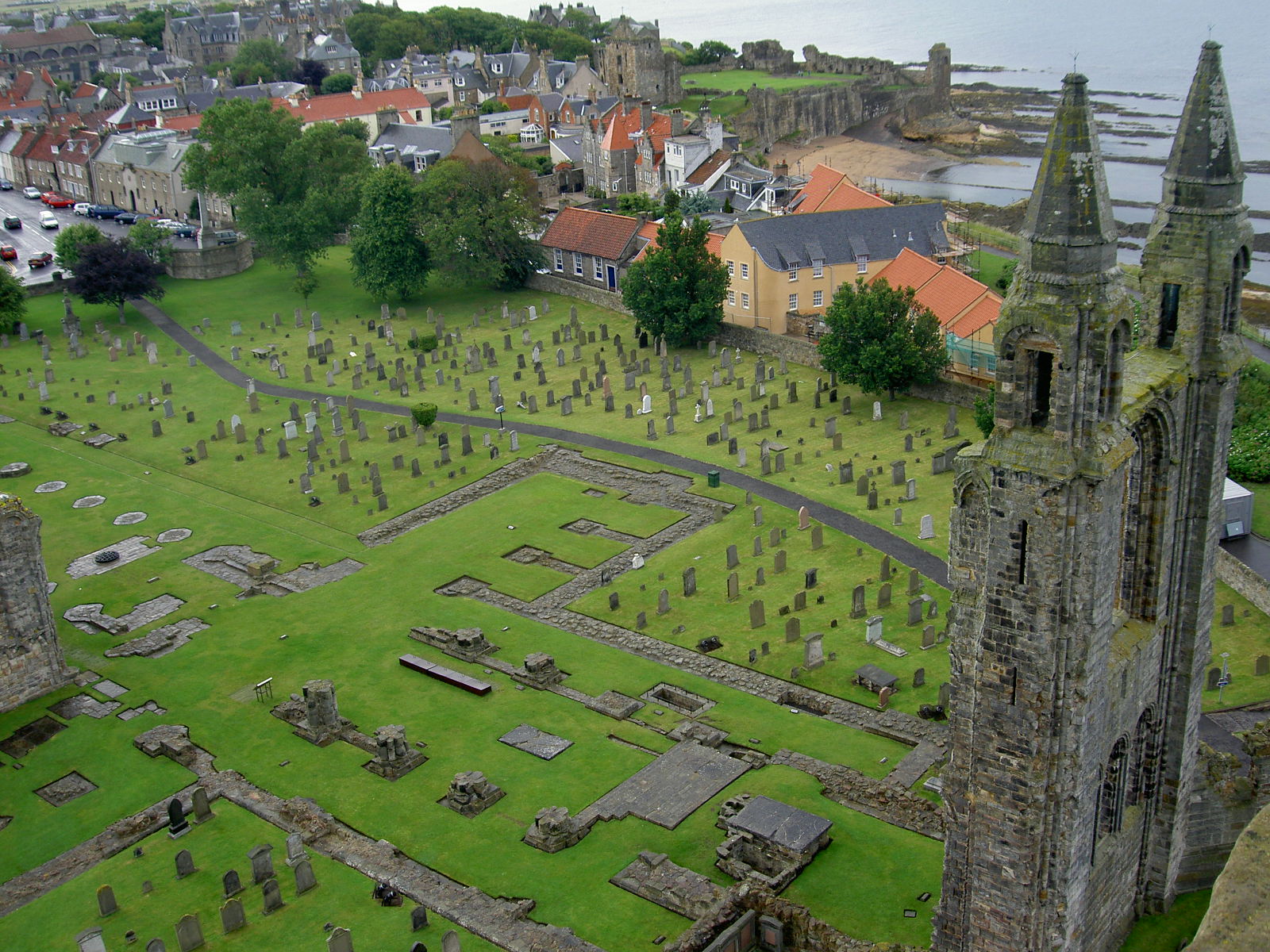
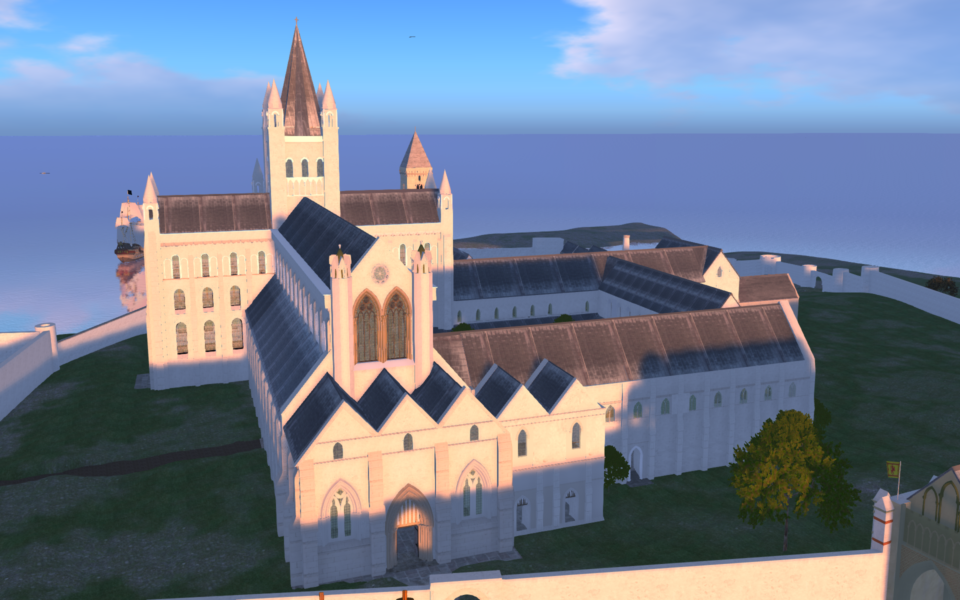
Above: the ruins of St. Andrew’s cathedral, Scotland.
Author’s note: Our Medieval Fathers in the Faith loved grouping Saints – even though unrelated in life – in categories, according to what devotions or patronages were paid to them. So in the Rhineland of Germany, the Four Holy Marshals were St. Anthony the Abbot, patron of pigs; St. Cornelius of cattle; St. Hubertus of dogs; and St. Quirinus of horses. Each saint has his own centre of devotion: Anthony was venerated at Cologne, Hubertus at St-Hubert in the Ardennes, Cornelius at Aachen, and Quirinus at Neuss. The more celebrated Fourteen Holy Helpers were Ss. Christopher, Dionysius or Denis, Catherine of Alexandria, Blaise, Vitus or Guy, George, Erasmus or Elmo, Margaret, Barbara, Eustachius or Eustace, Achatius, Cyriacus, Pantaleon, and Giles – all invoked together for, among other things, protection from the plague. A more secular collection were the Nine Worthies. These military heroes comprised three pagans: Hector, Alexander the Great, and Julius Caesar; three Jews: Joshua, David, and Judas Maccabeus; and three Christians: Arthur, Charlemagne, and Godefroy de Bouillon.
In similar fashion, The Seven Defenders of Christendom referred to St. Andrew, patron for Scotland; St. Anthony for Italy; St. David for Wales; St. Dionysus or Denis for France; St. George for England; St. James the Great for Spain; and St. Patrick for Ireland. Now, quite a few patrons were left out; but as this particular list was popular in England, it makes sense that it concentrates in the four countries of the British Isles, and the three continental nations with whom they had the most to do in terms of trade, warfare, and travel. For us to-day, given the terrible state of Europe, we can pray to them to defend Christendom in general and their own countries in particular from the modern-day infidels of all faiths and none, as once our fathers prayed for protection against the Saracens.
Faur frae Scotland tho’ I be,
Gude St Andra, succour me.
Gie me this an’ ilka day,
Will for wark, an’ spunk for play.Whiles my sorrow has nae name,
Whiles I’m seek and sair for hame;
Ilka Yule ma thochts will turn
Tae the hoose abune the burn,
Whaur I could slock my fevered drouth
Wi’ caller watter in my mooth.Gude St Andra let me see
A vision o’ my ain countree;
Gar its memory keep me here
Blithe through a’ the comin’ year;
Mak this content me wi’ my lot –
I MICHT NO HAE BEEN BORN A SCOT.
Let the thocht o’ sic a fate
Keep me eident, sune an’ late.
Gude St Andra, succour me,
Faur frae Scotland tho’ I be.
—Kate Y.A. Bone, “A Prayer to St. Andrew.”
Anyone who knows his Gospel, knows St. Andrew. St. Peter’s brother, he was martyred at Patras in Greece. He is claimed as first Patriarch of Constantinople, and so that hierarch is often referred to as “Successor of St. Andrew,” in the same way that the Pope is called “Successor of St. Peter” – a relationship made much of when the two Patriarchs are in good humour with each other. His relics were taken from there to Amalfi, in Italy, although his head is in Patras since being given to the Greek Orthodox there by Paul VI in 1964. The head had been given to Pope Pius II 500 years earlier by a Sultan who was hoping for some advantage. Dom Guéranger describes the triumphant arrival of the relic in some detail in his article on St. Andrew in The Liturgical Year, and then goes on to observe:
Thus has the glory of St. Andrew been blended, in Rome, with that of St. Peter. But the apostle of the cross, whose feast was heretofore kept in many Churches with an octave, has also been chosen as patron of one of the kingdoms of the west. Scotland, when she was a Catholic country, had put herself under his protection. May he still exercise his protection over her, and, by his prayers, hasten her return to the true faith!
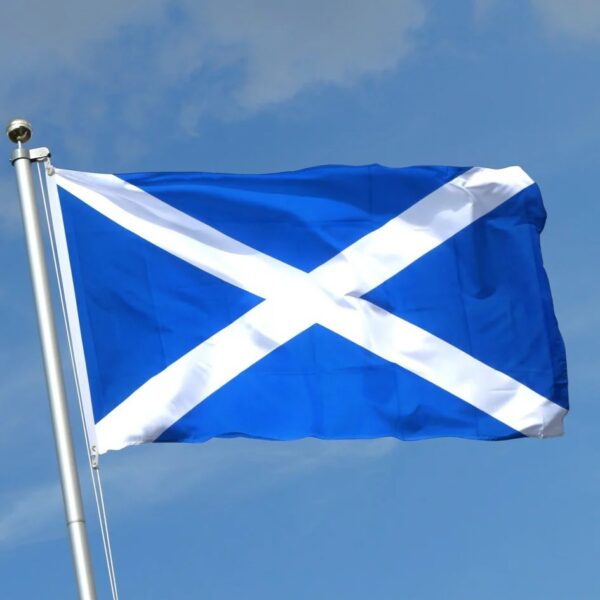
That St. Andrew’s patronage is impossible to escape will be known by anyone who knows the Scots. The Scottish flag, the saltire, bear the white Cross of St. Andrew on a blue field – and this in turn became a constituent portion of the Union Jack, alongside the Crosses of Ss. George and Patrick. Around the world, St. Andrew’s Societies keep St. Andrew’s Day with as much fervour as they keep Burns’ Night. So how did all of this come about?
St. Andrew’s relics were kept in the city of his martyrdom, Patras, until the Emperor Constantine the Great ordered that they be brought to his new capital of Constantinople. His intent was to enshrine them in his new Church of the Apostles, which he intended both to hold relics of all Twelve, and to serve as a mausoleum for him and his family. However, in any event, only relics of St. Andrew, St. Luke, and St. Timothy (the latter two not among the Twelve) were acquired.
In any case, when the news came to Patras that the Emperor was going to requisition what had become the city’s chief treasure, a monk named St. Regulus (or St. Rule in Scots English) dreamed that an angel told him to take some of the relics to “the ends of the earth” for safety’s sake. He did so and took a ship for Roman Britain. But a storm blew them off course, and the ship was wrecked near what is now the city of St. Andrews. There, St. Regulus built a small church to hold the relics; successive rebuilding would in time create a grand cathedral.
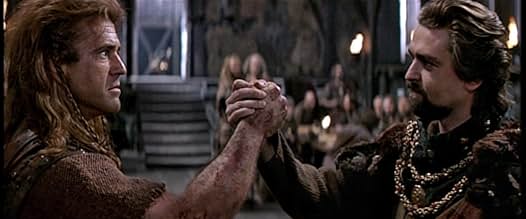
King Angus II of the Picts led a mixed force of Picts and Scots in in 832 A.D. against a larger Anglo-Saxon army led by King Athelstan. Near what is now the village of Athelstaneford in East Lothian. Outnumbered as he was, King Angus prayed for Heavenly aid. That night, the Apostle appeared to him in a dream, and promised victory. In the morning, a cloud formation, a white diagonal cross (the Saltire – St. Andrew’s Cross) appeared against a clear blue sky. Encouraged by this sign, the Picts and Scots won the battle. The Saxon King was slain at a nearby river crossing (giving the village its name), and Angus declared St. Andrew the patron saint of Scotland, and his cross its symbol. The Saltire Cross became the heraldic arms that every Scot is entitled to fly and wear. Both William Wallace and King Robert the Bruce appealed to St. Andrew to aid them against the English. In 1320, when Scotland’s independence was secured with The Declaration of Arbroath, St. Andrew’s patronage was official reaffirmed, and his Saltire flew on Scottish ships, adorned Scottish coins and seals, and was displayed at the funerals of Scottish kings and queens.
This political patronage was affirmed in the spiritual sphere as well. The monastery where his relics were enshrined had become a cathedral and its abbot Scotland’s first bishop by 1000. The 11th century saw St. Margaret, Queen of Scotland, endowing a ferry service across the river Forth, with hostels, at North and South Queensferry for pilgrims. Initially the relics were enshrined in St Rule’s Church and eventually in the Cathedral of St Andrews. Twice yearly St. Andrew’s relics were carried in procession around the town. They were accompanied by Masters and scholars from the colleges, Greyfriars, Blackfriars, Augustinian canons of the metropolitan church, and trade guilds. Cathedral and church bells rang; in the evening were bonfires and fireworks. The See of St. Andrew struggled with the English Archdiocese of York over ecclesiastical supremacy over the country, until Pope Sixtus II made it an Archdiocese and its holder Primate of Scotland in 1472. Almost a century later, the last two Catholic Archbishops of St. Andrew were murdered by the Protestants. The Cathedral had already been ransacked and the shrine and relics destroyed by a mob led by John Knox in 1559, and the cathedral was left to fall into ruin after 1561.
Nevertheless, St. Andrew’s Cross remained the symbol of the country. When, in 1707 the Parliaments of England and Scotland were united and the two countries became the United Kingdom of Great Britain, the Saltire flag, as mentioned, became part of the Union Jack. As the British Empire expanded, Scots settled overseas – the first two St. Andrew’s Societies were founded in Charleston and New York in the 18th century, continuing until to-day. There are now at least one hundred scattered over the globe. These first two St. Andrew’s Societies revived celebration of St. Andrew’s Day as a national and cultural rather than a religious event – the Calvinists of the Church of Scotland frowned on such observances, although the Country’s Catholics and Anglicans continued to offer the Saint veneration. For the former, it was a Holy day of Obligation in Scotland until 1918.
As a secular celebration, it features performances of Scots music (especially the bagpipe), parades, and the flying of the Saltire. St. Andrew’s dinners will feature such traditional dishes as haggis, neeps, and tatties, Cullen skink (smoked-haddock soup), and cranachan (a dessert made of cream, oatmeal, and whisky).
But the “Second Spring” of Catholicism brought a renewed public veneration at last of Scotland’s long-suffering patron. When the Catholic hierarchy in Scotland was restored in in 1878, although the revived primatial see would have to be centred in the capital, it was given the name of “St. Andrews and Edinburgh.” The following year the Bishop of Amalfi gave a portion of St. Andrew’s shoulder to the new St. Mary’s Cathedral in Edinburgh; it was placed in a silver gilt shrine donated by the Marquess of Bute (who unsuccessfully sought to rebuild the Medieval Cathedral of St. Andrews). On the feast of St. Andrew in that year, the relic was exposed in the Cathedral; a pontifical High Mass was offered. That evening, the relic was carried round the Cathedral in a grand procession, with 72 men from three different Army regiments, a line of schoolchildren, and 60 altar boys.
Pope Paul VI contributed part of the saint’s skull in 1969 to mark the creation of Joseph Gray as the first Scots cardinal in 400 years. The Pope gave it to him in St. Peter’s on Rome, in 1969, with the words “Peter greets his brother Andrew.” In 1982 both relics were housed in new reliquaries placed in the altar to the north of the High Altar. This chapel, originally dedicated to the Sacred Heart, now serves as the National Shrine of St Andrew, successor to the Shrine destroyed in 1559. To-day, St. Andrew’s Day is marked at the cathedral with two Masses, public veneration of the relics, and a Eucharistic Holy Hour.
Certainly, since the restoration of the hierarchy in Scotland, St. Andrew has been prayed to for the reconversion of the country. The League of St. Andrew for the Conversion of Scotland was formed in the 1890s by Benedictine monks to pray and advocate for the return of Scotland to the ancient faith following the Protestant Reformation.
New Dawn in Scotland, which has revived pilgrimages in that country, put out the following prayer for the Country’s return to the Faith:
For the Conversion of Scotland
Lord, our nation once sent missionaries throughout the world to proclaim the Good News.
We now pray for a fresh outpouring of Your Holy Spirit.
Rekindle that zeal in us to spread Your Word and to renew our hearts with Your Holy Fire.
St. Michael the Archangel defend us with the heavenly armies to protect us from all evil
and remove the darkness which covers this land.
St Andrew intercede so that we will become a people who will shine the light of Christ
once more to every nation.
Our Lady of Aberdeen, pray for us.Amen
Without a doubt, St. Andrew’s legacy to-day is central to Scots identity. Prominent Scots Catholic layman James Bundy explains his continuing importance:
St Andrew has been many things for Scotland: apostle, protector, national emblem, political symbol, Protestant heritage figure, Catholic memory, and modern civic brand. His meaning has shifted across centuries, but he has never been irrelevant.
For Scottish Catholics, however, the heart of Andrew’s importance remains spiritual. He links Scotland to the apostolic age; he reminds us that holiness precedes nationhood; he calls us to fidelity in times of upheaval; and he continues to ask, in the words of the traditional hymn, that ‘Scotland yet again may love the faith, entire and true.’
In a secular age, recovering St Andrew is not about reclaiming political ground or resisting cultural change. It is about recognising that even a familiar national symbol contains a deeper invitation, one calling Scotland back to its spiritual roots, and calling Scottish Catholics to live out the apostolic faith with the same courage and humility as the fisherman who first said ‘yes’ to Christ.
In this sense, just as St. Andrew was first invoked for protection of Scotland against her enemies, so too now. But those enemies are not the English in the sense of Athelstan or Edward I. Rather, they are interior and exterior, the enemies of both the traditional Scottish Faith and the culture she built – even if it has been wayward for five centuries. In this he has much in common with his six brother defenders of Christendom, whose client nations often were hostile to each other historically – but all of whom face the same threats to-day.
The brother of St. Peter, also invoked by the Greeks, the Russians, and the Ukrainians, can be a strong patron for all of us who seek unity of the face of hostility, peace in the face of conflict, and assurance in the face of confusion. But as his crucifixion shows, St. Andrew has that special sort of bravery that only those with real grace can possess. May he share it with the Scots – and all the rest of us.