
St George he was for England,
And before he killed the dragon
He drank a pint of English ale
Out of an English flagon.
For though he fast right readily
In hair-shirt or in mail,
It isn’t safe to give him cakes
Unless you give him ale.
—G.K. Chesterton, “The Englishman.”
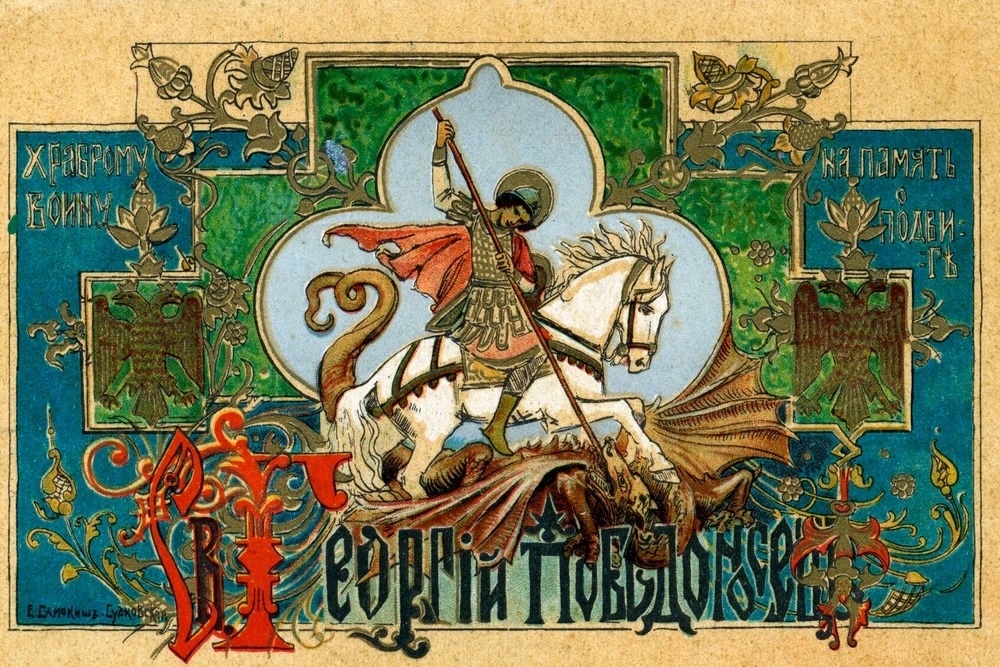
This year, ironically enough, April 23, the feast of St. George, patron of England, shall find me in Scotland. Of course, Scotland’s own patron, St. Andrew, has to wait until November 30 for his feast day. Nevertheless, the Saint and flag – the Cross of St. George – shall be commemorated all over England this day. Above all, he will be portrayed with the dragon he is credited with slaying.
A great many people think of St. George as purely mythical or legendary character – not unlike the venomous firebreather he despatched. But there is a lot more to him than that. Dom Guéranger describes him with his usual gusto:
Clad in his bright coat of mail, mounted on his war steed, and spearing the dragon with his lance, George, the intrepid champion of our Risen Jesus, comes to gladden us today with his feast. From the East, where he is known as the great Martyr, devotion to St. George soon spread in the Western Church, and our Christian armies have always loved and honored him as one of their dearest patrons. His martyrdom took place in Paschal Time; and thus he stands before us as the guardian of the glorious sepulcher, just as Stephen, the Protomartyr, watches near the crib of the Infant God.
The Roman Liturgy gives no lessons on the life of St. George, but in their stead, reads to us a passage from St. Cyprian on the sufferings of the martyrs. This derogation from the general rule dates from the fifth century. At a celebrated Council held in Rome in the year 496, Pope St. Gelasius drew up, for the guidance of the faithful, a list of books which might or might not be read without danger. Among the number of those that were to be avoided, he mentioned the Acts of St. George as having been compiled by one who, besides being an ignorant man, was also a heretic. In the East, however, there were other Acts of the holy martyr, totally different from those current in Rome; but they were not known in that city. The cultus of St. George lost nothing in the holy city by this absence of a true legend. From a very early period, a church was built in his honor; it was one of those that were selected as Stations, and give a Title to a Cardinal; it exists to this day and is called Saint George in Velabro (the Veil of Gold).
The Bollandists were in possession of several copies of the forbidden Acts; they found them replete with absurd stories, and, of course, they rejected them. Father Papebroch has given us other and genuine Acts written in Greek, and quoted by St. Andrew of Crete. They bring out the admirable character of our martyr, who held an important post in the Roman army during the reign of the Emperor Diocletian. He was one of the first victims of the great persecution and suffered death at Nicomedia. Alexandra, the Emperor’s wife, was so impressed at witnessing the Saint’s courage that she professed herself a Christian, and shared the crown of martyrdom with the brave soldier of Christ.
As we have already said, devotion to St. George dates from a very early period. St. Gregory of Tours gives us several proofs of its having taken root in Gaul. St. Clotilde had a singular confidence in the holy martyr, and dedicated to him the Church of her dear Abbey of Chelles. But this devotion became more general and more fervent during the Crusades, when the Christian armies witnessed the veneration in which St. George was held by the Eastern Church, and heard the wonderful things that were told of his protection on the field of battle. The Byzantine historians have recorded several remarkable instances of the kind; and the Crusaders returned to their respective countries publishing their own experience of the victories gained through the Saint’s intercession. The Republic of Genoa chose him for its patron; and Venice honored him as its special protector, after St. Mark. But nowhere was St. George so enthusiastically loved as in England. Not only was it decreed in a Council held at Oxford, in the year 1222, that the feast of the Great Martyr should be observed as one of obligation; not only was the devotion to the valiant soldier of Christ encouraged throughout Great Britain by the first Norman Kings; but there are documents anterior to the invasion of William the Conqueror which prove that St. George was invoked as the special patron of England even so far back as the ninth century. Edward III did but express the sentiment of the country when he put the Order of the Garter, which he instituted in 1330, under the patronage of the warrior Saint. In Germany, King Frederic III founded the Order of St. George in the year 1468.
St. George is usually represented as killing a dragon; and where the representation is complete, there is also given the figure of a princess, whom the Saint thus saves from being devoured by the monster. This favorite subject of both sacred and profane art is purely symbolical, and is of Byzantine origin. It signifies the victory won over the devil by the martyr’s courageous profession of faith; the princess represents Alexandra, who was converted by witnessing the Saint’s heroic patience under his sufferings. Neither the Acts of St. George nor the hymns of the Greek Liturgy allude to the martyr’s having slain a dragon and rescued a princess. It was not till after the fourteenth century that this fable was known in the West; and it arose from a material interpretation of the emblems with which the Greeks honored St. George, and which were introduced among us by the crusaders.
Of course, as Patron Saint of England, he gets the most coverage in the Anglsophere – despite the break with Rome. The Cross of St. George remains the flag of England, and a constituent part of the Union Jack, as England is of the United Kingdom. The Royal Society of St. George (RSStG), with branches across the globe – as well as numerous local societies dedicated to the Saint – try to drum up pride in Englishness wherever Englishmen or their descendants may be found. At home and abroad the RSStG and its sister societies promote the observance of St. George’s Day, and knowledge of their patron. As their website tells us:
Stories of St. George’s courage soon spread and his reputation grew very quickly. He soon became known in Russia and the Ukraine as the Trophy Bearer and his remains are said to have been buried in the church that bears his name in Lydda. However, his head was carried to Rome, where it was preserved in the Church that is also dedicated to him.
St George was beatified by the Roman Catholic Church and is recognised in the liturgy of the Russian Orthodox and Greek Orthodox Churches as well as the Roman Catholic Church. He has been revered in the Ukraine since Christianity was established in 988 AD by Volodymyr the Great the Prince of the Kyivan empire. The Romanesque Monastic order in Prague established St. George’s Church in the Castle in the year 920AD and in the year 1119 AD the Cathedral of St George was founded in Novgorod. His reputation for virtue and chivalrous conduct became the spiritual inspiration of the Crusaders and by this time the pennant or flag with a red cross on a white or silver background became prominent as a means of recognition by English Knights. It was also worn on breast plates.
He remains the patron of the Order of the Garter, headquartered at the now Anglican St. George’s Chapel at Windsor Castle. The website of the Royal Family declares that “The patron saint of the Order is St George (patron saint of soldiers and also of England) and if there are vacancies in the Order, appointments are announced on St George’s Day (23 April).” But he is also the patron of Knighthood and Chivalry in general. The website of the Teutonic Order declares: “He is the second patron saint of the Teutonic Order. Saint George represents bravery, chivalry, and his selfless dedication to the faith. His courage, his devotion, and his unwavering loyalty to God serve as a daily example for us.”
St. George’s knightly patronage evolved into his guarding Cavalry and later Armour as well. According to the U.S. Armour Association’s explanation of the Honorable Order of St. George medal which that body issues:
St. George is the patron saint of cavalry since he is usually shown on horseback and even to better suit today’s mechanized force, he wears armour… One of St. George’s legends is his slaying a dragon that lived in a lake near Silena, Libya. For his brave feat the king gave him a large reward which St. George distributed to the poor before riding away. St. George is often painted on the ends of houses in southern Germany since he is also patron saint of field workers, agricultural workers, and farmers. He also serves as the patron saint of saddle makers, horsemen, and many others.
In Bavaria and Austria, villages with churches dedicated in his honour often host “George’s Rides,” which are horse-mounted pilgrimages on his feast day.
St. George’s military associations endeared him to Lord Baden-Powell, founder of Boy Scouting. He named St. George as patron of the new organization. B-P wrote of the Saint,
When he was faced by a difficulty or danger, however great it appeared, even in the shape of a dragon – he did not avoid it or fear it but went at it with all the power he could… That is exactly the way a Scout should face a difficulty or danger no matter how great or how terrifying it may appear. They should go at it boldly and confidently, using every power that they can to try and overcome it, and the probability is that they will succeed.
So multiplex is devotion to St. George across many countries and professions, that Wikipedia, in addition to its article on the Saint, includes separate articles on his day, devotions, and patronages. In addition to his chapel at Windsor, major centres of devotion to St. George include the Greek Orthodox Church of St. George in Lod, Israel, where his original tomb was, and Rome’s San Giorgio in Velabro, which boasts a part of his skull. St. George’s Cathedral in Southwark also boasts some of his relics.
This April 23, let us keep the festival of the Martyr St. George as well as we can, whether we are citizens of a country claiming him as patron, members of a knightly order, soldiers, scouts, equestrians, or anyone trying to teach, spread, or defend the Faith. If we are English or of English descent, we should be proud of it, especially on his day. But let us remember that this great figure is one of the Seven Defenders of Christendom: the others are St. Patrick for Ireland, St. Andrew for Scotland, St. David for Wales, St. Denis for France, St. James for Spain, and St. Anthony for Italy. Let us join citizens or descendants of those countries in celebrating their respective patron and nationalities – or even we Americans in venerating ours – Our Lady of the Immaculate Conception. The truth is that devotion to a national patron can help make that country a province of Christ’s Kingdom. In addition, each of these patrons has qualities that we all need – not least those martial ones associated with St. George.