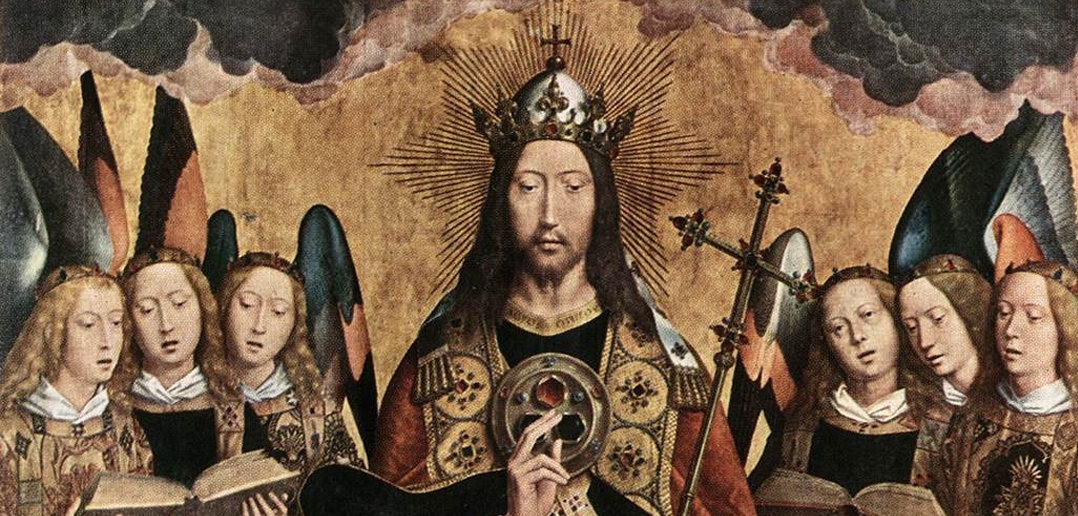

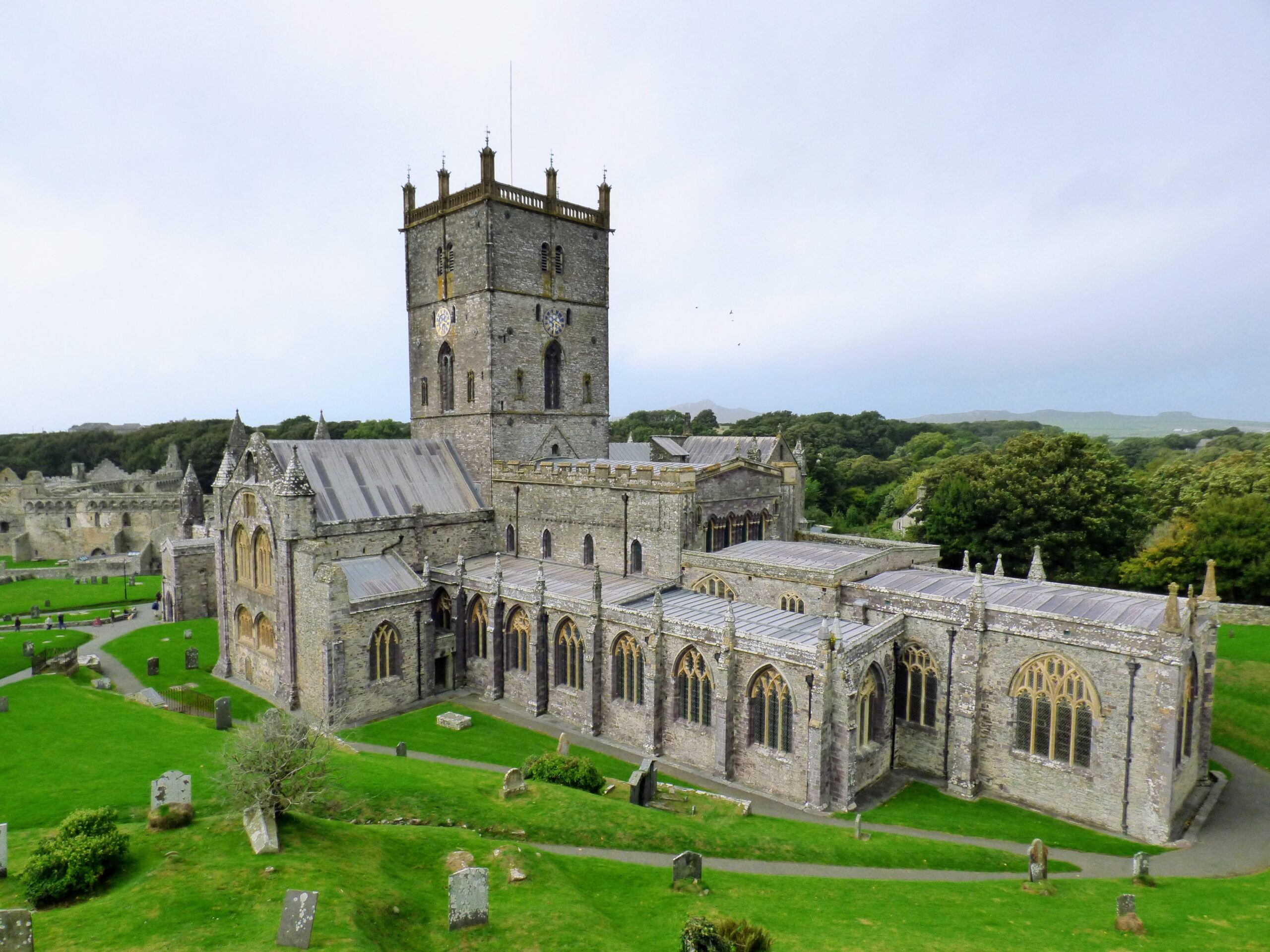
Above: Eglwys Gadeiriol Tyddewi (St. David’s Cathedral) restored as a shrine in 2012.
Author’s note: Our Medieval Fathers in the Faith loved grouping Saints – even though unrelated in life – in categories, according to what devotions or patronages were paid to them. So in the Rhineland of Germany, the Four Holy Marshals were St. Anthony the Abbot, patron of pigs; St. Cornelius of cattle; St. Hubertus of dogs; and St. Quirinus of horses. Each saint has his own centre of devotion: Anthony was venerated at Cologne, Hubertus at St-Hubert in the Ardennes, Cornelius at Aachen, and Quirinus at Neuss. The more celebrated Fourteen Holy Helpers were Ss. Christopher, Dionysius or Denis, Catherine of Alexandria, Blaise, Vitus or Guy, George, Erasmus or Elmo, Margaret, Barbara, Eustachius or Eustace, Achatius, Cyriacus, Pantaleon, and Giles – all invoked together for, among other things, protection from the plague. A more secular collection were the Nine Worthies. These military heroes comprised three pagans: Hector, Alexander the Great, and Julius Caesar; three Jews: Joshua, David, and Judas Maccabeus; and three Christians: Arthur, Charlemagne, and Godefroy de Bouillon.
In similar fashion, The Seven Defenders of Christendom referred to St. Andrew, patron for Scotland; St. Anthony for Italy; St. David for Wales; St. Dionysus or Denis for France; St. George for England; St. James the Great for Spain; and St. Patrick for Ireland. Now, quite a few patrons were left out; but as this particular list was popular in England, it makes sense that it concentrates in the four countries of the British Isles, and the three continental nations with whom they had the most to do in terms of trade, warfare, and travel. For us to-day, given the terrible state of Europe, we can pray to them to defend Christendom in general and their own countries in particular from the modern-day infidels of all faiths and none, as once our fathers prayed for protection against the Saracens.
ST. DAVID OF WALES
O God, who raised Blessed David to be an apostle and patron for your people in Wales, grant, we implore, that through his prayers the people may be restored to the truth which he taught, and to attain to everlasting life. Through Jesus Christ our Lord. Amen
March 1 is the feast day of St. David, patron of the Principality of Wales. He is the only one of the Seven Defenders to actually have been born in the country of which he is patron. Fr. Alban Butler says of him:
ST. DAVID, in Welsh Dewid, was son of Xantus, prince of Ceretice, now Cardiganshire. He was brought up in the service of God, and, being ordained priest, retired into the Isle of Wight, and embraced an ascetic life, under the direction of Paulinus, a learned and holy man, who had been a disciple of St. Germanus of Auxerre. He is said by the sign of the cross to have restored sight to his master, which he had lost by old age, and excessive weeping in prayer. He studied a long time to prepare himself for the functions of the holy ministry. At length, coming out of his solitude, like the Baptist out of the desert, he preached the word of eternal life to the Britons. He built a chapel at Glastenbury, a place which had been consecrated to the divine worship by the first apostles of this island. He founded twelve monasteries, the principal of which was in the vale of Ross, near Menevia, where he formed many great pastors and eminent servants of God…
The Pelagian heresy springing forth a second time in Britain, the bishops, in order to suppress it, held a synod at Brevy, in Cardiganshire, in 512, or rather in 519. St. David, being invited to it, went thither, and in that venerable assembly confuted and silenced the infernal monster by his eloquence, learning, and miracles. On the spot where this council was held, a church was afterwards built called Llan-Devi Brevi, or the church of St. David near the river Brevi. At the close of the synod, St. Dubritius, the archbishop of Caerleon, resigned his see to St. David, whose tears and opposition were only to be overcome by the absolute command of the synod, which however allowed him, at his request, the liberty to transfer his see from Caerleon, then a populous city, to Menevia, now called St. David’s, a retired place, formed by nature for solitude, being, as it were, almost cut off from the rest of the island, though now an intercourse is opened to it from Milford-Haven. Soon after the former synod, another was assembled by St. David at a place called Victoria, in which the acts of the first were confirmed, and several canons added relating to discipline which were afterwards confirmed by the authority of the Roman church; and these two synods were, as it were, the rule and standard of the British churches. As for St. David, Giraldus adds, that he was the great ornament and pattern of his age. He spoke with great force and energy, but his example was more powerful than his eloquence; and he has in all succeeding ages been the glory of the British church. He continued in his last see many years; and having founded several monasteries, and been the spiritual father of many saints, both British and Irish, died about the year 544, in a very advanced age. St. Kentigtern saw his soul borne up by angels into heaven. He was buried in his church of St. Andrew, which hath since taken his name, with the town and the whole diocese.
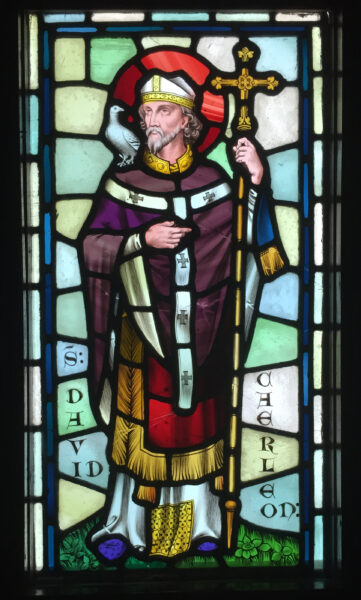
This is certainly an impressive resume. But St. David, although certainly patron saint of Wales has had a wider influence throughout what was left of Celic Britain: Wales, Cornwall, Strathclyde (thanks to its Apostle, his disciple St. Kentigern), and Brittany; as well as Ireland. Moreover, he was seen as a fighter against the hated Saxon invaders of Britain – counseling the soldiers who came for his blessing before battle to wear leeks on their helmets to distinguish themselves from the attackers. At Glastonbury, devotion to him was second only to that of founder St. Joseph of Arimathea himself. The Abbey may be a ruin, but to-day’s Catholic Shrine of Our Lady of Glastonbury includes him in a tapestry behind the altar, alongside the other Saints venerated there. The parish website explains:
St. David is depicted on the Tapestry with a dove alighting on his hand. It is said that once when he was preaching a snow-white dove descended on his shoulder, and the ground on which he was standing raised itself up, and his voice became as a trumpet so that he could be seen and heard by everyone gathered there.
Naturally, though, the centre of devotion to the Saint was his tomb – now shrine, in the Abbey-turned Cathedral he founded. Dying in 589, his last words to his brethren were:
Be Joyful. Keep the Faith. Do the little things that you have heard and seen me do.
Devotion to him grew after his death.
By the11h century, Wales was divided into small warring kingdoms. In 1081 Caradog ap Gruffydd invaded Deheubarth, driving its King, Rhys ap Tewdwr to seek sanctuary at St. David’s. He allied himself with Gruffudd ap Cynan who was trying to regain the throne of the Kingdom of Gwynedd. Together they swore undying allegiance to St. David at his shrine. Shortly afterwards at the Battle of Mynydd Carn they defeated and killed Caradog ap Gruffydd and his allies Trahaearn ap Caradog of Gwynedd and Meilyr ap Rhiwallon. William the Conqueror next arrived later that same year, on his own pilgrimage; Rhys paid him homage and was confirmed in possession of Deheubarth.
Saint David’s Day on March 1 been celebrated since at least the 10th century; he has been widely recognised as the Patron saint of Wales since at least the 12th century during the height of Welsh resistance to the Norman invasion. Numbers of pilgrims were growing to such degree that Pope Callistus II (r. 1119-1124) canonised St. David in 1120, thanks to Bishop Bernard, the first Norman bishop of Saint David’s. March 1 was proclaimed his feast day by the Pope. He declared St David’s Cathedral to be a place of pilgrimage; he further decreed that two pilgrimages to St David’s were equivalent to one to Rome, three to one to Jerusalem. In 1171, Henry II visited St David’s after the murder of Archbishop Thomas Becket in Canterbury. Edward I of England and Queen Eleanor of Castile, who visited St Davids in 1284, were among the throngs of pilgrims who flooded the shrine.
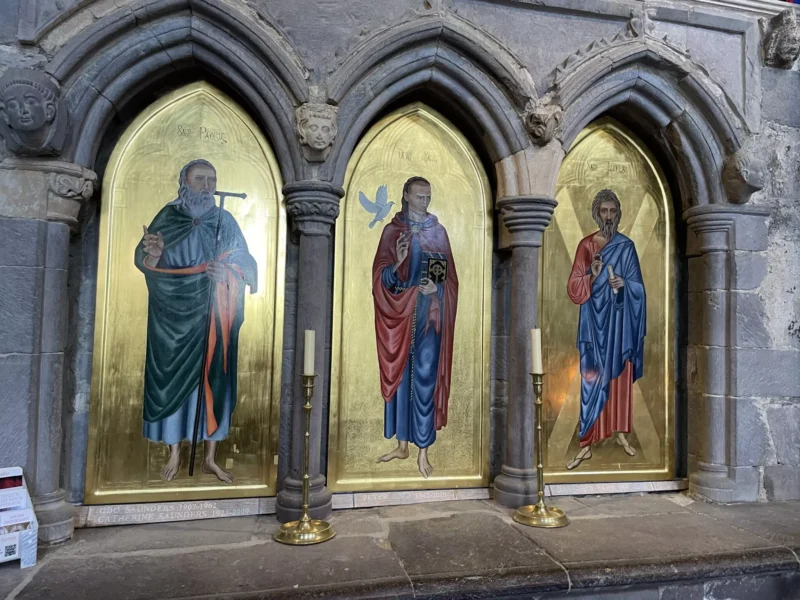
During the War of the Roses St. David’s Day took on a new significance after an invasion force landed at Mill Bay near Dale, Pembrokeshire. At its head was Henry Tudor, leader of the remnants of the Lancastrian party, who made much of his Welsh ancestry. He used Welsh symbols like St. David’s Day and the leek during his march through Wales. Encouraging Welsh patriotism, he rallied to his Welsh Dragon banner about 5,000–6,000 soldiers. Still outnumbered, Henry decisively defeated Richard III at the Battle of Bosworth Field on August 22, 1485. Henry Tudor became Henry VII, and St. David’s Day became a great court festivity, with its members giving each other leeks on the day. Ironically, Henry VIII’s appointee to the See of St. David’s in 1536, Bishop William Barlow, destroyed St. David’s shrine in keeping with his master’s orders against “Popish” devotions. Nevertheless, as the Holy Roman Emperor and the Kings of France and Spain were or are canons of various cathedral and churches, since Tudor times the Sovereigns – first of England, then of Great Britain – have been canons of St. Davd’s Cathedral, as Charles III is to-day. In a sort of delayed revenge, the restored Shrine of St. David was unveiled on St. David’s Day, 2012.
Despite the attempts of the Protestant “Reformers” to stamp out devotion to the saints in Wales as elsewhere, they made little headway against the national patron. In London and anywhere else they might be found outside their own country, the Welsh diaspora made a point of celebrating their patron. Samuel Pepys, the famed 17th century diarist, pointed out how their celebrations in London would spark anti-Welsh counter-celebrations, burning and symbolic lynching of life-sized effigies of Welshmen. In the next century, these continued, developing into English traditions such as the making of “taffies,” an English confection where gingerbread figures are baked in the shape of a Welshman riding a goat.
To-day, the celebration sees Welsh school children offer school concerts or eisteddfodau; younger girls wear traditional Welsh costumes to school – long woollen skirt, apron, white blouse, woollen shawl, and a Welsh hat.
The Welsh Regiments of the British Army use St. David’s cross, Saint David himself, or songs of Saint David in their celebrations. Welsh people wear one or both of the national symbols of Wales to celebrate St. David: the daffodil or the leek. The hundred-tear-old flag of St. David plays a central role in the celebrations and is seen flying throughout the Principality. Popular dishes traditionally eaten on Saint David’s Day include cawl (soup), bara brith tea loaf, Welsh Cakes, Welsh lamb, and Welsh rarebit. The saint is also commemorated in parades, the largest of which is in Cardiff, the capital.
Wherever Welshmen have gone across the globe, they have established St. David’s Societies to keep up their national customs – and the feast day – wherever they may be. The National Welsh American Foundation’s Web site lists more than forty Welsh or St. David’s societies throughout the United States. Outside the States there are fourteen organizations—including societies in South Africa, Australia, New Zealand, Hong Kong, and Japan—with an additional nine in Canada. The largest St. David’s celebration in the United States is in Los Angeles, where there is an eisteddfod, Celtic marketplace, classes, and a concert.
Unlike St. Patrick’s Day in Ireland, St. David’s Day is not a national holiday. However, there is strong support for it becoming a bank holiday in Wales to this day.Welsh schools used to take a half-day holiday, which continues in some parts of Wales.
Apart from cultural interest, however, the Catholic Churchi n Wales still invokes St. David for aid in reconverting his country:
Jesus, Give Back The Faith To Wales
Jesus, Have Mercy On This Country.Hail Mary…
Our Lady of Ransom, Pray for us
Our Lady of The Taper, Pray for us
St David, Pray for us
St Winifred, Pray for us
St David Lewis, Pray for us
St Richard Gwyn, Pray for us
Blessed William Davies, Pray for us
Blessed Martyrs of Wales, Pray for us
The Catholic Cathedral in Cardiff, capital of the Principality, is named St. David. Although built after World War II (its predecessor was a casualty of World War II bombing), it is impressive in its way, and it serves as the Metropolitan Cathedral.
Saunders Lewis, probably the best-known 20th century Welsh convert to Catholicism and a co-founder of the Nationalist Party Plaid Cymru (though he would probably have little use for where it has gone since) composed a poem to honour the national patron to whom he prayed for an entire return of his people to the Church. On the one hand, he addresses the ascetical severity of St. David and the other Celtic monks; on the other he relates him to modern sanctity:
St. David’s Last Sermon
Strange the sermon that David preached
After mass, the Sunday before the first of March,
To the crowd who had come there to grieve his dying:
‘Brothers and sisters, be cheerful,
Keep the faith, and do the little things
You have seen and heard from me.
As for me, I will go the road our father went.
Fare you well’ David said,
‘And never henceforth, shall we see one another.’That was once the site of Brefi’s synod and the saint’s feet and the miracles.
But no miracle, no angel, were found in David’s sermon
After mass, the Sunday before the first of March,
For the crowd who had come to grieve for his dying,
No summoning of the cloister as witness to the glories;
But an urging to the lowly paths. Be cheerful
and keep the faith and do the little things
You have seen and heard from me.It has been a fearsome thing to the historians, the rule of David,
With the Egyptian whip of his abstinence and the heavy yoke,
Lord of the saints, great-grandson of Cunedda and the purple.
But his final words, the sermon that nested in the memory
Of those who prayed on Teifi’s banks through centuries
Of terror, through war, beneath the frown of the vulture like castles,
Through the age when the grasshopper was a burden,
They were maidenly words, a nun’s tenderness,
The little way of Theresa to the purification and the union,
And the way of the poor lass who saw Mary at Lourdes.