
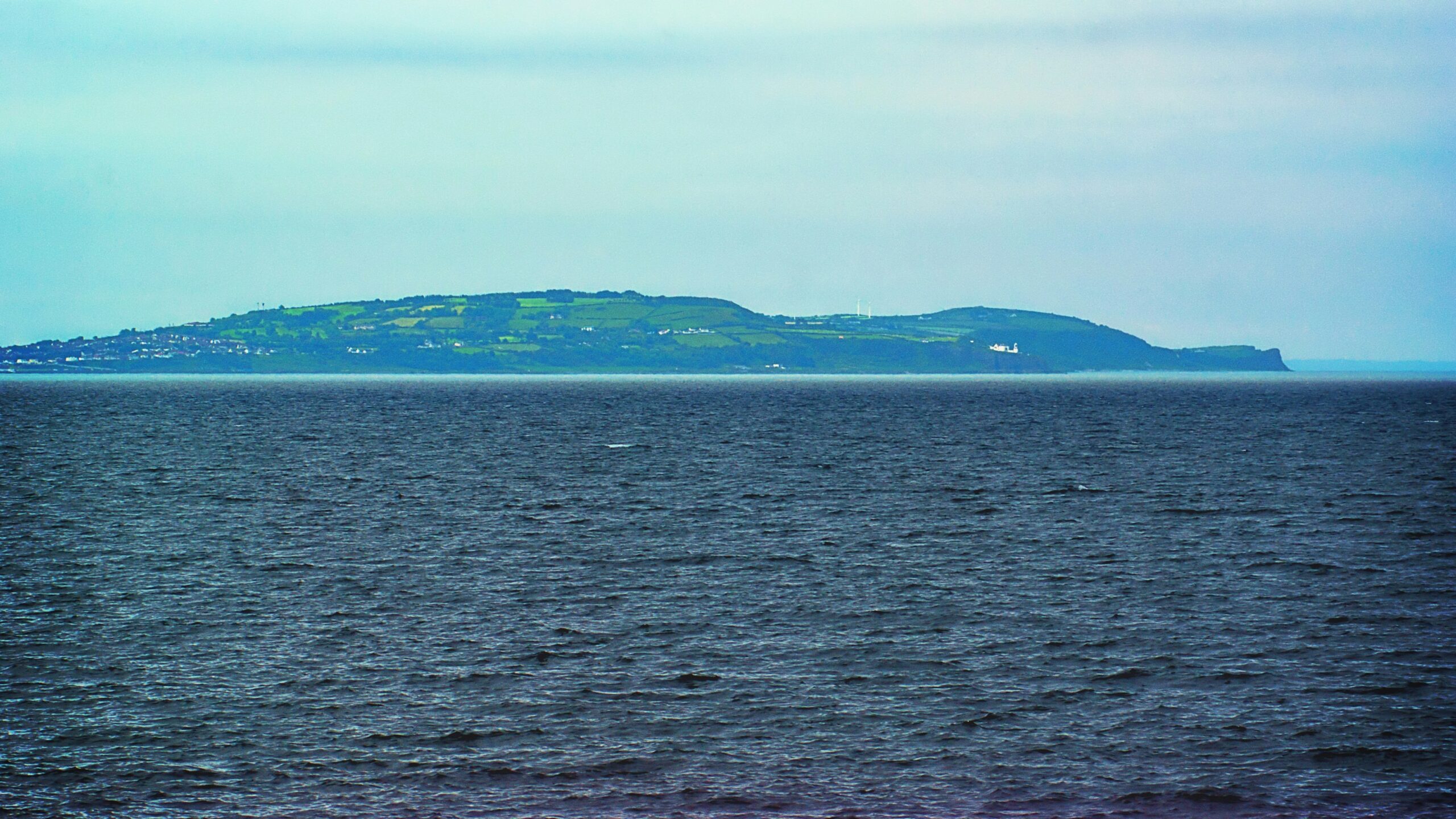
Above: Whitehead from across Belfast Lough, Bangor, County Down, Northern Ireland.
Author’s note: Our Medieval Fathers in the Faith loved grouping Saints – even though unrelated in life – in categories, according to what devotions or patronages were paid to them. So in the Rhineland of Germany, the Four Holy Marshals were St. Anthony the Abbot, patron of pigs; St. Cornelius of cattle; St. Hubertus of dogs; and St. Quirinus of horses. Each saint has his own centre of devotion: Anthony was venerated at Cologne, Hubertus at St-Hubert in the Ardennes, Cornelius at Aachen, and Quirinus at Neuss. The more celebrated Fourteen Holy Helpers were Ss. Christopher, Dionysius or Denis, Catherine of Alexandria, Blaise, Vitus or Guy, George, Erasmus or Elmo, Margaret, Barbara, Eustachius or Eustace, Achatius, Cyriacus, Pantaleon, and Giles – all invoked together for, among other things, protection from the plague. A more secular collection were the Nine Worthies. These military heroes comprised three pagans: Hector, Alexander the Great, and Julius Caesar; three Jews: Joshua, David, and Judas Maccabeus; and three Christians: Arthur, Charlemagne, and Godefroy de Bouillon.
In similar fashion, The Seven Defenders of Christendom referred to St. Andrew, patron for Scotland; St. Anthony for Italy; St. David for Wales; St. Dionysus or Denis for France; St. George for England; St. James the Great for Spain; and St. Patrick for Ireland. Now, quite a few patrons were left out; but as this particular list was popular in England, it makes sense that it concentrates in the four countries of the British Isles, and the three continental nations with whom they had the most to do in terms of trade, warfare, and travel. For us to-day, given the terrible state of Europe, we can pray to them to defend Christendom in general and their own countries in particular from the modern-day infidels of all faiths and none, as once our fathers prayed for protection against the Saracens.
The heat of July is a long way from the cool skies of March, in the midst of which appears St. Patrick’s Day. Nevertheless, he is arguably the most widely celebrated of the Seven Defenders of Christendom. The Sons of Erin’s Isle commemorate their patron not only across the Anglosphere they helped their English conquerors create, but any place – such as Argentina or France – where there are enough of them to do so. Indeed, notional political opponents are as one in celebrating the great Saint – both the President of the Ireland and the British Royal Family keep the feast: the former with Mass at Dublin’s Pro-Cathedral and speeches, and members of the latter celebrating with the Irish Guards and the Royal Irish Regiment. The Friendly Sons of St. Patrick in America helped plot revolution in the homeland throughout the 19th century. Meanwhile, the knightly Order of St. Patrick, a chivalric body given out by the Crown, was centred first at Dublin’s St. Patick’s Cathedral, and then in Dublin Castle itself – in the hall where the presidents of Ireland are now inaugurated. Bringing it all together, New York’s first major St. Patrick’s Day Parade (although there had been smaller ones since 1762) was sponsored by the British in 1779, as the Irish Volunteers (made up primarily of Catholic Loyalists), marched from Broadway to the Bowery. Wherever the sons of the Shamrock may be found, of whatever stripe, there is the day celebrated.
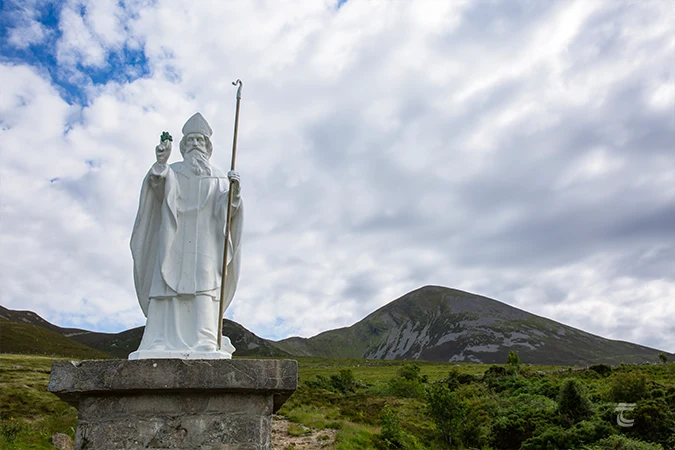
But who was the man himself? He was a Romano-Briton, born sometime toward the end of the Empire’s rule in that island; his uncle was St. Martin of Tours. According to his Confessio, his father, Calpurnius, was a senator and tax collector in Romano-British town which Patrick does not name; he was a deacon in the Church as well. Patrick’s grandfather Potitus was a priest. Looking back at his younger self, the Saint thought of himself then as thoughtless and callow. They were living in the twilight of the Empire in the West, a period that in a generation or two would produce the warlord who would come to be known as Arthur. The pagan Anglo-Saxons, Picts, and Irish who surrounded the hapless province were already raiding its shores; the light of Catholicism and civilisation flickered against the encroaching dark.
At the age of sixteen, Irish pirates took him from his family’s villa. Brought to Ireland, he was enslaved for six years. In his Confessio Patrick writes that God gave him the opportunity to be forgiven his sins and to grow in his faith through prayer. He worked as a herder, and learned the Irish language and customs thoroughly – something that would come in handy during his later career.
Six long years of slavery having passed, Patrick first heard a voice telling him that he would soon go home. Later it spoke again, telling him that his ship was ready. Patrick fled his master and travelled 200 Roman miles to a port, where he found a ship and persuaded the captain to take him aboard. Three days passed and reached Armorica – modern Brittany, later to become a refuge for Britons fleeing collapsing Britain. The entire company disembarked and wandered in the wilds, faint from hunger at the end, for twenty-eight days. About the sixteenth day, after Patrick prayed for relief they encountered a herd of wild boar; able to feed themselves, they reached civilisation.
After a few years, now in his early twenties, he returned to his family in Britain. Patrick then began his religious education. He spent time at Glastonbury and studied at Auxerre and Lérins Abbey in Gaul. St. Germanus of Auxerre ordained him to the priesthood, while St. Maximus of Turin consecrated him as bishop. A few years after his return from his studies, he writes:
I saw a man coming, as it were from Ireland. His name was Victoricus, and he carried many letters, and he gave me one of them. I read the heading: ‘The Voice of the Irish.’ As I began the letter, I imagined in that moment that I heard the voice of those very people who were near the wood of Foclut, which is beside the western sea—and they cried out, as with one voice: ‘We appeal to you, holy servant boy, to come and walk among us.’
St. Palladius and a few other missionaries had attempted to convert the Irish with little success. Pope Celestine I in 431 or 432 AD tasked Patrick with bringing the Christian faith to the Irish people; after selling his father’s estate to raise money for the mission, St. Patrick set off for Ireland.
He landed at what is now Arklow in County Wicklow. Patrick then decided to travel north for what was him an obvious target for conversion (especially given his vision of the forest): his former master, Miliuc of Dál mBuinne. He also intended to buy his own freedom, which tells us something about his conscience. He rested at what is now St. Patrick’s Island in the Skerries, and then sailed north. He landed at Mag Inis in the territory of Dál Fiatach. Unfortunately, when Miliuc heard that Patrick was returning to convert him, he locked himself in his house, and burned himself to death rather than submit to his former slave.
He had better luck with the chieftain Díchu, who gave him a barn as a church, now Saul Church (alas, in Anglican hands like the rest of the Medieval Irish churches). He then travelled clockwise around the island. He then came to the kingdom of Meath wherein was the royal capital of Tara. Patrick soon clashed with Lóegaire mac Néill, the High King at Tara. After the King forbade anyone to light fires on a given night, Patrick lit a Paschal fire on the Hill of Slane – visible from Tara, in defiance of the king. Despite all the efforts of the King and his druids, the fire could not be doused by anyone but Patrick, which led to his conversion.
From there Patrick “baptised thousands of people.” He travelled about all the regions of the island, converting high and low en masse. As he wrote of them:
Never before did they know of God except to serve idols and unclean things. But now, they have become the people of the Lord, and are called children of God. The sons and daughters of the leaders of the Irish are seen to be monks and virgins of Christ!
His adventures gave rise to many stories which modern critics love to try to dismiss as mere “legends.” Among these are his using the shamrock to illustrate the Trinity (and thus it became the primary symbol of Ireland); banishing the snakes from Ireland (it definitely is a later addition to claim they swam the Atlantic and became judges and politicians); his long fast on the mountain; his speaking with dead Irish ancestors – and resurrecting one to baptise him; and a great many more.
Not too surprisingly, his travels have left quite a mark on the Irish landscape. Among the places identified with him are Slemish, County Antrim and Killala Bay, County Mayo, both of which claim that he herded sheep there; the above mentioned Saul Monastery; Croagh Patrick, which he climbed and fasted on its summit for the forty days of Lent (it is a major pilgrimage site); Lough Derg, County Donegal, where Patrick killed a large serpent on this lake, turning the water red (it is another pilgrimage site, and on Station Island is St. Patrick’s Purgatory); Armagh, where Patrick founded a church and proclaimed it the holiest church in Ireland (it is today the primary seat of both the Catholic Church and Anglican Churches in Ireland – both cathedrals in the town are named after Patrick); Downpatrick, where the now Anglican Down Cathedral has his grave, of which it was written – “One grave three saints doth fill, Patrick, Bridget, and Columkill;” and Glastonbury Abbey, England, where St. Patrick’s Chapel is one of the few Abbey structures to have survived the Protestant revolt intact.
But late in his career, when he was in his sixties, St. Patrick faced major controversy. The Northern Britons and recently converted Picts began raiding the newly converted Irish – not least to revenge past deeds. Patrick’s Letter to the Soldiers of Coroticus was an open letter excommunicating the British king, Coroticus, and his soldiers, for killing and enslaving some of Patrick’s new converts during raids in Ireland. He wrote “I cannot say that they are my fellow-citizens, nor fellow-citizens of the saints of Rome, but fellow-citizens of demons, because of their evil works.” Coroticus is believed to be Ceretic of Alt Clut, the region surrounding Dumbarton (Ail Cluaithe in Irish).
This led to his being summoned to Britain at age sixty by church leaders to answer various accusations or charges. He was accused of excommunicating Coroticus although the King was not his subject; accepting valuable gifts from the Irish nobility (especially from prospective ordinands); and taking payment for baptisms. St. Patrick categorically refused to leave Ireland, instead issuing a lengthy denial of the accusations and self-defence. This must have satisfied his critics, because the problem went away.
One lovely prayer which he wrote it is called “St. Patrick’s Breastplate.” Of it, the oldest manuscript in which it is found says
Saint Patrick sang this when an ambush was laid against his coming by Loegaire, that he might not go to Tara to sow the faith. And then it appeared before those lying in ambush that they (Saint Patrick and his monks) were wild deer with a fawn following them.
From his time to our own, St. Patrick has been beloved by the Irish, and their great sustainer in difficult times. As Dom Guéranger says:
And then, what solidity there is in this great Saint’s work! When is it that Ireland receives the Faith? In the 5th century, when Britain was almost wholly buried in paganism; when the race of the Franks had not as yet heard the name of the true God; when Germany had no knowledge of Christ’s having come upon the earth; when the countries of Northern Europe deeply slumbered in infidelity – yes, it was before these several nations had awakened to the Gospel that Ireland was converted. The Faith, brought to her by her glorious Apostle, took deep root and flourished and fructified in this Isle, more lovely even by grace than she is by nature. Her Saints are scarcely to be numbered, and went about doing good in almost every country of Europe; her children gave, and are still giving, to other countries the Faith that she herself received from her beloved Patron. And when the 16th century came with its Protestantism; when the apostasy of Germany was imitated by England, Scotland, and the whole North of Europe, Ireland stood firm and staunch: no persecution, however cleverly, however cruelly carried on against her, has been able to detach her from the Faith taught her by St. Patrick.
So it was until the 1960s. Since then, Catholic Ireland has rather famously collapsed. But one is reminded of the four promises made to St. Patrick after his forty days on Croagh Patrick:
That the people of Ireland keep the Christian faith until the end of time. That an ocean would drown and submerge the island seven years before the Day of Judgment so they would escape the worst tribulations and torments of the end times. That foreign invaders (such as the Saxons) would never conquer the land. That Patrick himself would be allowed to judge the people of Ireland on Judgment Day.
But there are still folk in Ireland loyal to the religion of their patron. The Round Tower Association in Galway, Dublin’s Brandsma Review, Latin Mass communities in Dublin, Belfast, Limerick, and elsewhere are all apolitical seeds of a better Ireland. On a more purely political basis is the National Party – which is dedicated to restoring the social traditions of the country.
The practical loss of Ireland to the Faith, after 400 years of fidelity in struggle is a horrific thing. It gives all the more urgency to Dom Guéranger’s parting prayer to St. Patrick:
Thy life, great Saint! was spent in the arduous toils of an Apostle; but how rich was the harvest thou didst reap! Every fatigue seemed to thee light, if only thou couldst give to men the precious gift of Faith; and the people to whom thou didst leave it, have kept it with a constancy, which is one of thy greatest glories. Pray for us, that this Faith, without which it is impossible to please God, may take possession of our hearts and minds. … Pray for Erin, that dear country of thine, which loves and honors thee so fervently. She is threatened with danger even now, and many of her children have left the Faith thou didst teach. An odious system of proselytism has disturbed thy flock; protect it, and suffer not the children of Martyrs to be Apostates. Let thy fatherly care follow them that have been driven by suffering to emigrate from their native land: may they keep true to the Faith, be witnesses to the True Religion in the countries they have fled to, and ever show themselves to be the obedient children of the Church. May their misfortunes thus serve to advance the Kingdom of God. Holy Pontiff! intercede for England; pardon her the injustice she has shown to thy children; and by thy powerful prayers, hasten the happy Day of her return to Catholic Unity. Pray, too, for the whole Church; thy prayer, being that of an Apostle, easily finds access to Him that sent thee.
Photo by K. Mitch Hodge on Unsplash