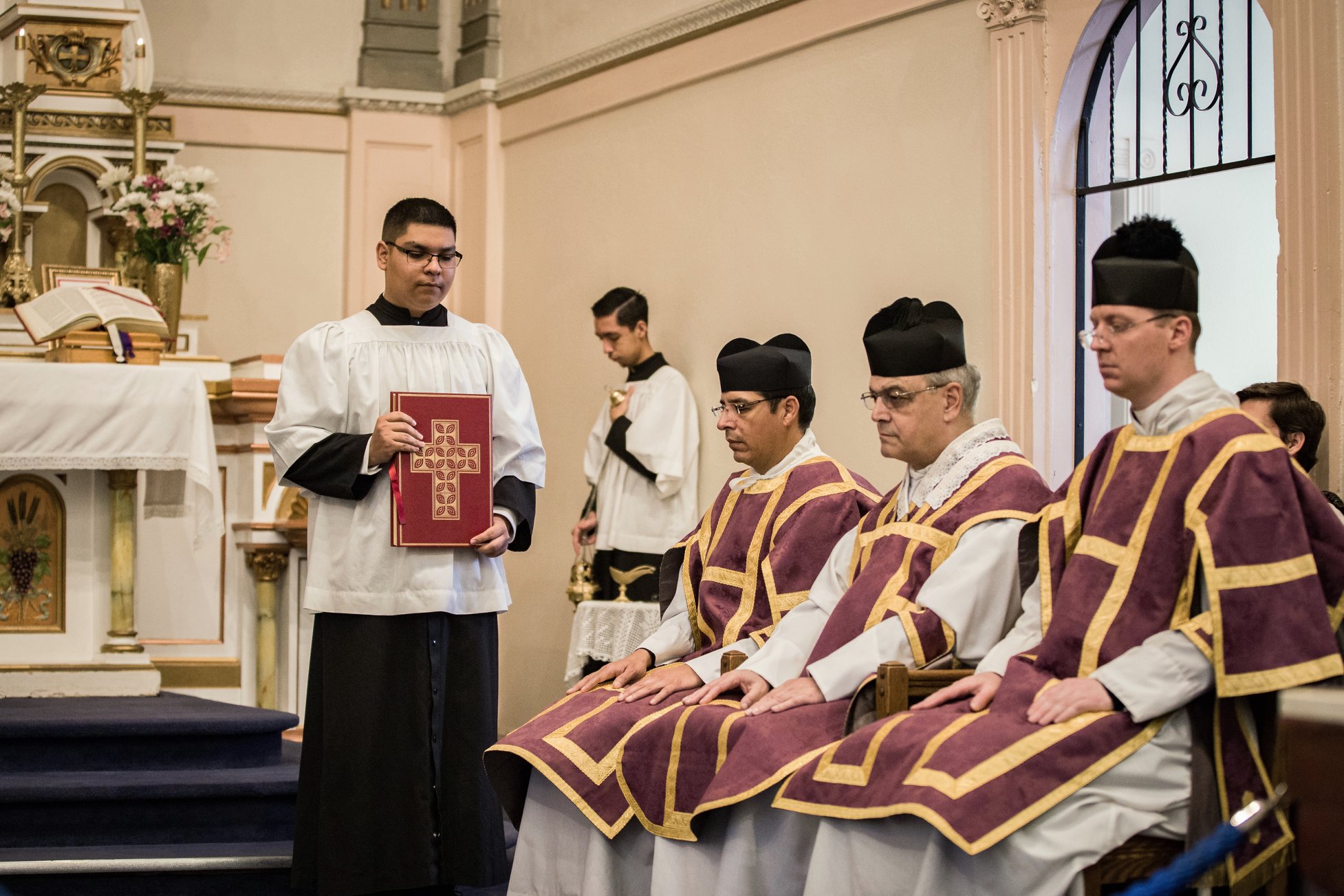

Above: Fr. Josef Bisig, founder of the FSSP (middle cleric).
In this month of the Sacred Heart I’ve said that I want to publish only clerics’ views on the SSPX debate, in order to emphasise that this issue is a clerical issue for the clerics to resolve. Lay people should temper their involvement and allow the clerics to handle it – instead, let’s fast and pray for clerics (join our crusade). We have published one SSPX priest in this debate, as well as one diocesan priest. In this post I want to simply highlight the views of a few non-SSPX priestly fraternities who are devoted to the Latin Mass.
The Priestly Father Wound – the FSSP & FSVF
First, most intimately connected to the SSPX are the views given by Father Louis-Marie de Blignières, founder of the Fraternity of Saint Vincent Ferrer (FSVF), and Father Josef Bisig, co-founder of the Priestly Fraternity of Saint Peter (FSSP). Both of these men were ordained by Archbishop Lefebvre and chose to side against him in his consecrations of 1988. They say of His Grace:
We… suffered through the painful separation from Bishop Marcel Lefebvre, the bishop who ordained us in 1977, and whose great priestly and missionary spirit has always edified us.
Therefore both of these men suffered the father wound that we all feel today, in one way or another. Archbishop Lefebvre was their direct father in the priesthood, but they chose the Holy Father against their personal father. No doubt, the Archbishop himself, as a bishop, felt this pain as well when he chose to beget sons and brothers – by means of episcopal consecration – against his own father, the Holy Father, and suffered the pain of this separation even unto death.
As lay people we cannot possibly understand the clerical agony of these choices. The only thing comparable in the lay world is a marriage vow. So imagine some crazy situation where you had to stay faithful to your spouse when he was abusive – or when she was unfaithful – or some other horror that tries the hearts of every Christian. That’s scratching the surface of what all these good priests feel in their hearts in the midst of this clerical dispute for the good of souls.
The Necessary Source Material
These two aforementioned priests both authored extensive theological studies which justified their decision to break with Archbishop Lefebvre. If you, as a layman, have not studied these sources in depth, and you do not speak about all these clerics and their father wounds with great reverence, you should not be taken seriously on the SSPX issue.
I emphasise this because I lament the fact that, in the midst of this possible break in Eucharistic communion – a reality that, whatever your opinion, wounds the hearts of Jesus and Mary – there is so much indifference and pride reigning through the devil’s playground known as social media.
So please, brother, for the love of Christ Our Lord, take a deep breath and, if you really want to have an informed opinion, study these sources, and then talk to a priest who has a studied these issues and follow his direction.
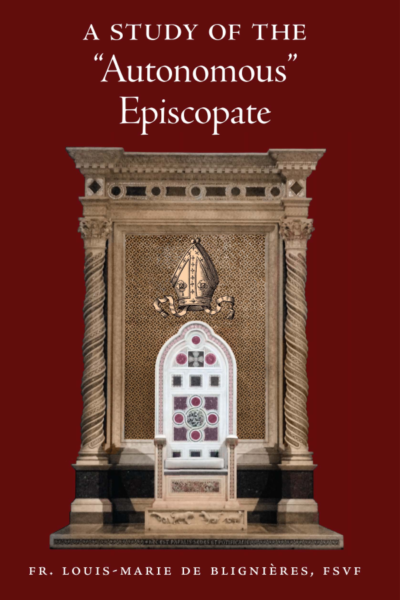
The first theological study is by Father Louis-Marie de Blignières from 1987, and it has been recently brought into English by Arouca press as A Study of the Autonomous Episcopate.
The next theological study is entitled “A Study of Episcopal Consecrations against the will of the Pope applied to the consecrations of 30th June 1988 by Archbishop Marcel Lefebvre.” It was written during the time of 1988 consecrations “under the direction of Fr. Josef Bisig.” This text can be found on the FSSP website here.
Reading these two texts will give the lay faithful an informed opinion about what motivated these two SSPX priests to side against the 1988 Consecrations. In 2022, SSPX priest Abbé Jean-Michel Gleize published three articles in the SSPX journal Courrier de Rome reflecting on the 1988 consecrations.[1] Fr. Gleize presented an ecclesiology of the episcopate according to his interpretation of Tradition and criticized the FSSP for their views. Frs. Bisig and Blignières responded in their own article entitled “A Look Back at the Consecrations of June 30, 1988,” presenting their interpretation of Tradition.
This theological conversation among the clerics hinged on a dubium out of Vatican II regarding the nuances of jurisdiction and order in the episcopate. I’ve read through these texts and frankly, they were difficult for me to understand, much less have a strong opinion about. But one thing from Frs. Bisig and Blignières struck me, and I could understand this:
We are both founders of Fraternities canonically erected by the Holy See in October 1988. Archbishop Lefebvre and many of the priests who followed him predicted that our Fraternities would not remain faithful to their founding acts, that we would be contaminated by “modernism,” and that we would eventually be suppressed within a short time. The past thirty-four years have shown the inaccuracy of these predictions. Our Institutes, in spite of various pressures, both internal and external, have remained faithful to their initial raison d’être. Despite multiple oppositions, they have undergone significant growth. This point sheds a telling light on what those who favor the consecrations call “survival operation”: the 1988 consecrations were, they say, absolutely necessary for “the Tradition” to survive. Our existence proves just the opposite.[2]
This would seem to be one of the primary view points of the non-SSPX, traditional clerics: they assert that since their survival has endured, there is no state of necessity which would require direct disobedience to the pope. That’s their view. The SSPX priests obviously disagree in their conscience. We should respect each priest’s view and pray for them.
Other Traditional Clerical Societies
Besides these two traditionalist clerical societies, there are others, such as the Institute of Christ the King. This group was formed in 1990 in Gabon, Africa, where Fr. Marcel Lefebvre had taught at the Holy Ghost seminary. Henry Sire comments that “the Institute of Christ the King brings a much-needed strain of aestheticism to the otherwise rather Spartan traditionalist movement.”[3] I could not find any official statements from the Institute on the current SSPX debate, but if you have any, send me an email.
Back in February when the SSPX Consecrations were first announced, Mr. Edward Pentin reported that a French diocesan priest, Abbé Claude Barthe, formerly of the SSPX, who now teaches at the seminary for the Institute, had this to say about the planned SSPX consecrations:
I think we need to be very careful when talking about this matter… It is clear that the highly publicized affair of the episcopal consecrations announced by the SSPX is one of the consequences of the wound opened in the Church by the last council and by the liturgical reform that followed. It would be reasonable for this affair to give rise to open and peaceful exchanges of views between the ‘two parties,’ the Holy See and the SSPX.
Another significant branch of Tradition which was formerly with the SSPX is Bishop de Castor Mayer, who was the co-consecrator with Archbishop Lefebvre in 1988 and was also excommunicated with him. His priests, the Priestly Society of Saint John Mary Vianney, went on pilgrimage to Rome in 2000 with the SSPX and decided to seek full canonical status with the Holy See. Thus since January 2002 this society of priests has had full canonical status in Brazil, celebrating the Latin Mass. (For a summary of the rise and fall of the alliance between the SSPX and Campos, see Dr. Vinícius Couzzi Mérida.)
I could not find anything official from this priestly society, so I again invite readers to email me with any information. But I did find a comment in the context of the Campos group’s canonical regularity from Jan Filip Libicki, a Senator in Poland, back in February:
[T]hirty-eight years have now passed since the last episcopal consecrations carried out by Archbishop Lefebvre. During this time, the phenomenon often—rather unfortunately—labeled “traditionalism” has not only failed to disappear, but has grown significantly. Moreover, the Roman Church has in practice tested various forms of its canonical functioning: both through institutes of consecrated life and through personal structures, such as the Personal Apostolic Administration of Saint John Mary Vianney in Brazil.
These solutions—regardless of how one evaluates them—demonstrate one thing: the Holy See is capable of creating non-standard, flexible legal formulas when it deems them necessary for the good of the Church. The current Pope himself, even before his election to the See of Peter, had experience in governing structures with a special canonical status. This means that the issue is not entirely abstract or purely theoretical for him.
Let us continue to fast and pray for our priests inside and outside the SSPX, and for our Holy Father Pope Leo, and for the reconciliation of all in the Eucharistic Heart of Jesus.
VIVA CRISTO REY!
T. S. Flanders
Editor
St. John Francis Regis
Tuesday in the Octave of the Sacred Heart
[1] Abbé Jean-Michel Gleize, Courrier de Rome 655 (July-August 2022): “Pie XII et l’épiscopat,” 1-5; “L’Opinion commune des théologiens sur l’épiscopat,” 5-9; “La Fraternité Saint Pierre et l’épiscopat,” 10-12.
[2] Father Louis-Marie de Blignières and Father Josef Bisig, “A Look Back at the Consecrations of 1988.”
[3] Henry Sire, Phoenix from the Ashes(Kettering, OH: Angelico Press, 2016), 439.