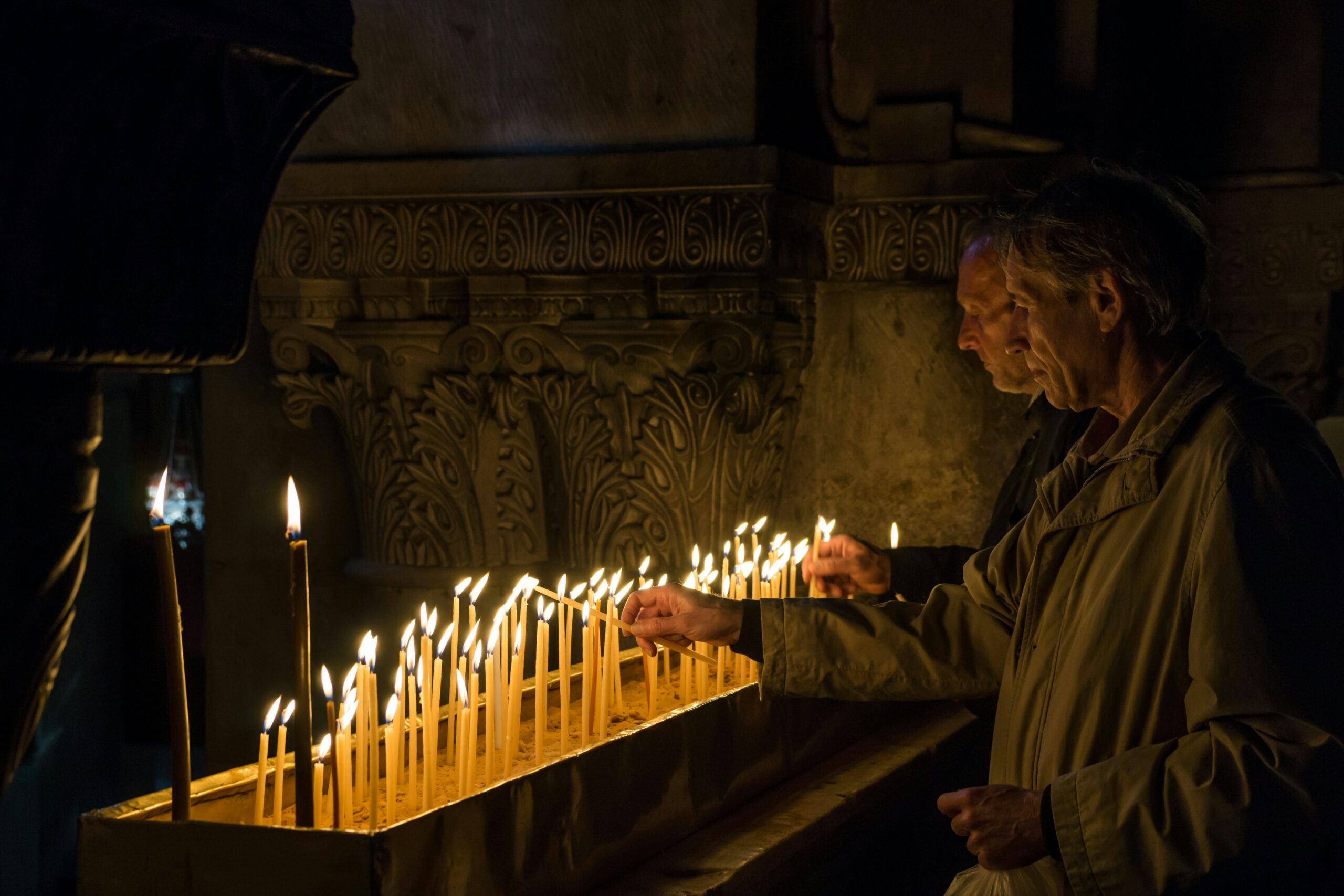
Above: pilgrims lighting candles in the church of the Holy Sepulchre in Jerusalem.
Editor’s note: there is no free, digitised version of the Patristic homily appointed in the office for today’s Gospel. The sermon is Homily 33 of St. Gregory the Great, and an excerpt can be found here (under “Reading 1”) and a full translation can be found here.
This text is taken from The Liturgical Year, authored by Dom Prosper Gueranger (1841-1875)
The Station at Rome, is in the Church of Saint Apollinaris, who was a disciple of St. Peter, and, afterwards. Bishop of Ravenna, and Martyr.
Collect
Grant, we beseech thee, O Almighty God, that the dignity of human nature, which hath been wounded by excess, may be cured by the practice of healing temperance. Through Christ our Lord. Amen.
Lectio Danielis Prophetæ.
Thus did Juda, when captive in Babylon, pour forth her prayers to God, by the mouth of Azarias. Sion was desolate beyond measure; her people were in exile; her solemnities were hushed. Her children were to continue in a strange land for seventy years; after which God would be mindful of them, and lead them, by the hand of Cyrus, back to Jerusalem, when the building of the second Temple would be begun, that Temple which was to receive the Messias within its walls. What crime had Juda committed, that she should be thus severely punished? The Daughter of Sion had fallen into idolatry; she had broken the sacred engagement which made her the Spouse of her God. Her crime, however, was expiated by these seventy years of captivity, and when she returned to the land of her fathers, she never relapsed into the worship of false gods. When the Son of God came to dwell in her, he found her innocent of idolatry. But scarcely had forty years elapsed after the Ascension of this Divine Redeemer, than Juda was again an exile; not indeed led captive into Babylon, but dispersed in every nation under the sun after having first seen the massacre of thousands of her children. This time, it is not merely for seventy years, but for eighteen centuries, that she is without prince, or leader, or prophet, or holocaust, or sacrifice, or Temple. Her new crime must be greater than idolatry, for, after all these long ages of suffering and humiliation, the justice of the Father is not appeased! It is, because the blood that was shed, by the Jewish people, on Calvary, was not the blood of a man—it was the blood of a God. Yes, the very sight of the chastisement inflicted on the murderers proclaims to the world that they were deicides. Their crime was an unparalleled one; its punishment is to be so too; it is to last to the end of time, when God, for the sake of Abraham his beloved, and Isaac his servant, and Jacob his holy one, will visit Juda with an extraordinary grace, and her conversion will console the Church, whose affliction is then to be great by reason of the apostasy of many of her children. This spectacle of a whole people bearing on itself the curse of God for having crucified the Son of God, should make a Christian tremble for himself. It teaches him that Divine justice is terrible, and that the Father demands an account of the Blood of his Son, even to the last drop, from those that shed it. Let us lose no time, but go at once and, in this precious Blood, cleanse ourselves from the share we have had in the sin of the Jews; and, throwing off the chains of iniquity, let us imitate those among them whom we see, from time to time, separating themselves from their people and returning to the Messias—let us also be converts, and turn to that Jesus whose hands are stretched out on the Cross, ever ready to receive the humble penitent.
Sequentia sancti Evangelii secundum Lucam.
What consolation there is for us in this Gospel, and how different are the reflections it suggests, from those we were just making upon the Epistle! The event here related does not belong to the time of our Savior’s Passion; but, during these days of mercy, does it not behoove us to glorify the meekness of that Divine Heart, which is preparing to grant pardon to countless sinners throughout the world? Besides, is not Magdalene the inseparable Companion of her dear Crucified Master, even to Calvary? Let us, then, study this admirable penitent, this type of love faithful even to death.
Magdalene had led a wicked life: as the Gospel tells us elsewhere, seven devils had taken up their abode within her. But no sooner has she seen and heard Jesus, than immediately she is filled with a horror for sin; divine love is enkindled within her heart; she has but one desire, and that is to make amends for her past life. Her sins have been public; her conversion must be so too. She has lived in vanity and luxury; she is resolved to give all up. Her perfumes are all to be for her God, her Jesus; that hair of hers, of which she has been so proud, shall serve to wipe his sacred feet; her eyes shall henceforth spend themselves in shedding tears of contrite love. The grace of the Holy Ghost urges her to go to Jesus. He is in the house of a Pharisee, who is giving an entertainment. To go to him now would be exposing herself to observation. She cares not. Taking with her an ointment of great worth, she makes her way into the feast, throws herself at Jesus’ feet, washes them with her tears, wipes them with the hair of her head, kisses them, anoints them with the ointment. Jesus himself tells us with what interior sentiments she accompanies these outward acts of respect: but even had he not spoken, her tears, her generosity, her position at his feet, tell us enough; she is heartbroken, she is grateful, she is humble: who but a Pharisee could have mistaken her?
The Pharisee, then, is shocked! His heart had within it much of that Jewish pride which is soon to crucify the Messias. He looks disdainfully at Magdalene; he is disappointed with his Guest, and murmurs out his conclusion: This man, if he were a Prophet, would surely know who and what manner of woman this is! Poor Pharisee!—if he had the spirit of God within him, he would recognize Jesus to be the promised Savior, by this wonderful condescension shown to a penitent. With all his reputation as a Pharisee, how contemptible he is, compared with this woman! Jesus would give him a useful lesson, and draws the parallel between the two—Magdalene and the Pharisee:—he passes his own divine judgment on them, and the preference is given to Magdalene. What is it that has thus transformed her, and made her deserve not only the pardon but the praise of Jesus? Her love: She hath loved her Redeemer, she hath loved him much; and therefore, she was forgiven much. A few hours ago, and this Magdalene loved but the world and its pleasures; now she cares for nothing, sees nothing, loves nothing, but Jesus: she is a Convert. Henceforward, she keeps close to her Divine Master; she is ambitious to supply his wants; but above all, she longs to see and hear him. When the hour of trial shall come, and his very Apostles dare not be with him, she will follow him to Calvary, stand at the foot of the Cross, and see Him die that has made her live. What an argument for hope is here, even for the worst of sinners! He to whom most is forgiven, is often the most fervent in love! You, then, whose souls are burdened with sins, think of your sins and confess them; but most of all, think how you may most love. Let your love be in proportion to your pardon, and doubt it not: Your sins shall be forgiven.
Humiliate capita vestra Deo.
Be propitious, O Lord, we beseech thee, to thy people; that, forsaking what displeaseth thee, they may find comfort in keeping thy law. Through Christ our Lord. Amen.
Let us close this Thursday of Passion Week with the following devout Hymn, taken from the Mozarabic Breviary.
O Word of the Father, that camest into this world, and wast made Flesh! O Lamb of God, that takest away the sins of the world! to thee do we come, and, in prostrate adoration, beseech thee to give us to drink of the Blood shed for us in thy sacred Passion.
Show unto us the marks of thy divine wounds! Let the invincible Standard of thy glorious Cross be raised on high, and, by its imperishable power, bring salvation to them that believe.
The Reed, the Nails, the spittle, the Gall, the Crown of Thorns, the Whips, the Spear—these were the Instruments of thy sufferings: oh! cleanse us by them from all our sins.
May the Blood that gushed from thy sacred Wounds, flow on our hearts the purify them from their stains of guilt, enable us to pass through this world without sin, and give us, in the next, the reward of bliss.
That when the resurrection-day shall break upon the world, brightening it with the splendors of the eternal kingdom, we may ascend by the path that leads above, and dwell in heaven, citizens eternal.
Honor be to the Eternal God! Glory be to the One Father, and to his Only Son, together with the Holy Ghost:—the Almighty Trinity, that liveth unceasingly for ever and ever. Amen.
Let us again borrow from the Greek Church the expression of our devotion to the Holy Cross.
Hymn
(Feria V. mediæ Septimanæ)The wood wherewith Eliseus drew the axe from the Jordan, was a figure of thy Cross, O Jesus! wherewith thou didst draw, from the depths of their vanities, the nations that thus sing to thee in joy: Blessed art thou the God of our Fathers!
Let the heavens rejoice together with the earth, as we venerate thy Cross; for it was by thee that Angels and men are united, and sing: Blessed is the Lord our God!
Venerating the Cross of our Lord, and glorifying our Redeemer, let us present him a three-fold homage: our Compassion, like the fragrant cypress; our Faith, like the cedar; our Love, like the pine.
Thou didst stretch forth thy hands upon the Cross, to show that ’twas thou didst destroy the sin done by the hand of licentious man. Thou wast wounded with the spear, that thou mightest wound our foe. Thou didst taste Gall, that thou mightest turn evil pleasures from us. Thy drink was Vinegar, that thou mightest be a joy to each of us.
I have eaten of the Tree of sin, and it was my ruin; I have tasted a pleasure that has caused me death. Bring me to life, O Lord! Raise me from my fall. Make me an adorer of thy Sufferings, a partner in thy Resurrection, a co-heir of them that love thee.
O Cross! thou standard of joy, thou armor invulnerable, thou glory of the Apostles, thou strength of Pontiffs—supply my languid soul with power, and oh! may I venerate thee, and thus cry out thy praises: “All ye works of the Lord, praise the Lord, and extol him, above all, for ever!”
Photo by Peter Aschoff on Unsplash