
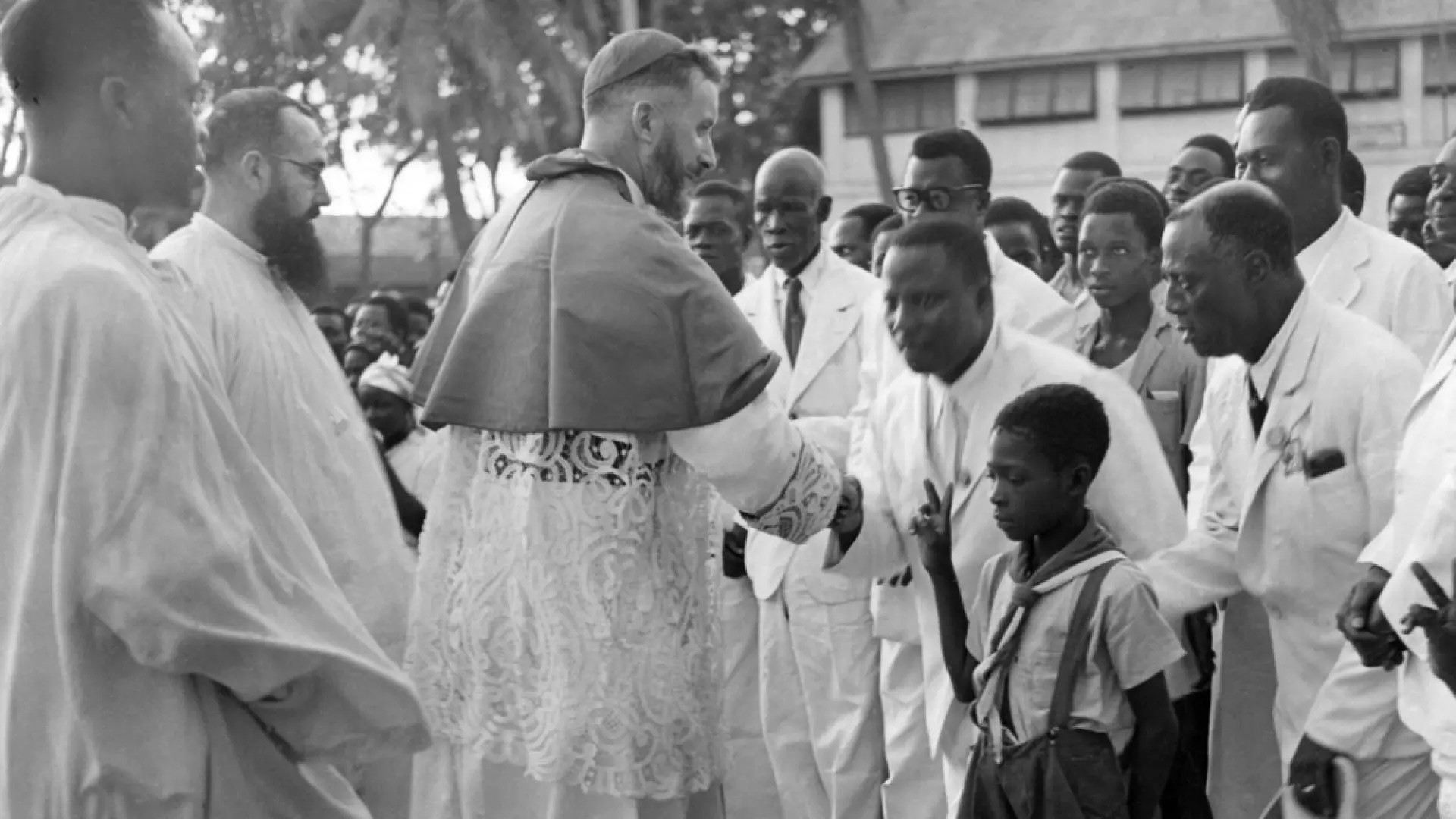
Above: Archbishop Marcel Lefebvre, Apostolic Delegate for French speaking Africa during a parish visit. Photo credit: SSPX
The Vincentian Canon & the Case of Sacred Music in the Philippines
In August of 2023, the SSPX Priory in Manila, published an announcement (here) about the year’s annual Fiesta Mass, where Marcelo Adonay’s Pequeña Misa Solemne sobre Motivos de la Misa Regía del Canto Gregoriano, composed a century ago, would be the special composition for the occasion. But this Fiesta Mass, particularly at a traditional Church, performed by its choir with the St. Gregory the Great Festival Orchestra, was met with whisperings and criticism from some faithful. Perhaps the critics were taking off from this specific passage in Pope Pius X’s Tra le Sollecitudini (VI.9):
Among the instruments which the Church has admitted into her temples, the organ indisputably holds the principal place… Nevertheless, the employment of the organ or other instruments must be regulated with such care that they do not hinder the singing… Other instruments may be allowed, but only with the consent of the Ordinary, and on condition that they are suitable for sacred use… Loud or frivolous instruments, such as drums, cymbals, bells, and the like, are absolutely prohibited.
While Pius X clearly did not condemn or ban orchestral masses, it might seem to some traditionalists that an orchestra is intrinsically “loud” and “frivolous” and might hence be replacing the organ’s principal place. After all, Pius X set the gold standard for sacred music in the early 20th century in his 1903 motu proprio, declaring that nothing in church music should “disturb or even merely diminish the piety and devotion of the faithful,” observing how profane and theatrical styles had exerted a “fatal influence” on sacred music, and reminding the Church that music is the handmaid of the liturgy, not the master. In addition, the liturgical texts and action always take precedence; musical settings must serve the Mass, never overshadow it. These principles – holiness, beauty, universality, and the primacy of the rite — became the measuring stick for what is “proper” sacred music. Given Pius X’s strict norms, it may seem a dilemma how the SSPX would’ve done an orchestral Mass.
Bishop Richard Williamson (✟), once said,
In 1969, in the revolution in the Church, Catholic authority split from Catholic truth… ever since, all Catholics are more or less schizophrenic, because if truth and authority are separated… then either I follow authority and forget truth or I forget authority and follow truth.
He praised Archbishop Marcel Lefebvre for steering between two problematic extremes: 1) the modernist “left,” who were leading their communities to fall prey to modernists in Rome, and 2) the sedevacantist “right,” who were putting themselves in a position as uncertain as it is dangerous, by stating more than Church teaching allows one to state. The Archbishop’s position: ‘recognize and resist’, maintaining a balance grounded in the Vincentian Canon—quod semper, quod ubique, quod ab omnibus (what has been taught always, everywhere, and by everyone), in its recognition of an authority in crisis. Whether or not the reader believes Catholic authority split from Catholic truth, it is at least undeniable that confusion reigns and that the church has been in a crisis—hence, the timeliness of the Vincentian Canon.
Citing Archbishop Lefebvre in his book, The Biography: Marcel Lefebvre, Bishop Bernard Tissier (✟) declared, “Looking at what is expedient, at purely temporal means, and putting our confidence in rational systematic organization” would be to “copy the Church’s enemies.” Hence, according to Bishop Tissier (✟), Archbishop Lefebvre said, “that the first essential means for the apostolate should be the teaching of Christian doctrine and catechism.” At the same time, Bishop Tissier (✟) cited the Archbishop again, and declared, “Why should we use less intelligence than worldly people to organize our ministry with the providential means that are given to us seeking to make things grow in so far as Providence itself wishes to make them grow.” However, the Archbishop also cautioned priests to “avoiding being too absorbed by material considerations, and neglecting to prepare sermons, catechism lessons, or spiritual talks.” Nonetheless, the Archbishop wished his priests to have “an inventive and ingenious zeal” since:
Our Lord means for us to blaze new trails and to avoid the immobility that comes through mere routine or the tendency to do slavishly what our predecessors did. In their own time they blazed new trails, and when we do the same thing we are continuing their work and imitating them.
According to Bishop Tissier (✟), the Archbishop believed in “bringing methods of the apostolate up-to-date… because of changes in material circumstances, and because of new dangers.” Referring to the situation in Senegal, the Archbishop said, “We are in the Senegal of the twentieth century in a given time and place, with the means of our time, and the errors and enemies of the Church of our time.” One such inventive zeal as Archbishop of Dakar in the 1950s was the founding of Fogola (“Friends of Christians”), an association for non-baptized individuals who were favorable toward Christianity. Members received identity cards tying them to the Church and were expected to promise baptism before death. It was designed as a bridge between pagan cultural life and the Gospel—offering catechesis, facilitating future marriages under the Catholic rite, and planting Church roots in the region. It was a strategic pastoral missionary tool for non-Christians to slowly come into the Church and resist the spread of Islam, and intimately laying the groundwork for a future Catholic community. It exemplified Archbishop Lefebvre’s pragmatic yet pastoral creativity—seeking ways to evangelize effectively in difficult contexts, taking account of local cultural realities—reflecting his belief that cultural proximity to the Faith (even before baptism) could be nurtured—not by formal assimilation of native ritual, but through gradual incorporation into Church life via structured associations. Fogola also functioned as a social safeguard: it provided members with community and support while they awaited full conversion, thus countering Islamic influence in Senegal. And indeed, the statistics on conversions during the Archbishop’s tenure, proves the fruit of this pastoral approach that kept Christ center and King, in spite the challenging environment. Bishop Tissier (✟) explains, however, “the Archbishop did not advocate blind progressiveness” and wrote:
On the one hand, one must avoid narrowness of mind, an outdated and fossilized traditionalism that closes its eyes to the materialism and atheism running amok among the youth: it locks itself away in its church, content with the present of a few good parishioners and children. On the other hand, one must avoid a spirit of novelty qui sapit haeresim (which smacks of heresy), the heresy of activism that neglects prayer, preaching, the parish Mass on Sunday, or religious instruction.
Bishop Tissier (✟) adds, “Thus, while respecting the guidance of canon law concerning the ministry” Archbishop Lefebvre wrote, “the Church increases the range of means she uses to bring home the message of the Gospel through the initiatives of priests and bishops inspired by enlightened zeal,” and it is in these conditions, which the Archbishop believed, the spirit of our Lord and the Church will inspire the missionary’s initiatives, and give him “the ingenuity that comes from true zeal.”
In my attempt to understand and navigate the crisis in the Church, time and again, I have returned to the same conclusion—in the war between truth and authority, the SSPX position is correct and the best position to hold, as it merely mirrors the Catholic attitude and practice prior to the Second Vatican Council. It mirrors 1,800+ years of
quod semper, quod ubique, quod ab omnibus (what has been taught always, everywhere, and by everyone). As we will see, the Vincentian Canon insists that genuine reform protects perennial doctrine while adapting prudently to time and place. That same tension—continuity and measured creativity—frames the question of sacred music in the Philippines, whose 333-year Catholic story is a laboratory of chant, polyphony, vernacular hymnody, and pastoral exceptions. The Vincentian Canon in tandem with the SSPX position (recognize and resist) is an excellent rule not only for navigating the crisis in the Church, but also for pastoral choice, including music, as it warns against two opposite dangers: novelty that erases tradition (music that is theater rather than solemn sanctuary), and fossilized cold routine that refuses inevitable cultural practices that might otherwise have been a practical strategy for channeling and uplifting local piety and love for the Almighty, and for some cases, as Christian missionaries used to do (and as the Archbishop did), convert pagans into Christians.
In this series, we will explore and present the interplay of the Vincentian Canon and the significance of keeping moderation (‘recognize and resist’) as the perennial Catholic attitude and position, with sacred music in the Philippines as case in point.