
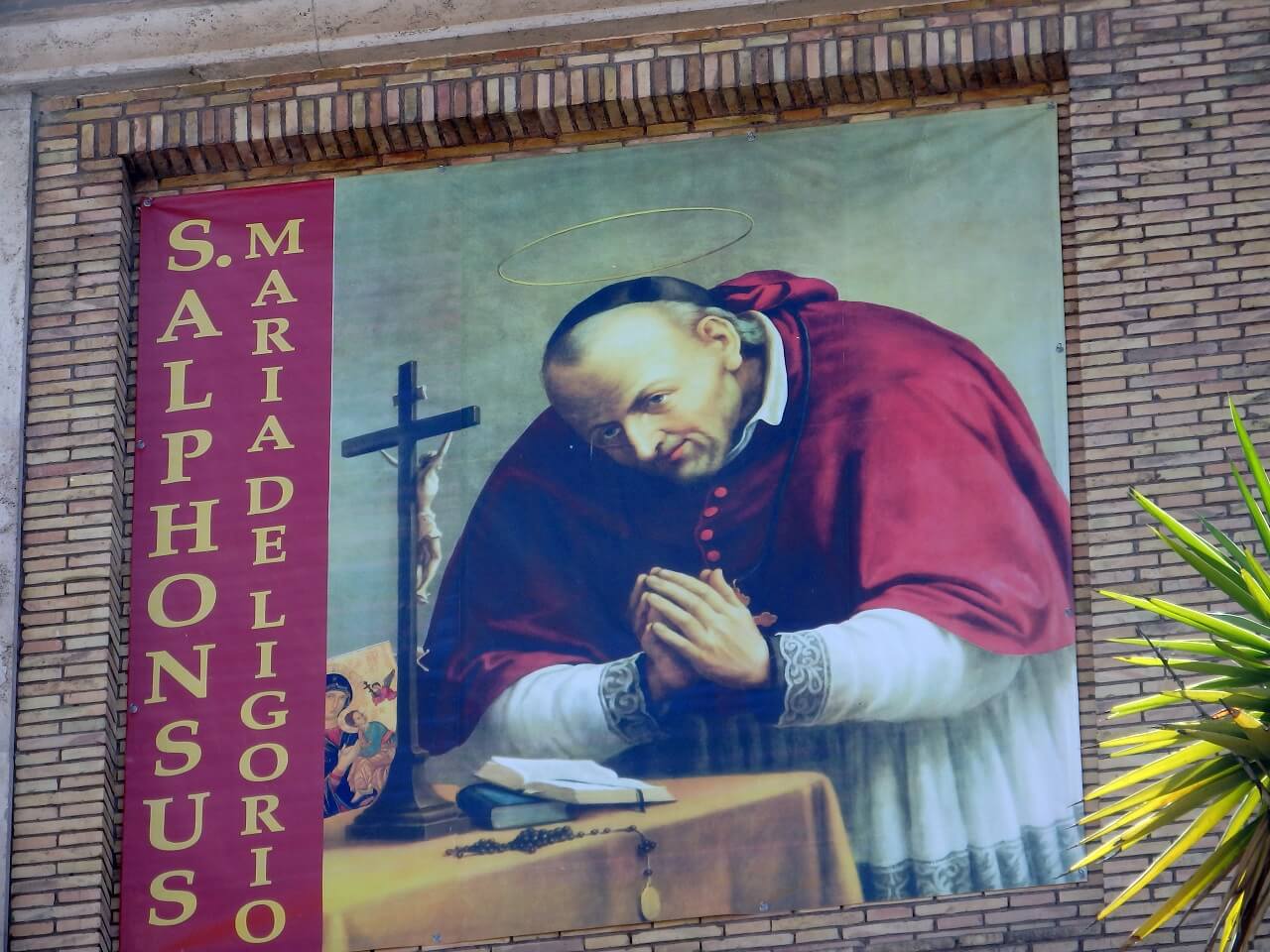
Canonized in 1839 and declared a Doctor of the Church in 1871, Saint Alphonsus Liguori—also known as the “Doctor Most Zealous”—is arguably the greatest moral theologian in the history of Catholicism. In this article, I will provide an extensive account of Saint Alphonsus’s spiritual contribution to Catholicism; explicate his doctrine on prayer; and highlight his unique charism.
First, regarding Saint Alphonsus’s spiritual contribution to Holy Mother Church, the Doctor Most Zealous composed over one-hundred books throughout his lifetime. In particular, his School on Christian Perfection is a reliable guide for Catholics who wish to advance in holiness. For instance, in order to give God the opportunity to cultivate the virtue of charity within the soul, the Doctor Most Zealous admonishes his reader “to deny oneself by gladly embracing what is opposed to self-love, and refusing what self-love demands.”[1] A practical way to accomplish this task is to deny “what pleases us most,” which could be eating delicious food or even the conjugal act.[2]
However, not only does this advice extend to corporeal goods, but spiritual ones, as well. Immediate obligations of charity for our neighbor always trump our own spiritual “goods.” This is because we manifest our love for God by our love for neighbour. For example, if a man’s sick spouse disturbs his prayer to ask him to drive her to the hospital, then he “should not be disquieted” by the interruption; rather, he should accept the will of God—especially that which is most inconvenient – pause his spiritual time, and love his wife.
According to St. Francis de Sales, our self-love wants to have a share in everything, even in things the most holy. For this very reason, says the Saint, we must love even virtue without attachment. For example, it is necessary to love prayer and solitude; but when obedience or charity prevent us from devoting ourselves to prayer and solitude we should not be disquieted, but accept resignedly everything that happens by the will of God to thwart our inclinations.[3]
While this advice may seem counterintuitive, various members of the Church Triumphant make it clear that “God is infinitely good and supremely amiable, deserving of our undivided love.”[4] As a result, following God’s will at all times—even when it doesn’t make sense to us—is the surest path to salvation.
Second, regarding Saint Alphonsus’s doctrine on prayer, his How to Pray at All Times, published in 1753, gives the reader “a [sure] method of conversing continually and lovingly with God.”[5] In this method, the Doctor Most Zealous explains that, even though the soul must humble itself exceedingly before the Divine Majesty, it should not prevent itself from worshipping its Maker “with the most tender confidence and love.”[6] In other words, while it’s true that the gap between God and creature is insurmountable, the reality is that God truly is our Father. If that doesn’t sound convincing enough, Saint Alphonsus takes it a step further, claiming that “neither friend, nor brother, nor father, nor mother, nor spouse” loves a soul more than God does.[7]
While one often hears wonderful statements like this from the prelates of Holy Mother Church, due to the Enemy’s overwhelming influence and domination upon the Earth, the truth can be difficult to believe. Therefore, in order to reject the lies of evil, Saint Alphonsus recommends that the soul “call[s] to mind [God’s] loving treatment… and the gracious means He has used” to increase one’s love for Him.[8] Similar to a husband who is displeased with his wife for not giving him her whole heart, “God is displeased with a want of confidence” in the faithful soul.[9] Rather, Saint Alphonsus assures his reader that “[God’s] delights are to be with” His beloved.[10] As a result, “to appear before God as a timid slave, trembling with alarm” is to be avoided at all costs, for it shows Him that the soul is still lacking in love.[11]
Finally, regarding Saint Alphonsus’s unique spiritual charism, after acting as an ordained priest for only six years, the thirty-six-year-old cleric founded the Congregation of the Most Holy Saviour—eventually changed by Pope Benedict XIV in 1749 to “Congregation of the Most Holy Redeemer.” Although I was unable to find a copy of the original Rule created by Saint Alphonsus, I was able to discover the post-Vatican II amendment of the Rule.[12] Attached to this document is the reason that Saint Alphonsus himself gave to Pope Benedict XIV for founding the Congregation of the Most Holy Saviour:
[H]aving felt deeply the great abandonment in which the poor find themselves in great areas of the Kingdom [of Naples]…[we desire] to dedicate [ourselves] to help the rural poor by means of missions, instructions and other (ministerial exercises). These are the most in need of spiritual help, as frequently they have no one to administer to them the Holy Sacrament or the Word of God; their plight is such that many, for lack of (apostolic) labourers, reach death’s door without knowing anything at all of the necessary truths of the faith.[13]
Thus, the Congregation of the Most Holy Redeemer and their members, known as Redemptorists, primarily engage in celebrating the Most Holy Sacrifice of the Mass; administering the Sacraments of Holy Mother Church; and preaching Holy Scripture—all for the sake of the salvation of the souls, especially the poor. At first, the Redemptorists only took three simple (i.e. temporary) vows: poverty; chastity; and obedience. However, after the promulgation of the apostolic constitution Conditae a Christo by Pope Leo XIII at the turn of the twentieth century, the vows of the Redemptorists were elevated to solemn (i.e. permanent) vows.[14] In addition to these vows, “they add the vow and oath of perseverance to live in [their respective] congregation[s] until death.”[15] Originally, the Redemptorists also took a fifth vow to preach the Gospel to infidels, heretics, and schismatics, for Saint Alphonsus was anxious to bring these lost sheep into the house of the New Israel, the Church (cf. Saint Luke 15:4).[16] However, in 1743, the Holy See suppressed it for unknown reasons.
As of 2022, the number of Redemptorists amounts to about 4600 members—3500 of those being priests.[17] While the number of religious in general has largely declined since the close of the Second Vatican Council, one cannot deny the impact that the Congregation of the Most Holy Redeemer has had upon Catholics worldwide for almost three hundred years. Therefore, having spent his entire life dedicated to the glory of God and to the salvation of souls, it is only right that Catholics refer to Saint Alphonsus as the “Doctor Most Zealous.”
[1] Saint Alphonsus Liguori, The School of Christian Perfection (Boston: Mission Church Press, 1910), chap. 3
[2] Ibid.
[3] Ibid.
[4] Ibid.
[5] Saint Alphonsus Liguori, How to Pray at All Times (New South Wales, Australia: Mount Saint Alphonsus, 1753), preface.
[6] Ibid.
[7] Ibid.
[8] Ibid.
[9] Ibid.
[10] Ibid.
[11] Ibid., chap. 2.
[12] “Constitutions of the Congregation of the Most Holy Redeemer,” Redemptorists International, accessed July 6, 2024.
[13] Ibid.
[14] Ibid.
[15] Catholic Encyclopedia (New York: Robert Appleton Company, 1911), “Redemptorists.”
[16] Redemptorists International, “Constitutions of the Congregation of the Most Holy Redeemer.”
[17] “Statistics of the Congregation of the Most Holy Redeemer,” GCatholic, last modified June 27, 2024,