
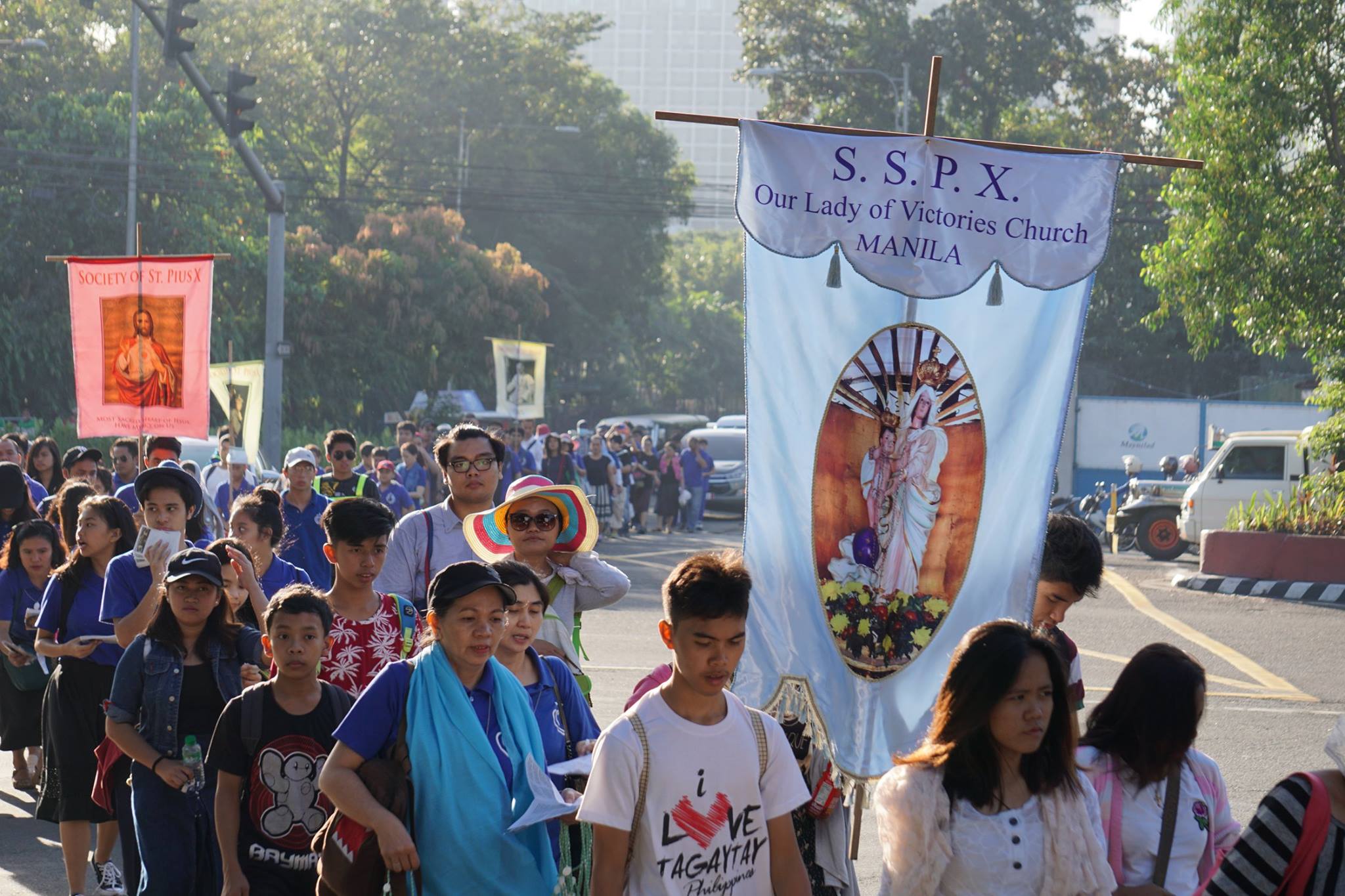
Above: annual SSPX pilgrimage for Our Lady of Guadalupe in Manila. Photo Credit: SSPX.
From Principles to Fruits
Parts I and II set the rule of measure: Vincent of Lérins and Newman distinguish profectus (growth) from permutatio (change of kind); Tra le Sollecitudini and Mediator Dei articulate ideals and guardrails; and Spain/Philippines supply the historical laboratory where prudent pastoral adaptation served—rather than displaced—the Roman Rite. Part III gathers the fruits of that rule in the Philippines and shows how the same logic still guides SSPX Manila.
A Manila Case Study: Orchestral Mass Done Prudently
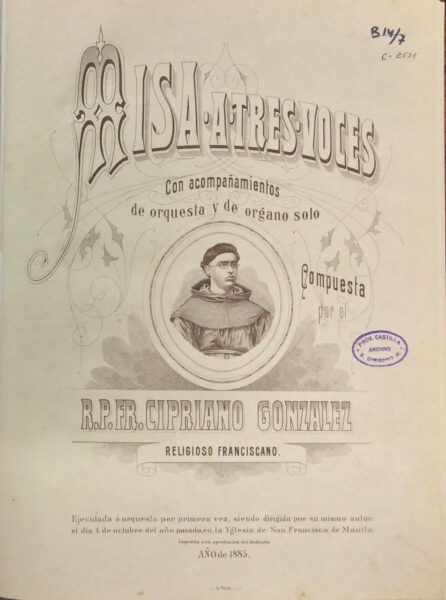
In 2018, conductor Victor Gregory D. Capahay encountered the Traditional Latin Mass and was struck by its chant and prayerful contour. From 2021–2023 he proposed—cautiously and in dialogue with then Prior, Fr. Benoit Wailliez—to revive Marcelo Adonay’s Pequeña Misa Solemne sobre Motivos de la Misa Regia del Canto Gregoriano, noting its earlier use in Intramuros at San Agustín and its place in Filipino sacred patrimony. An announcement was made similar to how such were done in Spanish Philippines.
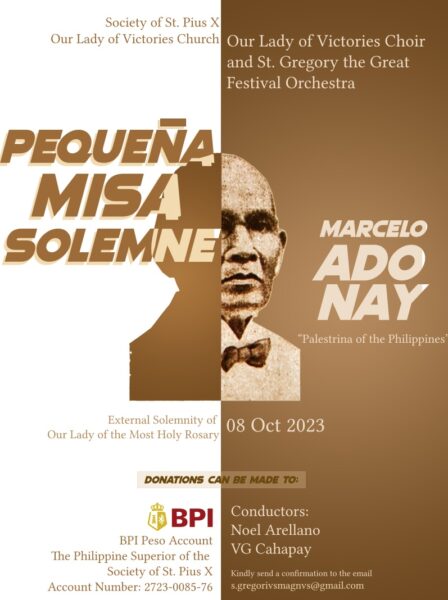
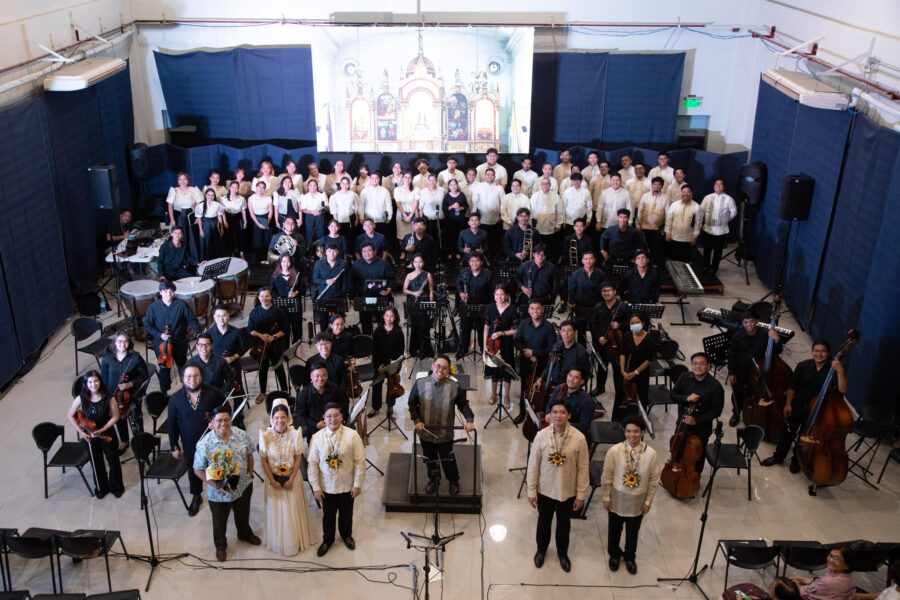
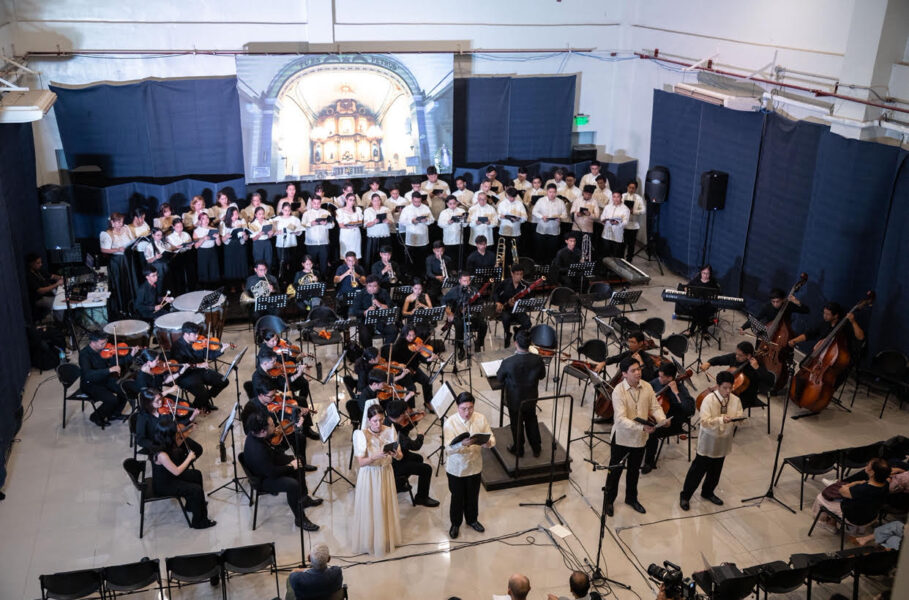
On 8 October, the Mass was sung at Our Lady of Victories (SSPX, Manila) by the SSPX choir together with the St. Gregory the Great Festival Orchestra, before a packed congregation—reverently festive and unmistakably rooted in Manila’s baroque Catholic memory. It was not novelty for novelty’s sake, but a measured recovery: a local treasure fitted to a parish fiesta, under clerical prudence, with the liturgy’s primacy intact.
Why this matters for our thesis: the event exemplifies the pattern defended in Parts I–II—ideals safeguarded, culture harnessed—precisely the balance Pius X wanted when he warned against theatrical intrusions at Mass while allowing broader pastoral space around it.
Two Models of Inculturated Fidelity
When sacred music is inculturated, it means:
- it uses the musical idioms familiar to a local people;
- it preserves the structure and purpose of the liturgy (e.g., does not alter the Mass text); and
- it expresses reverence, not entertainment or self-display. In short, inculturated sacred music is culturally specific yet liturgically obedient. It does not mean blending into popular taste or diluting the sacred; rather, it offers something beautiful from a local culture in a way that truly serves and glorifies God in the liturgy.
1) Santiago Suarez: Romantic Color, Liturgical Obedience
In my effort to understand the nuances of inculturated fidelity in both Pius X and XII’s documents, I sought the advice of the SSPX Prior in Manila, Fr. John Hattrup, who pointed me to Andrew Childs (Associate Dean, St. Mary’s College, Kansas). In a lecture Childs delivered on Bach and Beethoven, he proposes practical criteria for assessing music: melody orders the intellect; harmony moves the affections; rhythm touches the passions—hence Gregorian chant, being almost pure melody, most directly forms rightly ordered prayer. Good sacred music is revelatory, not decorative: each instrumental line has theological intent (e.g., trumpet as declaration, oboe as prayer, flute as contemplation). Sacred music is not self-expression but obedience to the text; it should train reverence and teach the soul to listen to God. “Bad” music forms the soul wrongly by fostering sentimentality or distraction. Sacred music must therefore be guarded, taught, and lived as an inheritance, not curated as a museum relic.
Applying these criteria, Childs assesses Santiago Suarez’s Misa de la Coronación (for the canonical coronation of Our Lady of La Naval de Manila). Suarez—active across the late Spanish and early American periods—wrote in a Spanish-Romantic idiom influenced by Gounod and Verdi. The Mass is lyrical and expressive yet restrained, formally clear, and devout. Childs praises it for holiness and excellence of form.
While Suarez’s Mass is not “universal” in the way chant or Roman polyphony are (a parish in Bavaria or Nigeria might find it stylistically foreign), this is a limit, not a flaw. It is contextual rather than exportable. Yet it exemplifies inculturated fidelity: a Romantic Filipino idiom that preserves the Roman Rite’s structure and reverent tone. It emerges from a specific cultural-historical context but does not violate liturgical principles. In this sense, Suarez offers a local good—culturally rooted, theologically obedient.
2) Marcelo Adonay: Filipino Synthesis Anchored in Chant
In her book, The Life and Works of Marcelo Adonay, Elena Mirano describes Adonay (the “Palestrina of the Philippines”)—as strictly liturgical in style, four-voice aware, and devout in tone. He synthesizes Palestrina’s purity with Gounod’s melodic warmth, yet avoids operatic excess. Even where late-Romantic colors appear, they are governed by chant sensibility and theological restraint. His works (Misa Solemne, Misa de Requiem, Te Deum, Benedictus, Miserere, In Monte Oliveti, Missa Regina) put prayer before display—an instance of “growth without change of kind.”
Catholic Church Tradition Has Always Been Pastoral
Long before the 1960s, the Holy See legislated principled openness within strict limits:
- Low Mass: vernacular sacred songs may assist devotion (Offertory, Communion, and after Mass), provided themes fit the moment. 1950s legislation explicitly allowed popular-language hymns at Missa lecta under conditions. The 1958 instruction of the Sacred Congregation of Rites commended vernacular religious songs as aids to devotion and expressly permitted them at Low Mass—if suited to the liturgical moment (e.g., thanksgiving or love of God at Communion).
- High (sung) Mass: the same instruction forbade vernacular hymns except where an immemorial custom (≥100 years) made suppression pastorally unwise—and then only after the Latin liturgical text had been sung. Latin chant remains normative for sung portions.
- Mission/exception cases: exceptions and pastoral adaptations as a consequence of organic development emerged, such as the Irish Indult. Under persecution and lacking resources, Irish Catholics often had only Low Mass with no trained choir; the faithful filled the silence with hymns or the rosary. Over time this became entrenched; Rome acknowledged the organic development, granting an indult for certain vernacular hymns at Low Mass. By the mid-20th century, Pius XII’s Musicae Sacrae (1955) generalized such exceptions, allowing vernacular hymns at certain parts. We should note however while De Musica Sacra (1958) gave a “universal concession” to sing sacred vernacular songs during the Latin liturgy (without altering the official Latin texts), Dr. Brill discusses problems with the Instruction, one of which pertains to the addition of “popular religious singing” as a recognized category, blurring the line between liturgical music and devotional or popular music—hence, a dilution of the liturgy’s integrity by opening the door to non-liturgical genres under the guise of “sacred.”
Popes applied reform with prudence. Pius XI (Divini Cultus, 1928) reaffirmed norms while urging reforms that draw the faithful closer to the liturgy. Pius X did not condemn orchestral Masses per se and confined Tra le Sollecitudini juridically to Italy, where theatrical abuses were acute. Its principles—sanctity, beauty, universality; primacy of chant; clarity of the text; rejection of profane/theatrical styles—are timeless, but the Church has consistently paired them with pastoral judgment regarding cultural practices, trained resources, and organic development.
Thus, in Spain, the Philippines, and other former Spanish colonies, orchestral Masses continued for major fiestas, often with local composers blending sacred texts with lush Romantic harmonies—within the bounds of the sacred. The fiesta model—music, procession, fireworks—was deeply embedded in Catholic life. Even clergy sympathetic to Cecilian ideals tolerated orchestral Masses to avoid alienating the faithful. Local church bands and choirs saw these as religious honors; suppressing them risked erasing community participation.
SSPX: Continuing with Tradition
The SSPX maintains the same pastoral pattern the Church has long practiced:
- Inside the liturgy’s core: the text rules, chant leads, and polyphony supports—no theatrical display.
- At the edges (devotions, processions, post-Communion thanksgiving, parish fiestas): pastors may admit culturally resonant music when it conduces to prayer and catechesis, never when it eclipses the rite. See their guidelines here. The Angelus notes that even a modest three-voice schola can lead hymns or motets at those moments in a Low Mass with the pastor’s permission. Examples from Asia (here, here, and here) show missionaries encouraging beloved Marian hymns in Visayan or Tagalog in processions or post-Communion devotion, without replacing the prescribed Latin chants. An announcement from Our Lady of Victories Church (SSPX’s main church in Metro Manila) indicates that in May they hold the Flores de Mayo right after the Sunday Mass – during which Filipino Marian hymns are traditionally sung while children offer flowers.
- Over time: accommodations are bridges (not endpoints) that form the faithful toward the ideal.
The principle is constant: hold the ideal; guide the people toward it; never deform the rite. Pastoral charity can warrant exceptions, provided no doctrine is violated and the Mass is not desecrated. These are ad casum, under authority, with the goal of gradually elevating the faithful’s liturgical sense. But Latin chant and polyphony hold pride of place. Where the faithful are not yet trained in Latin chant or deeply attached to certain vernacular hymns, they may allow these hymns at Low Mass or after the Communion rite as a stepping-stone toward fuller liturgical participation. In no way do they negate the ideal – rather, they’re a merciful “accommodation” (a tolerated custom or pastoral tool, not the ideal) in the Thomistic sense of bending to human conditions, gently encouraging a return to Latin over time.
Moving Forward
The post-conciliar landscape often ignored these boundaries, breeding confusion. But we cannot legislate anew; we can obey what already binds. Since the Council, sacred music in the Philippines has often gone the way both Pius X and the Cecilians warned against. One might argue for a stricter, Tra-le-style correction in light of abuses; but unless the Pope commands it, we apply the perennial pattern already built into Catholic life:
- Immutable doctrine: the liturgy is the worship of God; music is integral but subordinate; it must be holy, true art, and (in its ideal) Roman in idiom.
- Liturgical ideals (Pius X & XII): chant first; polyphony continuous with tradition; instrumental restraint (organ preferred); interior participation over sentimentality.
- Organic/local custom (rightly judged): local practices (villancicos, orchestral Masses, vernacular hymns) are weighed by universal norms, not popularity; many were pastoral tolerations, not models.
- Pastoral exceptions: real but non-normative—means, under authority, to raise souls toward the ideal, never permanent redefinitions.
As Fr. Fidel Ferrer, FSSPX, who is well versed in Spanish-Philippine history put it starkly: “We were aborted, before we were born”—Spain’s departure halted a maturing Catholic culture. With today’s crisis, the reverse of those four principles often prevails. Yet Spanish Manila shows the older pattern: the Church did not fear magnitude; she governed it. The path ahead is the same—teach chant, cultivate polyphony, recover worthy local treasures (Adonay; select Suarez) in fitting contexts, and use pastoral accommodations only as training wheels toward the Roman ideal. This is the Vincentian Canon in action; this is Newman’s “growth without change of kind”; this is what a truly Catholic pastoral looks, which traditionalists can look to, to restore the inheritance from Catholic Spain, and to bring sacred back to music.
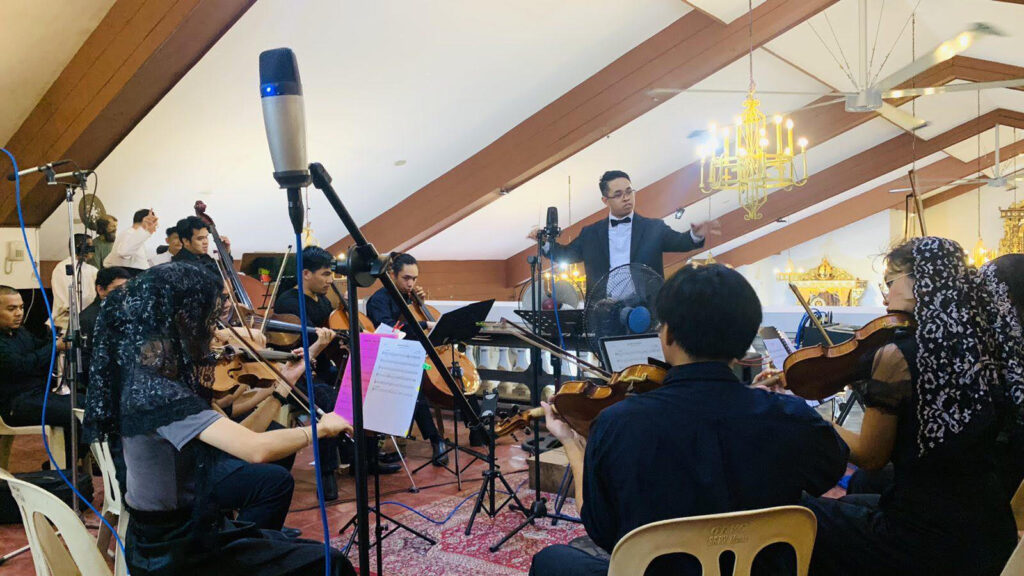
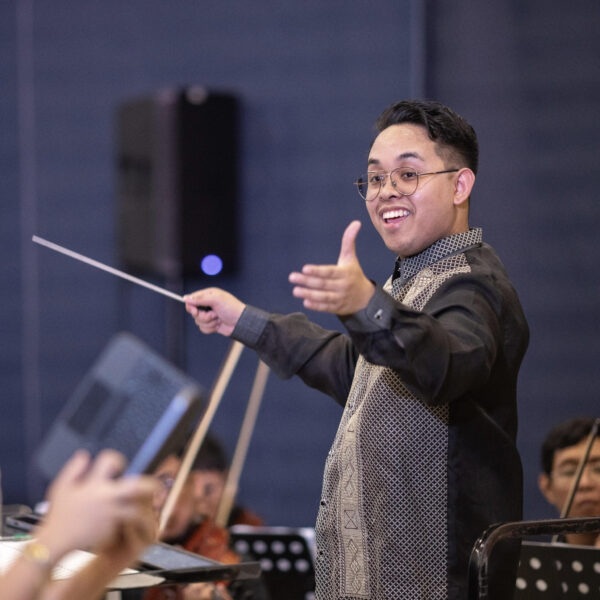
Meanwhile, the reader can watch and listen to the entirety of Marcelo Adonay’s Pequeña Misa Solemne sobre Motivos de la Missa Regia del Canto Gregoriano (Small Solemn Mass based on the motifs of Misa Regia of the Gregorian Chant) here and Juan de Sahagun Hernandez’s Misa Brevis here, with conductor Victor Gregory D. Capahay and hopefully, with this inheritance, Filipino Catholics find their way back to the sacred. Perhaps the Spanish Philippine experience might shed light on how to deal with moving the Church and faithful back from Vatican II and the Novus Ordo Mass.