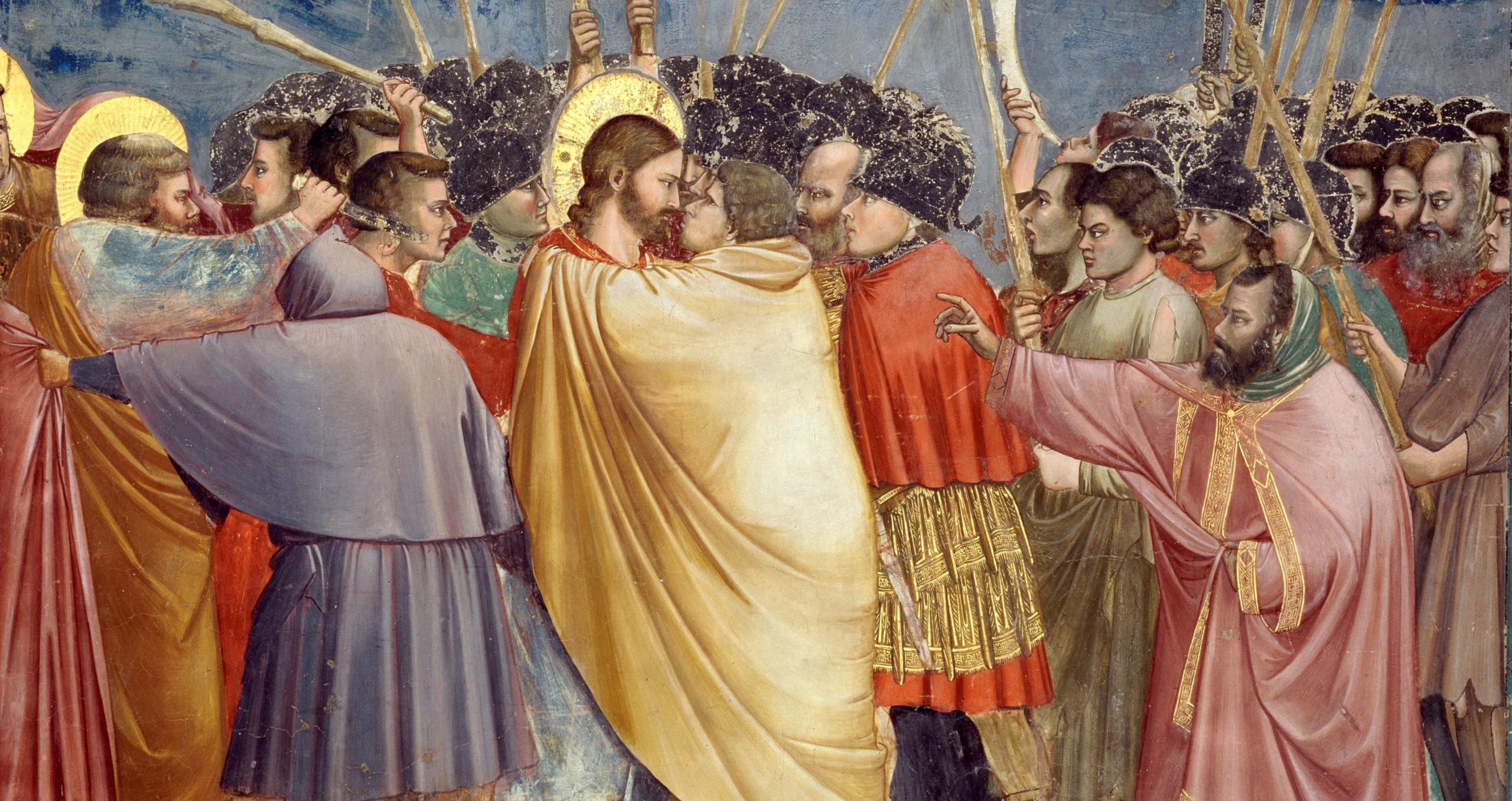
Above: The Kiss of Judas by Giotto di Bondone (between 1304 and 1306) .
This text is taken from The Liturgical Year, authored by Dom Prosper Gueranger (1841-1875)
The Chief Priests and the Ancients of the people are met today, in one of the rooms adjoining the Temple, for the purpose of deliberating on the best means of putting Jesus to death. Several plans are discussed. Would it be prudent to lay hands upon him at this season of the Feast of the Pasch, when the City is filled with strangers who have received a favorable impression of Jesus from the solemn ovation given to him three days back? Then, too, are there not a great number of the inhabitants of Jerusalem, who took part in that triumph, and whose enthusiastic admiration of Jesus might excite them to rise up in his defense? These consideration persuade them not to have recourse to any violent measure, at least for the present, as a sedition among the people might be the consequence, and its promoters, even were they to escape being ill-treated by the people, would be brought before the tribunal of the Roman Governor, Pontius Pilate. They therefore come to the resolution of letting the Feast pass quietly over, before apprehending Jesus.
But these blood-thirsty men are making all these calculations as though they were the masters. They are, if they will, shrewd assassins, who put off their murder to a more convenient day, but the Divine decrees, which from all eternity, have prepared a Sacrifice for the world’s salvation, — have fixed this very year’s Pasch as the day of the Sacrifice, and, tomorrow evening, the holy City will re-echo with the trumpets, which proclaim the opening of the Feast. The figurative Lamb is now to make way for the true one; the Pasch of this year will substitute the reality for the type; and Jesus’ Blood, shed by the hands of wicked priests, is soon to flow simultaneously with that of victims, which have only been hitherto acceptable to God, because they prefigured the Sacrifice of Calvary. The Jewish priesthood is about to be its own executioner, by immolating Him, whose Blood is to abrogate the Ancient Alliance, and perpetuate the New one.
But how are Jesus’ enemies to get possession of their divine Victim, so as to avoid a disturbance in the City? There is only one plan that could succeed, and they have not thought of it: it is treachery. Just at the close of their deliberations, they are told that one of Jesus’ Disciples seeks admission. They admit him, and he says to them: What will you give me, and I will deliver him unto you? They are delighted at this proposition: and yet, how is it that they, doctors of the law, forget that this infamous bargain between themselves and Judas has all been foretold by David in the 108th Psalm? They know the Scriptures from beginning to end—how comes it that they forget the words of the Prophet, who even mentions the sum of thirty pieces of silver. Judas asks them what they will give him; and they give him thirty pieces of silver! All is arranged: tomorrow, Jesus will be in Jerusalem, eating the Pasch with his Disciples. In the evening, he will go, as usual, to the Garden on Mount Olivet. But how shall they, who are sent to seize him, be able to distinguish him from his Disciples? Judas will lead the way; he will show them which is Jesus, by going up and kissing him!
Such is the impious scheme devised on this day, within the precincts of the Temple of Jerusalem. O testify her detestation at it, and to make atonement to the Son of God for the outrage thus offered in the Holy Church, from the earliest ages, consecrated the Wednesday of every week to penance. In our own times, the Fast of Lent begins on a Wednesday and when the Church ordained that we should commence each of the four Seasons of the year with fasting, Wednesday was chosen to be one of the three days thus consecrated to bodily mortification.
On this day, in the Roman Church, was held the sixth Scrutiny, for the admission of Catechumens to Baptism. Those upon whom there had been previous doubts were now added to the number of the chosen ones, if they were found worthy. There were two Lessons read in the Mass, as on the day of the great Scrutiny, the Wednesday of the fourth Week of Lent. As usual, the Catechumens left the Church after the Gospel; but as soon as the Holy Sacrifice was over, they were brought back by the Door-Keeper, and one of the Priests addressed them in these words: “On Saturday next, the Eve of Easter, at such an hour, you will assemble in the Lateran Basilica, for the seventh Scrutiny; you will then recite the Symbol, which you must have learned and lastly, you will receive, by God’s help, the sacred laver of regeneration. Prepare yourselves zealously and humbly, by persevering fasts and prayers, in order that, having been buried, by this holy Baptism, together with Jesus Christ, you may rise again with him, unto life everlasting. Amen.”
At Rome, the Station for today is in the Basilica of Saint Mary Major. Let us compassionate with our Holy Mother, whose Heart is filled with poignant grief at the foresight of the Sacrifice, which is preparing.
MASS
The Church commences her chants with one to the glory of the Holy Name of Jesus, outraged as it is, on this day, by them that plot his Death. This Name, which was given him by heaven, and signifies that he is our Savior, is now being blasphemed by his enemies: in a few hours, their crime will bring its full meaning before us, for his Death will have worked the Salvation of the world.
| Introit | |
| In nomine Jesu omne genu flectatur, cœlestium, terrestrium, et infernorum: quia Dominus factus est obediens usque ad mortem, mortam autem crucis: ideo Dominus Jesus Christus in gloria est Dei Patris. | At the name of Jesus every knee should bow, of those that are in heaven, on earth, and under the earth; because the Lord became obedient unto death, even the death of the cross: therefore the Lord Jesus Christ is in the glory of God the Father. |
In the first Collect, the Church acknowledges to God that her children have sinned against him: but she reminds him of the Passion, endured for their sakes, by his Only Begotten Son, and this revives her hope.
| Collect | |
| Oremus | Let us pray |
| ℣. Flectamus genua. | ℣. Let us kneel down. |
| ℟. Levate. | ℟. Stand up again. |
| Præsta, quæsumus, omnipotens Deus: ut qui nostris excessibus incessanter affligimur, per unigeniti Filii tui Passionem liberemur. Qui tecum. | Grant, we beseech thee, O Almighty God, that we, who continually are punished for our excesses, may be delivered by the Passion of thy Only Begotten Son. |
Lectio Isaiæ prophetæ
How terrible is this our Defender, who tramples his enemies beneath his feet, as they that tread in the wine-press; so that their blood is sprinkled upon his garments! But is not this the fittest time for us to proclaim his power, now that he is being treated with ignominy, and sold to his enemies by one of his Disciples? These humiliations will soon pass away; he will rise in glory, and his might will be shown by the chastisements, wherewith he will crush them that now persecute him. Jerusalem will stone them that shall preach in his name; she will be a cruel step-mother to those true Israelites who, docile to the teaching of the Prophets, have recognized Jesus as the promised Messias. The Synagogue will seek to stifle the Church in her infancy; but no sooner shall the Church, shaking the dust from her feet, turn from Jerusalem to the Gentiles, than the vengeance of Christ will fall on the City, which bought, betrayed, and crucified him. Her citizens will have to pay dearly for these crimes. We learn from the Jewish historian Josephus (who was an eyewitness to the siege) that the fire which was raging in one of the streets, was quenched by the torrents of their blood. Thus were fulfilled the threats pronounced by our Lord against this faithless City, as he sat on Mount Olivet, the day after his triumphant Entry.
And yet the destruction of Jerusalem was but a faint image of the terrible destruction which is to befall the world at the last day. Jesus, who is now despised and insulted by sinners, will then appear on the clouds of heaven, and reparation will be made for all these outrages. Now he suffers himself to be betrayed, scoffed at, and spit upon; but when the day of vengeance is come, happy they that have served him and have compassionated with him in his humiliations and sufferings! Woe to them that have treated him with contempt! Woe to them who, not content with their own refusing to bear his yoke, have led others to rebel against him! For he is King; he came into this world that he might reign over it; and they that despise his Mercy, shall not escape his Justice.
The Gradual, which immediately follows upon this sublime passage from Isaias, is a prayer addressed by Jesus to his Eternal Father: the words are taken from one of the Psalms.
In the second Collect, the Church again reminds our Heavenly Father of the Death which his Divine Son deigned to suffer, in order to set us free from the yoke of Satan; she prays that we may have a share in the glorious Resurrection of this our Redeemer.
| Collect | |
| Deus, qui pro nobis Filium tuum Crucis patibulum subire voluisti, ut inimici a nobis expellere potestatem: concede nobis famulis tuis, ut resurrectionis gratiam consequamur. Per eumdem. | O God, who wouldst have thy Son suffer on the Cross, to deliver us from the power of the enemy; grant that we thy servants, may obtain the grace of his resurrection. |
Lectio Isaiæ Prophetæ
Again it is Isaias that instructs us, not indeed upon the triumph which our Emmanuel is to win over his enemies, but upon the sufferings of the Man of Sorrows. So explicit is his description of our Lord’s Passion that the holy Fathers have called him the fifth Evangelist. What could be more sublimely plaintive than the language here used by the son of Amos? And we, after hearing both the Old and New Testament upon the sufferings which Jesus went through for our sins—how shall we sufficiently love this dear Redeemer, who bore our infirmities and carried our Sorrows, so as to look as a leper, and as one struck by God, and afflicted?
We are healed by his bruises! O heavenly Physician, that takes upon himself the sufferings of them he comes to cure! But not only was he bruised for our sins; he was also slaughtered as a lamb: and this not merely as a Victim submitting to the inflexible justice of his Father who hath laid upon him the iniquity of us all, but (as the Prophet here assures us) because it was his own will. His love for us, as well as his submission to his Father, led him to the great Sacrifice. Observe too how he refuses to defend himself before Pilate, who could so easily deliver him from his enemies: He shall be dumb as a lamb before his shearers, and he shall not open his mouth. Let us love and adore this divine Silence, which works our Salvation. Let us not pass over an iota of the devotedness which Jesus shows us—a devotedness which never could have existed, save in the Heart of a God. Oh! how much he has loved us—his children, the purchase of his Blood, his Seed, as the Prophet here calls us. O Holy Church! thou long-lived Seed of Jesus, that laid down his life!—thou art dear to him, for he bought thee at a great price. Faithful Souls! give him love for love! sinners! be converted to this your Savior; his Blood will restore you to life, for if we have all gone astray like sheep, remember what is added: The Lord hath laid upon him the iniquity of us all. There is no sinner, however great may be his crimes; there is no heretic, or infidel, who has not his share in this precious Blood, whose infinite merit is such that it could redeem a million worlds, more guilty even than our own.
The Tract, which follows this Lesson, is taken from the 101st Psalm, in which the Royal Prophet expresses the sufferings of body and mind endured by Jesus, in his human Nature.
The Church then gives us the history of the Passion according to St. Luke. This Evangelist mentions several details not given by Saints Matthew and Mark, which will assist us to a fuller understanding of the divine mystery of the Sufferings and Sacrifice of the Man-God.
Passio Domini nostri Jesu Christi secundum Lucam
At that time: The feast of Unleavened Bread, which is called the Pasch, was at hand. And the chief priests and the scribes sought how they might put Jesus to death; but they feared the people. and Satan entered into Judas, who was surnamed Iscariot, one of the twelve; and he went, and discoursed with the chief priests and the magistrates, how he might betray him to them. And they were glad, and covenanted to give him money. And he promised; and he sought opportunity to betray him in the absence of the multitude….
The words of the Offertory are those of Jesus, suppliantly beseeching his Eternal Father not to turn his face from his own Son, who is a prey to every suffering, both of body and mind.
In the Secret, the Church prays that we may have a tender devotion for the Holy Sacrifice of the Mass, in which the Passion of our Savior is daily commemorated.
The Church takes her Communion-Anthem from the same Psalm, which supplied her with the Tract and Offertory, namely the 101st.
The Death of Jesus should be to us an unceasing motive for confidence in the divine mercy. This confidence is one of the first conditions of our salvation. The Church asks it for us in the Postcommunion.
Humiliate capita vestra Deo
Look down, O Lord, we beseech thee, on this thy family, for which our Lord Jesus Christ hesitated not to be delivered into the hands of wicked men, and undergo the punishment of the Cross.
As an appropriate exercise for the close of this day, we offer our readers the following stanzas from a Hymn of the Greek Liturgy: they allude to the mysteries we have been explaining.
| Hymn (In Parasceve) | |
| Hodie Judas Magistrum derelinquit, et diabolum assumit: obcæcatur passione amoris pecuniæ; decidit a lumine, obscuratus est ille. Quomodo namque videre poterat ille qui Luminare vendidit triginta argenteis? Sed nobis exortus est ille, qui passus est pro mundo. Ad quem clamemus: Qui passus, et compassus es hominibus, gloria tibi. | On this day, Judas leaves his Master, and takes the devil for his guide. The love of money blinds him. He fell from the light, he became darkened; for how could he be said to see, who sold the Light for thirty pieces of silver? But to us he has risen, that he suffered for the world: let us thus cry out unto him: Glory be to thee, that didst endure thy Passion, and hadst compassion, for mankind! |
| Quænam te ratio, Juda, Salvatoris proditorem effecit? Numquid ille ab Apostolorum te choro segregavit? Numquid sanitatum te gratia privavit? Numquid cum cœnaret una cum illis, a mensa te expulit? Numquid aliorum cum lavisset, pedes tuos neglexit? O quantorum factus es immemor beneficiorum! et tuum sane consilium ingratum infamia notatur: illius autem prædicatur incomparabilis patientia et misericordia magna. | What was it, O Judas! that led thee to betray Jesus? Had he cut thee off from the number of his Apostles? Had he deprived thee of the gift of healing the sick? When he supped with his Apostles, did he drive thee from table? When he washed their feet, did he pass thee by? And yet, thou wast unmindful of these great favors! Thy ungrateful plot has branded thee with infamy: but his incomparable patience and great mercy are worthy of praise. |
| Dicite iniqui quidnam a Salvatore nostro audistis? Nonne Legem ac documenta Prophetarum exposuit? Quomodo ergo Verbum quod ex Deo est, et nostras animas redimit, Pilato tradere cogitastis? | Say, O ye unjust ones! what is it ye have heard from our Savior? Did he not expound unto you the Law and the Prophets? Why, therefore, have ye plotted how to deliver up to Pilate the Word that is from God, and that came to redeem our souls? |
| Crucifigatur, clamabant ii qui tuis semper muneribus fuerant delectati; petebantque ut malefactorem acciperent pro benefactore interfectores illi justorum. Sed tacebas, Christe, eorum proterviam sustinens: volens pati, nosque salvare, ut hominum amans. | They that had enjoyed thy unceasing gifts cried out: Let him be crucified! These murderers of such as were innocent, sought thee, that they might treat thee, their benefactor, as an evil-doer. But thou, O Christ! didst bear their wickedness with silence, for thou being the lover of mankind, didst desire to suffer for and save us. |
| Loquendi libertatem non habemus propter multa peccata nostra; tu ex te genitum exora, Virgo Deipara: multum enim valet deprecatio Matris apud clementiam Domini. Ne despicias peccatorum supplicationes, o castissima; quia misericors est et potens ad salvandum, is qui pro nobis etiam pati sustinuit. | We are prevented from speaking byt he multitude of our sins: do thou, O Virgin-Mother of God! pray for us to Him that was born of thee, for the Mother’s prayer avails much with the mercy of our Lord. Despise not, O most pure Virgin! the prayers of sinners, for he that refused not even to suffer for us, is merciful, and is able to save us. |
We subjoin the following beautiful Preface from the Ambrosian Missal: it expresses, in a most touching manner, the sentiments which a Christian should have within him on this vigil of our Lord’s Supper.
| Preface | |
| Dignum et justum est, æquum et salutare, nos tibi semper hic et ubique gratias agere, Domine sancte, Pater omnipotens, æterne Deus, per Christum Dominum nostrum, qui innocens pro impiis voluit pati, et pro sceleratis indebite condemnari. Cujus mors delicta nostra detersit, et resurrectio Paradisi fores nobis reseravit. Per quem tuam pietatem supliciter exoramus; ut nos hodie a peccatis emacules; cras vero venerabilis Cœnæ dapibus saties; hodie acceptes nostrorum confessionem delictorum: cras vero tribuas spiritualium incrementa donorum; hodie jejuniorum nostrorum vota suscipias; cras vero nos ad sanctissimæ Cœæ convivium introducas. Per eumdem Christum Dominum nostrum. Amen. | It is meet and just, right and available to salvation, that we should ever, here and in all places, give thanks to thee, O Holy Lord, Almighty Father, Eternal God, through Christ our Lord: who, being innocent, willed to suffer for sinners, and be unjustly condemned for the guilty. His Death wiped away our crimes, and his Resurrection opened for us the gates of heaven. Through him we beseech thy clemency, that, today, thou cleanse us from our sins, and, tomorrow, feed us on the banquet of the venerable Supper; that, today, thou receive the confession of our faults, and tomorrow, grant us the increase of spiritual gifts; that, today, thou receive the offering of our fasts, but, tomorrow, introduce us to the feast of the most holy Supper. Through the same Christ our Lord. |