This text is taken from The Liturgical Year, authored by Dom Prosper Gueranger (1841-1875)
A night has passed over the Tomb, wherein lies buried the Body of the Man-God. Death is triumphant in that silent cave, and hold captive Him that gives life to every creature—but his triumph will soon be at an end. The Soldiers may watch, as best they will, over that Grave: they cannot hold Jesus prisoner, as soon as the moment fixed for his Resurrection comes. The holy Angels are there, profoundly adoring the lifeless Body of Him whose Blood is to reconcile all things, both on earth, and in heaven. This Body, though, for a brief interval, separated from the Soul, is still united to the Person of the Son of God; so likewise, the Soul, during its separation from the Body, has not, for an instant, lost its union with the Word. The Divinity remains also united with the Blood that lies sprinkled on Calvary, and which, at the moment of the Resurrection of the Man-God, is to enter once more into his sacred veins.
Let us, also, return to the Sepulcher, and adore the Body of our Buried Jesus. Now, at last, we understand what sin has done: By sin, death entered into the world; and it passed upon all men. Though Jesus knew no sin, yet has he permitted Death to have dominion over him, in order that he might make it less bitter to us, and, by his Resurrection, restore unto us that eternal life, of which we had been deprived by sin. How gratefully we should appreciate this Death of our Jesus! By becoming Incarnate, he became a Servant; his Death was a still deeper humiliation. The sight of this Tomb, wherein his Body lies lifeless and cold, teaches us something far more important than the power of death: it reveals to us the immense, the incomprehensible love of God for man. He knew that we were to gain by his humiliations—the greater his humiliations, the great our exaltation: this was his principle, and it led him to what seems like an excess! Let us, then, love this sacred Sepulcher, which is to give us Life. We have thanked him for having died for us upon the Cross; let us thank him, but most feelingly, for having humbled himself, for our sakes, even to the Tomb!
And now, let us visit the Holy Mother, who has passed the night in Jerusalem, going over, in saddest memory, the scenes she has witnessed. Her Jesus has been a Victim to every possible insult and cruelty: he has been crucified: his precious Blood has flowed in torrents from those Five Wounds: he is dead, and now lies buried in yonder Tomb, as thou he were but a mere man, yea the most abject of men. How many tears have fallen during these long hours from the eyes of the Daughter of David! and yet, her Son has not come back to her! Near her is Magdalene; heartbroken by yesterday’s events, she has no words to tell her grief, for Jesus is gone, and, as she thinks, forever. The other Women, less loved by Jesus than Magdalene, yet still dear to him, stand round the disconsolate Mother. They have braved every insult and danger in order to remain on Calvary till all was over, and they intend returning thither with Magdalene, as soon as the Sabbath is over, to honor the Tomb and the Body of Jesus.
John, the adopted son of Mary, and the Beloved Disciple of Jesus, is oppressed with sorrow. Others, also, of the Apostles and Disciples visit the house of mourning. Peter, penitent and humble, fears not to appear before the Mother of Mercy. Among the Disciples are Joseph of Arimathea and Nicodemus. We may easily imagine the conversation—it is on the Sufferings and Death of Jesus, and on the ingratitude of the Jews. The Church, in the 7th Responsory of today’s Tenebræ, represents these men as saying: “Behold! how the Just One dieth, and there is none that taketh it to heart. Iniquity has had its way. He was silent as a Lamb under his shearer, and he opened not his mouth. He was taken away from distress and judgment: but his memory shall be in peace.”
Thus speak the men!—the women are thinking of their morrow’s visit to the Sepulcher! The saintliness of Jesus, his goodness, his power, his Sufferings, his Death—everything is remembered, except his Resurrection, which they had often heard him say should certainly and speedily take place. Mary alone lives in expectation of his triumph. In her was verified that expression of the Holy Ghost where, speaking of the Valiant Woman, he says: Her lamp shall not be put out in the night. Her courage fails not, because she knows that the Sepulcher must yield up its Dead, and her Jesus will rise again to Life. St. Paul tells us that our religion is vain unless we have faith in the mystery of our Savior’s Resurrection: where was this faith on the day after our Lord’s Death? In one heart only—and that was Mary’s. As it was her chaste womb that had held within it Him whom heaven and earth cannot contain, so on this day, by her firm and unwavering faith, she resumes within her single self the whole Church. How sacred is this Saturday, which, notwithstanding all its sadness, is such a day of glory to the Mother of Jesus! It is on this account that the Church has consecrated to Mary the Saturday of every week.
But it is time to repair to the House of God. The Bells are still silent: our faith must speak to us, and make us eager to assist at the grand Mysteries which the Liturgy is about to celebrate. Surely, the christian sentiment must be dead in them who can be willingly absent from their Church on such a morning as this. No, it cannot be that we, who have followed the celebration of the Mysteries of our Religion thus far, can flag now, and lose the graces of this Morning’s magnificent Service.
THE NIGHT OFFICE
The ceremonies used by the Church for the Tenebrae of Holy Saturday having been already explained, we deem it unnecessary to repeat our instructions. The reader may refer to them, should he require to refresh his memory.
The Morning Service
It was the practice of the Church, and one that had been handed down from the earliest Ages, that the Sacrifice of the Mass should not be offered up either yesterday or today. Yesterday, the anniversary of Jesus’ Death, was exclusively devoted to the remembrance of the Mystery of Calvary, and a holy fear kept the Church from renewing that Sacrifice upon her Altars. For the same reason, she abstained today, also, from its celebration. The Burial of Christ is a sequel of his Passion: and during these hours when his Body lay lifeless in the Tomb, it was fitting that the Sacrifice wherein he is offered as the glorious and Risen Jesus, should be suspended. Even the Greek Church, which never fasts on the Saturdays of Lent, follows the practice of the Latin Church for this Saturday: she not only fasts, but she even omits the celebration of the Mass of the Presanctified.
Such, we repeat, was the discipline of the Latin Church for nearly a thousand years: but about the 11th century, an important change began to be introduced with regard to the celebration of Mass on Holy Saturday. The Mass which, hitherto, had been celebrated during the Night preceding Easter Sunday, then began to be anticipated on the Saturday; but it was always considered as the Mass of the hour of our Lord’s Resurrection, and not as the Mass of Holy Saturday. The relaxations that had been introduced with regard to Fasting were the occasion of this change in the Liturgy. In the first ages, the Faithful watched the whole night in the Church, awaiting the hour when our Lord rose triumphant from the Tomb. They also assisted at the solemn administration of Baptism to the Catechumens, which so sublimely expressed the passing from spiritual death to the life of grace. There was no other Vigil in the whole Year which was so solemnly observed as this: but it lost a great portion of its interest when the necessity of baptizing Adults was removed by Christianity having triumphed wheresoever it had been preached. The Orientals have kept up the ancient tradition to this day: but in the West, dating from the 11th century, the Mass of the Resurrection Hour has been gradually anticipated, until it has been brought even to the morning of Holy Saturday. Durandus of Menda, who wrote his Rational of the Divine Offices towards the close of the 13th century, tells us that in his time, there were very few Churches which observed the primitive custom: even these soon conformed to the general practice of the Latin Church.
As a result of this change, there is an apparent contradiction between the mystery of Holy Saturday and the Divine Service which is celebrated upon it; Christ is still in the Tomb, and yet we are celebrating his Resurrection: the hours preceding Mass are mournful—and before mid-day, the paschal joy will have filled our hearts. We will conform to the present order of the Holy Liturgy, thus entering into the spirit of the Church, who has thought proper to give her children a foretaste of the joys of Easter. We will give a general view of the solemn Service at which we are going to assist; afterwards, we will explain each portion as it comes.
The great object of the whole of today’s Service, and the center to which every one of the ceremonies converges is the Baptism of the Catechumens. The Faithful must keep this incessantly before them, or they will be at a loss how to understand or profit by the Liturgy of today. First of all, there is the Blessing of the new Fire, and the Incense. This is followed by the Blessing of the Paschal Candle. Immediately after this are read the Twelve Prophecies, which have reference to the mysteries of today’s Service. As soon as the Prophecies are finished, a procession is formed to the Baptistery, and the Water is blessed. The matter of Baptism thus prepared, the Catechumens receive the Sacrament of Regeneration. Confirmation is then administered to them by the Bishop. Immediately after this, the Holy Sacrifice is celebrated in honor of our Lord’s Resurrection, and the Neophytes partake of the Divine Mysteries. Finally, the joyous Vesper Office comes in, and brings to a termination the longest and most trying Service of the Latin Liturgy. In order to assist our readers to enter fully into its spirit, we will go back a thousand years and imagine ourselves to be celebrating this solemn Eve of Easter in one of the ancient Cathedrals of Italy, or of our own dear land.
At Rome, the Station is at Saint John Lateran, the Mother and Mistress of all Churches. The Sacrament of Regeneration is administered in the Baptistery of Constantine. The sight of these venerable Sanctuaries carries us back in thought to the 4th century; there, each year, holy Baptism is conferred upon some adult; and a numerous Ordination adds its own to the sacred pomp of this day, whose liturgy, as we have just said, is the richest of the whole year.
The Blessing of the New Fire and Incense
Last Wednesday, the Catechumens were told to present themselves at the Church for the hour of today’s Tierce (that is, nine o’clock in the morning). It is the final Scrutiny. The Priests are there to receive them; they who have not previously been examined upon the Symbol are now questioned. The Lord’s Prayer, and the biblical attributes of the four Evangelists, having been explained, one of the Priests dismisses the Candidates for Baptism, bidding them spend the interval in recollection and prayer.
At the hour of None (our three o’clock in the afternoon), the Bishop and all the Clergy repair to the Church, and Holy Saturday Vigil begins from this moment. The first ceremony consists in the blessing the new fire, which is to furnish light for the whole Service. It was the daily custom, in the first Ages of the church, to strike a light from a flint before Vespers: from this the lamps and candles were lighted for the celebration of that Hour, and the light thus procured was kept up in the Church till the Vespers of the following day. The Church of Rome observed this custom with great solemnity on Maundy Thursday morning, and the new fire received a special blessing. We learn from a letter written in the 8th century by Pope St. Zachary to St. Boniface, Archbishop of Mayence, that three lamps were lighted from this fire, which were then removed to some safe place, and care was taken that their light was kept in. It was from these lamps that the light for Holy Saturday Night was taken. In the following century, under St. Leo the Fourth, whose Pontificate lasted from 847 to 855, the custom of every day procuring new fire from a flint was extended also to Holy Saturday.
It is not difficult to understand the meaning of this ceremony, which is now not observed by the Latin Church save on this day. Our Lord said of himself: I am the Light of the world. Light, then, is an image of the Son of God. Stone, also, is one of the types under which the Scriptures speak to us of the Messias. St. Peter and St. Paul, quoting the words of the Prophet Isaias, speak of Jesus as the Corner-Stone. The spark which is struck from the flint represents our Lord rising from his rock-hewn Sepulcher, through the Stone that had been rolled against it.
It is fitting, therefore, that this fire, which is to provide light for the Paschal Candle, as well as for those that are upon the Altar, should receive a special blessing, and be triumphantly shown to the Faithful. All the Lamps in the Church have been extinguished; formerly, the Faithful used to put out the fires in their houses, before going to the Church: they lighted them, on their return, with light taken from the blessed Fire, which they received as a symbol of our Lord’s Resurrection. Let us not here omit to notice that the putting out of all the lights in the Church is a symbol of the abrogation of the Old Law, which ended with the rending of the Veil of the Temple; and that the new Fire represents the preaching of the New Law, whereby our Lord Jesus Christ, the Light of the World, fulfilled all the figures of the ancient Covenant.
In order to help our readers to enter more fully into the mystery of the ceremony we are describing, we will here mention a miracle which was witnessed for many centuries. The clergy and people of Jerusalem assembled for the Service of Easter Eve in the Church of Holy Sepulcher. After waiting for some time in silence, one of the lamps that were suspended over our Lord’s Tomb, was miraculously lighted. The other lamps and torches throughout the Church were lighted from this, and the Faithful took its holy flame with them to their homes. It would seem that this annual miracle first began after the Saracens had taken possession of Jerusalem; God so ordaining, that it might be a proof to these Infidels of the Divinity of the Christian Religion. The historians of those times, who have written upon the Latin Kingdom of Jerusalem, all speak of this miracle as of an incontestable fact; and when Pope Urban the Second went to France, there to preach the first Crusade, he brought forward this Miracle as one of the motives which should inspire the Faithful with zeal for the defense of the Sepulcher of Christ. When our Lord, in the unsearchable ways of his justice, permitted Jerusalem to be reconquered by the Infidels, the Miracle ceased, nor has it ever been witnessed from that time. Our readers have no doubt heard of the scandalous scene, which is now repeated every Saturday in the Church of the Holy Sepulcher in Jerusalem: we allude to the deception practiced by the schismatic Greek Priests, whereby they persuade their deluded people that their ingenious trick for lighting a lamp is the continuation of the Miracle.
The Church also blesses the give grains of Incense, which are to be used in this Morning’s Service. They represent the perfumes prepared by Magdalene and her holy companions for the embalming the Body of Jesus. The Prayer said by the Bishop, when blessing the Incense, not only shows us the connection there is between it and the Light, but it also teaches us what is the power these several sacred objects have against the wicked spirits.
The Bishop and his attendants go, in procession, from the Church to the place where he is to bless the Fire and Incense. The Fire, as we have already said, is the symbol of our Lord Jesus Christ; and the Sepulcher, whence he is to rise to life, is outside the walls of Jerusalem. The holy Women and the Apostles, when they go to the Sepulcher, will have to go forth from the City.
The Bishop, having come to the appointed place, blesses the Fire by the following prayers.
| ℣. Dominus vobiscum. | ℣. The Lord be with you. |
| ℟. Et cum spiritu tuo. | ℟. And with thy Spirit. |
| Oremus | Let us pray |
| Deus, qui per Filium tuum, angularem scilicet lapidem, claritatis tuæ ignem fidelibus contulisti, productum e silice, nostris profuturum usibus, novum hunc ignem sanctifica; et concede nobis, ita per hæc festa Paschalia cœlestibus desideriis inflammari; ut ad perpetuæ claritatis, puris mentibus, valeamus festa pertingere. Per eumdem Christum Dominum nostrum. | O God, who by thy Son, the corner-stone, hast bestowed on the faithful the fire of thy brightness; sanctify this new fire produced from a flint for our use: and grant, that during this Paschal festival, we may be so inflamed with heavenly desires, that with pure minds we may come to the solemnity of eternal splendor. Through the same Christ our Lord. |
| ℟. Amen. | ℟. Amen. |
| Oremus | Let us pray |
| Domine Deus, Pater omnipotens, lumen indeficiens, qui es conditor omnium luminum: benedic hoc lumen, quod a te sanctificatum atque benedictum est, qui illuminasti omnem mundum: ut ab eo lumine accendamur, atque illuminemur igne claritatis tuæ; et sicut illuminasti Moysen exeuntem de Ægypto, ita illumines corda et sensus nostros; ut ad vitam et lucem æternam pervenire mereamur. Per Christum Dominum nostrum. | O Lord God, Almighty Father, never failing light, who art the author of all light: bless this light, that is blessed and sanctified by thee, who has enlightened the whole world: that we may be enlightened by that light, and inflamed with the fire of brightness: and as thou didst give light to Moses, when he went out of Egypt, so illumine our hearts and senses, that we may obtain light and life everlasting. Through Christ our Lord. |
| ℟. Amen. | ℟. Amen. |
| Oremus | Let us pray |
| Domine sancte, Pater omnipotens, æterne Deus, benedicentibus nobis hunc ignem in nomine tuo, et unigeniti Filii tui Dei ac Domini nostri Jesu Christi, et Spiritus Sancti, cooperare digneris, et adjuva nos contra ignita tela inimici, et illustra gratia cœlesti. Qui vivis et regnas cum eodem Unigenito tuo et Spiritu Sancto, Deus, per omnia sæcula sæculorum. | O Holy Lord, Almighty Father, Eternal God: vouchsafe to cooperate with us, who bless this fire in thy name, and in that of thy only Son Christ Jesus, our Lord and God, and of the Holy Ghost: assist us against the fiery darts of the enemy, and illumine us with thy heavenly grace. Who livest and reignest with the same only Son and Holy Ghost, one God, for ever and ever. |
| ℟. Amen. | ℟. Amen. |
The Bishop then blesses the Incense, thus addressing himself in prayer to God:
| Veniat, quæsumus, omnipotens Deus, super hoc incensum larga tuæ benedictionis infusio: et hunc nocturnum splendorem invisibilis regenerator accende: ut non solum sacrificium, quod hac nocte litatum est, arcana luminis tui admixtione refulgeat: sed in quocumque loco ex hujus sanctificationis mysterio aliquid fuerit deportatum, expulsa diobolicæ fraudis nequitia, virtus tuæ Majestatis assistat. Per Christum Dominum nostrum. | Pour forth, we beseech thee, O Almighty God, thy abundant blessing on this Incense: and kindle, O invisible regenerator, the brightness of this night: that not only the sacrifice that is offered this night may shine by the secret mixture of thy light; but also into whatever place any thing of this mysterious sanctification shall be brought, there, by the power of thy majesty, all the malicious artifices of the devil may be defeated. Through Christ our Lord. |
| ℟. Amen. | ℟. Amen. |
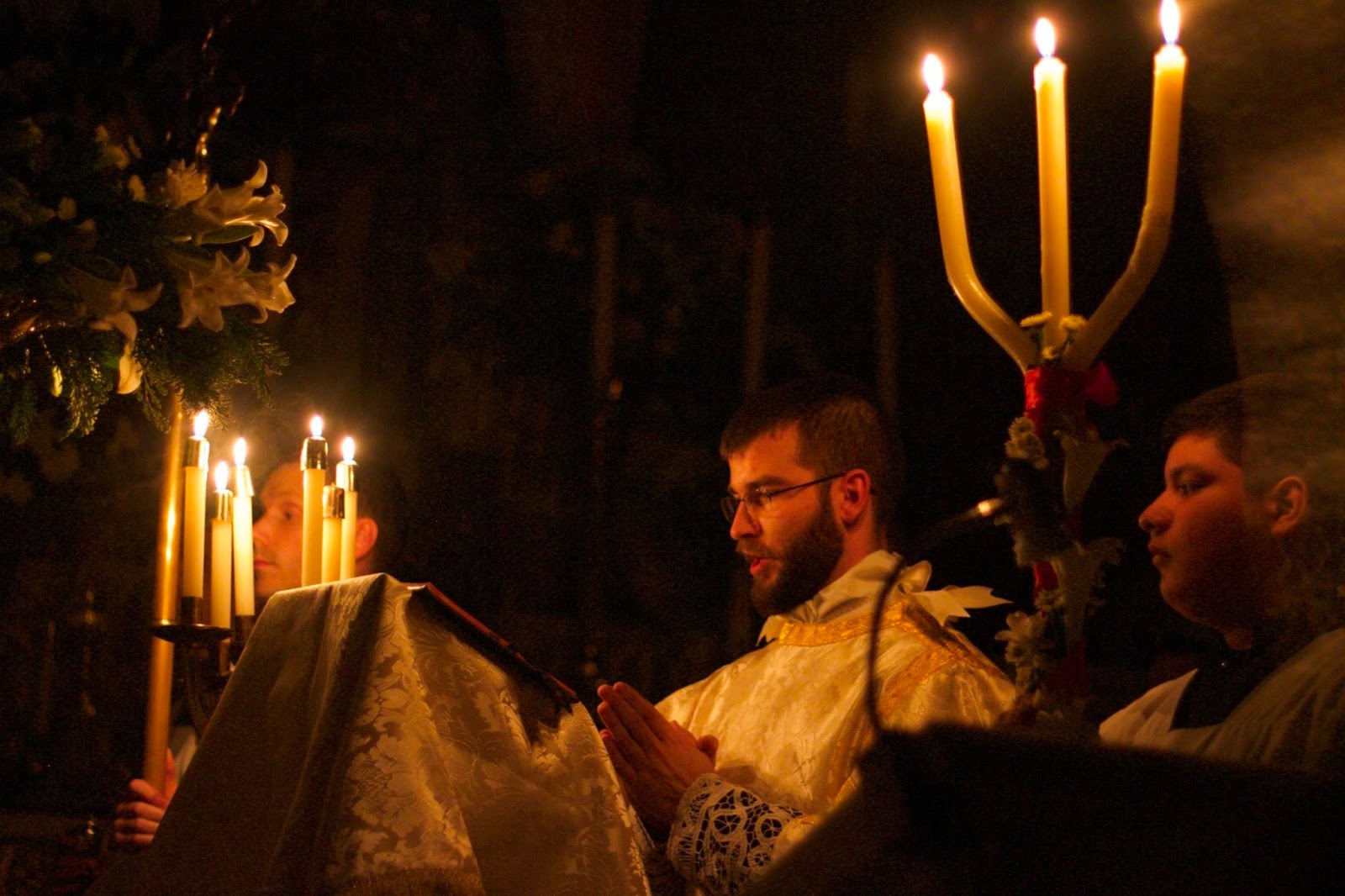
After these prayers, an Acolyte puts some of the blessed Fire in the thurible. The Bishop then censes the Fire and the Incense, after having first sprinkled them with holy water. Another of the Acolytes lights a candle from the blessed Fire, that the new light may be brought into the Church. The Deacon them vests in a white Dalmatic. This festive color, which contrasts so strongly with the purple cope worn by the Bishop, is worn on account of the joyful ministry which the Deacon is about to fulfill. He takes into his right hand a Reed, on the top of which is placed a triple-branched candle. The Reed is in memory of our Lord’s Passion: it also expresses the weakness of the Human Nature, which he assumed to himself by the Incarnation. The three-branch candle signifies the blessed Trinity, of which the Incarnate Word is the Second Person.
The Procession returns. Having entered the Church, the Deacon, after advancing a few steps, lowers the Reed, and the Acolyte, who carries the new light, lights one of the three branches of the candle. The Deacon then kneels, as do also all the clergy and people. Raising the light on high, he sings these words:
| Lumen Christi. | The Light of Christ! |
All answer:
| Deo gratias. | Thanks be to God! |
This first showing of the Light expresses the revelation made to us, by Jesus, of the Divinity of the Father. No one, says he, knoweth the Father, but the Son, and he to whom it shall please the Son to reveal him.
| Lumen Christi. | The Light of Christ! |
The whole assembly answers:
| Deo gratias. | Thanks be to God! |
This second showing of the Light signifies the world’s receiving the knowledge of the Divinity of the Son; he appeared and dwelt among us, and, with his own sacred lips, taught us that he was God, equal to the Father in all things.
The procession continues as far as the Altar steps. The third branch of the Candle on the Reed is lighted, and the Deacon once more sings, but on a still higher and gladder note:
| Lumen Christi. | The Light of Christ! |
Again, the response is made:
| Deo gratias. | Thanks be to God! |
This third showing of the Light signifies the revelation of the Divinity of the Holy Ghost, which was made to us by our Savior when he commanded his Apostles to do what the Church is to do this very Night: Teach ye all nations, baptizing them in the name of the Father, and of the Son, and of the Holy Ghost. It is, then, by Jesus, who is the Light of the world, that mankind has been taught to know the Blessed Trinity. The Bishop, before administering Baptism to the Catechumens, will ask them if they believe in this great Mystery. During the whole of this Night’s Service, they will have before their eyes the expressive symbol of the Trinity—the three-branch Candle.
This, then, is the first use to which the new Fire is put: to proclaim the Holy Trinity. It is next to publish the glory of the Incarnate Word, by lighting up the glorious symbol which is now to be brought before us. The Bishop is seated on his throne. The Deacon kneels before him, and asks a blessing, before beginning the great work entrusted to him. The Pontiff thus blesses him.
| Dominus sit in corde tuo, et in labiis tuis: ut digne et competenter annunties suum Paschale præconium. In nomine Patris, et Filii, et Spiritus Sancti. Amen. | The Lord be in thy heart and lips, that thou mayest worthily and fitly proclaim his Paschal praise. In the name of the Father, and of the Son, and of the Holy Ghost. Amen. |
Thus prepared, the Deacon rises, and goes to the Ambo. The Acolytes, holding the triple Candle and the five grains of Incense, are standing at his side. Near the Ambo is a marble pillar, on which is fixed the Paschal Candle.
The Paschal Candle
The sun is setting, and our earth will soon be mantled in darkness. The Church has provided a torch, which is to spread its light upon us during the whole of this long Vigil. It is of an unusual size. It stands alone, and is of a pillar-like form. It is the symbol of Christ. Before being lighted, its scriptural type is the pillar of a cloud, which hid the Israelites when they went out from Egypt; under this form, it is the figure of our Lord, when lying lifeless in the tomb. When lighted, we must see in it both the pillar of fire, which guided the people of God, and the glory of our Jesus risen from his grave. Our holy mother the Church would have us enthusiastically love this glorious symbol, and speaks its praises to us in all the magnificence of her inspired eloquence. As early as the beginning of the 5th century, Pope St. Zozimus extended to all the Churches of the City of Rome the privilege of blessing the Paschal Candle, although Baptism was administered nowhere but in the Baptistery of St. John Lateran. The object of this grant was that all the Faithful might share in the holy impressions which so solemn a rite is intended to produce. It was for the same intention that, later, every Church, even though it had no Baptismal Font, was permitted to have the Blessing of the Paschal Candle.
The Deacon proclaims the Easter Solemnity to the people, while chanting the praises of this sacred object: and while celebrating the glory of Him whose emblem it is, he becomes the herald of the Resurrection. The Altar, the Sanctuary, the Bishop, all are in the somber color of the Lenten rite; the Deacon alone is vested in white. At other times, he would not presume to raise his voice as he is now going to do, in the solemn tone of a Preface: but this is the Eve of the Resurrection, and the Deacon, as the interpreters of the Liturgy tell us, represents Magdalene and the holy women, on whom our Lord conferred the honor of being the first to know his Resurrection, and to whom he gave the mission of preaching to the very Apostles, that he had risen from the dead, and would meet them in Galilee.
But let us listen to the thrilling Exsultet of our Deacon, and learn from him the joys that await us on this wonderful Night…
| …O vere beata nox, quæ sola meruit scire tempus et horam, in qua Christus ab inferis resurrexit. Hæc nox est, de qua scriptum est: Et nox sicut dies illuminabitur; et: Nox illuminatio mea in deliciis meis. Hujus igitur sanctificatio noctis, fugat scelera, culpas lavat et reddit innocentiam lapsis, et mæstis lætitiam. Fugat odia, condorciam parat, et curvat imperia. | O truly blessed Night, which alone deserved to know the time and hour when Christ rose again from hell. This is the Night of which it is written: And the Night shall be as light as the day, and the Night is my illumination in my delights. Therefore the sanctification of this Night blots out crimes, washes away sins, and restores innocence to sinners, and joy to the sorrowful. It banishes enmities, produces concord, and humbles empires. |
Here the Deacon pauses, and taking the five grains of Incense, he fixes them in the Candle in the form of a Cross. They represent the Five Wounds received by our Lord upon the Cross; as also, the perfumes which Magdalene and her companions had prepared for embalming his Body in the Tomb. Thus far, as we have already explained, the Paschal Candle is the figure of the Man-God not yet glorified by the Resurrection.
| In hujus igitur noctis gratia, suscipe, sancte Pater, incensi hujus sacrificium vespertinum quod tibi in hac Cerei oblatione solemni, per ministroru manus de operibus apum, sacrosancta reddit Ecclesia. Sed jam columnæ hujus præconia novimus, quam in honorem Dei rutilans ignis accendit. | Therefore on this sacred Night, receive, O holy Father, the evening sacrifice of this incense, which thy holy church by the hands of her ministers, presents to thee in the solemn oblation of this wax Candle made out of the labor of bees. And now we know the excellence of this pillar, which the sparkling fire lights for the honor of God. |
After these words, the Deacon again pauses, and taking the Reed which holds the triple candle, he lights the Paschal Candle with one of its branches. This signifies the instant of our Lord’s Resurrection, when the divine power restored his Body to life, by uniting with it the Soul which death had separated. The glorious Symbol of Christ, our Light, is now perfect; and holy Church exults in the thought of soon beholding her heavenly Spouse triumph over death.
| Qui licet sit divisus in partes, mutuati tamen luminis detrimenta non novit. Alitur enim liquantibus ceris, quas in substantiam pretiose hujus lampadis, apis mater eduxit. | Which fire, though now divided, suffers no loss from the communication of its light. Because it is fed by the melted wax, which its mother, the bee, made for the composition of the precious torch. |
Here are lighted, from the new fire, the lamps of the Church. They are lighted after the Paschal Candle, to signify that Jesus’ Resurrection was made known gradually. It also tells us that our Resurrection is to be a consequence and a likeness of that of our Savior, who opens to us the way whereby after having, like him, passed through the tomb, we shall enter into life everlasting.
Here, the Deacon takes off the white Dalmatic, vests in purple, and returns to the Bishop. Then begin the Prophecies from the Old Testament.
The Prophecies
The Torch of the Resurrection now sheds its light from the Ambo throughout the holy place, and gladdens the hearts of the Faithful. How solemn a preparation for what is now to engage our attention—the Baptism of the Catechumens, whose instruction and progress in good works we have followed with such interest during the past forty days! They are assembled together under the outward porch of the Church. The Priests are performing over them the preparatory rites, which embody such profound teaching, and were instituted by the Apostles. First of all, the sign of the cross is made upon their foreheads; and then the Priest, imposing his hand upon the head of each Catechumen, adjures Satan to depart from his soul and body, and give place to Christ. Imitating thus our Redeemer, the Priest then touches with his spittle the ears, saying: “Be ye opened!” He does the same to the nostrils, and says: “Breathe ye in the sweetness of fragrance!” The Neophyte is next anointed, on the breast and between the shoulders, with the Oil of Catechumens: but as this ceremony expresses his having to fight the spiritual combat, the Priest first receives from him the promise to renounce Satan, with his works and pomps.
These rites are performed first over the men, and then over the women. The children of Christian parents are also admitted to take their place among the Catechumens. If any of these latter be laboring under any sickness, and have notwithstanding come to the Church in order to receive, tonight, the grace of Regeneration—a Priest says over them a Prayer, in which he fervently begs of God to heal them, and confound the malice of Satan.
These ceremonies, which are called the Catechisation, occupy a considerable portion of time, on account of the great number of the aspirants to Baptism. It is for this reason that the Bishop came to the Church at the hour of None (three o’clock in the afternoon), and that the great Vigil began so early. While these rites are being administered to the Catechumens, the rest of the Faithful are listening to appropriate passages from the Scripture, which are being read from the Ambo, and which are the complement of the Lenten Instructions.
These Lessons are twelve in number: but in the venerable Basilica, where we are now supposing ourselves to be, we may say they are twenty-four, since each of the Twelve is read in Latin first, and then in Greek. In order to fix the attention, and excite the devotion, of her children to what she reads to them, the Church, after each lesson, recites a Prayer which sums of the doctrine expressed in the preceding Prophecy. To some of them is added an appropriate Canticle from the Old Testament, and it is sung, by the whole assembly, to the well known melody of the Tract. The aspirants to Baptism, as soon as they have received the ceremonies of Catechisation, are allowed to enter the Church, where, in the place assigned to them, they listen to the Lessons, and join in the Prayers: how could they better continue their preparation for the great Sacrament? And yet there is an aspect of mournfulness about this portion of the Service which tells us that the longed-for hour is not yet come. Frequent genuflections, and the somber colored Vestments, strongly contrast with the beautiful flame of the Paschal Torch, which sheds its silent beams of light upon the Faithful. Their hearts are still throbbing with the emotions excited within them by the Exsultet: they are impatient to see their Jesus’ Resurrection fulfilled in the Baptism of the Catechumens.
First Prophecy
(Genesis, Chap. i.)
The first Lesson speaks to us of the Creation, of the Spirit of God moving over the waters, of the separation of light from darkness, and of Man’s being made to the likeness of his God. This work of the Creator had been deranged and spoiled by Satan’s malice. The time is come, when it is to recover all its beauty. The time is come when it is to recover all its beauty. The Holy Ghost is about to effect this regeneration by Water; Christ, our Light, is going to rise from the darkness of the tomb; the image of God is to reappear in Man, for he is to be cleansed by the Blood of his Redeemer, who is the new Adam, that came down from heaven, in order to reinstate, in all his rights, the old and earthly Adam.
Second Prophecy
(Genesis, Chap. v.)
…The second lesson gives us the history of the Deluge. God makes the Waters serve as the minister of his justice, those very Waters which were, afterwards, by Jesus, to become the instrument of his mercy; the Ark, which is a type of the Church, is the shelter for those who would be saved from the flood; the human race is preserved by one family, which represents the Disciples of Christ, who, at first, were few in number, but afterwards peopled the whole earth.
Third Prophecy
(Genesis, Chap. xxii.)
…In the third prophecy, Abraham, the Father of Believers, is here offered to our Catechumens as a model of Faith. They are taught how man should ever depend upon his God, and faithfully serve him. The obedience shown by Isaac to his father’s orders is a figure of that which our Savior has shown on Calvary. The wood for the holocaust, carried up the mountain by Abraham’s son, brings to our minds the Son of God carrying his Cross.
Fourth Prophecy
(Exodus, Chap. xiv.)
…In the fourth prophecy, here we have the great type of Baptism. The People of God, delivered from Pharao’s tyranny, are saved by the very water that destroys the Egyptian. The Catechumens will come forth from the Baptismal Font freed from Satan’s sway; their sins will perish forever in its saving waters.
Fifth Prophecy
(Isaias, Chap. liv.)
…The sublimest of the Prophets, Isaias, in the fifth prophecy invites our Catechumens to come to the waters, that their thirst may be quenched: he bids them satiate their hunger with the sweetest food: he tells them of the inheritance which God has in store for them: they need not fear their poverty, for the infinitely rich God will overwhelm them with good things.
Sixth Prophecy
(Baruch, Chap. iii.)
In this admirable passage from the Prophet Baruch, God reminds the Catechumens, who are about to receive holy Baptism, of their past sins, which made them unworthy of pardon: but by his gratuitous mercy, he has vouchsafed to pour out his Wisdom upon them, and they came unto him. He then speaks to them of those men of the Gentile world, who were wealthy and powerful and enterprising, and have left a name behind them. But they perished, and their earthly wisdom with them. The New People, whom the Lord this day forms to himself, shall not go astray: Wisdom is to be their portion. Heretofore, God spoke his mysteries to Jacob; but this his word did not reach all men: now he is come, in person, upon earth; he conversed with men, and dwelt among them; therefore, the people he now raises up for himself, shall be forever faithful.
Seventh Prophecy
(Ezechiel, Chap. xxxvii.)
[Guéranger includes no commentary for this prophecy.]
Eighth Prophecy
(Isaias, Chap. iv.)
The seven women here mentioned as having been set free from ignominy and cleansed from defilement, represent the souls of our Catechumens, on whom God is about to pour his mercy. They desire to be called after the name of their Deliverer: their desire shall be granted, for, as they come from the Font, they shall be called Christians, that is, children of Christ. Henceforth, they shall abide on Mount Sion, sheltered from whirlwind and rain. The abode of light and rest here promised them is the Church; there they shall dwell in company with her divine Spouse.
Ninth Prophecy
(Exodus, Chap. xii.)
It was by the blood of the figurative Lamb that Israel was protected against the sword of the destroying Angel, was delivered from Egypt, and began his journey towards the Promised Land:—it is by the Blood of the true Lamb, wherewith they are to be marked, that our Catechumens shall be delivered from eternal death, and from the slavery in which Satan has heretofore held them. They shall be guests of that Banquet, where the Flesh of this Divine Lamb is eaten, for the Pasch is close upon us, and they are to join us in its celebration.
Tenth Prophecy
(Jonas, Chap. iii.)
Ninive is the Gentile world, debased by every crime, and a prey to false doctrines. God took compassion upon her and sent her his Apostles, in the name of his own Son. She heard their preaching, abjured her errors and vices, and did penance: and God made her the City of his elect. Our Catechumens were once children of Ninive: they are soon to be numbered among the children of Jerusalem. The grace of God, and their works of penance, have brought about this wondrous adoption.
Eleventh Prophecy
(Deuteronomy, Chap. xxxi.)
The holy Church instructs the Catechumens, by this Lesson, upon the obligations they are about to contract with God. The grace of Regeneration is not to be conferred upon them, until they have made a solemn promise that they renounce Satan, the enemy of their God. Let them be faithful to their promise, and remember that God is the avenger of every infringement of so solemn a vow.
Twelfth Prophecy
(Daniel, Chap. iii.)
Here is the last instruction given to our Catechumens, before they descent into the Font of salvation. It is requisite that they should have a clear knowledge of what the Christian warfare will demand of them. Perhaps they will one day have to confess their God before the potentates of earth. Are they resolved to suffer every torture, even death itself, rather than deny his holy Name? Have there not been Apostates among those whose Baptism was once a source of joy to the Church? It is of the utmost importance, therefore, that they should know the trials that await them. Our holy Mother the Church tells them the history of the three young Jews who refused to adore the statue of the king of Babylon, though their refusal was to be punished by their being cast into a fiery furnace. Since the promulgation of the Christian law, millions of Martyrs have followed their example. The representation of these Three heroes of the true God is a favorite subject among the paintings of the Catacombs. It is true—peace has been given to the Church; but the World is ever the enemy of Christ, and who knows but what julian the Apostate may succeed Constantine?…
The Blessing of the Font
These Lessons and Prayers and Chants have taken up a considerable portion of time: the sun has long since set, and the night is far advanced. All the preparatory exercises are over, and it is time to repair to the Baptistery. During the Prophecies, seven Subdeacons went thither, and there they have thrice recited the Litany; in the first recitation, they repeated each invocation seven times; in the second, five times; and in the third, three times. A Procession is formed towards this building, which is detached from the Church, and is either circular or octagonal in form. In the center is a large Font, with several steps leading down to it. A stream of clear water flows into it from the mouth of a metal stag. Over the Font is suspended a canopy or cupola, in the center of which is a dove with extended wings, which represents the Holy Ghost giving virtue to the Water beneath. Round the Font is a railing, within which none may enter but they who are to be baptised, the Sponsors, the Bishop and the Priests. Two Pavilions—one for the men, the other for the women—have been put up; they are for the Baptised, wherein, after they come from the Font, they may change their garments.
The Procession moves from the Church to the Baptistery in the following order. The Paschal Candle (which represents the pillar of fire that guided the Israelites, by night, to the Red Sea, in whose waters they found salvation) goes first, leading on the Catechumens. These follow, having their Sponsors on their right hand, for each candidate for Baptism is to be presented by a Christian. Then come two Acolytes; one carries the holy Chrism, the other the Oil of Catechumens. Next, the Clergy; and lastly, the Bishop and his assistant Ministers. The Procession is by torch-light. The stars are brightly shining in the canopy of heaven, and the air resounds with the melodious chanting. They are singing those verses of the Palm in which David compares his soul’s pining after her God to the panting of a stag that thirsts for a fount of water. The Stag, an image of which is in the Font, is a figure of the Catechumen who longs for Baptism.
| Tract | |
| Quemadmodum desiderat cervus ad fontes aquarum, ita desiderat anima mea ad te, Deus. | As the hart panteth after the fountains of water; so my soul panteth after thee, O God. |
| ℣. Sitivit anima mea ad Deum fortem, vivum; quando veniam, et apparebo ante faciem Dei? | ℣. My soul hath thirsted after the strong living God; when shall I come and appear before the face of God? |
| ℣. Fuerunt mihi lacrimae meae panes die ac nocte, dum dicitur mihi quotidie: Ubi est Deus tuus? | ℣. My tears have been my bread day and night, whilst it is said to me daily: Where is thy God? |
They soon reach the Baptistery. The Bishop, having come within sight of the Font, prefaces his blessing by a Prayer, in which he again uses the comparison of a panting Stag, to express to God the longing of this people after the new life, of which Christ is the source.
| ℣. Dominus vobiscum. | ℣. The Lord be with you. |
| ℟. Et cum spiritu tuo. | ℟. And with thy spirit. |
| Oremus | Let us pray |
| Omnipotens sempiterne Deus, respice propitius ad devotionem populi renascentis, qui, sicut cervus, aquarum tuarum expetit fontem: et concede propitius ut fidei ipsius sitis, Baptismatis mysterio animam corpusque sanctificet. Per Dominum. | Almighty and Everlasting God, look mercifully on the devotion of the people desiring a new birth, that as the hart pants after the fountain of thy waters: so mercifully grant that the thirst of their faith may, by the sacrament of Baptism, sanctify their souls and bodies. Through, &c. |
| ℟. Amen. | ℟. Amen. |
The blessing of water for Baptism is of Apostolic institution, as we learn from many of the Holy Fathers, among whom we may mention St. Cyprian, St. Ambrose, St. Cyril of Jerusalem, and St. Basil. It is just, that the instrument of so divine a work should receive every mark of honor, that could secure to it the respect of mankind: and, after all, does not this honor and respect redound to that God who chose this creature to be, as it were, the cooperator of his mercies to us? It was from water that we came forth Christians. The early Fathers allude to this, when they call Christians the Fish of Christ. We cannot be surprised, after this, that the sight of the element that gave us our spiritual life should excite us to joy, or that we should pay to this element an honor which is referred to the Author of all the graces about to be bestowed.
The prayer used by the Bishop for blessing the Water is so full of elevation of thought, energy of diction, and authority of doctrine, that we may, without hesitation, attribute it to the earliest ages of the Church. The ceremonies which accompany it bespeak its venerable antiquity. It is sung to the solemn tone of the Preface, which imparts such a lyric effect. The Pontiff first recites a preliminary prayer, and then begins his magnificent Blessing. He is filled with the holy enthusiasm of the Church. He turns to the Faithful, and they respond. He is going to lead them to such grand mysteries—Sursum corda!
| ℣. Dominus vobiscum. | ℣. The Lord be with you. |
| ℟. Et cum spiritu tuo. | ℟. And with thy spirit. |
| Oremus | Let us pray |
| Omnipotens sempiterne Deus, adesto magnæ pietatis tuæ mysteriis, adesto sacramentis; et ad recreandos novos populos, quos tibi fons Baptismatis parturit, Spiritum adoptionis emitte: ut quod nostræ humilitatis gerendum est ministerio, virtutis tuæ impleatur effectu. Per Dominum nostrum Jesum Christum Filium tuum, qui tecum vivit et regnat in unitate Spiritus Sancti, Deus, | Almighty and Everlasting God, be present at these mysteries, be present at these sacraments of thy great goodness: and send forth the spirit of adoption to regenerate the new people, whom the font of Baptism brings forth: that what is to be done by our weak ministry, may be accomplished by the effect of thy power. Through our Lord Jesus Christ thy Son, who liveth and reigneth with thee, in the unity of the Holy Ghost, God, |
| Per omnia sæcula sæculorum. | For ever and ever! |
| ℟. Amen. | ℟. Amen. |
| ℣. Dominus vobiscum. | ℣. The Lord be with you. |
| ℟. Et cum spiritu tuo. | ℟. And with thy spirit. |
| ℣. Sursum corda. | ℣. Lift up your hearts! |
| ℟. Habemus ad Dominum. | ℟. We have them fixed on God. |
| ℣. Gratias agamus Domino Deo nostro. | ℣. Let us give thanks to the Lord our God. |
| ℟. Dignum et justum est. | ℟. It is meet and just. |
| Vere dignum et justum est, æquum et salutare, nos tibi semper et ubique gratias agere, Domine sancte, Pater omnipotens, æterne Deus: Qui invisibili potentia sacramentorum tuorum mirabiliter operaris effectum: Et licet nos tantis mysteriis exsequendis simus indigni: Tu tamen gratiæ tuæ dona non deserens, etiam ad nostras preces aures tuæ pietatis inclinas. Deus, cujus Spiritus super aquas inter ipsa mundi primordia ferebatur: ut jam tunc virtutem sanctificationis aquarum natura conciperet. Deus, qui, nocentis mundi crimina per aquas abluens, regenerationis speciem in ipsa diluvii effusione signasti: ut, unius ejusdemque elementi mysterio, et finis esset vitiis et origo virtutibus. Respice, Domine, in faciem Ecclesiæ tuæ, et multiplica in ea regenerationes tuas, qui gratiæ tuæ affluentis impetu lætificas civitatem tuam: fontemque baptismatis aperis toto orbe terrarum gentibus innovandis: ut, tuæ majestatis imperio, sumat Unigeniti tui gratiam de Spiritu Sancto. | It is meet and just, right and availing unto salvation, to give Thee thanks always and in all places, O holy Lord, almighty Father, everlasting God, Who, by Thine ineffable power dost wonderfully produce the effect of Thy Sacraments: and though we are unworthy to perform such great mysteries: yet, as Thou dost not abandon the gifts of Thy grace, so Thou inclinest the ears of Thy goodness, even to our prayers. O God, Whose Spirit in the very beginning of the world moved over the waters, that even then the nature of water might receive the virtue of sanctification. O God, Who by water didst wash away the crimes of the guilty world, and by the pouring out of the deluge didst give a figure of regeneration, that one and the same element might in a mystery be the end of vice and the beginning of virtue. Look, O Lord, on the face of Thy Church, and multiply in her Thy regenerations, who by the streams of Thine abundant grace fillest Thy city with joy, and openest the font of Baptism all over the world for the renewal of the Gentiles: that by the command of Thy Majesty she may receive the grace of Thine only Son from the Holy Ghost. |
Here the Pontiff pauses a moment, and putting his hand into the Water, divides it in the form of a cross, to signify that it is by the Cross that this element receives the power of regenerating the souls of men. This wonderful power had been promised to Water; but the promise was not fulfilled until Christ had shed his Blood upon the Cross. It is this Blood which operates by the Water, on the souls of men; and with the action of this precious Blood, is joined that of the Holy Ghost, as the Pontiff tells us in his Prayer, which he thus continues:
| Qui hanc aquam, regenerandis hominibus præparatam, arcana sui numinis admixtione fecundet: ut, sanctificatione concepta, ab immaculato divini fontis utero, in novam renata creaturam, progenies cœlestis emergat: Et quos aut sexus in corpore aut ætas discernit in tempore, omnes in unam pariat gratia mater infantiam. Procul ergo hinc, jubente te, Domine, omnis spiritus immundus abscedat: procul tota nequitia diabolicæ fraudis absistat. Nihil hic loci habeat contrariæ virtutis admixtio: non insidiando circumvolet: non latendo subrepat: non inficiendo corrumpat. | May He by a secret mixture of His divine virtue render this water fruitful for the regeneration of men, to the end that a heavenly offspring, conceived by sanctification, may emerge from the immaculate womb of this divine font, reborn a new creature: and may all, however distinguished either by sex in body, or by age in time, be brought forth to the same infancy by grace, their mother. Therefore may all unclean spirits, by Thy command, O Lord, depart far from hence: may the whole malice of diabolical deceit be entirely banished: may no power of the enemy prevail here: let him not fly about to lay his snares; may he not creep in by stealth: may he not corrupt with his infection. |
After having thus besought God to protect the Water of the Font from the influence which Satan seeks to exercise over every creature, the Bishop puts his hand upon it. The august character of a Pontiff or Priest is a source of sanctification: the mere contact of their consecrated hand produces a salutary effect, as often as they act in virtue of the Priesthood of Christ, which dwells within them.
| Sit hæc sancta et innocens creatura libera ab omni impugnatoris incursu, et totius nequitiæ purgata dicessu. Sit fons vivus, aqua regenerans, unda purificans: ut omnes hoc lavacro salutifero diluendi, operante in eis Spiritu Sancto, perfectæ purgationis indulgentiam consequantur. | May this holy and innocent creature be free from all the assaults of the enemy, and purified by the destruction of all his malice. May it be a living fountain, a regenerating water, a purifying stream: that all those that are to be washed in this saving bath, may obtain, by the operation of the Holy Ghost, the grace of a perfect purification. |
While pronouncing the following words, the Bishop blesses the Water, thrice making over it the sign of the cross.
| Unde benedico te, creatura aquæ, per Deum vivum, per Deum verum, per Deum sanctum: per Deum, qui te; in principio, verbo separavit ab arida: cujus Spiritus super te ferebatur. | Therefore I bless thee, O creature of water, by the living God, by the true God, by the holy God: by that God who in the beginning separated thee by his word from the dry land, whose Spirit moved over thee. |
The Bishop next makes an allusion to the four rivers which watered the earthly Paradise. He again divides the Water with his hand, and sprinkles it towards the North, South, East and West, for the four parts of the World received the preaching of Baptism. While performing this expressive ceremony, he continues his prayer as follows:
| Qui te de Paradiso fonte manare fecit, et in quatuor fluminibus totam terram rigare præcepit; qui te in deserto amaram, suavitate indita fecit esse potabilem, et sitienti populo de petra produxit. Benedico te, et per Jesum Christum Filium ejus unicum, Dominum nostrum: qui te in Cana Galilææ, signo admirabili, sua potentia convertit in vinum. Qui pedibus super te ambulavit: et a Joanne in Jordane in te baptizatus est. Qui te una cum sanguine de latere suo produxit: et discipulis suis jussit, ut credentes baptizarentur in te, dicens: Ite, docete omnes gentes, baptizantes eos in nomine Patris, et Filii, et Spiritus Sancti. | Who made thee flow from the fountain of Paradise, and commanded thee to water the whole earth with thy four rivers. Who changing thy bitterness in the desert into sweetness, made thee fit to drink, and produced thee out of a rock to quench the thirst of the people. I bless thee also by our Lord Jesus Christ, his only Son: who in Cana of Galilee changed thee into wine, by a wonderful miracle of his power. Who walked upon thee dry foot, and was baptized in thee by John in the Jordan. Who made thee flow out of his side together with his blood, and commanded his disciples, that such as believed should be baptized in thee, saying: Go, teach all nations, baptizing them in the name of the Father, and of the Son, and of the Holy Ghost. |
Here the Bishop interrupts the solemn and triumphant tone of the Preface, and simply reads the following words. He has signed the Water with the sign of the Cross; he now invokes upon it the vivifying action of the Holy Ghost.
| Hæc nobis præcepta servantibus, tu Deus omnipotens, clemens adesto: tu benignus adspira. | Do thou, Almighty God, mercifully assist us that observe this command: do thou graciously inspire us. |
The Holy Ghost is called Spirit, which means a Breath: he is the Divine Breathing, that mighty Wind, which was heard in the Cenacle. The Pontiff, to express this character of the Third Person of the Blessed Trinity, thrice breathes, in the form of a cross, over the Water of the Font, and then continues in the same reading tone:
| Tu has simplices aquas tuo ore benedicito: ut præter naturalem emundationem, quam lavandis possunt adhibere corporibus, sint etiam purificandis mentibus efficaces. | Do thou with thy mouth bless these clear waters: that besides their natural virtue of cleansing the body, they may also be effectual for the purifying of the soul. |
Then taking the Paschal Candle, he dips the lower end of it into the Font. This rite signifies the mystery of Christ’s Baptism in the Jordan, whereby the element of Water received the pledge of its future sanctifying power. The Son of God went down into the stream, and the Holy Ghost came upon him in the form of a Dove. But now, it is something more than a promise: the Water receives the reality, the virtue; and it receives it by the action of these two Divine Persons. The Bishop, therefore, resuming the tone of the Preface, chants these words, while plunging into the Font the Paschal Candle, the symbol of Christ, over whom hovers the celestial Dove:
| Descendat in hanc plenitudinem fontis virtus Spiritus Sancti. | May the virtue of the Holy Ghost descend into all the water of this font. |
After these words, the Pontiff takes the Candle out of the Water, and then plunges it in again still deeper, singing the same words, but on a higher note:
| Descendat in hanc plenitudinem fontis virtus Spiritus Sancti. | May the virtue of the Holy Ghost descend into all the water of this font. |
Having again withdrawn the Candle, he plunges it a third time into the Water, even to the bottom of the Font: he sings the same words to a still higher note:
| Descendat in hanc plenitudinem fontis virtus Spiritus Sancti. | May the virtue of the Holy Ghost descend into all the water of this font. |
Before taking the Candle from the water the third time, the Bishop leans forward over the Font: and that he may signify the union of the power of the Holy Ghost with that of Christ, he breathes again upon the Water, no, this time, in the form of a cross, but in that of the Greek letter ψ, which is the initial of the Greek word for Spirit. This done, he resumes his Prayer by the following words:
| Totamque hujus aquæ substantiam, regenerandi fœcundet effectu. | And make the whole substance of this water fruitful and capable of regenerating. |
The Paschal Candle is then raised out of the Font, and the Bishop thus continues:
| Hic omnium peccatorum maculæ deleantur: hic natura ad imaginem tuam condita, et ad honorem sui reformata principii, cunctis vetustatis squaloribus emundetur: ut omnis homo sacramentum hoc regenerationis ingressus, in veræ innocentiæ novam infantiam renascatur. | Here may the stains of all sins be washed out: here may human nature, created to thy image, and reformed to the honor of its author, be cleansed from all the filth of the old man: that all who receive this sacrament of regeneration, may be born again new children of true innocence. |
The Bishop recites the rest in the simple reading tone:
| Per Dominum nostrum Jesum Christum Filium tuum: qui venturus est judicare vivos et mortuos, et sæcula per ignem. | Through our Lord Jesus Christ thy Son: who shall come to judge the living and the dead, and the world by fire. |
| ℟. Amen. | ℟. Amen. |
As soon as the people have answered Amen, one of the Priests sprinkles them with the Water, that has thus been blessed; and an Acolyte fills a large vessel with it, that it may be used in the service of the Church, and in sprinkling the houses of the Faithful.
But the Church is not satisfied with having given her blessing to the Water. On Thursday, she was put in possession of the graces of the Holy Ghost by receiving the Holy Oils: with these she would now honor the Font, by mingling a portion of them with the Water. The Faithful—seeing how every symbol expressive of divine adoption is made to bear upon the Water, whence men receive salvation—will learn what should be the reverence they should have for the Font. The Bishop, taking the Oil of Catechumens, pours it into the Water, saying:
| Sanctificetur, et fœcundetur fons iste Oleo salutis renascentibus ex eo, in vitam æternam. | May this font be sanctified and made fruitful by the Oil of salvation, for such as are regenerated therein unto life everlasting. |
| ℟. Amen. | ℟. Amen. |
Then taking the Holy Chrism, he pours it into the Font, saying:
| Infusio Chrismatis Domini nostri Jesu Christi, et Spiritus Sancti Paracliti, fiat in nomine sanctæ Trinitatis. | May this infusion of the Chrism of our Lord Jesus Christ, and of the Holy Ghost the Comforter, be made in the name of the Holy Trinity. |
| ℟. Amen. | ℟. Amen. |
Finally, taking the Chrism in his right hand, and the Oil of Catechumens in his left, he pours from the two phials, at one and the same time. This sacred rite signifies the superabundant grace of Baptism. While pouring in the two Oils together, the bishop says:
| Commixtio Chrismatis sanctificationis et Olei unctionis, et aquæ baptismatis, pariter fiat, in nomine Patris, et Filii, et Spiritus Sancti. | May this mixture of the Chrism of sanctification, and of the Oil of unction, and of the water of Baptism, be made in the name of the Father, and of the Son, and of the Holy Ghost. |
| ℟. Amen. | ℟. Amen. |
After these words, the Bishop puts his hand into the Font, and mixes the holy Oils with the Water, that thus every portion of it may come into contact with this additional source of sanctification. Having wiped his hand, he takes off such of his Vestments as would inconvenience him in the administration of Baptism.
Baptism
The Pontiff returns to the Font, and the Catechumens are called in turns. They come one by one, led by their Sponsors. The Bishop stands upon a platform, that reaches over the Font. The Catechumen takes off all garments as far as the waist, descends the steps, and goes into the Water, within reach of the Bishop’s hand. The Bishop then asks the Catechumen: “Dost thou believe in God, the Father Almighty, Creator of heaven and earth?” The Catechumen answers: “I do believe.”—Dost thou believe in Jesus Christ, his only Son, our Lord, who was born and suffered for us?”—“I do believe.”—“Dost thou believe in the Holy Ghost, the holy Catholic Church, the communion of Saints, the forgiveness of sins, the resurrection of the body, and life everlasting?”—“I do believe.” And having thus received the confession of the Catechumen’s Faith, the Bishop asks him, or her: “Wilt thou be baptized?”—“I will,” answers the Catechumen. Then the Bishop places his hand upon the Catechumen’s head, and thrice immerges him, or her, under the Water, saying: “I baptize thee, in the name of the Father—and of the Son—and of the Holy Ghost.”
Thrice, then, has the Catechumen entirely disappeared under the Water: they have closed over and shrouded him. We have the explanation of this given us by the great Apostle: the Water of Baptism is the tomb in which we are buried together with Christ; and, together with him, we rise again to life: the death we had suffered was the death of sin; the life we are henceforth to live is the life of grace. Thus is the mystery of Jesus’ Resurrection repeated, with all its fullness, in them that are baptized. But before the Baptized comes from the Font, a sacred rite is performed over him which completes his resemblance with Christ. While Jesus was yet standing in the waters of the Jordan, the Holy Ghost descended upon him in the form of a Dove: and before the Neophyte comes forth from the Font, a Priest anoints his head with the Chrism, which is a gift received from the Holy Spirit. This anointing expresses the kingly and priestly character that resides in the Christian, for, by his union with Jesus Christ, his Head, he partakes, in some degree, of the Royalty and the Priesthood of this Divine Mediator. Thus loaded with honors by the Divine Word and the Holy Ghost, and adopted by the Eternal Father, who sees in him a member of his own Son—the Neophyte comes up from the Font by the steps of the side opposite to that by which he descended, beautiful and grace and spotless as the flocks of which the Canticle speaks such praises. The Sponsor is ready to receive him of the Font; he stretches out his hand to help him to mount the steps, and covers his shoulders with a cloth.
Thus goes on the divine work of the holy Font: each Baptism is a resurrection from sin to justification. But the Pontiff has to administer to the Neophytes another Sacrament, which is the confirming them by the gift of the Holy Ghost, and which he alone can confer. Were he to wait till all are Baptized, Easter day would dawn upon them before the whole of tonight’s service is over. He therefore baptizes a few himself—men, women, and children—and leaves his Priests to administer baptism to all the rest. In the Baptistery, there is a part which is called the Chrismarium, because the Sacrament of Chrism, or Confirmation, is given there. Thither does the Pontiff now repair, and sits upon the throne prepared for him. He resumes the Vestments he had laid aside, when descending to the Font; and immediately, they bring to him the Neophytes he has baptized, and, after them, those baptized by the Priests. He gives to each a white robe, which they must wear till the following Saturday; and as he gives it, he says: “receive this white garment, which is holy and unspotted: and see thou carry it before the judgment-seat of our Lord Jesus Christ, that thou mayest have eternal life!” As soon as the Neophytes have received it, they retire to the Pavilions prepared in the Baptistery. there they change their wet clothes for others and, aided by their Sponsors, they vest themselves with the White robe. They then return to the Chrismarium, where they are to receive the Sacrament of Confirmation.
Confirmation
On Thursday last, when consecrating the Chrism, the Pontiff told us how, when the Waters of the deluge had fulfilled their office of purifying the earth, the Dove appeared, bearing an olive branch in her beak;—it was the symbol of peace, and of the reign of Him whose sacred Name signifies the Anointed: his name is Christ. Our Neophytes have been purified from their sins by the Water of Baptism: they are now kneeling before the Pontiff, awaiting the gift of the Dove, and longing for that pledge of peace whereof the Olive is the symbol. The holy Chrism has been already marked upon their heads; but, then, it was only a sign of the dignity to which they had been raised. Now it does more than signify grace—it works it in the soul. Neither is it in the power of a Priest to give this anointing, which confirms the Christian; it requires the hand of a Bishop, for he alone can consecrate the Chrism.
The Neophytes are arranged before him: on one side, the men; on the other, the women; the infants are in their Sponsors’ arms. The Adults place their right foot on the right foot of their godfather or godmother, showing, by this sign of union, their spiritual filiation in the Church.
The sight of this innocent flock gladdens the heart of the Pontiff. He rises from this throne, and thus addresses them: “May the Holy Ghost come down upon you, and may the power of the Most High keep you from sin!” Then stretching forth his hands, he invokes upon them the seven gifts of the Holy Spirit, whose action is to confirm, in our Neophytes, the graces they have received in the Font of Baptism.
Led by their Sponsors, they come, one by one, before the Bishop. Their faces express the eagerness wherewith they long to receive what will make them perfect Christians. The Pontiff signs the forehead of each of them with the holy Chrism; and by this he imprints an indelible character on the soul. The words he uses are these: “I sign thee with the sign of the Cross, and I confirm thee with the Chrism of salvation, in the name of the Father, and of the Son, and of the Holy Ghost.” Then giving a slight blow on the cheek (which, with the ancients, was the sign of a slave’s being made a freedman), he signifies that the Neophyte is admitted into the liberty of the Children of God; and he says: “Peace be with thee!” The assistant Ministers tie a bandlet round the forehead, so that nothing may touch the part which has been anointed with holy Chrism. The Neophytes have to wear this bandlet until the Saturday following, when they will lay aside the white garments received at their Baptism.
The night has passed away during the solemnization of these sublime mysteries: the hour has come for the glad celebration of the Holy Sacrifice in honor of our Lord’s Resurrection from the Tomb. It is time for the Pastor to lead back to the Temple his happy flock, that has received such a glorious addition. It is time for him to give to his dear Sheep the Divine Nourishment, to which they have henceforth a claim. The gates of the Baptistery are thrown open, and all return in procession to the Church. The Paschal Candle, the Pillar of Fire, goes before the troop of Neophytes, whose white robes glitter in the day-dawn of Easter. The faithful people follow after the Bishop and Clergy, and all enter, with an air of triumph, into the Church. During the Procession, they again chant the Canticle that was sung by Moses and the children of Israel after the Passage through the Red Sea. The Bishop repairs to the Secretarium, where he is robed in the richest Vestments of the Treasury. During this interval, the Chanters recommence the Litany, repeating each invocation thrice over. According to the present arrangement of the Liturgy, it is sung but once during the whole of today’s Service—that is, as soon as the Clergy return to the Choir, after the Blessing of the Font—and each invocation is sung twice. In Churches where there is no Font, the Litany is sung after the Prayer which follows the Twelfth Prophecy; and as far as the words, Peccatores, te rogamus audi nos, the Celebrant and Ministers lie prostrate on the Altar steps, praying for the Neophytes who are this added to the Church, throughout the world. We here give the Litany as it is now sung, with the additions that have been made to it at various periods.
Mass
The solemn Litany is drawing to its end, and the Choir has already begun its closing invocation, the Kyrie eleison! The Pontiff comes forth from the Secretarium, with all the pomp that marks the principal Feasts of the Church. The chant becomes more majestic, and lingers on the brief words of supplication. Kyrie eleison!—thrice to the Father: Christe eleison!—thrice to the Son: Kyrie eleison!—thrice to the Holy Ghost. During this time, the Bishop is reciting, at the foot of the Altar, the usual Psalm and Prayers; and then, ascending to the Altar, he offers the homage of Incense to the Most High. Hence, an Introit, which, on other occasions, is sung by the Choir during the Procession from the Secretarium to the Altar, is not needed.
The Morning-star has blended its rays with those of our Paschal Candle, as the Deacon prayed might be; but now, the Morning-star itself begins to pale, for the Star of Day—the figure of our Jesus, the Sun of Justice—is soon to rise. The assembly of the Faithful people—the men on the right, the women on the left—is now greater than it was at first. The space near the doors, for Catechumens, is vacant. In a prominent part of the aisles, we see the Neophytes, with their White Robe, and Bandlet, and lighted taper in their hands.
The censing of the Altar is finished: and then—O glorious triumph of our Risen Jesus!—the Pontiff sings forth, in a transport of joy: Gloria in excelsis Deo! The hitherto silent Bells peal to the glad Angelic Hymn. The enthusiasm of our holy Faith has mastered every heart, making it beat with emotion. The people take up the heavenly Canticle, and continue it to the end; and then the Bishop sings the following prayer for the newly Baptized:
| Collect | |
| Deus, qui hanc sacratissimam noctem gloria Dominicæ Resurrectionis illustras: conserva in nova familiæ tuæ progenie adoptionis Spiritum quem dedisti: ut corpore et mente renovati, puram tibi exhibeant servitutem. Per eumdem Dominum. | O God, who enlightenest this most sacred night, by the glory of the Resurrection of the Lord; preserve in the new offspring of thy family the spirit of adoption thou hast given them; that being renewed in body and soul, they may serve thee with purity of heart. Through the same, &c. |
After the Collect, the Subdeacon ascends the Epistle Ambo, and chants these impressive words, that are addressed by the great Apostle to the Neophytes, who have just rise, by Baptism, with Christ.
| Epistle | |
| Lectio Epistolæ beati Pauli Apostoli ad Colossenses. | |
Having chanted these few, but telling, words, the Subdeacon comes down from the Ambo, and goes to the Bishop’s throne. He bows before the Pontiff, and thus addresses him; and as he speaks, the souls of the Faithful, yea, the very walls of the church, echo with the joyful tidings: “Venerable Father! I bring you tidings of great joy: it is the Alleluia!” The Bishop rises and, filled with holy ardor, intones the Alleluia to the well known melody. The Choir repeats it after him. Thrice (and, each time, with an increase of joy) is the heavenly word interchanged between the Pontiff and the Choir. At this moment, all mournfulness is at an end. One feels that God has accepted the expiatory works of our Lent; and that, by the merits of his Son now Risen from the Grave, he pardons our earth, snice he permits us to hear once more the Song of Heaven. The Choir subjoins this verse of the Psalm, which celebrates the mercy of Jehovah.
| Confitemini Domino quoniam bonus: quoniam in sæculum misericordia ejus. | Praise the Lord, for he is good: for his mercy endureth for ever. |
But there is still wanting something to the joy of our Easter. Jesus has risen from the Tomb; but so far, he has not shown himself to all. His Blessed Mother, Magdalene, and the other holy women, are the only ones who have as yet seen him: it is not till the evening, that he will appear to his Apostles. We have but just begun the Day. Therefore it is, that the Church once more offers her praise to her God, under the Lenten formula of the Tract.
| Tract | |
| Laudate Dominum omnes gentes: et collaudate eum omnes populi. | Praise the Lord all ye nations; join in his praise, all ye people. |
| ℣. Quoniam confirmata est super nos misericordia ejus: et veritas Domini manet in æternum. | ℣. For his mercy is confirmed upon us; and the truth of the Lord remaineth for ever. |
While the Choir is singing this Psalm to a melody, which has something of mournfulness about it, the Deacon goes to the Ambo, from which he is to chant the Gospel. The Acolytes do not accompany him with their torches, but the Thurifer goes with him, as usual, with the Incense. Here again we have an allusion to the events which took place on this great morning: the Women went to the Sepulcher, carrying sweet spices with them, but the light of faith in the Resurrection was not as yet in their hearts. The Incense signifies their spices; the absence of light signifies their want of faith.
| Gospel | |
| Sequentia sancti Evangelii secundum Matthæum. | |
The Bishop does not intone the glorious Symbol of Faith: it is reserved for the second Mass, which is to be sung at a later hour in the morning. By this omission of the Creed, the Church would remind us of the hours which elapsed, before the Apostles, who were to preach to the world the Mystery of the Resurrection, had themselves honored it by their faith.
After having saluted the people with the usual Dominus vobiscum, the Pontiff at once proceeds to offer to the Divine Majesty the bread and wine, which are to be used in the Sacrifice; and the Choir omits the Antiphon, which is called the Offertory, and is sung or recited in every other Mass. The Offertory is intended as a chant to be sung while the people go up to the Sanctuary when offering the bread and wine for the Holy Sacrifice, and which they are to receive, at the Communion, changed into the Body and Blood of Christ. But the Service of Holy Saturday is so long that this ceremony of the offering is omitted. The spirit is as prompt and fervent as ever, but the body begins to feel exhausted; and the little children, who are kept fasting, on account of having to go to holy Communion, show by their cries that they, too, are suffering from want of food. To save time, therefore, the bread and wine, the matter of the Sacrifice, areprovided this morning by the Church. The Neophytes will, nevertheless, approach to holy Communion, although they themselves have not brought bread and wine to the Sanctuary.
After having made the offering, and censed, first the Bread and Wine, then the Altar, the Pontiff recites the Secret, which is followed by the Easter Preface.
The Canon commences, and the divine mystery is effected. Nothing in the sacred rites is changed until close upon the Communion. It is a custom which has come down from the times of the Apostles that, before receiving the Body and Blood of our Lord in Communion, the Faithful should give to each other the Kiss of Peace, saying: “Peace be with thee!” This ceremony is omitted in this first Mass. It was not till the evening of the day of his Resurrection, that Jesus spoke these words to his Disciples. Holy Church, reverencing, as she does, every detail of her Jesus’ life, loves to imitate them in her own practice. For the same reason, she omits the Agnus Dei, which, in its third repetition, has these words: “Give us Peace.”
And now the moment has come, when our Neophytes are to receive, for the first time, the Bread of Life and the Heavenly Chalice, which were instituted by Jesus at the Last Supper. Baptized in Water and the Holy Ghost, they have a right to approach the holy Table; and their White Robes are the outward expression of their souls’ possessing the Wedding Garment, which all must have on, who would partake of the Banquet of the Lamb. They go up to the Altar with joy and reverence. The Deacon gives them the Body of our Lord, and then the Chalice of his precious Blood. The infants are also admitted to Communion: the Deacon dips his finger into the Chalice, and then puts it into their innocent mouths. Lastly, to signify that all are now, by their Baptism, those new-born babes of whom St. Peter speaks—they receive, after holy Communion, a little milk and honey; it is a symbol of infancy, and at the same time, an allusion to the Promised Land.
The Communion over, the Bishop ends the Holy Sacrifice with a Prayer, in which he beseeches God to unite us all to each other in a spirit of fraternal charity, seeing that we all participate in the celebration of the Pasch. We have all the same Mother—the Church; the same Font of Baptism has given to us all the same life of grace; we are all members of Jesus, our Head; the same Holy Spirit has signed us all with his seal, and the Father has made us all one family by adopting us as his Children. The signal for departure being given by the Deacon, in the Bishop’s name, the Faithful leave the Church, and return to their homes, there to remain till they reassemble for the Holy Sacrifice, which is again to be offered up in a still more solemn celebration of this the Feast of Feasts—the Pasch of the Resurrection.
Vespers
During the centuries when the Church celebrated the Vigil of Easter in the manner we have been describing, Holy Saturday had no Vespers. The Vigil began towards the hour of None, and continued, as we have seen, till the early morning of the Sunday. It was not till later—when custom had authorized the ancitipating the Easter midnight Mass, and saying it on the morning of Holy Saturday—that this last day of Holy Week was provided with the Office of Vespers. In consequence of the service being so long, the Church made these Vespers as short as possible, and gave them a joyous character, in keeping with the return of the “Alleluia.” They are drawn up so as to form part of the Mass. They begin immediately after the Communion, and the Postcommunion serves as a conclusion both to them and the Mass itself. This Postcommunion Prayer is the one of which we have just been speaking, as terminating the ancient celebration of the Easter Vigil.
After the Communion, then, the Choir sings the following Antiphon and Psalm:
| Ant. Alleluia, alleluia, alleluia. | Ant. Alleluia, alleluia, alleluia. |
| Psalm 116 | |
| Laudate Dominum omnes gentes: * laudate eum omnes populi. | Praise the Lord, all ye nations; praise him all ye people. |
| Quoniam confirmata est super nos misericordia ejus: * et veritas Domini manet in æternum. | For his mercy is confirmed upon us; and the truth of the Lord remaineth for ever. |
| Gloria Patri, &c. | Glory, &c. |
| Ant. Alleluia, alleluia, alleluia. | Ant. Alleluia, alleluia, alleluia. |
No other Psalm is sung at these Vespers. There is no Capitulum, Hymn, or Versicle; but the Magnificat follows at once, with this as its Antiphon:
| Antiphon of the Magnificat | |
| Vespere autem Sabbati, quæ lucescit in prima Sabbati, venit Maria Magdalene, et altera Maria videre sepulcrum, alleluia. | In the evening of the Sabbath which dawns on the first day of the week, came Mary Magdalene, and another Mary, to see the sepulcher, alleluia. |
During the Magnificat, the Celebrant censes the Altar; and as soon as the Antiphon has been repeated, he sings, at the Altar, the following Prayer:
| Postcommunion | |
| Spiritum nobis, Domine, tuæ charitatis infunde: ut quos sacramentis Paschalibus satiasti, tua facias pietate concordes. Per Dominum. | Pour forth on us, O Lord, the spirit of thy love; that those whom thou hast filled with the Paschal sacrament, may, by thy goodness, live in perfect concord. Through, &c. |
When the Deacon turns to the people, to give them the signal for departure, he adds two Alleluias to the usual formula. The same is observed in every Mass till the following Saturday inclusively.
| ℣. Ite Missa est, alleluia, alleluia. | ℣. Go, the Mass is finished, alleluia, alleluia. |
| ℟. Deo gratias, alleluia, alleluia. | ℟. Thanks be to God, alleluia, alleluia. |
The Mass concludes, as usual, with the Blessing of the Celebrant, and the Gospel of St. John.
Such is the Service of this great Saturday. The Prayers and Ceremonies are precisely the same as in former times: but its being celebrated so early in the day, and the Baptism of Catechumens having ceased to be a part of the function, rendered it almost a necessity that we should have embodied in our explanation the ancient ceremonial, otherwise the Faithful would lose much of the meaning and grandeur of today’s Service.
During the day, the Priest visits the houses of his parishioners, and sprinkles them with the Baptismal Water, taken from the Font before the Holy Oils were put into it. This pious practice is an allusion to the Command given by God to his people, on occasion of the first Passover—that they should mark their houses with the blood of the Lamb, as a protection against the destroying Angel. In a country like our own, it may be difficult to observe this holy custom; but where it can be done, the Faithful should eagerly avail themselves of it, as it brings a special blessing upon our houses.
=======
THE EVENING
The description we have been giving of the magnificent ceremonies of Baptism, has made us forget the Sepulchre wherein reposes the Body of our Crucified Jesus. Let us return thither in thought, for the hour of his Resurrection is not yet come. Let us devote a few moments in meditating on the mystery of the three days, during which the Soul of our Redeemer was separated from his Body. We went, this morning, to visit the Tomb, where lies our buried Jesus; we adored that sacred Body, which Magdalene and her companions are preparing to honour, by anointing it early on the morrow. Now let us offer the tribute of our profound adoration to the Soul of our Divine Master. It is not in the Tomb, where his Body is : — let us follow it to the place where it lives during these hours of separation.
In the centre of the earth, there are four immense regions, into which no one living can ever enter : it is only by divine revelation that we know of their existence. The farthest from us is the Hell of the damned, the frightful abode where Satan and his angels and the reprobate are suffering eternal torments. It is here that the Prince of darkness is ever forming his plots against God and his creatures. Nearer to us, is the Limbo wherein are detained the souls of children, who departed this world before being regenerated. The opinion which has met most favour from the Church, is that these souls suffer no torment; and that although they can never enjoy the beatific vision, yet are they enjoying a natural happiness, and one that is proportionate to their desires. Above the abode of these children, is the place of expiation, where souls, that have departed this life in the state of grace, cleanse themselves from any stains of lesser sins, or satisfy for the debt of temporal punishment still due to divine justice. And lastly, still nearer to us, is the Limbo where are kept from heaven the saints who died under the Old Law. Here are our First Parents, Abel, Noe, Abraham, Moses, David, and the Prophets; the just Gentiles, such as that great Saint of Arabia, Job; and those holy personages who were closely connected with our Lord, such as Joachim and Anne, the parents of his Blessed Mother, — Joseph, her Spouse and his own foster-father, — and John, his Precursor, together with his holy parents, Zachary and Elizabeth.
Until such time as the gate of heaven shall have been opened by the Blood of the Redeemer, none of the Just can ascend thither. How holy soever they might have been during this life, they must descend into Limbo after death. We meet with innumerable passages of the Old Testament, where mention is made of hell, (that is, that portion of the regions in the centre of the earth, which we call Limbo) as being the abode of even the holiest of God’s Servants: it is only in the New Testament that Heaven is spoken of as being the abode of men. The Limbo of the Just is not one of torment, beyond that of expectation and captivity. The souls that dwell there are confirmed in grace, and are sure of enjoying, at some future period, an infinite happiness; they resignedly bear this long banishment, which is a consequence of Adam’s Sin ; and, as they saw the time drawing nigh for their deliverance, their joy was beyond all we can imagine.
The Son of God has subjected himself to every thing, (save sin,) that our human nature has to suffer or undergo : it is by his Resurrection that he is to triumph, it is by his Ascension alone that he is to open the gates of heaven : — hence, his Soul, having been separated from his Body by Death, was to descend into the depths of the earth, and become a companion with the holy exiles there. He had said of himself : The Son of Man shall be in the heart of the earth three days and three nights (Matt 12:40) What must have been the joy of these countless Saints ! and how majestic must not have been the entrance of our Emmanuel into their abode ! No sooner did our Jesus breathe his last upon the Cross, than the Limbo of the Saints was illumined with heavenly splendour. The Soul of the Redeemer, united to the Divinity of the Word, descended thither, and changed it, from a place of banishment, into a very Paradise. Thus did he fulfil the promise he had made to the Good Thief: This day shalt thou he with me in Paradise.
The happy hour, so long expected by these Saints, is come ! What tongue could tell their joy, their admiration, and their love, as they beheld the Soul of Jesus, who thus comes among them, to share and close their exile ! He looks complacently on this countless number of his Elect, — this fruit of four thousand years of his grace, — this portion of his Church purchased by his Blood, and to which the merits of his Blood were applied by the mercy of his Eternal Father, even before it was shed on Calvary ! Let us who hope, on our departure from this world, to ascend to Him, who has gone to prepare a place for us in Heaven, (John 14:2) — let us joyfully congratulate these our holy ancestors. Let us also adore the condescension of our Emmanuel, who deigns to spend these three days in the heart of the earth, that so he might sanctify every condition of our Nature, and take upon himself even what was but a transient state of our existence.
But, the Son of God would have this his visit to the regions beneath our earth to be a manifestation of his sovereign power. His Soul does not, it is true, descend into the Hell of Satan, but he makes his power be felt there. The Prince of this world is now forced to bend his knee and humble him self. (Philipp 2:10) In this Jesus, whom he has instigated the Jews to crucify, he now recognises the Son of God. Man is saved, Death is conquered. Sin is effaced. Henceforth, it is not to the Bosom of Abraham, but to Heaven itself, that the souls of the Just made perfect shall ascend, there to reign, together with the faithful Angels, with Christ their Divine Head. The reign of Idolatry is to be at an end : the altars, whereon men have offered incense to Satan, are to be destroyed. The house of the strong one is to be entered by his Divine Adversary, and his goods are to be rifled. (Matt 12:29) The Hand-writing of our condemnation is snatched from the Serpent. (Coloss 2:14) The Cross, which he had so exultingly prepared for the Just One, has been his overthrow, or, as St. Antony so forcibly expresses it, the bait thrown out to the Leviathan, which he took, and, taking it, was conquered.
The Soul of our Jesus makes its presence felt also by the just who dwell in the abode of expiation. It mercifully alleviates their sufferings, and shortens their Purgatory. Many of them are delivered altogether, and numbered with the Saints in Limbo, where they spend the Forty Days, between this and the Ascension, in the happy expectation of ascending to Heaven with their Deliverer. It is not contrary to the principles of Faith, to suppose, as several learned Theologians have taught, that the visit of the Man-God to Limbo was a source of blessing and consolation to the abode of unregenerated Children, and that they then received a promise, that the time would come when they should be re-united to their bodies, and, after the Day of Judgment, be placed in a happier land than that in which Divine Justice now holds them captives.
We adore thee, O holy Soul of our Redeemer! for thy having deigned to pass these hours with thy Saints, our fathers, in the heart of the earth. We extol thy goodness and love shown towards these thy Elect, whom thou hast made to be thine own Brethren. We give thee thanks for that thou didst humble our enemy: oh, give us grace to conquer him ! But now, dearest Jesus! it is time for thee to rise from thy Tomb, and re-unite thy Soul to thy Body! Heaven and Earth await thy Resurrection! The Church, thy Spouse, has already sung the Alleluia of her glad expectation! Rise, then, from thy Grave, O Jesus, our Life! Triumph over Death, and reign our King for ever!