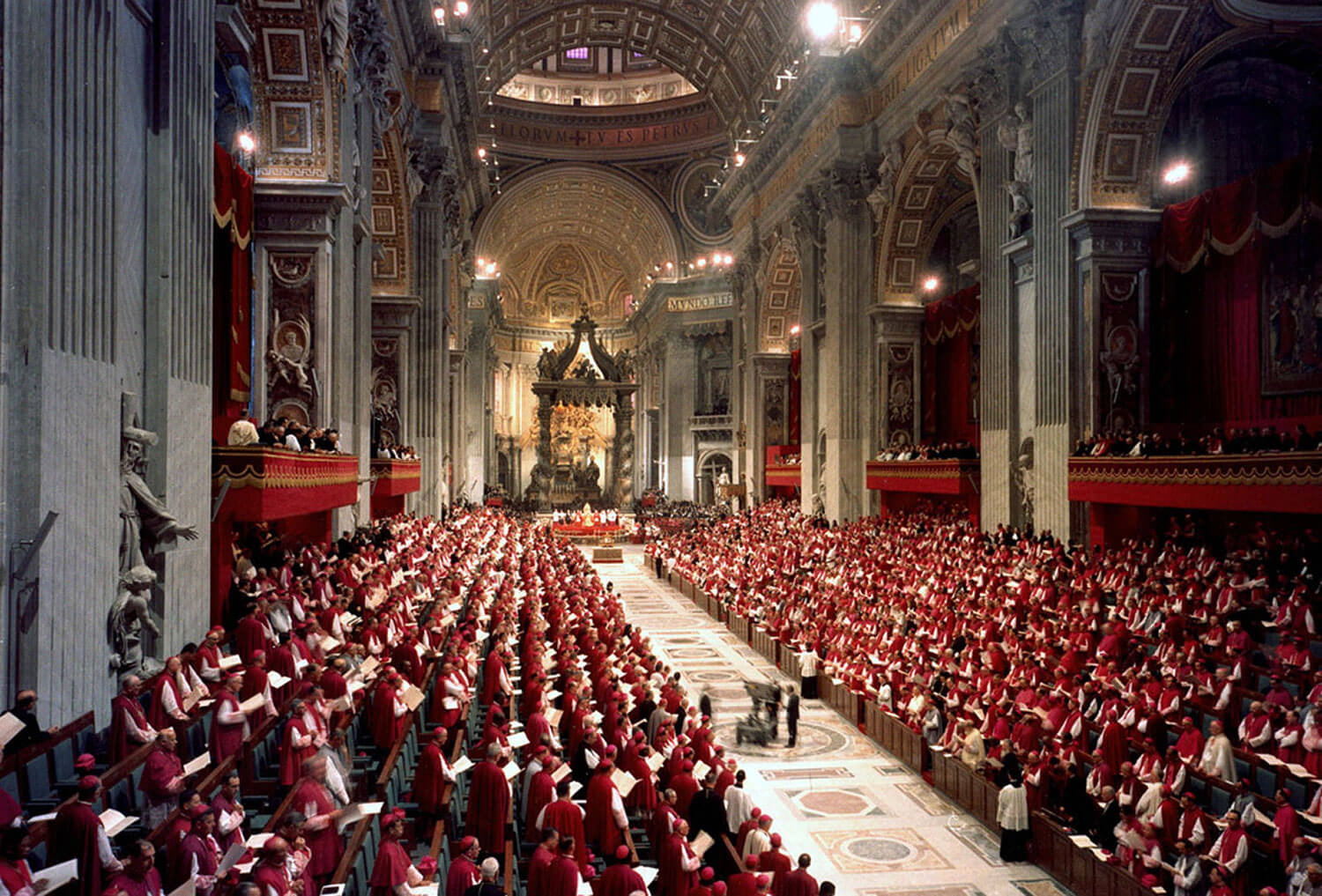
The Second Vatican Council (1962–1965) is often remembered through the figures who shaped its reformist majority: Cardinals Augustin Bea, Léon-Joseph Suenens, Julius Döpfner, and theologians such as Yves Congar and Karl Rahner. Yet the Council also witnessed the emergence of an organized conservative minority determined to defend what it understood as the doctrinal, liturgical, and political inheritance of the pre-conciliar Church. Among its most important leaders were two bishops whose friendship would have consequences far beyond Vatican II: Archbishop Marcel Lefebvre and Bishop Antônio de Castro Mayer.
Their collaboration did not begin as a campaign against the Council itself. Both participated fully in the conciliar process and attempted to influence its direction from within. Nevertheless, their growing concern over the rejection of the preparatory schemas, the influence of reformist theologians, and debates concerning religious liberty, collegiality, ecumenism, and the liturgy gradually brought them together. Their cooperation eventually became one of the foundations of the Coetus Internationalis Patrum (CIP), the principal organized traditionalist minority at Vatican II.
Marcel Lefebvre approached the announcement of Vatican II with considerable caution. He later criticized what he regarded as Pope John XXIII’s excessive optimism about the Council and the modern world. In Lefebvre’s interpretation, Pius XII had already considered the possibility of convening a council but had prudently recognized the dangers involved in such an undertaking.
Despite these reservations, Lefebvre did not initially reject the conciliar project. On the contrary, he became directly involved in its preparation. In June 1960, while Archbishop of Dakar, he was appointed by John XXIII to the Central Preparatory Commission. The schemas produced during the preparatory phase generally received Lefebvre’s approval. He particularly appreciated the doctrinal orientation associated with Cardinal Alfredo Ottaviani and the Roman theological tradition. Lefebvre would later argue that, had these texts remained the foundation of the Council, Vatican II might have offered the modern world a forceful reaffirmation of Catholic doctrine.
His apprehension increased, however, even before the Council formally opened. In June 1961, Lefebvre protested the inclusion among the conciliar experts of theologians such as Yves Congar, Henri de Lubac, and Karl Rahner. He believed that theological tendencies previously regarded with suspicion in Rome were now acquiring institutional influence over the coming Council.
An even more significant confrontation occurred during the preparatory discussions of 1962. Lefebvre opposed the approach to religious liberty promoted by the Secretariat for Promoting Christian Unity under Cardinal Bea and supported the more traditional schema associated with Cardinal Ottaviani. For Lefebvre, the dispute concerned more than pastoral strategy: it involved fundamentally different understandings of the relationship between the Catholic Church, civil society, and the modern concept of religious freedom.
The events of the Council’s first weeks reinforced his fears. The original preparatory schemas were increasingly challenged, substantially revised, or rejected. Lefebvre interpreted this development as evidence that the Council was moving away from the theological framework established during its preparation.
A remarkably similar concern was developing in Brazil. Antônio de Castro Mayer, Bishop of Campos in the state of Rio de Janeiro, belonged to a strongly Thomistic and anti-modernist Catholic tradition. Educated at the Gregorian University in Rome and deeply influenced by the anti-modernist pontificate of Pius X, Castro Mayer regarded modernism, secularism, liberalism, and communism as serious threats to Catholic civilization.
Between John XXIII’s announcement of the Council in January 1959 and its opening in October 1962, publications associated with Castro Mayer—particularly the Brazilian monthly Catolicismo—reflected increasing concern about the direction the Council might take. His response to Cardinal Domenico Tardini’s pre-conciliar consultation in 1959 provides an important window into his expectations.
Castro Mayer submitted sixteen proposals. Rather than asking for doctrinal innovation, he envisioned Vatican II largely as an act of reaffirmation and restoration. The Council, he believed, should explicitly condemn communism, socialism, and philosophical liberalism. It should reinforce the teaching of Trent and Vatican I and reaffirm the principles expressed in Pius IX’s Syllabus of Errors.
His proposals also included a stronger Marian emphasis, including support for the universal mediation of the Blessed Virgin Mary and devotion to the Immaculate Heart of Mary. He furthermore urged greater scrutiny of candidates for the episcopate regarding modernism, secularism, and revolutionary doctrines. Castro Mayer therefore arrived in Rome with expectations markedly different from the pastoral orientation expressed by John XXIII.
The Pope’s opening address, Gaudet Mater Ecclesia, emphasized that the Church preferred “the medicine of mercy” rather than severity and famously criticized the “prophets of gloom” who perceived only disaster in the modern age. Castro Mayer was deeply uncomfortable with this optimism. His understanding of ecclesiastical history emphasized the necessity not only of teaching truth but also, when necessary, of explicitly condemning error.
He regarded his presence in Rome almost in military terms. In private correspondence, Castro Mayer suggested that failing to travel to Rome to defend Catholic tradition would have been comparable to a soldier deserting his post. It was precisely in this atmosphere that his relationship with Marcel Lefebvre became historically significant.
Lefebvre was already familiar with Castro Mayer’s thought before they began working together at the Council. The Brazilian bishop’s 1953 pastoral letter on problems of the modern apostolate had circulated outside Brazil and had been translated and publicized in France by the journal Verbe. During the first conciliar session in October 1962, Lefebvre met with Castro Mayer and another Brazilian bishop, Geraldo de Proença Sigaud.
The events surrounding the opening of the Council convinced them that the bishops favoring reform were considerably better organized than the conservative minority. The interruption of the planned election of conciliar commissions on October 13 was particularly important. For conservatives, it demonstrated that the Central European bishops and their allies possessed both a strategy and an effective network. Lefebvre, Castro Mayer, and Sigaud concluded that those who wished to defend the preparatory theological orientation also needed to organize.
From these meetings emerged the piccolo comitato, or “small committee,” an informal study group that examined schemas, exchanged information, and sought bishops with similar concerns. This nucleus gradually developed into the Coetus Internationalis Patrum. By the second session in 1963, the organization had become increasingly structured, and by 1964 the name Coetus Internationalis Patrum was established.
Within the CIP, Lefebvre, Castro Mayer, and Sigaud performed complementary roles. Lefebvre became its most visible leader. His previous experience as Apostolic Delegate in French-speaking Africa and Superior General of the Holy Ghost Fathers gave him considerable international prestige and administrative experience. Castro Mayer played a more intellectual role. Reserved in temperament, he became one of the principal theological references for the group, bringing a strongly Thomistic framework to its criticism of conciliar texts.
Sigaud, meanwhile, proved particularly important as an organizer. He maintained contacts, encouraged participation, arranged meetings, and helped coordinate correspondence among sympathetic bishops. Other figures participated in this network, including Bishop Luigi Maria Carli and theologians such as the French priest Victor-Alain Berto, Lefebvre’s private theological adviser. The CIP never represented anything close to a majority of the Council Fathers. Its importance lay instead in its organization. It sought to transform a scattered conservative tendency into a coordinated parliamentary and theological force within the Council.
Lefebvre and Castro Mayer cooperated on several of the most controversial questions discussed during the Council. One was liturgy. Both defended Latin and expressed concern about reforms they believed could weaken the sacrificial understanding of the Mass or contribute to the desacralization of Catholic worship.
Another major controversy involved episcopal collegiality. The conservative minority feared formulations that could appear to weaken papal primacy by presenting the college of bishops as possessing authority parallel to that of the Roman Pontiff. The debate eventually contributed to the inclusion of the Nota Explicativa Praevia attached to Lumen Gentium, clarifying how collegiality should be understood in relation to papal authority.
Religious liberty became another major battlefield. Lefebvre and Castro Mayer opposed the theological orientation that eventually produced Dignitatis Humanae. They argued that the proposed formulations represented a significant departure from earlier Catholic teaching concerning the duties of states toward the true religion. Ecumenism generated similar concerns. Their opposition was based on the fear that new language regarding other Christian communities might encourage religious indifferentism or obscure Catholic claims concerning the nature of the Church.
Communism provided perhaps the clearest example of coordinated political action by the conservative minority. Members of the CIP organized petitions requesting an explicit conciliar condemnation of Marxism and communism. One petition in 1963 gathered more than two hundred signatures, while another initiative in 1965 obtained more than four hundred. They also promoted appeals connected with the consecration of Russia and the world to the Immaculate Heart of Mary.
Their activism extended far beyond speeches in St. Peter’s Basilica. The conservative network established a secretariat in Rome capable of reproducing theological studies, proposed amendments, voting recommendations, and other documents. Materials prepared by members and advisers were distributed among bishops through hotels, mailboxes, and personal contacts. The struggle over Vatican II was therefore not merely theological. It was also organizational.
When Vatican II ended in December 1965, Lefebvre and Castro Mayer remained bishops of the Roman Catholic Church who had participated in an ecumenical council summoned and presided over by the Pope. Yet both left Rome convinced that serious theological problems had emerged during the conciliar process. The importance of their collaboration became even clearer during the post-conciliar period.
Many bishops associated with the conservative minority eventually accepted the reforms or ceased organized opposition to them. Geraldo de Proença Sigaud himself gradually moved away from the position he had defended alongside Castro Mayer and Lefebvre. Lefebvre and Castro Mayer followed another path.
As the liturgical and ecclesiastical reforms accelerated after the Council, the two bishops increasingly became international symbols of resistance to the post-conciliar transformation of Catholicism. Their principal battlefield eventually became the liturgy, particularly after the promulgation of the new Roman Missal under Paul VI.
Their friendship, however, had been forged years earlier inside St. Peter’s Basilica. The collaboration that began with the piccolo comitato and developed through the Coetus Internationalis Patrum established a relationship that would survive Vatican II and shape the emerging traditionalist movement for decades.
Twenty-three years after the Council ended, that relationship reached its most controversial moment. On June 30, 1988, at Écône, Switzerland, Marcel Lefebvre consecrated four bishops without pontifical mandate. At his side stood the elderly Antônio de Castro Mayer as co-consecrator.
The road to Écône did not begin in 1988. To understand why these two bishops stood together that day, one must return to Rome in October 1962, when Lefebvre, Castro Mayer, and Sigaud concluded that an organized movement was necessary to resist what they perceived as a profound transformation taking place within Catholicism.
The Coetus Internationalis Patrum ultimately lost most of its battles at Vatican II. Yet historically, its significance extends far beyond the number of votes it obtained. It created networks, arguments, and personal alliances that survived the Council itself. Among those alliances, none proved more consequential than the partnership between Marcel Lefebvre and Antônio de Castro Mayer.