
Leo XIV’s trip to South America raised very different expectations.
When Leo XIV returned to Chiclayo, Peru, many of those who came to see him had known him long before he wore white. They knew him as Father Roberto, the Augustinian missionary who worked in northern Peru, and later as the bishop who stood by them through floods and the pandemic. Days earlier, in Argentina, other Catholics had used the occasion of his visit to call for the dismissal of Cardinal Víctor Manuel Fernández. Then, on the flight back to Rome, a French journalist asked the Pope whether he was willing to ease restrictions on the Tridentine Mass. These three moments help explain why the trip drew such an enthusiastic public response while leaving some traditionalist Catholics disappointed.
Why Is Peru Leo XIV’s Second Homeland?
Robert Francis Prevost was born in Chicago and elected pope on May 8, 2025. Between those two events, he spent about two decades in Peru over several stays. The first began in 1985, when the Order of Saint Augustine sent him to Chulucanas, in the Piura region. Peru at the time was marked by poverty and by the violence of its internal conflict with the Shining Path, the Communist party of Peru. It was there that the young Augustinian began the missionary work that would shape the course of his life.
After completing his doctorate in canon law, Prevost returned to Peru in 1988 and spent about eleven years in Trujillo. He helped train future Augustinians, taught canon law, and ministered in neighborhoods on the outskirts of the city. That combination helps us understand the future pope. He came to know the Peruvian Church through parish ministry, the formation of future priests, and his responsibilities in Church administration. He brought that experience with him when he later led the Order of Saint Augustine worldwide.
In 2014, Francis sent him back to Peru as apostolic administrator of Chiclayo. In August 2015, Prevost became a naturalized Peruvian citizen. The following month, he was appointed diocesan bishop. During his episcopate, he stood by the local population through crises such as the flooding associated with El Niño and the COVID-19 pandemic. In 2018, he was elected second vice president of the Peruvian Episcopal Conference. In 2023, Francis called him to Rome to lead the Dicastery for Bishops. When we speak of Peru as his second homeland, then, we are talking about his years there as a missionary and a bishop, as well as a formal tie to the country. Prevost became a Peruvian citizen.
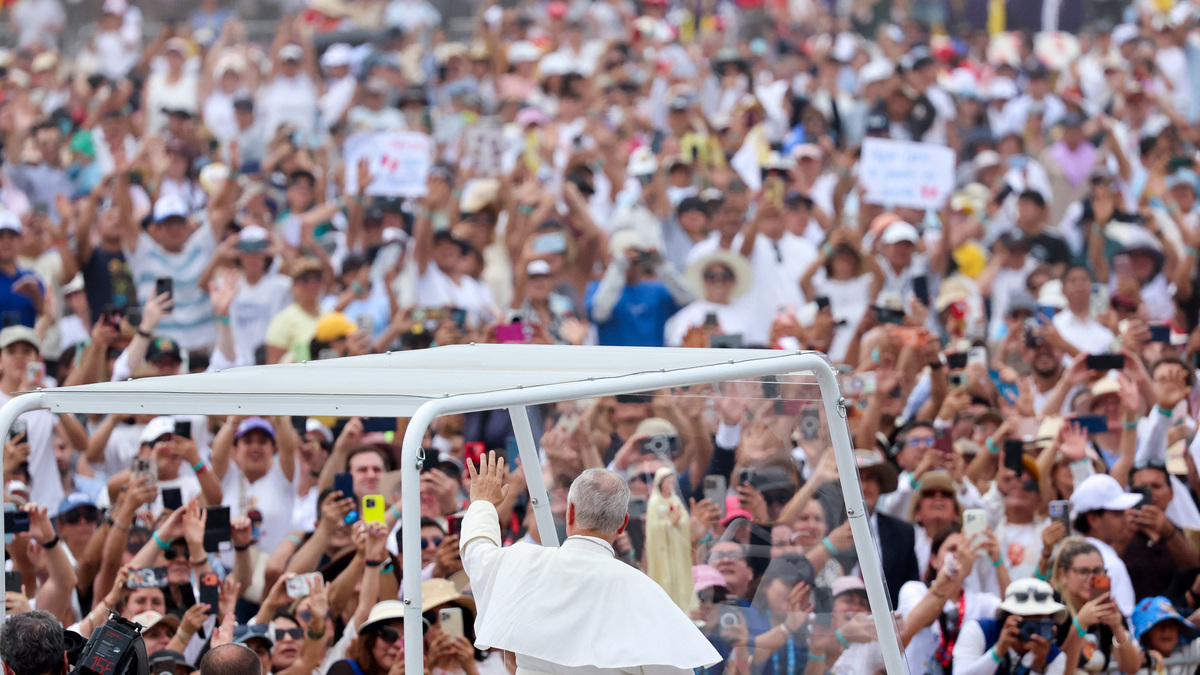
That connection was plain on the very day of his election. From the balcony of St. Peter’s Basilica, before a worldwide audience, Leo XIV switched to Spanish to send a special greeting to his former diocese of Chiclayo. In November 2026, Peru hosted the longest leg of his South American trip, with engagements in Lima, Chiclayo, Cusco, and Pucallpa, among other places. The reunion in Chiclayo carried that first greeting forward in front of the cameras. For the local people, the man they now saw as Pope was someone with whom they shared a history.
From Uruguay to Argentina, Two Ways of Being Catholic in Public Life
In Uruguay, Leo XIV encountered a society with a strong secular tradition. For generations, the Church has lived alongside a public culture in which religious affiliation carries less weight than in other countries in the region. When the Pope addressed government officials and civil society in Montevideo, he was speaking to an audience that extended well beyond parish communities. In Paysandú, he celebrated Mass and spoke directly to the faithful. The itinerary itself shows two responsibilities a papal visit brings together. The pontiff engages with the state and serves as pastor to the Catholic community.
Catholicism had a different public presence in Argentina. Mass at the Basilica of Our Lady of Luján, the country’s patroness, showed the enduring public appeal of Marian devotion. The visit also brought Leo XIV face to face with the legacy of Jorge Mario Bergoglio, Pope Francis, in his homeland. And it was on Avenida de Mayo in Buenos Aires that posters appeared calling on the Pope to remove Cardinal Víctor Manuel Fernández, known as Tucho, from his position as prefect of the Dicastery for the Doctrine of the Faith.
Why did Fernández become the target of the protest? Because he is one of the figures most closely associated with the pastoral approach of Francis’s pontificate. The best-known example is Fiducia Supplicans, a declaration issued in 2023 by the dicastery Fernández heads. It allows spontaneous pastoral blessings for couples in situations the Church considers irregular and for same-sex couples, while upholding Catholic teaching on marriage and ruling out blessings in the form of a liturgical rite. That is where the controversy lies. Supporters see the blessing as a request for divine assistance. Critics argue that when a blessing is given to a couple, it can be publicly understood as approval of their union. The posters brought that dispute onto the streets of Buenos Aires. Fernández was still in office when the trip ended.
Pachamama and the Pope’s Choice of Gestures in Peru
To understand why there was so much talk about Pachamama ahead of the Peruvian leg of the trip, we need to go back to the 2019 Synod for the Amazon. That year, wooden carvings associated with Pachamama appeared at a ceremony in the Vatican Gardens. Statues were later taken from a church in Rome and thrown into the Tiber. Francis referred to the carvings as statues of “Pachamama” and said they had been placed in the church without any idolatrous intent. The controversy extended beyond what the participants intended. It also concerned the religious meaning those symbols could take on in a ceremony held at the Vatican.
As Leo XIV traveled through the Andes and the Amazon, the question of how he would approach Indigenous traditions resurfaced. In Cusco, the Pope met with representatives of popular Catholic devotions. In Chiclayo, he presided over the crowning of an image of the Immaculate Virgin. In Pucallpa, he listened to missionaries and representatives of Amazonian peoples, spoke in defense of communities affected by illegal exploitation and violence, and explicitly invoked Francis’s example in Puerto Maldonado. Pachamama did not feature in the official events of this leg of the trip. That pleased conservatives who had strongly objected to the presence of an image of this pagan goddess in the Vatican Gardens. Here we see continuity in the defense of Indigenous peoples and a difference in the choice of public symbols.
The Tridentine Mass and the Decision to Keep Traditionis Custodes in Force
On the flight from Lima to Rome, journalist Jean-Marie Guénois asked whether Leo XIV intended to ease the restrictions imposed by Traditionis Custodes. To understand the significance of the answer, it helps to recall what is at stake. In 2021, Francis restricted the use of the 1962 Roman Missal, which is used to celebrate what is commonly known as the Tridentine Mass. In 2023, Rome reserved certain permissions to the Holy See, including permission to use a parish church for these celebrations and permission for priests ordained after the document was issued to celebrate according to the older missal. For communities attached to the older missal, the question is whether they can have regular Masses in accessible locations with priests authorized to celebrate them.
The controversy over Traditionis Custodes, issued by Pope Francis on July 16, 2021, involves two questions. The first concerns the changes to the rules governing the celebration of the Tridentine Mass according to the 1962 Roman Missal. The second concerns the consultation with bishops that preceded the decision. In July 2025, the release of internal documents from what was then the Congregation for the Doctrine of the Faith brought that consultation back into the debate. What position had prevailed among the bishops who responded?
To understand the full scope of Francis’s decision, we need to go back to 2007. That year, Benedict XVI issued Summorum Pontificum, which broadened access to the 1962 missal. At Masses celebrated without a congregation, for example, priests of the Latin rite could use the older missal without seeking special permission. The document also made it possible to accommodate requests from stable groups of the faithful in parishes. Benedict saw this opening as a way to foster reconciliation within the Church.
Francis withdrew that broader freedom. Under Traditionis Custodes, authorization to celebrate according to the 1962 missal became a matter for the diocesan bishop, within the rules set by Rome. The document directed bishops to refrain from authorizing new groups and stipulated that, as a rule, these celebrations should take place outside parish churches. In 2023, Francis confirmed that certain permissions were reserved to the Holy See, including the use of parish churches and authorization for priests ordained after the motu proprio was issued to celebrate according to the older missal. This had practical consequences for communities attached to the Tridentine Mass. Keeping a regular Mass depended on finding an available venue and priests authorized to celebrate it.
In the letter accompanying the document, Francis said he had taken into account the responses to a consultation sent to bishops in 2020. In his assessment, the freedom granted by Benedict XVI had been used in some circles to fuel divisions and to call into question the liturgical reform and the Second Vatican Council itself. Francis presented the decision as a defense of the Church’s unity.
The material released in 2025 raised a more specific question. Were most of the bishops who responded in favor of restricting the Tridentine Mass or keeping Benedict XVI’s rules in place? According to the internal summary made public, most favored keeping Benedict’s rules. The report said that relations had improved in dioceses where bishops and communities attached to the older missal were in dialogue. It also noted interest among young people and the presence of vocations within these groups. According to the published material, most respondents recommended keeping the existing rules, arguing that further restrictions could deepen the very divisions they were meant to address.
Matteo Bruni, the Holy See’s spokesman, described the documents that had been released as “partial and incomplete” and said Francis had considered other materials and consultations before making his decision. The summary that came to light raises the question of how much weight was given to the prevailing view among the bishops who responded. The Vatican’s response indicates that the decision drew on a broader body of information. The controversy persists because that material has yet to be made public in full.
The reaction attributed to Benedict XVI helps explain the difference between the two pontificates. According to his personal secretary, Archbishop Georg Gänswein, the pope emeritus read Traditionis Custodes “with a heavy heart” and regarded the measure as a mistake. Both Benedict XVI and Francis sought to preserve the unity of the Church, each in his own way. Benedict believed that expanding access to the older missal would help reconcile communities attached to it. Francis regarded restrictions as necessary in light of what he saw as a challenge to the liturgical reform. The 2025 leak brought that disagreement back to the center of the debate. Thousands of Catholics now want Traditionis Custodes suspended because they believe it rests on a false account of the consultation.
Leo XIV replied that he would continue to follow Francis’s decision. He invoked the unity of the Church, reaffirmed the central place of the missal promulgated by Paul VI, and noted that those concerned can request dispensations. A dispensation addresses an individual case. A change in the rules would affect communities as a whole. The Pope’s answer therefore had a clear practical meaning. The rules remain in force, and requests will continue to be considered through the established procedures. Groups attached to the Tridentine Mass were understandably disappointed by his remarks, since they want greater freedom to celebrate according to the older missal.
Conclusion
My reading is that the trip showed Leo XIV to be diplomatic, popular, and media-savvy. He was diplomatic in the way he addressed officials in a country with a strong secular tradition, listened to the concerns of Amazonian peoples, and answered a question that divides Catholics without escalating the dispute. His popular appeal, especially in Chiclayo, drew on relationships he had built long before becoming pope. And he showed his media savvy by recognizing that a greeting in Spanish, a Marian celebration, and an answer given aboard a plane can reach very different audiences and shape how each understands his pontificate.
Leo XIV has kept important decisions of Francis’s pontificate in place. He has retained Traditionis Custodes, kept Fernández at the head of the Dicastery for the Doctrine of the Faith, and continued to speak in defense of the Amazon and Indigenous peoples. Even so, I consider Leo XIV more conservative than Francis in the public exercise of the papacy. That comes through in the restraint of his liturgical celebrations, the place he gives to traditional Catholic devotions, and his caution with symbols that could reignite religious controversies. For traditionalists hoping for a change in the rules governing the Tridentine Mass, the interview on the plane was decisive. Anyone seeking to understand how Leo XIV chose the public gestures of his trip should look at what he did in Chiclayo, Cusco, and Pucallpa. Taken together, these moments show a pope who is more conservative in his liturgical style and public gestures while preserving key decisions Francis made in governing the Church. In that sense, I see Leo XIV as a moderate pope, and his trip to South America reinforces that assessment.