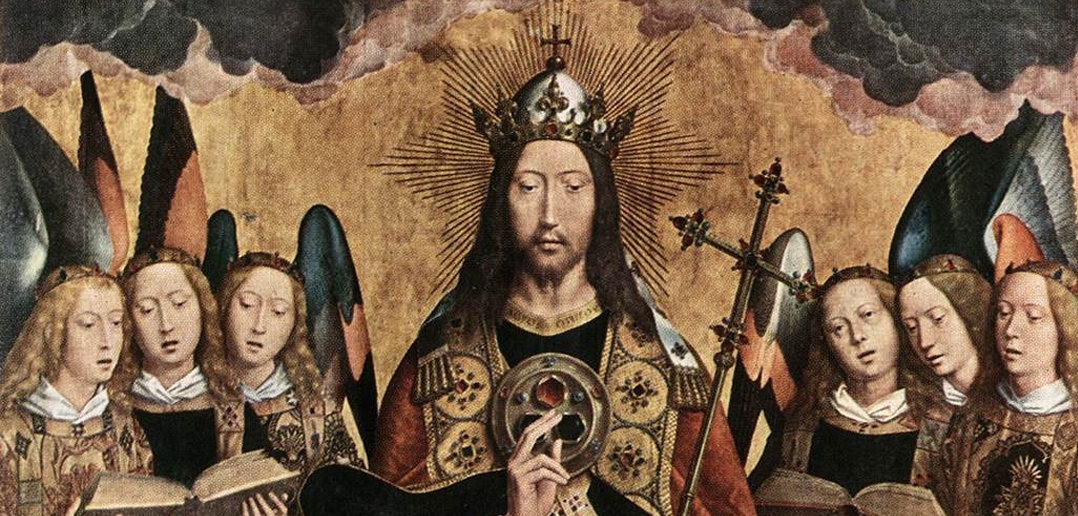

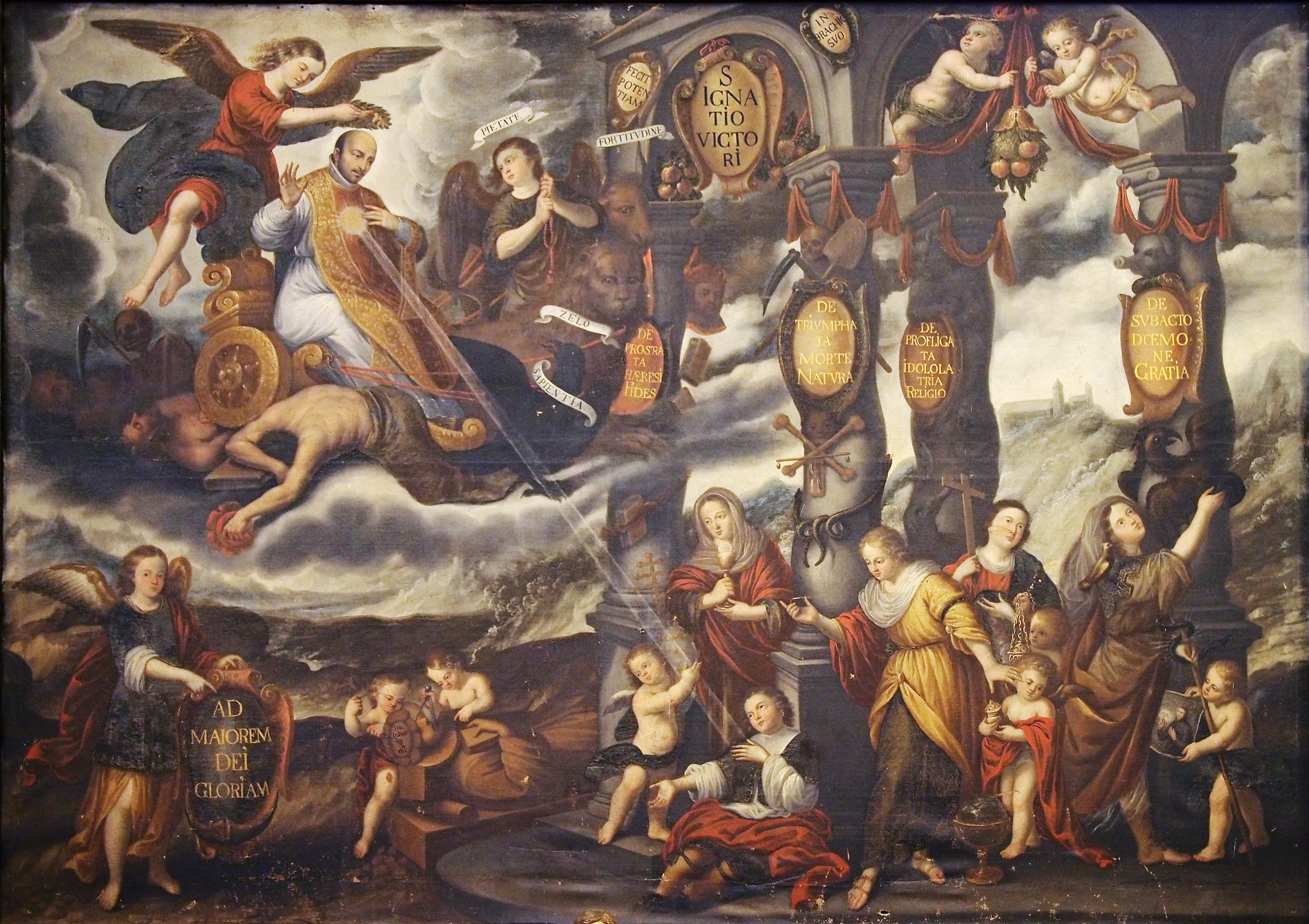
Above: Apoteosis de San ignacio de Loyola (1675) by Diego Díez Ferreras.
Dear brethren in Christ,
VIVA CRISTO REY!
On this feast of the great St. Ignatius, I feel obliged by a debt of gratitude for the immense wisdom of this militant saint. As I discussed in my series “My Struggle as Editor of OnePeterFive,” I struggled with depression for years in this job until I ran into St. Ignatius’s 14 Rules of Discernment via Mr. Dan Burke’s book, Spiritual Warfare and the Discernment of Spirits.
Mr. Burke teaches this class over at the Avila Institute based on a modern spiritual master, Fr. Timothy Gallagher (you’ll have to pardon the unpardonable aesthetics of this book cover, it’s actually a modern classic – see for yourself).
Mr. Burke has now brought out another text (with Dr. Mary Ruth Hackett) specifically for young adult Catholics:
It’s incredible what a difference this very short list of 14 rules makes in my life and the life of so many souls over centuries. Here’s the Gill Translation below. Next time you’re feeling depressed, doubtful, despairing, or struggling in any way, try pausing for a minute and reading through Rules 5-9. That’s what’s really helped for me. When I’m really struggling, I just pause and read through those rules and it changes everything. Then I can embrace the cross that God places upon me as a Father to His son.
Persevere under discipline. God dealeth with you as with his sons; for what son is there, whom the father doth not correct? But if you be without chastisement, whereof all are made partakers, then are you bastards, and not sons. Moreover we have had fathers of our flesh, for instructors, and we reverenced them: shall we not much more obey the Father of spirits, and live? And they indeed for a few days, according to their own pleasure, instructed us: but he, for our profit, that we might receive his sanctification.
Now all chastisement for the present indeed seemeth not to bring with it joy, but sorrow: but afterwards it will yield, to them that are exercised by it, the most peaceable fruit of justice. Wherefore lift up the hands which hang down, and the feeble knees, And make straight steps with your feet: that no one, halting, may go out of the way; but rather be healed. Follow peace with all men, and holiness: without which no man shall see God. Looking diligently, lest any man be wanting to the grace of God; lest any root of bitterness springing up do hinder, and by it many be defiled (Heb. xii. 7-15).
—
RULE 1 SE 314 In the case of those who go from one mortal sin to another, the enemy is ordinarily accustomed to propose apparent pleasures. He fills their imagination with sensual delights and gratifications, the more readily to keep them in their vices and increase the number of their sins. With such persons the good spirit uses a method which is the reverse of the above. Making use of the light of reason, he will rouse the sting of conscience and fill them with remorse.
RULE 2 SE 315 In the case of those who go on earnestly striving to cleanse their souls from sin and who seek to rise in the service of God our Lord to greater perfection, the method pursued is the opposite of that mentioned in the first rule. Then it is characteristic of the evil spirit to harass with anxiety, to afflict with sadness, to raise obstacles backed by fallacious reasonings that disturb the soul. Thus he seeks to prevent the soul from advancing. It is characteristic of the good spirit, however, to give courage and strength, consolations, tears, inspirations, and peace. This He does by making all easy, by removing all obstacles so that the soul goes forward in doing good.
RULE 3 SE 316 Spiritual Consolation. I call it consolation when an interior movement is aroused in the soul, by which it is inflamed with love of its Creator and Lord, and as a consequence, can love no creature on the face of the earth for its own sake, but only in the Creator of them all. It is likewise consolation when one sheds tears that move to the love of God, whether it be because of sorrow for sins, or because of the sufferings of Christ our Lord, or for any other reason that is immediately directed to the praise and service of God. Finally, I call consolation every increase of faith, hope, and love, and all interior joy that invites and attracts to what is heavenly and to the salvation of one’s soul by filling it with peace and quiet in its Creator and Lord.
RULE 4 SE 317 Spiritual Desolation. I call desolation what is entirely the opposite of what is described in the third rule, as darkness of soul, turmoil of spirit, inclination to what is low and earthly, restlessness rising from many disturbances and temptations which lead to want of faith, want of hope, want of love. The soul is wholly slothful, tepid, sad, and separated, as it were, from its Creator and Lord. For just as consolation is the opposite of desolation, so the thoughts that spring from consolation are the opposite of those that spring from desolation.
RULE 5 SE 318 In time of desolation we should never make any change, but remain firm and constant in the resolution and decision which guided us the day before the desolation, or in the decision to which we adhered in the preceding consolation. For just as in consolation the good spirit guides and counsels us, so in desolation the evil spirit guides and counsels. Following his counsels we can never find the way to a right decision.
RULE 6 SE 319 Though in desolation we must never change our former resolutions, it will be very advantageous to intensify our activity against the desolation. We can insist more upon prayer, upon meditation, and on much examination of ourselves. We can make an effort in a suitable way to do some penance.
RULE 7 SE 320 When one is in desolation, he should be mindful that God has left him to his natural powers to resist the different agitations and temptations of the enemy in order to try him. He can resist with the help of God, which always remains, though he may not clearly perceive it. For though God has taken from him the abundance of fervor and overflowing love and the intensity of His favors, nevertheless, he has sufficient grace for eternal salvation.
RULE 8 SE 321 When one is in desolation, he should strive to persevere in patience. This reacts against the vexations that have overtaken him. Let him consider, too, that consolation will soon return, and in the meantime, he must diligently use the means against desolation which have been given in the sixth rule.
RULE 9 SE 322 . The principal reasons why we suffer from desolation are three: The first is because we have been tepid and slothful or negligent in our exercises of piety, and so through our own fault spiritual consolation has been taken away from us.The second reason is because God wishes to try us, to see how much we are worth, and how much we will advance in His service and praise when left without the generous reward of consolations and signal favors.The third reason is because God wishes to give us a true knowledge and understanding of ourselves, so that we may have an intimate perception of the fact that it is not within our power to acquire and attain great devotion, intense love, tears, or any other spiritual consolation; but that all this is the gift and grace of God our Lord. God does not wish us to build on the property of another, to rise up in spirit in a certain pride and vainglory and attribute to ourselves the devotion and other effects of spiritual consolation.
RULE 10 SE 323 When one enjoys consolation, let him consider how he will conduct himself during the time of ensuing desolation, and store up a supply of strength as defense against that day.
RULE 11 SE 324 He who enjoys consolation should take care to humble himself and lower himself as much as possible. Let him recall how little he is able to do in time of desolation, when he is left without such grace or consolation. On the other hand, one who suffers desolation should remember that by making use of the sufficient grace offered him, he can do much to withstand all his enemies. Let him find his strength in his Creator and Lord.
RULE 12 SE 325 The enemy conducts himself as a woman. He is a weakling before a show of strength, and a tyrant if he has his will. It is characteristic of a woman in a quarrel with a man to lose courage and take to flight if the man shows that he is determined and fearless. However, if the man loses courage and begins to flee, the anger, vindictiveness, and rage of the woman surge up and know no bounds. In the same way, the enemy becomes weak, loses courage, and turns to flight with his seductions as soon as one leading a spiritual life faces his temptations boldly, and does exactly the opposite of what he suggests. However, if one begins to be afraid and to lose courage in temptations, no wild animal on earth can be more fierce than the enemy of our human nature. He will carry out his perverse intentions with consummate malice.
RULE 13 SE 326 Our enemy may also be compared in his manner of acting to a false lover. He seeks to remain hidden and does not want to be discovered. If such a lover speaks with evil intention to the daughter of a good father, or to the wife of a good husband, and seeks to seduce them, he wants his words and solicitations kept secret. He is greatly displeased if his evil suggestions and depraved intentions are revealed by the daughter to her father, or by the wife to her husband. Then he readily sees he will not succeed in what he has begun. In the same way, when the enemy of our human nature tempts a just soul with his wiles and seductions, he earnestly desires that they be received secretly and kept secret. But if one manifests them to a confessor, or to some other spiritual person who understands his deceits and malicious designs, the evil one is very much vexed. For he knows that he cannot succeed in his evil undertaking, once his evident deceits have been revealed.
RULE 14 SE 327 . The conduct of our enemy may also be compared to the tactics of a leader intent upon seizing and plundering a position he desires. A commander and leader of an army will encamp, explore the fortifications and defenses of the stronghold, and attack at the weakest point. In the same way, the enemy of our human nature investigates from every side all our virtues, theological, cardinal and moral. Where he finds the defenses of eternal salvation weakest and most deficient, there he attacks and tries to take us by storm.