

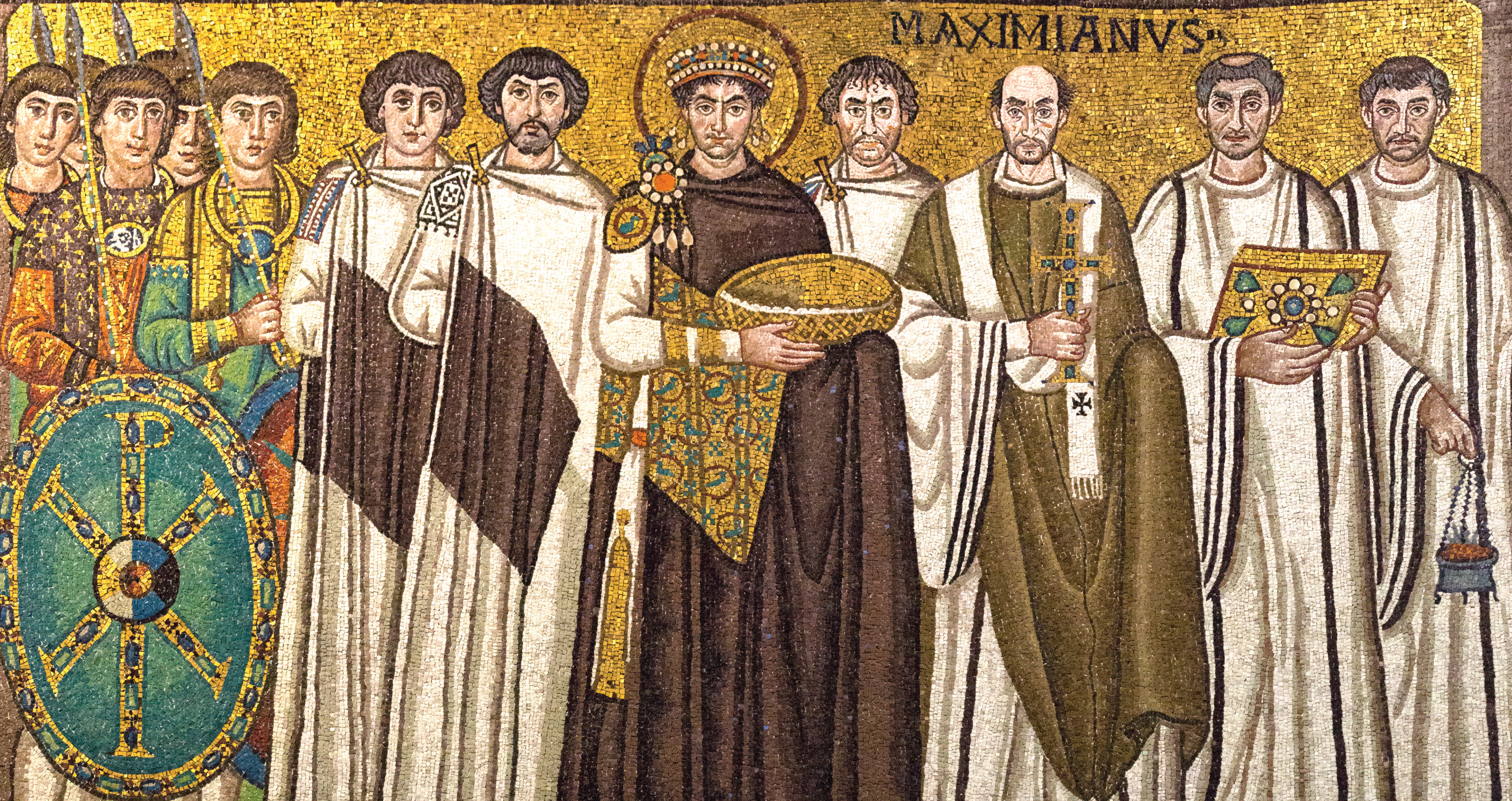
Above: 6th century Mosaic of Emperor Justinian in Ravenna, the Western exarchate of the Roman Empire.
Editor’s note: this is an excerpt from the author’s book City of God vs. City of Man: the Battles of the Church from Antiquity to the Present. See also the following two selections for origins of Christian politics before the annunciation of the Two Swords dogma.
The Bishop’s Altar is the Throne of Christ the King in every City-State-Nation
The King of Kings over Rome and All Nations
Two Swords Crusade for the City of God
The first prolonged schism between east and west happened when the Emperor Zeno attempted to impose a compromise with truth, the henotikon, which attempted to reconcile the supporters of Chalcedon with its opponents. For this, the pope excommunicated all who held this doctrine. This was the Acacian schism (484-519).
Pope Gelasius wrote to the emperor saying that the demons had inspired the pagan emperors to assume the title pontifex maximus.[1] He enunciated the foundation of the covenant for Christian peoples:
There are two swords, august Emperor, by which this world is chiefly ruled, namely, the sacred authority of the priests and the royal power. Of these that of the priests is the more weighty, since they have to render an account for even the kings of men in the divine judgment. You are also aware, dear son, that while you are permitted honorably to rule over human kind, yet in things divine bow your head humbly before the leaders of the clergy and await from their hands the means of your salvation. In the reception and proper disposition of the heavenly mysteries you recognize that you should be subordinate rather than superior to the religious order, and that in these matters you depend on their judgment rather than wish to force them to follow your will.[2]
The two swords were meant to work together, each in its own proper sphere, to baptize all of society and make a Christian people.
This is what the saints, our fathers had instinctively followed in Armenia, Georgia, Ethiopia, Ireland and at this time, France, where king Clovis was baptized during this schism. The king must rule according to the cultus as determined by the elders of Christian culture. Yet between king and bishop there exists an organic mutual aid. Just as body and soul are united in one person, so the two swords are united in one body politic. This was the proper ordering of Christian culture and peoples. In theory, the east agreed, but in practice, the Roman emperor was pontifex maximus, deposing bishops at will, rearranging the cultus to serve his ends.[3] This was in imitation of Cain and the rabbis who imposed their will on cultus.
Because of this, over the course of 464 years from Constantine (323) to the Seventh Ecumenical Council (787), the eastern bishops would hold heretical doctrines and be out of communion with Rome for at least 203 years.[4] These were the schismatic Greeks, while the orthodox Greeks chose to suffer or flee to the west.
The emperor did not listen to the pope in the Acacian schism, and in 516, he continued to style himself pontifex.[5] The central question was this: who is the pontifex maximus, the high priest: the emperor or the pope? It was true that the Roman emperor held a relationship with the bishops that was sacred, but in what sense could he be said to have a priesthood?
Justinian’s Crusade for the Earthly City
The Acacian schism was ended in 519 when a new dynasty conceded the Petrine primacy of “Roman doctrinal prestige” and imposed this on all the eastern bishops.[6] Justinian came to the imperial throne in 527 with his wife, the powerful Theodora, who grew up from prostitution to become the Christian Augusta. Would she be an Artemesian Eudoxia or a Marian Pulcheria?
Dawson says Theodora “fascinated and subdued” Justinian who, according to his contemporary critic Procopius, “overturned the social order” by failing in masculinity and letting his wife dominate.[7] Indeed he himself codified the Two Swords doctrine yet in a way that left open the question of whether he remained in some sense the pontifex maximus.[8]
A sympathetic reading sees his whole reign as an attempt at “the deliberate restoration of the ancient Roman empire” now Christianized.[9] That meant conquest and monuments. Justinian did not lead his army in battle but sent his generals to fight wars with Persia (527-532, 540-562). The Christians under Persia were not only recovering from an internal schism over the sons of Syriac bishops but also, under St. Aba the Great, spreading the Gospel east of the Persian empire and south to modern Yemen and Socotra.[10]
But while the Syriacs were conquering with the Gospel, Justinian was conquering the west with a brutal twenty-year campaign in north Africa and Italy (535-554). This restored most of the borders of Caesar’s empire, allowing his top general Belasarius to celebrate a Christianized rite of triumph in 553.[11]
In his decrees, Justinian celebrated that by his conquests the Persians were made “quiet,” the barbarian Vandals and Moors were made “obedient,” the western Romans “have recovered their former freedom” and “the Tzani [barbarians] have, for the first time, been subjected to Roman domination (which is something that God had not permitted to take place up to this time and until Our reign).”[12] A new Virgil composed a Latin epic poem about the conquests.[13] Meanwhile, the local Roman populace of Italia suffered with the loss of land and souls under the decades of bloodshed.
Justinian imposed punishing taxes on the populace that allowed him to build great building like the hippodrome. But his strict rule, taxes and corrupt bureaucracy, exacerbated the economic and religious tensions. This led to the brutal Nika riots, which burned down much of Constantinople, destroying the Theodosian Hagia Sophia. Justinian was considering running away when Theodora told him in the presence of the Roman senate, “may I never be separated from this [royal] purple, and may I not live that day on which those who meet me shall not address me as mistress” proclaiming that she would rather die in her royal garments than flee.[14] He then killed 30,000 civilians and put down the riots.[15]
Immediately he began to rebuild Hagia Sophia greater and more excellent than ever before. This seems to have become the Christianized triumph arch to cement himself as pontifex maximus presiding over the holy city of New Rome and the sacred empire. Theodora also received a halo in the mosaics of the time. Like Caesar Augustus, Justinian’s propaganda made it seem like “the hidden influence of God” was made “to support the self-assured brilliance of the emperor.”[16]
While this was being built, in 535 Justinian named the city Justiniana Prima after himself and attempted to exalt its bishop’s authority.[17] Missionary activity was closely linked to forming diplomatic alliances to the earthly city.[18]
While Justinian’s wife may not have understood the terminology, she “was emotionally deeply committed to the [Alexandrian] cause.”[19] Even though in theory Justinian believed in the Petrine primacy of pope and bishops, he proved he still saw himself as pontifex by devising a doctrinal compromise between the Antiochian and Alexandrian factions.
For a time he sponsored true dialogos between the parties, but he soon took matters into his own hands.[20] His plan was to suppress some of the terms of the Fathers and then condemn Theodore Mopsuestia to appease the Alexandrians and his wife. [21] The problem was the Petrine authority. Therefore, Meyendorff admits that Theodora “groomed” Vigilius to be pope and extracted a promise to follow the Imperial program of compromise once “elected.”[22] Theodora worked with the wife of the general Belasarius and got him to depose Pope St. Silverius, who died in exile from harsh treatment, and appoint Vigilius instead.[23]
At the same time, Theodora also appointed a parallel hierarchy for the Alexandrians known as the “Jacobites.” This hierarchy elected a new bishop of Alexandria, Theodosius I, whom Justinian himself later deposed.[24] Before this, most faithful simply communed with the local bishop. But the actions of Theodora “led to a permanent schism.”[25]
Then in 543 God sent a severe plague that afflicted, according to one contemporary “the whole world” and left cities “altogether depopulated.”[26] Modern estimates range from 15-100 million dead.[27] It is still called the “Plague of Justinian” to this day. Procopius said this wrath was for Justinian’s brutal taxes and persecution, while Alexandrian John of Ephesus said it was “not only a sign of threat and of wrath, but also a sign of grace and a call to repentance.”[28] In fact, the emperor himself was struck with this plague. In 548, Theodora went to her eternal reward. The Alexandrian Oriental Orthodox venerate her as a saint.
The plague and the death of Theodora seem to have only galvanized his zeal to impose his doctrine as pontifex maximus, seemingly to appease God’s wrath. He called on Pope Vigilius, therefore to keep up his bargain and support the imperial doctrine. But the grace of office proved to give Vigilius back his crusading spirit, and Justinian had to resort to violent coercion to force the pope to sign the “conciliar unanimity” of the Fifth Ecumenical Council, provoking another schism with the west.[29]
Shortly thereafter an earthquake rocked the east, and even parts of Hagia Sophia collapsed. Justinian instituted a service of supplication every year to commemorate the earthquake, and told the city that the immorality of the citizens had caused God’s wrath.[30] He then “employed drastic measures” of coercion to enforce the council. But after Theodora’s parallel hierarchy was set up, he now faced “the resistance of the masses led by ‘underground’ leaders, proud of their martyrdom and gradually beginning to identify their religious cause with cultural non-Greek and non-Roman identity of Syrians, Armenians, Arabs and Copts.”[31]
In 563, Justinian went on pilgrimage to the shrine of St. Michael in Germania seeking healing from the plague.[32] He then suddenly began imposing yet another new doctrine—aphthartodocetism, which proclaimed that Christ’s body was divine—and deposed his bishop of Constantinople for opposing it.
He died without establishing a lasting earthly city, nor a lasting peace for the heavenly, and his religious policy is seen by Meyendorff as a “failure.”[33] To the Imperial Greek Christians, he is officially “the great and glorious…holy emperor” yet there seems to be very little devotion to him.[34] The Copts condemn Justinian but praise Theodora, while the Roman martyrology does not commemorate either.[35] His successors attempted the same mixture of dialogos and violence with the same result. Then in 572, while the plague still raged, war broke out with Persia again. No doubt every pious soul cried out to the King of Kings for mercy.
[1] Cameron, “The Imperial Pontifex,” 362.
[2] Robinson, op. cit., 72-73.
[3] Alan Ryan, On Politics (New York: Liveright, 2012), vol. I, 215ff; Posnov, op. cit.,217.
[4] Monsignor L. Duchesne, The Churches Separated from Rome (Kegan Paul, 1907), 109.
[5] Cameron, op. cit., 363.
[6] Meyendorff (Imperial Unity, 212-216) admits this yet attempts to obviate the significance of the event.
[7] Dawson, The Making of Europe, 117; Leslie Brubaker, “The Age of Justinian: Gender and Society,” Michael Maas, ed., Cambridge Companion to the Age of Justinian (Cambridge, 2005), 433-436.
[8] Posnov, 215-217; Robert Browning, Justinian and Theodora, rev. ed., (London, Thames and Hudson: 1987) 61.
[9] Louth, “Justinian and His Legacy,” Cambridge History of the Byzantine Empire, 107.
[10] Baum and Winkler, op. cit., 33-34.
[11] Mary Beard, The Roman Triumph (Harvard University Press, 2009), 318-319.
[12] Novella I, preface, trans. S. P. Scott, The Civil Law, XVI, (Cincinnati, 1932) <https://droitromain.univ-grenoble-alpes.fr/Anglica/N1_Scott.htm>, accessed March 25, 2021.
[13] Johannis and De Bellis Libycis by Flavius Cresconius Corippus.
[14] Procopius, Wars 1.24, trans. H. B. Dewing (London: William Heinemann, 1914).
[15] Ibid.
[16] Rousseau, op. cit.,123-124.
[17] Posnov, op. cit.,245.
[18] Browning, op. cit.,62.
[19] Ibid.
[20] Meyendorff, op. cit., 222, 233-234, 236ff.
[21] Browning, 63.
[22] Meyendorff, op. cit.,227.
[23] J. P. Kirsch, “Pope St. Silverius,” Catholic Encyclopedia (1912) <https://www.newadvent.org/cathen/13793a.htm>, accessed March 26, 2021.
[24] Meyendorff, 256.
[25] Ibid., 228-230.
[26] Evagrius, Church History, bk IV, ch. 24. XXIX, trans. E. Walford (1846) <http://www.tertullian.org/fathers/evagrius_4_book4.htm>, accessed March 25, 2021.
[27] Lee Mordecha et. al., “The Justinianic Plague: An inconsequential pandemic?” Elsa M. Redmond, ed., Proceedings of the National Academy of Sciences Dec 2019, 116 (51) 25546-25554; Thomas Maugh, “An Empire’s Epidemic,” Los Angeles Times (May 6, 2002), University of California Los Angeles School of Public Health <https://www.ph.ucla.edu/epi/bioter/anempiresepidemic.html>, accessed March 25, 2021; William Rosen, Justinian’s Flea: Plague, Empire, and the Birth of Europe (New York City: Viking Adult, 2007), 3.
[28] In Rosen, Justinian’s Flea excerpt, <http://www.justiniansflea.com/bio.htm>, accessed March 25, 2021.
[29] On the story of this schism, see Erick Ybarra, “Vigilius,” <https://erickybarra.org/?s=vigilius&submit=Search> and his forthcoming volume, The Papacy.
[30] Brian Croke, “Justinian’s Constantinople,” in Michael Maas, ed., The Cambridge Companion to the Age of Justinian,71.
[31] Meyendorff, 230.
[32] Peter Brown, The Rise of Western Christendom, 181.
[33] For a further sympathetic overview of his legacy, see Meyendorff, 245-250
[34] Prologue of Ohrid, November 14th, http://www.westsrbdio.org/prolog/my.html?month=November&day=14&Go.x=15&Go.y=7
[35] Ethiopian Synaxarion, St. Severus of Antioch, February 21(Yekatit 14).