
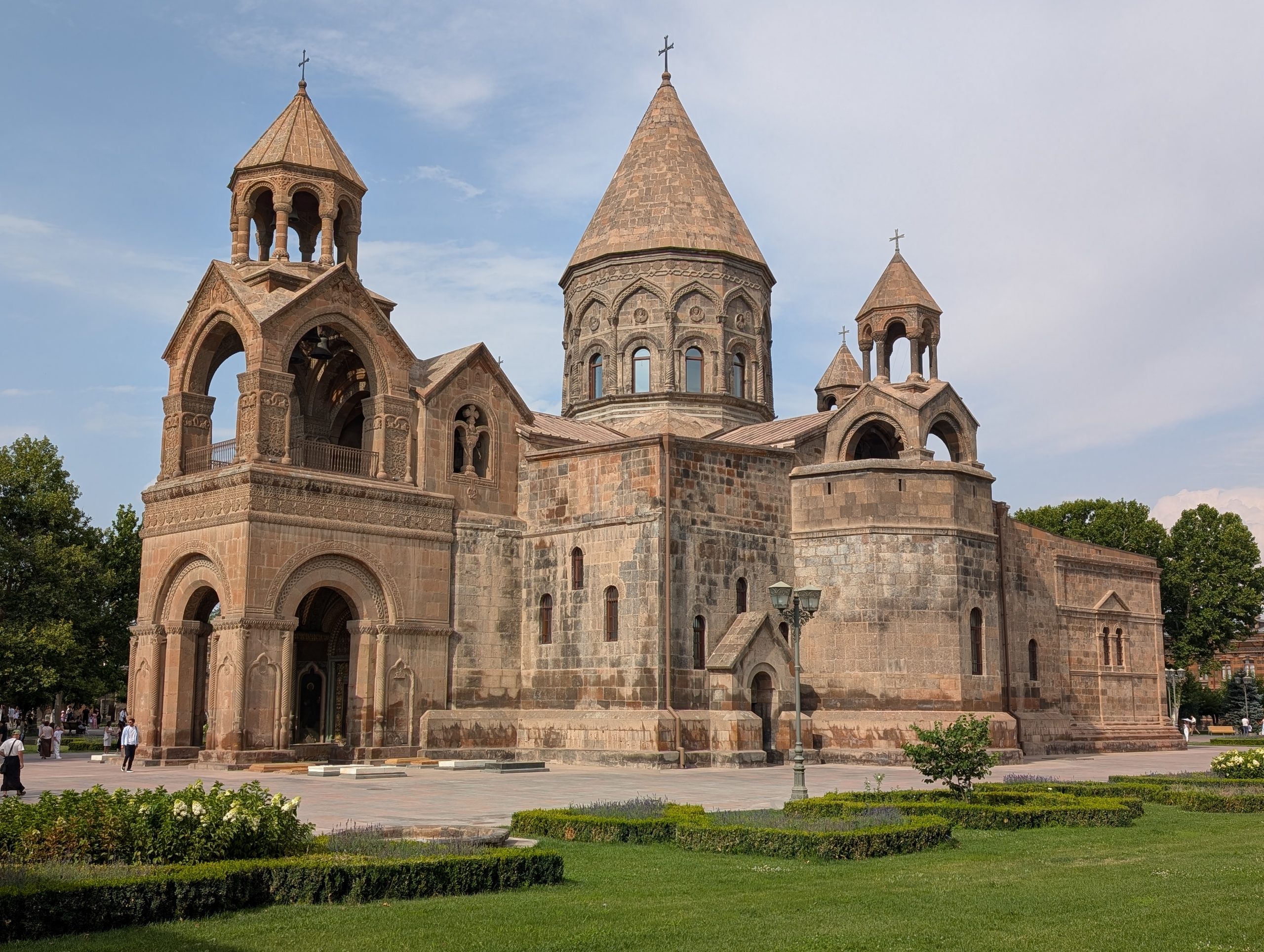
Above: Էջմիածնի մայր տաճար, that is, Etchmiadzin Cathedral, often regarded as the oldest cathedral in the world.
Editor’s note: this is an excerpt from the author’s book City of God vs. City of Man: the Battles of the Church from Antiquity to the Present.
Donate to our Christ the King Campaign to keep OnePeterFive free for all
In the year 297 AD, Rome was at war with Persia again. A Roman officer named Constantine was fighting in this struggle with the Persian “king of kings” over control of Armenia. At the same time another war was being fought over Armenia, this time by St. Gregory the Illuminator:
When they had all been convinced to worship the only true God, Gregory and [King] Tiridates began traveling to other parts of the country to instruct the people and to destroy the altars of the false gods. In many of the provincial towns, demons in the form of armed soldiers fought against the evangelist’s efforts. They were put to flight each time, and then Gregory would tell the people not to be afraid, but to drive out their own personal demons of false worship, and follow Christ. He performed miracles to show the people how loving and powerful God is. And the king gave testimony about his sinful acts, and the miracles and mercy of healing which God had shown him. So they traveled through the provinces and everywhere they spread the light of the Gospel and destroyed the dark pagan superstitions which had held the people captive.[1]
The time had come to overthrow the public thrones of the devils. No man can enter into the house of a strong man and rob him of his goods, unless he first bind the strong man, and then shall he plunder his house (Mk. iii. 27). The demonic power had been destroyed by the Resurrection of Christ, and the demons were usurpers over souls and society. The rightful King cannot take his throne unless he destroys the power of the usurper. This had happened before as seen in Scripture: And all the people of the land went into the temple of Baal, and broke down his altars, and his images they broke in pieces thoroughly (IV Kngs xi. 18). He hath put down the mighty from their seat, and hath exalted the humble (Lk. i. 52). This is why His Majesty used violence in the Temple—His throne had been polluted by the demonic idols of avarice. But with the proclamation of the Gospel to the peoples, the crusading spirit of St. Gregory now shows itself in a public act of violence to dethrone the demonic power. And this is the pattern followed by every saint.
This violence is necessary to show the people that the demons have no power, since the people feared the demons, being bound under the dominion of death. It is an act of cultural momentum to turn everyone to repentance and accept the Good News of liberation from malicious devils. When the saint fearlessly destroys the idols and the demons are powerless to kill him because of the Sign of the Cross, the people can breathe a sigh of relief and place their faith in the King of Kings, and no longer fear the demonic usurpers.
The saint then preaches the Logos and if necessary, works further miracles by the Holy Spirit in order to freely invite the souls of men to be baptized. Those who use their reason can recognize that the demons are powerless and these are miraculous proofs—they receive their King, accept Him and are baptized. Those who are attached to their voluntarist sin choose against reason and seek out their filthy lucre, resisting the Gospel.[2]
Notice the distinction however: in the public order—the king and the coin—where the demons are usurping the throne for all to see, the saint violently attacks them and destroys their false throne. But in the private order—the depths of the human heart and his family—there is no forced Baptism, since the Gospel must be accepted freely. Thus the public order is ruled by one of two forces: Christ the King or Satan the usurper. Therefore a purified, spiritual violence is necessary, detached from any earthly allurement. The kingdom of heaven suffereth violence, and the violent bear it away (Mt. xi. 12).
Once the public order is liberated from Satan, the human soul is freed from the fear of death so that they can be raised up from earthly attachments to the heavenly Kingdom. Thus they can be truly free—that is, free from Satan’s coercion by means of the fear of death—to let go of the earthly city and accept the Kingdom of Heaven and be baptized for the hope of eternal life. This provides the cultural momentum in the public order to protect the little children and the faithful from the inclinations of Original Sin.
Baptism of the Society
The whole society and people is then baptized in the public order: some things are eradicated, some things stay the same, and some things are transformed. This is how Jesus King of Kings becomes “incarnate” in a people, as it is were. He unites the uncreated Logos with the created logos that the pre-Christian people has passed down from Adam.[3] The people’s ancient culture passed down but corrupted is purified of all demonic customs—every token of the usurper which can still enslave the people—is pulled up from the roots. The saint has the spiritual knowledge to discern which things are from logos and which things are not.
Then the two swords are drawn over the public order to cut a covenant—the spiritual sword of the priest and the temporal sword of the king—both must sanction the public order. This is the fundamental inclination of natural law as the history of all peoples shows abundantly. And Joiada [the priest] made a covenant between the Lord, and the king, and the people, that they should be the people of the Lord, and between the king and the people (IV Kngs xi. 17).
This covenant is then ratified by the building of a church over the former idolatrous shrine. This is the thing that is chiefly transformed—the prior “sacred” site, which paid allegiance to the usurper, becomes the earthly throne of the King of Heaven, literally crushing the usurper’s throne.
The cultus is celebrated publicly, which ratifies the covenant. Again we see this public covenant by cultus is seen in Scripture: And he commanded all the people, saying: Keep the passover to the Lord your God, according as it is written in the book of this covenant (IV Kngs xxiii. 21). Thus St. Gregory raised in Armenia what is said to be the oldest cathedral in the world: Etchmiadzin Cathedral. This is the new throne of Christ on earth. For at the altar, soul and sacrament become one, flowing to society.
In the case of Armenia and every kingdom converted since, the public order must be defined by the Logos Incarnate and not voluntarism. Only then can the king and coin (that is, politics and economics) come into order to truly serve the family and the salvation of souls.
Buy the book to read more:
[1] Agathangelos, History of St. Gregory and the Conversion of Armenia, bk. III, trans. anonymous<https://www.livius.org/sources/content/agathangelos/agathangelos-history-3/>, accessed March 23, 2021.
[2] On the phrase “filthy lucre” see I Tim iii. 8; Titus i. 7, 11; I Pet. v. 2.
[3] This is a spiritual analogy which applies the dogma of the Incarnation to the act of conversion. Jesus Christ was Incarnate of the Virgin Mary once and for all but spiritually, not physically, this act is repeated in every Christian people.