
Editor’s note: this is an excerpt from the author’s book City of God vs. City of Man: the Battles of the Church from Antiquity to the Present.
Read part I: “The Bishop’s Altar is the Throne of Christ the King in every City-State-Nation“
Rome
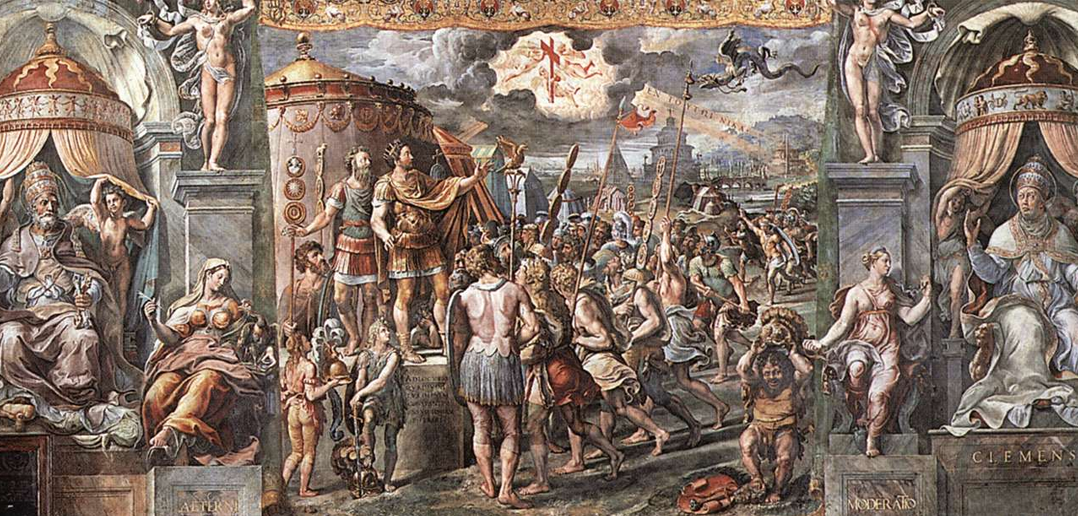
While all this was happening in Armenia, the final attacks of Satan were poured out through Diocletian and his successors, who, says Eusebius, are punished by God with plague, famine and war.[1] Constantine was roused by God to punish the evildoers and received the vision In Hoc Signo Vinces “In This Sign Conquer.” In this God showed a pagan emperor that the only power is in the Cross, not in force of arms. Thou comest to me with a sword, and with a spear, and with a shield: but I come to thee in the name of the Lord of hosts, the God of the armies of Israel, which thou hast defied (I Kngs. xvii. 45). With the banner of the Cross, Constantine’s army rallied the crusading spirit to crush to usurpers.
In 313 the Edict of Milan ended Christian persecution in the Roman Empire.[2] Then the victorious Church already manifested in Armenia continued for Rome. With his mother St. Helena, Constantine rebuilt the great city of Jerusalem and “cast down the idols and the temples which were found there” so that “Jerusalem which had presented a horrible mass of ruins was then adorned with most numerous and magnificent churches.”[3] By a miracle of healing, the True Cross was found and raised up as the new sign of power against the usurpers at the Church of the Holy Sepulcher in Jerusalem.
The public funding of churches is the manifestation of the King of Kings over the public order: the pagan Roman emperors had built the royal stoa (“basilica”) for the glory of their names. Constantine built the basilicas of Old St. Peter’s, St. Paul’s Outside the Walls, and St. John Lateran for the glory of His Holy Name. “The splendor of political dominion over the world was united to the transfigured splendor of holy Rome.”[4] Meanwhile, he built a new city on the Bosphorus as a Christian city, New Rome, and built the church of Hagia Eirene “Holy Peace.” But coins were already being minted exalting the city in his name.[5]
All Nations
And while Constantine and Tiridates were building churches to the King of Kings, St. Frumentius was converting King Ezana of Ethiopia. This kingdom too embraced the true King and converted the public order to His rule.[6] Together they ratified a Christian people with the building of St. Mary of Zion, trampling on the old throne of Satan.[7]
In neighboring Georgia, the devout woman St. Nino was taken captive by the Iberians (Georgians) around 327. Through the providence of God she healed the king’s wife and they were miraculously converted and spread the Gospel. And “the king having ascertained from his prisoner the plan on which churches were constructed among the Romans, ordered a church to be built, and immediately provided all things necessary for its erection; and the edifice was accordingly commenced.”[8] And, thus, the historic Svetitskhoveli Cathedral was built.
Within a few generations of this, a young boy from Roman Britain named Patricius became a victim of the Celtic slave raiders of Ireland. St. Patrick understood his captivity as a punishment from God for his own faithlessness.[9] Through God’s intervention, he was converted and escaped back to Britain.[10] Here he received a vision from God to leave Roman Britain and bear “many persecutions, even chains, so that [he] could give up [his] freeborn state for the sake of others.”[11]
Patrick lamented the slavery of the Irish to demons: “Never before did they know of God except to serve idols and unclean things.”[12] They are “fellow-citizens of demons, because of their evil works. By their hostile ways they live in death.”[13] They were under the dominion of shamans using music to commune with demons. But as Patrick returned to the island they prophesied “by their magical art,” the coming of “a kingdom” that would “destroy all their gods, banish all the works of their craft, and reign for ever.”[14] The pagan cultus (their “greatest feast day”) coincided that year with the Easter celebration that forbade the lighting of fires in their superstition.[15]
When St. Patrick lit the Easter Fire in defiance of the usurping demons, the shaman druids cried out in fear to the pagan king that “the kingdom that has been brought upon by him will overpower us all and you, and will seduce all the people of your kingdom, and all kingdoms will yield to it, and it will spread over the whole country and will reign in all eternity.”[16] The King then proceeded with his chariots and horseback to challenge Patrick, but he met them while uttering the verse some trust in chariots and some in horses, but we will call upon the name of the Lord our God (Ps. xix. 8). One of the druids blasphemed God openly to Patrick, against whom Patrick immediately pronounced a curse as St. Peter did and he died.[17]
At this the king roused his men to kill St. Patrick but he called upon God Who sent darkness and an earthquake while the pagans were thrown into chaos and started to kill one another. Then a showdown of miracles happened between the chief druid and Patrick. The druid, “through the invocation of demons,” performed miracles of bringing snow and fog.[18] When Patrick commanded him to remove these, the druid could not.
“You can do evil and cannot do good. Not so I.” Then he blessed the plain all around, and in no time, without rain or mist or wind, the snow vanished, and the crowds cheered and were greatly astonished and touched in their hearts.[19]
The druid finally tested Patrick by an ordeal of fire, and the druid was killed. As the “wrath of God” began to fall upon the pagans, the king then converted with “many others” and “preached everywhere” working miracles.[20] He “destroyed the idol at Leitrim the idol, Crom Cruach,” and continued on throughout the whole island:
Entering into a pagan territory he first preached to the chief men, knowing that when they were converted the people would follow. Wonderful indeed was his labour, and wonderful its results. He preached in almost every district in Ireland, confounded in argument the druids and won the people from their side; he built, it is said, 365 churches and consecrated an equal number of bishops, established schools and convents, and held synods; and when he died the whole machinery of a powerful Church was in operation, fully equal to the task of confirming in the faith those already converted and of bringing those yet in darkness into the Christian fold.[21]
He established a native clergy from the chieftains and by the 600s, paganism “had all but disappeared.”[22] After learning Latin the Irish Church developed a written script for their native tongue in Gaelic and began to send missionaries to Europe. St. Patrick would be known in Irish as Pádraig.
Thus by the preaching of the Logos and the working of the Holy Spirit, Ireland was converted to the Faith and began to offer cultus to the true King. The public order would henceforth receive the cultural momentum not from the voluntarist demons, but from the Logos Incarnate. Thus from the eastern border kingdoms of the Roman Empire, Georgia and Armenia, to the southern extremities in Ethiopia, and the northwest in Ireland, the saints understood that the public cultus of demons must be overthrown, and the throne of the King of Kings raised in its place.
The Public Cultus
St. Thomas says of the cultus that “at all times and among all nations there has always been the offering of sacrifices… and consequently the offering of sacrifice is of the natural law.”[23] Every people has offered cultus to the divine in a public act of the ruling government because this is the dictate of natural reason. The people received therefrom their principle of moral order.
Before the Gospel peoples offered cultus to false gods and fell into bondage to voluntarism, as the demons enslaved them to the “freedom” of their own will from logos. But the universal teaching of the saints was to transfer this public cultus from the false gods to the true God. This was due to the fundamental truth that human nature was wounded by Original Sin. Therefore divine grace was necessary for the public order, and hence the public cultus. Without this public supplication for divine grace, man, being ordered by natural reason to worship, would fall once again to the bondage to demons. The public cultus was the declaration of freedom from demonic occupation.
Just as it had been for the family in the private order, the public cultus would become the fundamental root of Christian culture everywhere, which began to form Christian peoples, the symbolic act of which was the king and bishop building a church on the ruins of pagan temples. This bond between bishop and king thus became the bond between soul and body of a people. The bishop publicly celebrated the cultus, from which came the soul of the people in the principle of moral order. The king, representing the body of the people, received direction from the cultus and then ordered the government, economy and families accordingly.
In the public order, the rights of God must be maintained and the king, coin and kitchen must be submitted to the King of Kings. In the private order, the rights of man must be maintained and no one should be forced to be baptized. The danger is that the rights of man could supplant the rights of God in the public order.
But while this conversion of faith was an event of Baptism, the conversion of morals would take centuries. For just as before, the powerful would not accept this new rule of logos without a fight. The enemies of the Church were ever at work seeking to undermine Christ’s Kingdom ruled from the hearts of men. At this same time the Persian “king of kings,” Shapur II (309-379) was provoked to “extreme cruelty,” embarking on a campaign against every soul who said Christ was King of Kings.[24] Wigram suggests this was urged on by the enemies of Christ among the Jews, heretics and pagans, eventually killing, says Sozomen, 16,000 Christians and others “beyond enumeration.”[25] Between 337-361 he would also make war on Rome from without. The Church’s enemies sought to destroy the Kingdom in the Persian Empire with the old methods, but in the Roman Empire some new tactic had to be found. For “the devil, seeing the temples of the demons deserted, and the human race running to the name of the liberating Mediator…moved the heretics under the Christian name to resist the Christian doctrine.”[26] This would necessitate a union between the moderate and strict parties to face a new danger.
[1] Eusebius, Church History,bk. IX, ch. 8.
[2] Socrates Scholasticus, Church History, bk. I, ch. 2; Sozomen, Church History, bk. II, ch. 3.
[3] Sulpitius Severus, Sacred History, bk. II, ch. 33.
[4] Dietrich von Hildebrand, Aesthetics, vol. II, 76.
[5] Richard Abdy “Tetrachy and the House of Constantine,” William E. Metcalf ed. The Oxford Handbook of Greek and Roman Coinage (Oxford University Press: 2012) 595.
[6] Socrates, Church History,bk. I, ch. 19; Fr. John Meyendorff, Imperial Unity and Christian Division (St. Vladimir’s Seminary Press, 2011), 118.
[7] “Sacred Sites of Ethiopia and the Arc of the Covenant,” World Pilgrimage Guide https://sacredsites.com/africa/ethiopia/sacred_sites_ethiopia.html. Accessed February 3, 2021.
[8] Socrates, op. cit., bk. I, ch. 20.
[9] St. Patrick, Confessions, 1, trans. McCarthy <https://www.confessio.ie/etexts/confessio_english#>, accessed March 23, 2021.
[10] Ibid., 17.
[11] Ibid., 23, 37.
[12] Ibid., 41.
[13] Ibid., Letter to the Soldier of Coroticus, 2, trans. McCarthy <https://www.confessio.ie/etexts/epistola_english#01>, accessed March 23, 2021.
[14] Muirchú, Life of Holy Patrick the Confessor, I.10, trans. L. Bieler <https://www.confessio.ie/more/muirchu_english#>, accessed March 23, 2021.
[15] Ibid., I.19, 1.
[16] Ibid., I.15, 6.
[17] Ibid., 1.17 5-6.
[18] Ibid., I.20.
[19] Ibid., I.20.
[20] Ibid., I. 21, 22.
[21] E. D’Alton, “Ireland,” The Catholic Encyclopedia (1910) <www.newadvent.org/cathen/08098b.htm>, accessed September 28, 2021.
[22] Ibid.
[23] Summa, II-II q85 a1.
[24] Sozomen, Church History, bk. II, ch. 14.
[25] Ibid.; W. A. Wigram, An Introduction to the History of the Assyrian Church (London: Society for Promoting Christian Knowledge, 1911), 62.
[26] Augustine, City of God, bk. XVIII, ch 51.