

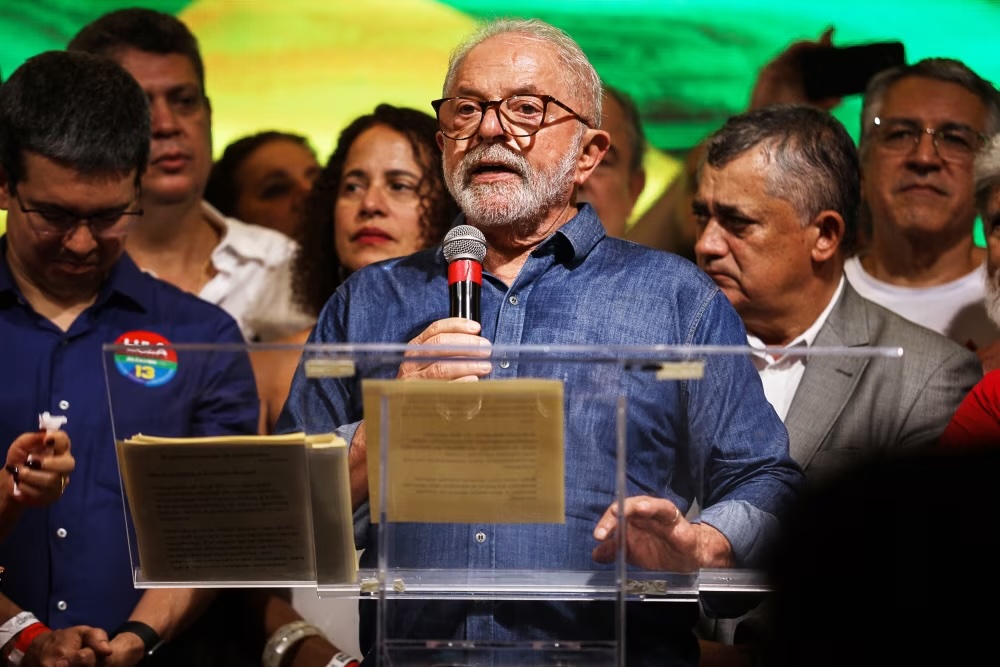
Above: Luiz Inacio Lula da Silva, recently re-elected president of Brazil. Photo credit.
Brazil’s political situation is complex. Since the June 2013 protests, when demonstrations swept through hundreds of cities, the country has experienced successive crises and deepening polarization. Initially heterogeneous, those protests expressed a range of grievances and marked a turning point in public life. In the years that followed, rivalry between the Right and the Left intensified, reaching families, institutions, and religious communities. During the 2026 elections, Brazilian Catholicism also participated in this process, both through initiatives promoting dialogue and through its leaders’ political positions, which drew support and protests from millions of Catholics.
Against this backdrop, more than 60 bishops signed a letter whose content favored Luiz Inácio Lula da Silva and rejected Flávio Bolsonaro, son of former president Jair Bolsonaro. This statement must be understood in historical perspective: it reflects a current within Catholicism that brings together evangelization, grassroots organizing, the defense of workers, and the preferential option for the poor.
Its roots lie in the pastoral and social transformations that developed from the 1950s onward, during the period when the National Conference of Bishops of Brazil (CNBB) was founded. This renewal deserves a separate analysis, which we will develop in another article. Here, it is important to clarify that the electoral support came from the bishops who signed the letter in their individual capacities and did not constitute an official endorsement by the episcopal conference.
The letter released before the second round did not name the candidates. Nevertheless, its descriptions made the authors’ preference identifiable. The candidate presented as committed to the poor, workers, environmental protection, and the democratic order was Lula. The candidate portrayed as a threat to democracy, social rights, and national sovereignty (including through his alignment with the United States), was Flávio Bolsonaro. The endorsement was indirect in its wording but clear in its political meaning.
Some signatory bishops stated that they were merely offering criteria for Christian discernment without asking for votes. This explanation describes the document’s form but does not eliminate its electoral direction. Omitting names does not make a message neutral: the selection of issues and the comparison between the candidates communicated an identifiable choice. It is therefore reasonable to interpret the letter as electoral support for Lula, although without an explicit request to vote for him by name.
To understand this convergence, we must look back at the history of the Catholic Church in Brazil. Founded in 1952, the CNBB brought together different theological and political outlooks. It did not begin as a uniformly Left-wing institution. In 1964, its leadership supported the ousting of President João Goulart (1919–1976). Subsequently, in response to repression, torture, and persecution, episcopal denunciations of Brazil’s military dictatorship became more widespread. The defense of human rights gained prominence, although some bishops continued to support the regime.
The Second Vatican Council, held between 1962 and 1965, and the Latin American episcopal conferences in Medellín in 1968 and Puebla in 1979 provided reference points for pastoral renewal. Poverty increasingly came to be examined as a consequence of economic structures and power relations. For sectors of the Church, evangelization meant confronting conditions that denied people their dignity.
This engagement contributed to accusations of Communism against members of the progressive clergy. Some accusations reflected substantive disputes over the use of Marxism; others confused any advocacy of social reform with Communist allegiance. This distinction matters: commitment to the poor can bring Catholics closer to Left-wing organizations without implying full acceptance of their ideologies.
Building on earlier experiences of social Catholicism, Liberation Theology developed its own distinctive formulation in the 1960s. It connected reflection on faith with the historical experience of the poor and the possibilities for social transformation. Its different formulations, particularly the use of Marxist categories, generated controversy and prompted doctrinal interventions from Rome in the 1980s, during the pontificate of John Paul II, with Cardinal Joseph Ratzinger playing a central role.
Basic Ecclesial Communities (Comunidades Eclesiais de Base, CEBs) were fundamental to this process. Some experiences preceded the systematization of Liberation Theology; many subsequently became settings for its reception. Organized in neighborhoods, urban outskirts, and rural areas, they brought people together to celebrate their faith, read the Bible, and reflect on everyday problems. Unemployment, land conflicts, and inadequate housing became part of community discussion.
The CNBB formally recognized their importance, particularly in Document 25 of 1982. The CEBs also helped develop leaders: participants learned to organize meetings, speak publicly, formulate demands, and act collectively. Under a dictatorship that restricted political participation, Church settings provided spaces for gathering and mobilization. These experiences fostered ties among Catholic activists, trade unions, grassroots movements, and left-wing organizations.
The Workers’ Party (Partido dos Trabalhadores, PT), founded on February 10, 1980, emerged from a convergence of trade unionists, intellectuals, Left-wing activists, and members of the CEBs and other expressions of social Catholicism. Having risen to prominence through the mobilization of metalworkers in São Paulo’s ABC industrial region, Lula became its principal leader. Catholic participation was significant, but the party was not institutionally founded by the Church or the CNBB.
These origins explain why the relationship between the PT and certain Catholic sectors extends beyond occasional electoral alliances. There are shared histories, personal ties, and decades of experience in grassroots organizing. The relationship also involves conflict: pastoral workers may support the party while criticizing its governments, alliances, and decisions.
In rural areas, the Pastoral Land Commission (Comissão Pastoral da Terra, CPT) became particularly important. It was established in June 1975 during a meeting of Amazonian bishops and prelates in Goiânia. Its emergence responded to violence against squatters and rural workers, concentrated land ownership, and labor exploitation. The CPT began accompanying communities, denouncing abuses, and supporting the organization of rural populations, developing a pastoral ministry with social and political consequences.
The Landless Rural Workers’ Movement (Movimento dos Trabalhadores Rurais Sem Terra, MST) was established nationally in 1984 in Cascavel, Paraná, bringing together different experiences of struggle for land. The CPT helped connect workers and leaders involved in this process. The movement nevertheless developed its own leadership and organization. Its proximity to pastoral workers and the PT does not negate its autonomy or the disagreements it has had with PT governments.
The Youth Pastoral Ministry (Pastoral da Juventude, PJ), drawing on the legacy of Catholic Action, became more organized particularly during the 1970s. Its groups combined Christian formation, community life, and reflection on social realities. Gatherings and educational activities encouraged young people’s participation. Some of its leaders later joined student movements, trade unions, grassroots organizations, and political parties, including the PT.
The University Pastoral Ministry (Pastoral Universitária, PU) has historical roots in Catholic University Youth (Juventude Universitária Católica, JUC), an important expression of Catholic engagement in student life. Its work connects faith, knowledge, academic life, and social responsibility. Parts of this milieu engaged with progressive perspectives and movements for political transformation. Its history nevertheless encompasses different orientations and cannot be reduced to party activism.
The Workers’ Pastoral Ministry (Pastoral Operária, PO) developed in different regions, especially during the 1970s, with participants from Young Christian Workers (Juventude Operária Católica, JOC), Workers’ Catholic Action (Ação Católica Operária, ACO), and other initiatives. Its work addressed wages, unemployment, working conditions, trade union organizing, and life on the urban periphery. This engagement encouraged closer ties with the labor movement and sectors of the left.
The PT, MST, CPT, PJ, PU, and PO therefore differ in nature. The PT is a political party; the MST is a social movement; the other organizations belong to the sphere of pastoral ministry. Their histories nevertheless intersect through shared activists and converging commitments to social rights. This network helps explain the affinity of certain sectors of the episcopate with Lula.
When considering the bishops’ orientation, we must distinguish doctrinal, economic, and electoral positions. A bishop may uphold Catholic teaching on abortion, euthanasia, and marriage while supporting labor rights, agrarian reform, and greater state intervention in the economy. He may also reject Bolsonarism without considering himself Left-wing. Conventional political classifications do not fully capture these combinations.
The CNBB grounds its work in Catholic social teaching, which values the common good, solidarity, subsidiarity, and human dignity. Its criticism of the subordination of social life to economic interests can bring it closer to causes championed by the Left. Nevertheless, this teaching also recognizes private property, economic initiative, and limits on state intervention. Reducing it to Communism or a party platform impoverishes our understanding of it.
In my interpretation, the language prevailing in the CNBB’s social engagement is closer to the center and center-Left than to the Bolsonaro-aligned Right. Some bishops identify with Right-wing positions, but this orientation does not determine the institution’s statements as a whole. This interpretation allows us to discuss a predominantly Left-leaning outlook in its public engagement, but it does not establish the numerical ideological distribution of the episcopate.
Many clergy members sympathetic to progressive causes likewise do not describe themselves as “Left-wing bishops.” They ground their positions in the Gospel and pastoral responsibility. This foundation can be sincere while also producing electoral effects. Understanding their orientation requires examining their priorities, interlocutors, and concrete positions, beyond the labels they accept or reject.
There is a difference in style compared with certain Protestant leaders who endorse candidates, appear at campaign rallies, and associate electoral projects with divine will. Some Catholic bishops prefer the language of moral and pastoral criteria. This discretion does not imply the absence of a position: a preference can be communicated without naming names. Neither style, however, characterizes all bishops or all pastors.
In the manifesto, criticisms of Flávio Bolsonaro concerned labor rights, access to firearms, environmental protection, national sovereignty, his closeness to the United States and Donald Trump, and doubts about his commitment to democracy. In the signatory bishops’ assessment, Lula was more compatible with these priorities. These judgments belong to the letter’s authors: their religious foundation does not automatically turn an electoral assessment into binding doctrinal teaching. Accordingly, the bishops’ letter was accepted by millions of Catholics and rejected by millions of others.
Nor is Catholic social teaching entirely synonymous with the PT’s platform. Agreement on certain policies coexists with disagreement on life, family, and other issues. Supporting a candidacy represents a choice between historical alternatives without implying unconditional approval of the party or its government.
Following Lula’s victory on October 25, 2026, the CNBB congratulated the reelected presidential ticket and called for priority to be given to the poor, reconciliation, and respect for institutions. It also reaffirmed the defense of life from conception to natural death. This statement following the result must be distinguished from the electoral support previously expressed by the signatory bishops.
Flávio Bolsonaro’s departure for the United States, with the Trump administration’s support for his entry, added another element to the post-election situation. The episode relates to the signatories’ concerns about foreign alignment, but it does not reveal how the bishops voted. Political support for his admission also does not necessarily amount to a personal reception by the U.S. president.
The history examined here makes it plausible that support for Lula extended beyond the group of signatory bishops, possibly reaching a majority of the episcopate. This hypothesis nevertheless remains unproven: voting is secret, and the signatures do not constitute a representative sample.
More than 60 bishops expressed politically clear electoral support for Lula, without episcopal unanimity or the CNBB’s official endorsement. This choice reflects a Catholic tradition that places social issues at the center of its concerns and finds common ground with sectors of the Left. Understanding it requires recognizing its historical ties and political effects while preserving the distinction between electoral preference and doctrinal authority in a country that remains far from political reconciliation.