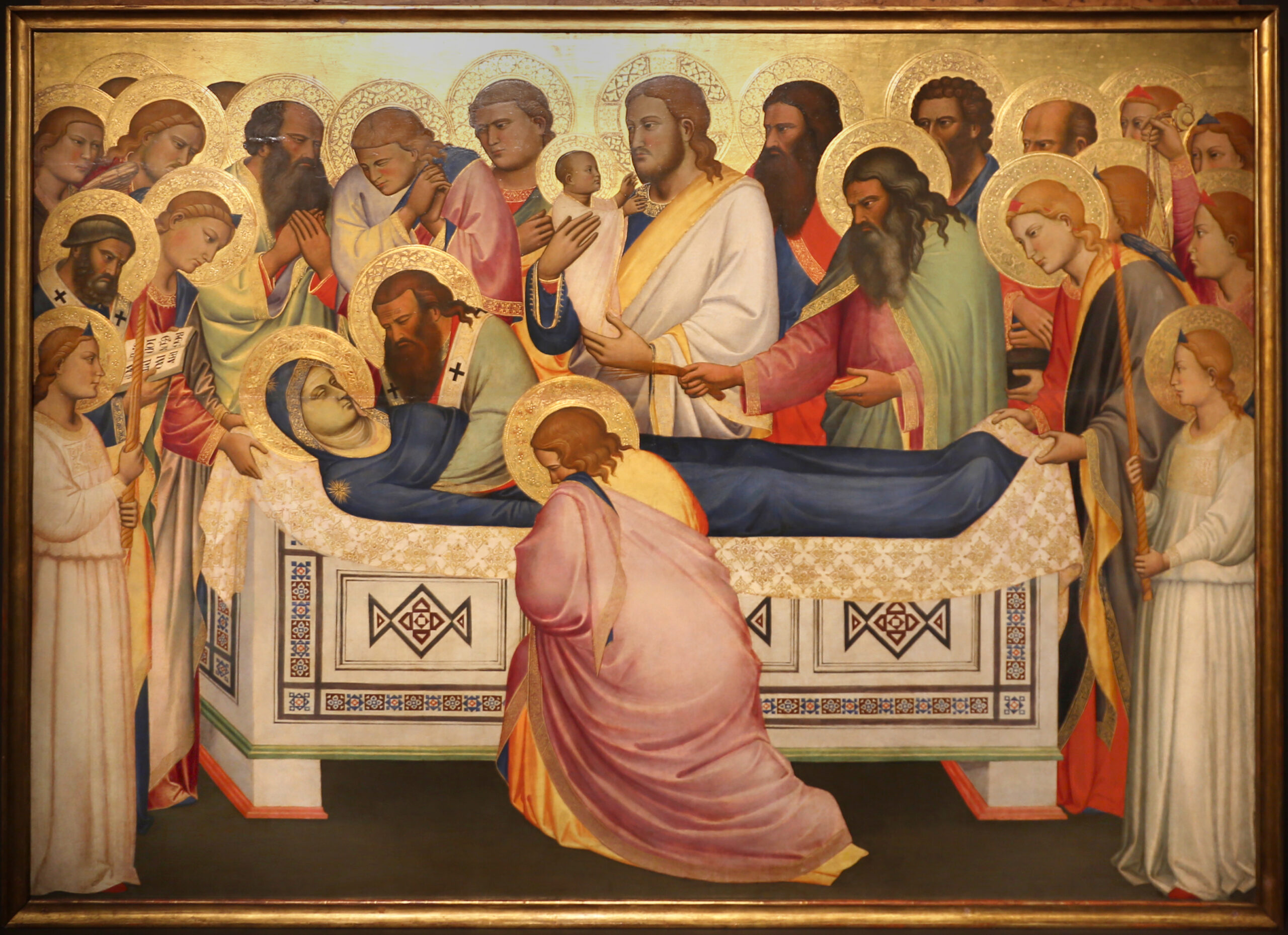
Above: Niccolò di Pietro Gerini, Death and Assumption of the Virgin, c. 1370–1375.
℣. Grant, Lord, a blessing.
Benediction. May God the Father Omnipotent, be to us merciful and clement.
℟. Amen.
Reading 4
From the Sermons of St. Bernard, Abbot of Clairvaux.
1st on the Assumption.
When the glorious Virgin this day mounted upon the heavens, without doubt, she abundantly increased the joy of the citizens above. This same is she the voice of whose salutation maketh to leap with joy even such as are still shut up in their mothers’ bellies (Luke i. 41, 44). If the soul of an unborn babe melted when Mary spake, what must we imagine to have been the jubilation of the heavenly ones, when it was their reward at once to hear her voice, and to see her face, and to enjoy her blessed presence.
℣. But thou, O Lord, have mercy upon us.
℟. Thanks be to God.
℟. When the Lord beheld the daughter of Jerusalem adorned with her jewels, He greatly desired her beauty
* And when the daughters of Zion saw her, they cried out that she was most blessed, saying thy name is as ointment poured forth.
℣. Upon thy right hand did stand the Queen in a vesture of gold wrought about with diverse colours.
℟. And when the daughters of Zion saw her, they cried out that she was most blessed, saying thy name is as ointment poured forth.
℣. Grant, Lord, a blessing.
Benediction. May Christ to all His people give, for ever in His sight to live.
℟. Amen.
Reading 5
But who also can picture to himself with what glory the Queen of the world went forth, and with what keen desire the whole multitude of the armies which are in heaven came out to meet her, with what hymns she was led to her throne of glory, with what a look of peace, with what a countenance of grace, with what Divine embraces her Son welcomed her, and set her above everything which God hath made? It was that be taken away from her honour of which such a Mother was worthy, and with that glory which beseemed such a Son.
℣. But thou, O Lord, have mercy upon us.
℟. Thanks be to God.
℟. All generations shall call me blessed.
* For He that is mighty, even the Lord, hath done to me great things; and Holy is His Name.
℣. And his mercy is on them that fear Him, from generation to generation.
℟. He that is mighty, even the Lord, hath done to me great things; and Holy is His Name.
℣. Grant, Lord, a blessing.
Benediction. May the Spirit’s fire Divine in our hearts enkindled shine.
℟. Amen.
Reading 6
Sweet indeed were the kisses which the Suckling, Whom His Mother had praised while yet He lay hid in her virginal womb, pressed upon her lips. But shall we not believe that sweeter were those which she received from Him in blessed welcome, when He was sitting at the right hand of His Father, and she went up to the throne of His glory, singing the marriage-song and saying Let Him kiss me with the kisses of His mouth? (Cant. i. 2). Who shall declare the generation of Christ or the Assumption of Mary? So much as she found grace on earth more than others, so much more excellent than that of others is the glory which she hath in heaven.
℣. But thou, O Lord, have mercy upon us.
℟. Thanks be to God.
℟. Blessed art thou, O Virgin Mary, who hast carried the Lord, the Maker of the world.
* Thou hast borne Him Who created thee, and thou abidest a virgin for ever.
℣. Hail, Mary, full of grace. The Lord is with thee.
℟. Thou hast borne Him Who created thee, and thou abidest a virgin for ever.
℣. Glory be to the Father, and to the Son, * and to the Holy Ghost.
℟. Thou hast borne Him Who created thee, and thou abidest a virgin for ever.
[from the 1888 Office containing the readings for St. Jane Frances de Chantal]
℣. Grant, Lord, a blessing.
Benediction. May God the Father Omnipotent, be to us merciful and clement.
℟. Amen.
Reading 4
Jeanne Frances Fremiot de Chantal was born of parents of the highest rank, at Dijon in Burgundy, on the 23rd day of January, in the year 1575. From her earliest childhood she gave no dark promise of a life of eminent holiness. It is said that when she was scarcely fifteen years of age she confuted with precocious acuteness a Presbyterian nobleman, and when he gave her a little present she put it in the fire, saying “That is how heretics will burn in hell for not believing Christ when He speaketh.” On the death of her mother, she placed herself under the keeping of the Virgin Mother of God, and discharged a maid who strove to beguile her into loving the world. She had nothing youthful about her ways. She shrank from the pleasures of life. She had a strong wish that she might die a martyr. She devoted herself unweariedly to religion and godliness. Her father gave her in marriage, at twenty years of age, to the Baron de Chantal, and she strove to excel in all the duties and graces of a wife. She made it her work to see that her children, her servants, and all others under her authority were taught the doctrines of the faith and the practice of good living. She relieved the sufferings of the poor by plentiful almsgiving, for which purposes God not unfrequently miraculously multiplied her money. And so it came to pass that no one ever asked her for food in Christ’s name and was refused it.
℣. But thou, O Lord, have mercy upon us.
℟. Thanks be to God.
℟. Because of truth, and meekness, and righteousness;
* And thy right hand shall lead thee wonderfully.
℣. In thy comeliness, and thy beauty, go forward, fare prosperously, and reign.
℟. And thy right hand shall lead thee wonderfully.
℣. Grant, Lord, a blessing.
Benediction. May Christ to all His people give, for ever in His sight to live.
℟. Amen.
Reading 5
When her husband was accidentally killed out shooting, in her widowhood she determined to embrace the more excellent way, and took a vow not to marry again. She bore her bereavement with resignation to the Will of God, and so far overcame her horror of the gentleman who had fired the shot, that, to show she attributed no blame to him, she stood god-mother to his little boy. She was quite content with few servants and plain cookery and dress, and sold her rich wardrobe for the benefit of charities. She received offers of second marriage which would have been both politic and honourable, but never was induced to accept one of them, and to harden herself in her intention of remaining in her widowhood, she renewed her vow to that effect, and branded on her chest with a hot iron the most holy name of Jesus Christ. Her love grew tenderer every day, and she had brought to her the starving, the abandoned, the diseased, and those who were afflicted with the most sickening disorders. Them she not only sheltered, comforted, and nursed, but washed and mended their filthy and ragged garments, and shrank not from putting her mouth to their sores oozing with disgusting matter. Whatever of her time was not taken up by her household duties she spent in prayer, reading godly books, and working.
℣. But thou, O Lord, have mercy upon us.
℟. Thanks be to God.
℟. Thou hast loved righteousness, and hated iniquity;
* Therefore God, thy God, hath anointed thee with the oil of gladness.
℣. Because of truth, and meekness, and righteousness.
℟. Therefore God, thy God, hath anointed thee with the oil of gladness.
℣. Grant, Lord, a blessing.
Benediction. May the Spirit’s fire Divine in our hearts enkindled shine.
℟. Amen.
Reading 6
She used the services of St. Francis de Sales as her spiritual adviser, and when she learnt from him what was the will of God, she scrupled not to disregard the wishes of her own father, brother-in-law, and even of her son, whom she left with calm determination, went forth from her home, and founded the holy Institution of the Sisters of the Visitation of St. Mary, at Annecy, upon Trinity Sunday 1610. She most rigidly kept the rules of this Institute, and loved so well to be poor, that it made her glad to lack even the necessaries of life. She showed herself a model of Christian lowliness, obedience, and all graces. Having settled in her heart still to go up higher and higher towards the Temple of the Lord, she bound herself by a most difficult vow always to do that which she should understand to be best. It was chiefly through her labour that the holy Institute of the Visitation became spread far and wide, and she stirred up the sisters to godliness and love by her words, by her example, and by writings full of Divine wisdom. She duly received the Sacraments before her death, and then, at Moulins, on the 13th day of December, in the year 1641, departed hence, to be for ever with the Lord. St. Vincent of Paul, who was far distant, in a vision beheld her soul borne to heaven, and St. Francis de Sales coming to meet it. Her body was afterwards taken to Annecy. She was famous for miracles both before and after her death, and Pope Benedict XIV enrolled her among the Blessed, and Pope Clement XIII among the Saints. Pope Clement XIV ordered her Feast-day to be kept by the whole Church upon the twenty-first day of August.
℣. But thou, O Lord, have mercy upon us.
℟. Thanks be to God.
℟. Favour is deceitful, and beauty is vain
* A woman that feareth God she shall be praised.
℣. Give her of the fruit of her hands, and let her own works praise her in the gates.
℟. A woman that feareth God she shall be praised.
℣. Glory be to the Father, and to the Son, * and to the Holy Ghost.
℟. A woman that feareth God she shall be praised.