
℣. Grant, Lord, a blessing.
Benediction. May God the Father Omnipotent, be to us merciful and clement.
℟. Amen.
Reading 4
From the Encyclical Letter of Pope Pius XI
According to that degree of perfection wherewith our oblation and our sacrifice do correspond to the Sacrifice of our Lord, that is to say, to the extent that we have immolated love of self and its passions, and thereby have crucified our flesh in that mystical crucifixion concerning which the Apostle wrote, in that same degree shall we gather the fruits of propitiation and expiation for ourselves and for others. For a wondrous bond doth join all the faithful unto Christ, namely, that bond which uniteth the Head with the members of the body, which is to say, the Communion of the Saints, a bond full of mystery in which we as Catholics do nevertheless verily believe. By virtue of this bond, individuals and nations are not only united the one with the other, but likewise with the Head itself, which is Christ: from whom the whole body, fitly joined together and compacted by that which every joint supplieth, according to the working in due measure of each several part, maketh increase of the body unto the building up of itself in love. This verily was the prayer which Christ Jesus himself, the Mediator between God and man, made at the time of his death: I in them, and thou in me, that they may be perfected into one.
℣. But thou, O Lord, have mercy upon us.
℟. Thanks be to God.
℟. The Lord is nigh unto all them that call upon him,
* Yea, unto all such as call upon him faithfully.
℣. The Lord is full of compassion and mercy, long-suffering and of great goodness.
℟. Yea, unto all such as call upon him faithfully.
℣. Grant, Lord, a blessing.
Benediction. May Christ to all His people give, for ever in His sight to live.
℟. Amen.
Reading 5
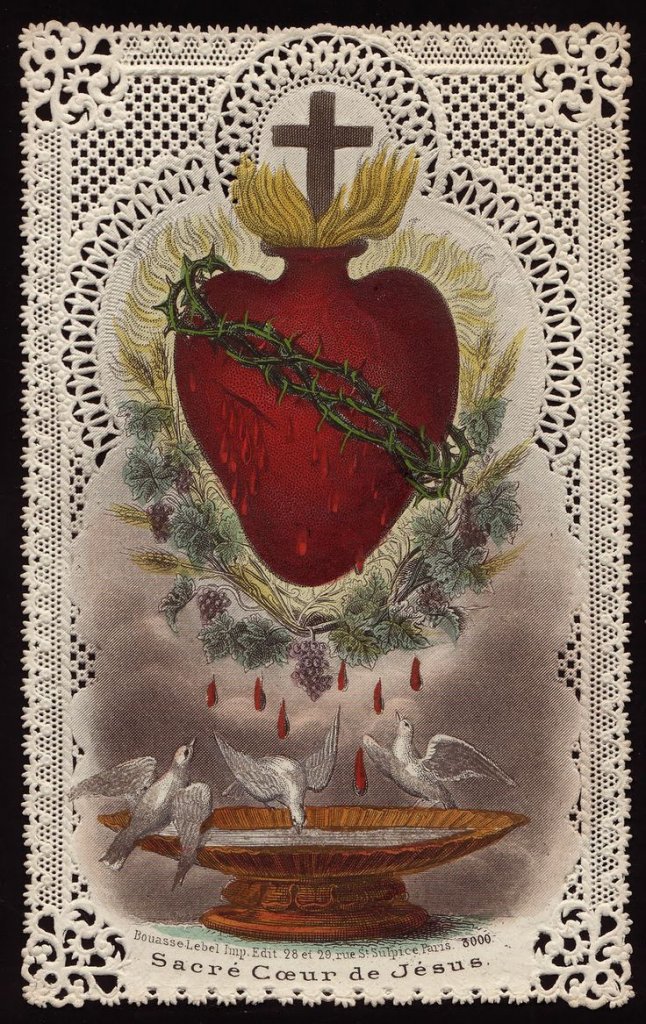
Therefore, even as our effort at consecration doth manifest and strengthen our union with Christ, so our practice of expiation (by purifying us from sins) is the beginning of such union; wherefrom our participation in the sufferings of Christ is the means of perfecting such union; and the offering which we make to him of our sacrifices for the welfare of our brethren bringeth such union to its final consummation. Now this is precisely the design of the mercy of Jesus, when he doth unveil to the gaze of mankind his Heart, surrounded by the emblems of his passion, and aflame with the Fire of Love, namely: that we, on the one hand, perceiving the unlimited malice of sin, and on the other, filled with a knowledge of the infinite love of him who is The Reparator, may detest sin more heartily, and substitute for it a burning love for him. And verily, the spirit of expiation or of reparation hath always played a chief part in the devotion to the most Sacred Heart of Jesus, and reparation is most consonant with the origin, nature, efficacy and particular practices of this special devotion, a fact confirmed by history and the customs of the faithful, by the sacred liturgy, and by the official documents of the Supreme Pontiffs.
℣. But thou, O Lord, have mercy upon us.
℟. Thanks be to God.
℟. I thank thee, O Father, Lord of heaven and earth, because thou hast hid these things from the wise and prudent;
* Yea, thou hast revealed them unto babes.
℣. Even so, Father, for so it seemed good in thy sight.
℟. Yea, thou hast revealed them unto babes.
℣. Grant, Lord, a blessing.
Benediction. May the Spirit’s fire Divine in our hearts enkindled shine.
℟. Amen.
Reading 6
Inasmuch as, when Christ revealed himself to the sight of Margaret Mary, though he then insisted on the immensity of his love, at the same time, with sorrowful mien, he grieved over the great number of horrible outrages heaped upon him by the ingratitude of mankind, he used then these words, words which should be graven on the hearts of all pious souls so as never to be forgotten by them: Behold that Heart which hath so loved men; which same hath heaped upon them so many benefits; in return for whose infinite love no gratitude is to be found; but instead cometh unto it forgetfulness, indifference, outrages; and all such things do come at times even from souls that are bound closely thereunto by the bonds of a very special love.
℣. But thou, O Lord, have mercy upon us.
℟. Thanks be to God.
℟. All nations whom thou hast made shall come,
* And they shall worship thee, O Lord.
℣. Yea, they shall glorify thy Name, for thou art great, and doest wondrous things.
℟. And they shall worship thee, O Lord.
℣. Glory be to the Father, and to the Son, * and to the Holy Ghost.
℟. And they shall worship thee, O Lord.
℣. Grant, Lord, a blessing.
Benediction. May the Gospel’s holy lection Be our safety and protection.
℟. Amen.
Reading 7
From the Holy Gospel according to John
John 19:31-37
At that time: The Jews, because it was the Preparation, that the bodies should not remain upon the cross on the Sabbath Day, for that Sabbath Day was an high day, besought Pilate that their legs might broken, and that they might be taken away. And so on.
A Homily by St. Bernardin of Siena
John continueth: One of the soldiers with a spear pierced his side, and forthwith came there out blood and water. O Love, thou that canst dissolve all things, how thou didst flow forth from our Beloved, for the sake of our redemption! In order that this thy flood of love might spread everywhere, the great firmament was rent above us, even the heights of the Heart of Jesus, which the cruel spear did not fail to pierce to its innermost abyss. And forthwith came there out blood and water. Blood for redemption flowed out, but also water for cleansing; whence the Church was formed from the side of Christ, that she might know herself ever to be the sole-beloved one of Christ, and that she might understand how greatly sin displeaseth him, as she seeth his divine blood flow forth from the God-Man, both in life and in death. For if the divine blood be shed for us, then we cost not a little.
℣. But thou, O Lord, have mercy upon us.
℟. Thanks be to God.
℟. If I be lifted up,
* I will draw all men unto me.
℣. This he said, signifying what death he should die.
℟. I will draw all men unto me.
℣. Grant, Lord, a blessing.
Benediction. God’s most mighty strength alway be His people’s staff and stay.
℟. Amen.
Reading 8
The water flowed not forth intermingled with the blood. For if it had so done, it could not have been perceived by simple folk. And perchance all the blood flowed forth from that divine body, as a sign that all his love was poured out, after which a watery humour came forth. Verily this was a token of a profound mystery, to wit, that from one and the same body came forth first the price of our redemption amongst all peoples. For many waters may be taken to signify many peoples; yet all who belong to the Christian Faith, are one people in the Faith, so that they are not as many waters; rather they are as one stream of water, and as such did flow from the side of Christ, as saith the Apostle in the tenth chapter of the former Epistle to the Corinthians: For we being many are one bread, and one body: for we are all partakers of that one bread and one cup. And again, in the fourth chapter of Ephesians, he saith: One God, one faith, one baptism.
℣. But thou, O Lord, have mercy upon us.
℟. Thanks be to God.
℟. Be ye therefore followers of God;
* And walk ye therefore in love.
℣. For Christ also hath loved us and hath given himself for us.
℟. And walk ye therefore in love.
℣. Glory be to the Father, and to the Son, * and to the Holy Ghost.
℟. And walk ye therefore in love.
℣. Grant, Lord, a blessing.
Benediction. May He that is the Angels’ King to that high realm His people bring.
℟. Amen.
Reading 9
Nevertheless, it is especially deserving of our attention that the side of Christ is said to have been pierced, that is, set open, not wounded, since a wound cannot properly be said to be inflicted except on a living body. For John the Evangelist saith: One of the soldiers with a spear pierced his side: that through this side thus opened, we might become aware of the love of his Heart, even unto death, and that we might enter into that unutterable love of his, through the same channel whereby it came unto us. Let us draw near then to his Heart, a deep Heart, a hidden Heart, a Heart thinking of all, a Heart knowing all, a Heart loving, yea, even on fire with love. Let us also recognize at least in the vehemence of his love that the gate is open; with our hearts made like unto his, let us enter into that secret place, hidden from all eternity, but now in death revealed, as it were, through the open side; for the opening of his side is a figure of the opening of the eternal temple, where is consummated the everlasting happiness of every creature.
℣. But thou, O Lord, have mercy upon us.
℟. Thanks be to God.
Te Deum