
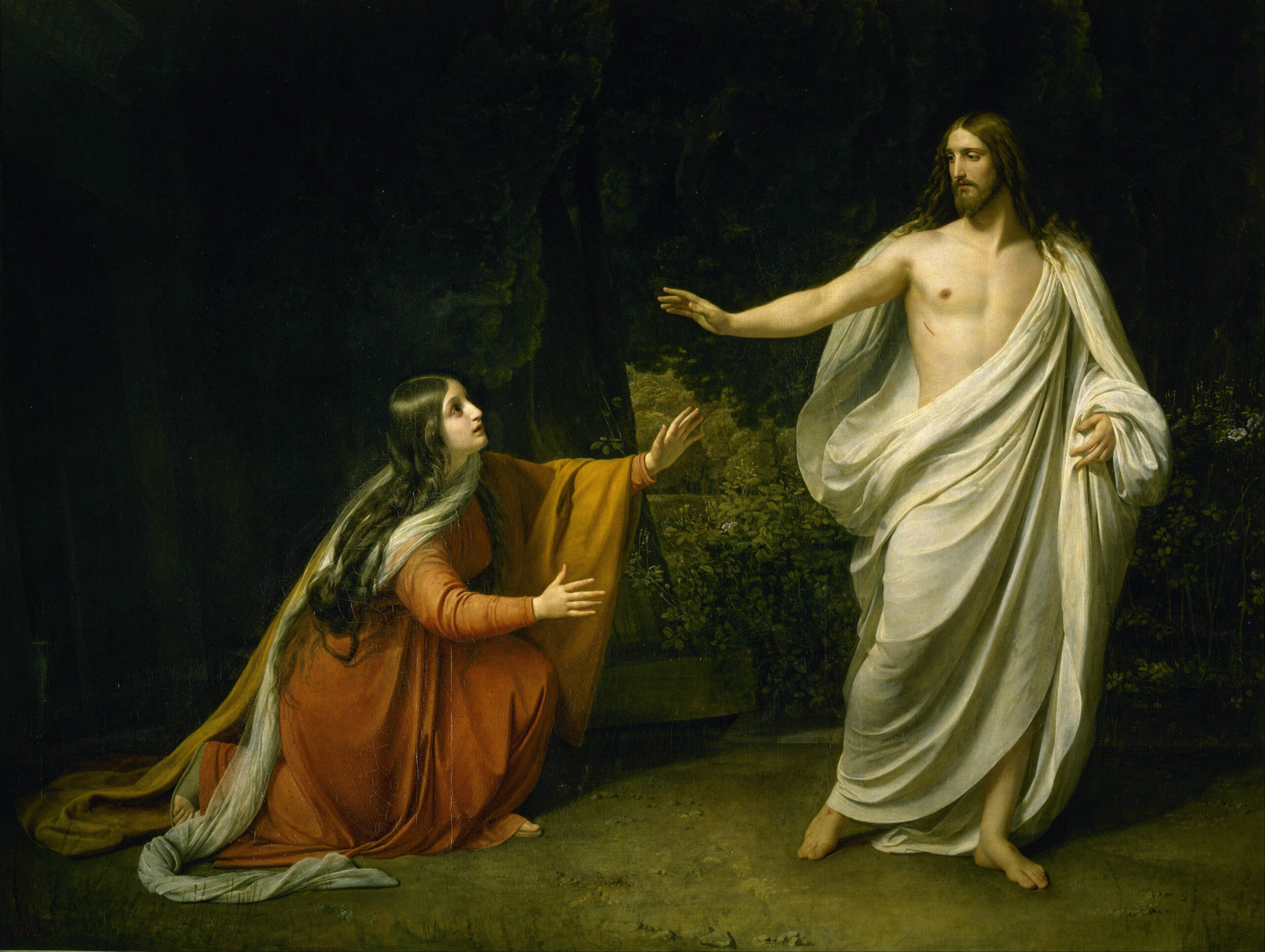
Above: Christ’s Appearance to Mary Magdalene after the Resurrection by Russian artist Alexander Ivanov (1806–1858).
There are several references to a “Mary” and “a woman” in the Bible. One of these Marys is possessed by seven demons. We find “a woman” brought to Our Lord as an adulteress who should be stoned. Then, we see “a woman who was a sinner” anoint the feet of Our Lord. Another Mary’s brother, Lazarus, dies. Finally, we see a Mary standing beside Our Lord’s Blessed Mother at the foot of the cross. After the resurrection, a Mary returns to the empty tomb to weep.
Scripture clearly says in only a few places that this “Mary” and “woman” was Mary Magdalene, “out of whom He had cast seven devils.” But some traditions (and some modern exegetes) give us reason to believe that these instances of “Mary” and “a woman” are all the same: Saint Mary Magdalene. In this article I’m going to assume that this is true.
St. Mary Magdalene, her brother and sister, Lazarus and Martha, were from Bethany. Mary’s wild, wicked life opened to her the unfortunate opportunity of being possessed by seven demons.
Whether or not Our Lord cast the demons out of her before or after the Pharisees brought her to Him to be stoned is unclear. She most likely was delivered before and was already trying to change her life when the Pharisees used her as a means to trap Jesus.
Scripture does not say what Our Lord wrote in the ground but we presume that He wrote the sins of the Pharisees. Archbishop Sheen would pause the narrative and say the he believed that Our Lord first wrote “thief and liar” in the sand. Of course, the Pharisee who was guilty of stealing and lying, turned away.
Then Our Lord wrote, “murderer.” Likewise, the culprit of this sin turned away. Our Lord continued to write several other sins in the sand until there was only one pharisee left, still holding a stone. Finally, Our Lord wrote, “adulterer,” and this man also turned away.
I have also heard of an innocent Catholic joke which takes place at the same scene.
When the last Pharisee leaves, someone gently throws a stone at Saint Mary Magdalene’s feet. Our Lord says, “Mother!” The Blessed Virgin replies, “I’m sorry, Son, I thought that when you said ‘Let he that is without sin be the first to cast a stone at her’ you were giving a command.”
Saint Mary Magdalene appears in the Bible again when her brother Lazarus dies. This story should be familiar. Lazarus got very sick and Mary and Martha sent word to Our Lord to come see him saying, “Lord, behold, he whom thou lovest is sick.”
Upon hearing this, Jesus told His Apostles that this sickness was not unto death, but for the glory of God. After two days, Our Lord then said that Lazarus was asleep and He would go awaken him. When the Apostles were confused by this statement, Our Lord said plainly that Lazarus was dead.
Martha saw Jesus coming and went out to meet Him. When she reached Our Lord, Martha said to Him, “Lord, if thou hadst been here, my brother had not died. But now also I know that whatsoever thou wilt ask of God, God will give it thee.”
Jesus replied that Lazarus would rise again. Martha said that she knew that he would rise again on the last day. Here is where Our Lord said: “I am the resurrection and the life: he that believeth in me, although he be dead, shall live.” Martha then professed her faith then went to get Mary Magdalene, who also met Him on the road.
When Mary reached Him, she fell at His feet and also said, “Lord, if thou hadst been here, my brother had not died.” At the sight of Saint Mary Magdalene crying, Our Lord also began to weep. He then asked where they had laid Lazarus.
When they reached the sepulcher, Our Lord asked that the stone be moved. Martha panicked and said that Lazarus had been dead for four days and surely reeked. Jesus reminded her that if she believed, she would see the glory of God.
The large stone was removed and Our Lord lifted His eyes and said, “Father, I give thee thanks that thou hast heard me. And I knew that thou hearest me always; but because of the people who stand about have I said it, that they may believe that thou hast sent me.” Then He cried in a loud voice, “Lazarus, come forth!” And Lazarus, who had been dead for four days, walked out of his own tomb.
The last few times that we meet Saint Mary Magdalene are the days surrounding Our Lord’s death. This excerpt, taken from The Little Pictorial Lives of the Saints is a beautiful description of Mary’s later role:
From the depth of her degradation, she raised her eyes to Jesus with sorrow, hope, and love. She said not a word but bathed His feet with her tears, wiped them with her hair of her head, kissed them in humility, and at their touch her sins and her stain were gone. Once again, on the eve of His passion, she brought the precious ointment, and, now purified and beloved, poured it on His head, and the whole house of God is still filled with fragrance of her anointing. She stood with Our Lady and St. John at the foot of the cross, the representative of the many who have had much forgiven. To her first, after His blessed Mother, Our Lord gave the certainty of His resurrection; and to her first He made Himself known, calling her by her name, because she was His.
Saint Mary Magdalene’s Skull and Cave Preserved in Southern France
Many people do not know what happened to Saint Mary Magdalene after the beginning of the spread of the Gospels. She, her brother Lazarus and others were put into an oarless and sailless boat and pushed off the coast of the Mediterranean Sea.
Instead of drowning or dying of starvation, the group landed in Gaul (Modern-day France). There, Saint Mary Magdalene the sinner, climbed a mountain cliff guided by an angel and there she spent many years in a cave. In 2016, I had the grace to visit this cave.
The hike was very steep but worth the climb in the end. I was a little disappointed to find that Saint Mary Magdalene’s greatest relic, her skull, was not preserved in the cave but actually in her basilica in Saint Maximin la Sainte Baume. But, no worries, our hotel was walking distance from the basilica, and I saw it the next day.
At the cave, on a clear day, on the top of the mountain, Saint Mary Magdalene could gaze out and see beyond the sea to Palestine and behold the land were Our Lord walked. The view from the cave is breathtaking!
The legend goes that when Saint Mary Magdalene’s end drew near she received her Lord and then peacefully fell asleep in death.