
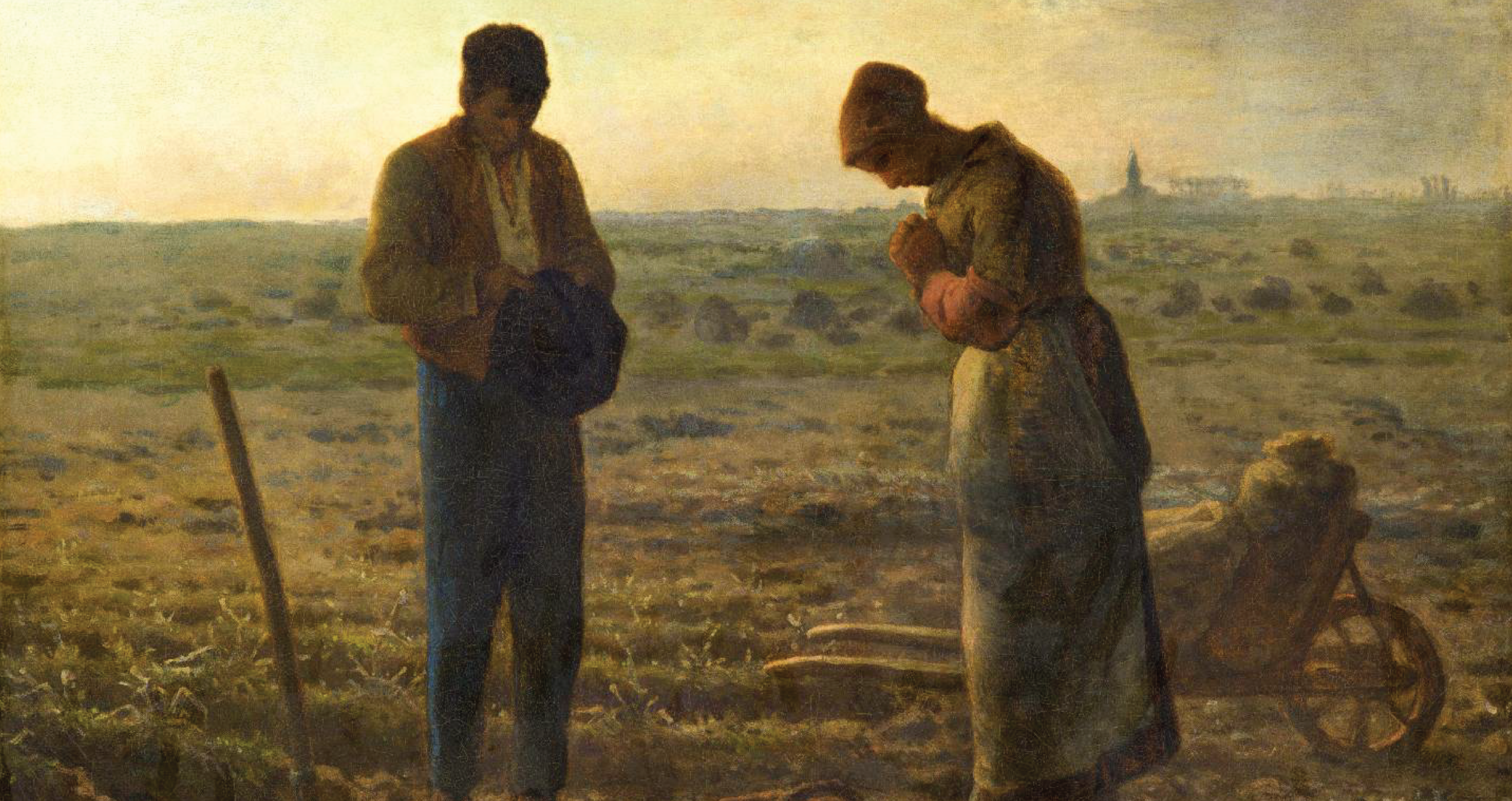
Above: L’Angelus by Jean-François Millet (1859).
Editor’s note: connect with the Catholic Land Movement at their website, of which the author is the executive director.
The Family possessed of the means of production-the simplest form of which is the possession of the land and the implements and capital for the working of land-cannot be controlled by others.
– Hiaire Belloc
The Crisis: The Great Divorce and the Servile State
It is a fundamental truth of human history that a society which divorces itself from the soil inevitably forfeits its freedom. For over a century, a quiet yet catastrophic exile has swept across nations under the hollow banner of “progress.” Millions of families have been severed from productive land, displaced from organic communities, and funneled into dense urban concentrations. In exchange for fragile conveniences, modern man has surrendered his material independence to the servile arrangements of industrial centralization and technocratic control.
This great divorce is not merely an economic shift; it is a spiritual calamity. When the domestic hearth ceases to be a site of real production and becomes instead a terminus of passive consumption, the family loses mooring to its natural order and its structural weight in the manifest of social order. Deprived of property, tools, and self-reliance, the household is reduced to a fragile unit dependent on wage-labor, volatile global supply chains, and technocratic apparatuses for its basic survival. The intellectual patrimony of the Catholic Land Movement long ago warned that an economy severed from the soil breeds a culture of spiritual starvation, hyper-political isolation, and pervasive social neurosis. When worship and work are torn asunder from the natural order, civilisational sanity rapidly decays. The Catholic understanding of the family as the core unit of society must be understood in the context of the words of Viscount Lymington:
To believe that it is possible to found and maintain a great civilization without first using, maintaining and even enriching its soil is to court disaster
This gives a dire read on the inherent disorder of contemporary social and civic paradigms.
The Remedy: A Realist Enterprise of Lay Restoration
Against this unnatural technocratic paradigm stands the Catholic Land Movement-a practical enterprise of lay restoration that seeks to re-anchor the Christian family upon productive, family-owned soil.
This effort is not a nostalgic retreat into a buried past, nor is it an exercise in idyllic romanticism. It is a vigorous re-assertion of normal human life and perennial truth. It posits that true freedom requires widely held productive property, that manual labor carries an innate God-given dignity, and that a thriving well-ordered culture can only grow upward towards the light of heaven from darkness of a healthy soil.
The architecture of this vision rests not upon the shifting sands of modern political fashion and ideology, but upon the bedrock of the Magisterium. It derives its initial momentum from Pope Leo Xlll’s monumental encyclical Rerum Novarum, which defended private property as the indispensable material safeguard for family stability. It finds contemporary urgency in Pope Francis’s Laudato Si’, which calls the faithful to a radical confrontation of the technocratic paradigm, one rooted in reverence for creation, fraternal love and God.
The Catholic Land Movement is nothing less than is an embodied work of Catholic identity. It was viewed as so vital that in 1933 the Holy See imparted an Apostolic Blessing upon its historic forebears. We are grateful that this blessing has been extended anew by Pope Leo XIV in 2025 to the faithful carrying this work forward today.
Agriculture is the first and most important of all the arts and the tiller of the soil still represents the natural order of things willed by God.
– Pope Pius XII
The Blueprint: Four Pillars of Agricultural Renewal
To execute this restoration in an age marked by division and alienation, the contemporary movement operates a rubric for social action resting upon four pillars:
- Resettlement: Support and cultivation of the physical resettlement of Catholic households onto rural, family-owned property-transforming passive economic dependents into productive, resilient homesteaders.
- Education: The transmission of peer to peer colloquial networks of practical domestic arts, soil management, animal husbandry, and craft traditions, integrated with rigorous formation in the Church’s social encyclicals.
- Fellowship: The creation of local chapters that foster networks of mutual aid, shared labor, and intellectual solidarity, effectively counteracting the atomization of modern life.
- Glorification of God: The explicit ordering of daily manual labor, domestic prayer, and community life toward Jesus Christ through the Sacraments and the rhythmic beauty of the Church’s liturgical calendar.
The practical urgency and fruitfulness of this work is already visible across over a hundred chapters worldwide. By placing intentional, faithful families back onto the land and integrating existing families on the land, dying rural communities are revived, parish life is fortified, and local economic resilience is rebuilt before traditional family farming is entirely swallowed by industrial technocratic forces.
Ultimately this work reaches its supreme culmination at the altar. When the Christian homestead offers up the wheat and grapes born of sweat, patience, and soil, these material gifts become, through the holy Mass, the Real Presence of Christ. Daily labor on the land has a sacramental ascent, making visible the enduring love of the Creator.
The Call to Action: Reclaim the Land, Rebuild the Hearth
The hour for passive critique has passed. We cannot solely vote or consume our way out of a crisis that is structural, spiritual, and ecological. Through the supernatural gift of hope we are compelled to embodied action from where we are with what we have. We must endeavor to prove in fact what the Church’s modern social teaching argues in principle.
We must seek the practical path Father Vincent McNabb called us toward over 100 years ago:
Go forth, Christian soul, to the unfallen earth, and there amidst the tares and briars sing the song of work that is worship. Soon around your croft will gather a sheaf of homes & homesteads where the Great sacrament May prepare the plowman for the furrow, the monk for the choir and the priest for the altar.
If we desire a fecund and holy culture of life rather than the sterility and terror of a culture of death, we must build the physical and social infrastructure that makes such life possible.
We call upon Catholic families, young and old, to cast off the false security of the technocratic machine. Seek land, grow in fraternal love, acquire tools, master crafts, and plant your families in real soil.
Let us reclaim our heritage as stewards of creation. When worship is restored to the center of human endeavor, the work of man’s hands on God’s earth becomes a powerful wellspring, that invites perfecting, grace, holiness, and true civilisational renewal. Toward the land, toward each other, and toward God!