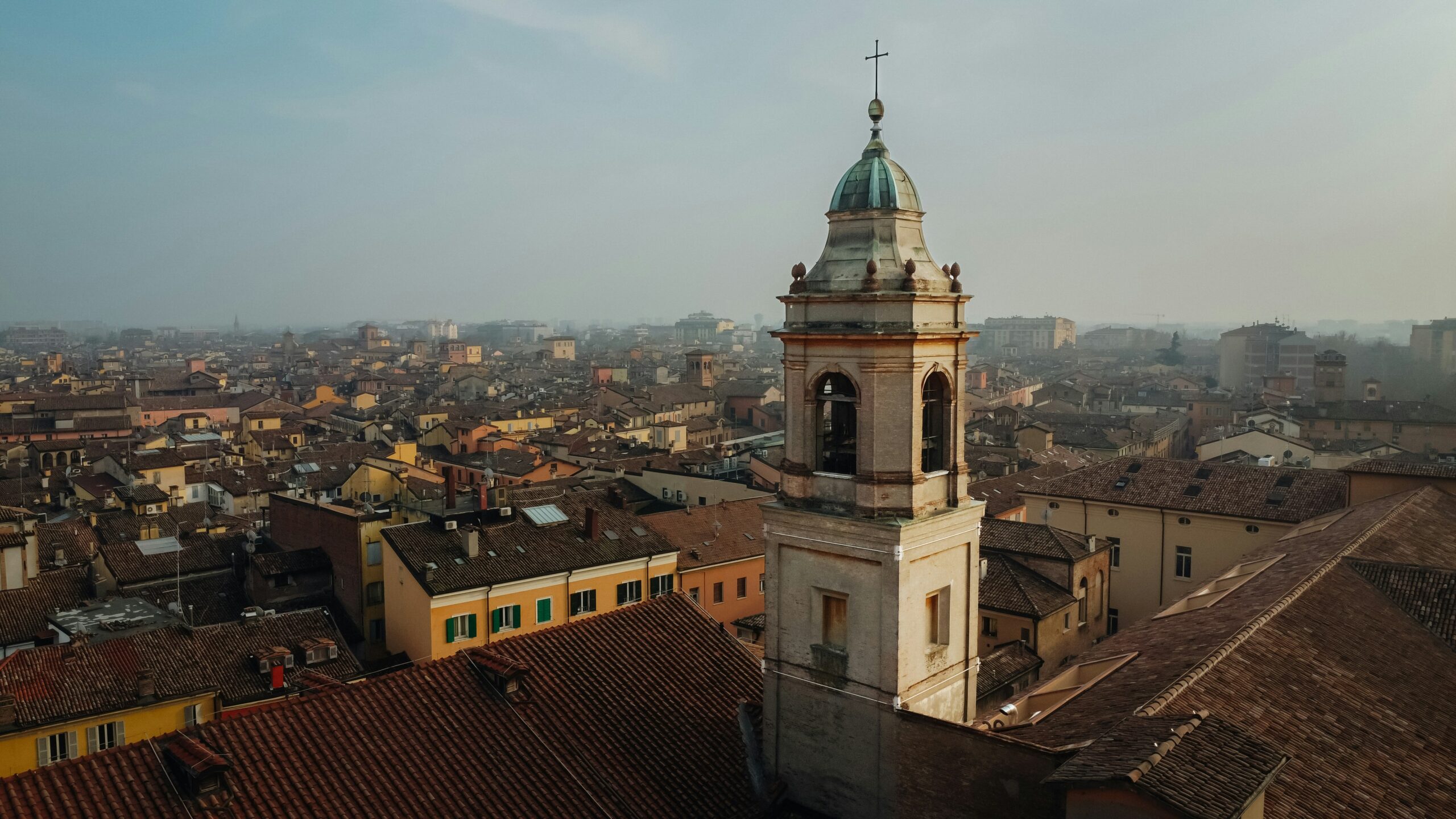
Above: Modena.
On July 8, 1726—three centuries ago—the composer Antonio Maria Bononcini died in Modena, northern Italy.
Born in the same city 49 years earlier, he was the younger brother of the more famous Giovanni Bononcini (†1747), remembered above all as a rival of George Frideric Handel (†1759) in England. After studying in Bologna, Antonio began his career in Naples and Rome, where he entered the service of Cardinal Benedetto Pamphilj (†1730). In 1696 he was admitted to the ancient Congregation of Saint Cecilia—an institution approved by Pope Sixtus V in 1585—which had also counted among its members the great Giovanni Pierluigi da Palestrina (†1594).
A brief stay in Berlin with his brother (1702) was followed by a longer period in Vienna (1704–1711), where from 1705 he served as Kapellmeister at the Imperial Court. During those years he achieved wide acclaim as a composer for the stage, with operas such as Arminio (1706) and La presa di Tebe (1708), alongside several oratorios. Returning permanently to Modena in 1716, he conducted the orchestras of the Molza and Rangoni theaters and in 1721 was appointed maestro di cappella to Duke Rinaldo d’Este (†1737), a post he held until his death.
Bononcini’s catalogue, still largely awaiting rediscovery, includes eleven operas, four oratorios, eight serenatas, forty-two cantatas, several liturgical works, and fifteen cello sonatas.
His earliest known composition dates back to the age of fifteen: a Laudate Pueri (Psalm 113), dated February 19, 1693, and dedicated “to Our Lord and His Holy Name.” It was probably performed only days later, on February 22, the feast of the Chair of Saint Peter, in a Bolognese church.
A hymn of praise inviting the community to glorify the name of God, the work is structured in five movements:
- Laudate pueri Dominum (Largo, B-flat major)
- Excelsus super omnes (Adagio, F major)
- Suscitans a terra inopem (Vivace, D minor)
- Gloria Patri (Largo, G minor)
- Sicut erat in principio (Presto, B-flat major)
The score is remarkable for its use of the obbligato cello: in the Gloria Patri it doubles the basso continuo, while in the other movements it enriches the texture with rapid scales, tremolos of repeated notes, or alternating pitches, often in thirty-second notes (sixteenth notes in the Suscitans). Some tremolos are marked with wavy lines, and in the outer movements the repeated notes appear in double stops.
These virtuosic traits—also found in the Sonatas for Cello and Basso Continuo (Nos. 1–12)—suggest that Bononcini composed them during the same youthful period, perhaps for liturgical performance in Bologna.
Among his most significant sacred works are the Stabat Mater in C minor (for four solo voices, choir, and strings) and the Messa concertata a cinque in G minor (for soloists, choir, strings, and continuo).
Both are characterized by dense, rigorous writing: counterpoint that is solid yet fluid, and a clear inclination toward vocal and instrumental virtuosity. It is not surprising that they have been compared—albeit with due proportion—to the great European masters of the early eighteenth century, beginning with Johann Sebastian Bach (†1750).
Bononcini’s Stabat Mater belongs fully to the Marian tradition that inspired some of the greatest masterpieces of sacred music. Pope John Paul II, in the Angelus of January 1, 1988, recalled this sequence, usually attributed to Jacopone da Todi (†1306):
And how can we not recall also the moving participation in Mary’s sorrow, present beneath the cross of Christ, which the greatest musicians, such as Palestrina, Pergolesi, Mozart, Haydn, Rossini, and many others, have experienced while meditating on the words of the Stabat Mater? Devotion to the Virgin has truly given rise to masterpieces and has inspired the greatest geniuses of music, enriching humanity with an artistic heritage that cannot be ignored (translation from the Italian).
Divided into thirteen sections, Bononcini’s Stabat Mater—a true masterpiece of eighteenth-century Marian devotion—alternates choral and solo passages. The polyphony always remains light and transparent, the counterpoint simple and linear, often built on narrow intervals. Dissonances and chromaticisms are handled with elegance, intensifying the dramatic image of the Virgin at the foot of the Cross.
Some of its most striking moments include
- Eja Mater, for contralto, strings, and continuo, with the violin weaving a cantabile line above the solo voice;
- Fac me vere tecum flere, for contralto accompanied only by violas and continuo, with a distinctive timbre that musicologist Gino Roncaglia (†1968) compared to sonorities later found in Gaetano Donizetti’s (†1848) Miserere and in the opening of Johannes Brahms’s (†1897) German Requiem;[1]
- the finale Quando corpus, solemn and homophonic, culminating in a fugue (Paradisi gloria) of extraordinary effect, which—according to composer Angelo Catelani (†1866, cited by Roncaglia)—found no parallel until Rossini’s (†1868) Stabat Mater.
No less imposing is the Messa concertata, where Bononcini alternates sections of intense choral writing with more lyrical, expansive arias. Particularly moving is the Crucifixus, in which two contraltos sing in canon a mournful, meditative melody accompanied only by the organ: a page of extraordinary sobriety and pathos.
Antonio Maria Bononcini’s sacred music belongs to that tradition of composers who, as John Paul II wrote in his Letter to Artists (April 4, 1999, no. 12), were not only masters of musical art but also “imbued with the sense of the mystery” and profoundly engaged in the life of the Church.
Long overshadowed by his brother and other contemporaries, Bononcini emerges instead as an original and surprising voice: solid in structure, elegant in melody, and intense in expression. His legacy deserves to be restored to today’s listening as a living part of the great European musical tradition of the early eighteenth century.
Photo by Grigorii Shcheglov on Unsplash
[1] G. Roncaglia, Antonio Maria Bononcini e il suo “Stabat Mater”, Siena 1958, pp. 117-125.