
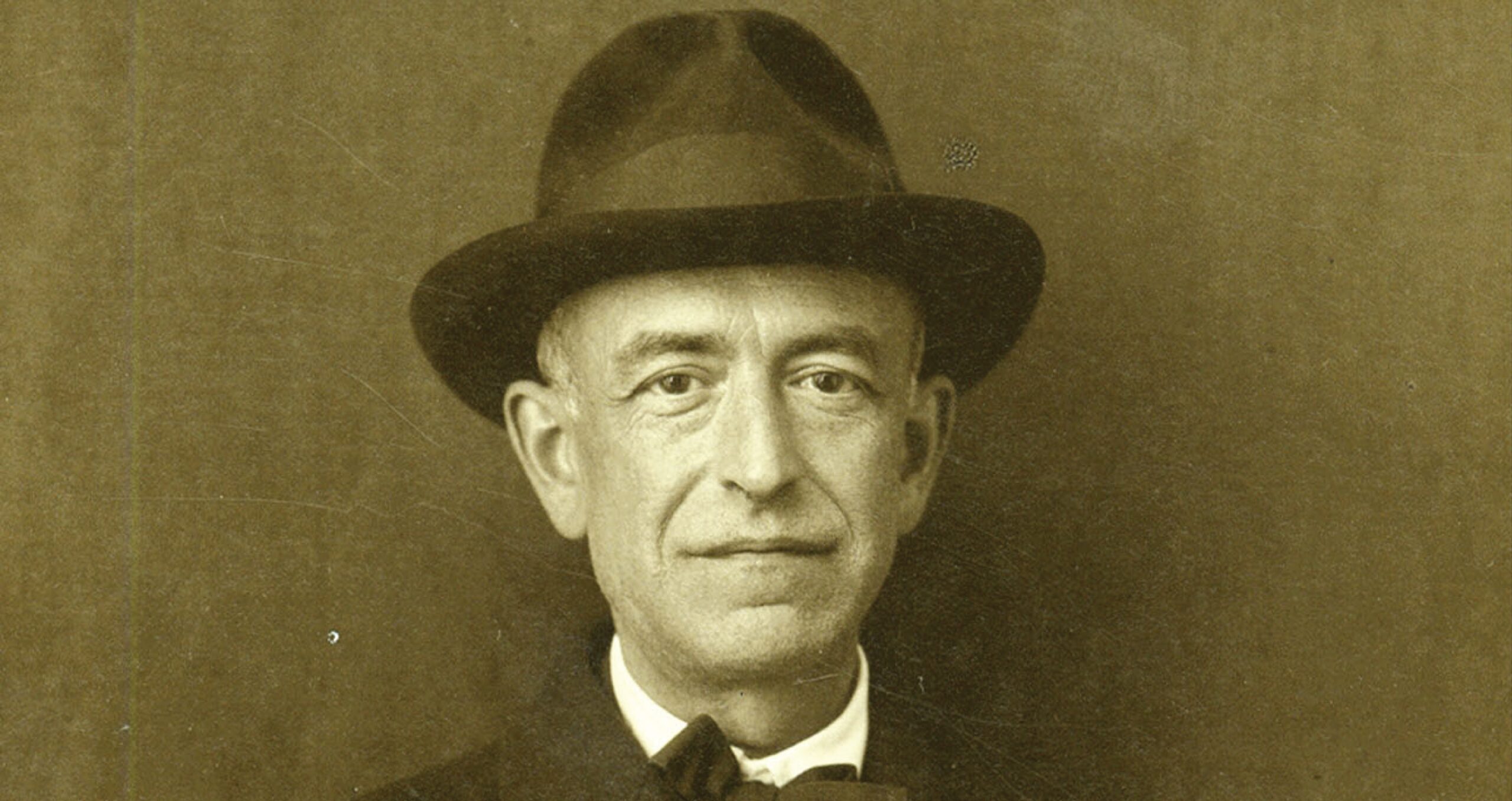
On November 23, 1876, in Cádiz, in Spain’s sun-washed south, a child was born who, in seventy years of life, would come to embody the very essence of Spanish music: Manuel de Falla. One hundred and fifty years later, his works still resonate—not only for their melodies and rhythms but also for the profound character and faith woven through every note.
At a 2011 concert in the Paul VI Hall at the Vatican—whose program included works by Manuel de Falla (†1946), Isaac Albéniz (†1909), Richard Strauss (†1949), and Nikolai Rimsky-Korsakov (†1908)—Pope Benedict XVI reflected on Falla’s music in particular:
“This evening, a little ‘piece’ of Spain, so to speak, has been brought to this Hall,” he said, sensing
the ‘alegría de vivir,’ ‘joie de vivre,’ a festive atmosphere that shines out in compositions such as the three Dances from El sombrero de tres picos [The Three-Cornered Hat] by de Falla, or the struggle against evil portrayed by this same composer in his famous Danza ritual del fuego [Fire Dance].[1]
Falla’s musical path began under his mother’s gentle guidance and soon advanced to rigorous studies in harmony and counterpoint in Madrid. From the start he sought an authentically Spanish voice—one that reached beyond mere folklore, grounded in professional discipline and a vivid creative imagination.
His originality first emerged in La vida breve, a verismo-tinged opera that won a national competition in 1905 but did not reach the stage until 1913 in Nice. A transformative stay in Paris, among contemporaries such as Claude Debussy (†1918), Paul Dukas (†1935), and Maurice Ravel (†1937), refined his craft and clarified his voice. From this period came two ballets of unmistakable Andalusian color: El amor brujo (1915) and El sombrero de tres picos (1919).
Falla’s range was remarkable. The impressionistic Noches en los jardines de España (1909–1915) for piano and orchestra evokes moonlit gardens and murmuring fountains, while El retablo de maese Pedro (1922)—a chamber work for puppets and actors inspired by an episode from Don Quixote—melds literary genius with musical wit, a tribute to his friendship with the Spanish poet Federico García Lorca (†1936).
In later years Falla adopted a more austere, contemplative style, heard in the Concerto for Harpsichord and Small Orchestra (1926). His final, unfinished project, Atlántida, begun after he voluntarily relocated to Argentina in 1939 following the Spanish Civil War, aimed to celebrate Iberian legend and history. It was eventually completed by his student Ernesto Halffter (†1989).
Yet Falla’s genius cannot be separated from his spirituality. Contemporaries described him as monastic, deeply Catholic, and profoundly humble. He attended daily Mass, lived simply, and gave generously to the poor. Even as Europe convulsed with political and social upheaval, he remained steadfast in faith—a devotion inseparable from his art.
Visitors captured unforgettable glimpses of this inner life. The French composer and pianist Francis Poulenc (†1963) recalled meeting him in Venice in 1932: “As soon as he entered the church, Falla began to pray, and I had the impression that I no longer existed for him. For me, the last image I have of the composer I admired and loved… is a kind of Assumption!”[2] The Irish writer and philosopher Walter Starkie (†1976), seeing him in 1935, thought him “an ascetic monk, whose life was spent between meditation in his cell and reverie in his garden.”[3]
The Spanish organist and composer Juan María Thomàs (†1966) remembered a rehearsal of an Ave Maria: “His hand, eyes, face implied that he was not conducting but praying, holding between his fingers an invisible rosary of fire.”[4]
Friends consistently emphasized both his faith and his openness. García Lorca noted that “Falla’s Catholic orthodoxy and scrupulous fulfillment of his religious duties did not tarnish the cordial and friendly relationship that united him to our youth group, which was very indifferent in religious matters.”[5] The Spanish writer José Bergamín (†1983) summed it up simply: “Maestro of music and faith […] Manuel de Falla was not like a saint—he was a saint.”[6] The Polish harpsichordist Wanda Landowska (†1959) called him “so evangelically good and simple,”[7] while the Spanish writer Ramón Pérez de Ayala compared him to a Carmelite: “Carthusian for his seclusion; […] Franciscan for his clear gaze […] It makes one think of […] Saint John of the Cross.”[8] The Spanish priest and composer Juan Alfonso García portrayed “an adult and mature faith […] crystallized in a personal way of feeling Christianly and living evangelically.”[9]
Manuel de Falla remains singular in music history: a composer who fused folk roots, modernist language, and profound spirituality—remarkably, without ever writing explicitly sacred music. As Pope Benedict XVI observed in that same 2011 concert, “Another element constantly surfaces in the more hispano compositions. It is the religious element with which the people of Spain are deeply imbued.”[10] Those words capture Falla perfectly: even without a liturgical oeuvre, his art breathes faith, devotion, and a rare human sincerity.
[1] Benedict XVI, Speech, November 26, 2011.
[2] G. Armero ed., Manuel de Falla: his life & works, London 1999.
[3] G. Armero, ibidem.
[4] S. Demarquez, Manuel de Falla, Philadelphia, 1968, p. 178.
[5] F. García Lorca, In the green morning: memories of Federico, New York 1986, pp. 124–125.
[6] G. Armero, ibidem.
[7] S. Lamberbourg, ed., Epistolario Manuel de Falla – Wanda Landowska 1922–1931, Granada, 2022, p. 139; our translation.
[8] R. Pérez de Ayala, Ramón Pérez de Ayala y las artes plásticas: escritos sobre arte de Ramón Pérez de Ayala, Granada 1991, p. 359; our translation.
[9] J. A. García, Falla y Granada y otros escritos musicales, Granada 1991, p. 88-89; our translation.
[10] Benedict XVI, ibidem.