
 In the 500 years since its inception, the Protestant revolt has evolved from the erroneous opinions of a single mad monk into a thousand-headed hydra of heresy, with each head snapping at the other almost as frequently as at the Catholic Church itself. Nonetheless, the many heads have remained joined at one common point – a point which Protestant theologians such as Paul Tillich and Dietrich Bonhoeffer desired to see writ large on the flag of modern Protestantism: Ecclesia semper reformanda est, i.e. “The Church is always to be reformed.”
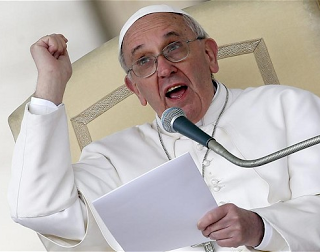
Pelagianism, the Pope told faithful gathered in Florence cathedral, “prompts the Church not to be humble, selfless and blessed. And it does so with the appearance of being a good.” Such an approach, he added, “brings us confidence in structures, organizations, in perfect planning because it’s abstract.”
But often “it leads us also to take a controlling, hard, regulatory style,” he said. “The law gives to the Pelagian security to feel superior, to have a precise orientation. This is its strength, not the light of the breath of the Spirit.”
“In facing evils or the problems of the Church,” the Pope went on, “it is useless to look for solutions in conservatism and fundamentalism, in the restoration of practices and outdated forms that aren’t even able to be culturally meaningful.”
Complaints against the Pelagian trend of theology of his own time is recurrent in young Luther. One of the most striking is found in Operationes in Psalmos(1519-1521). What is worse, he stressed in this work, is the fact that there was a new form of Pelagianism; the one he was fighting. It was worse than any other because it was not declared. It was Pelagianism disguised as an orthodox doctrine. The Reformer regarded Pelagianism as the most dangerous and pernicious of heresies (Inter omnes autem gladios imiorum maximum et nocentissimum meo iuditio merito pelagianam impietatem censebimus) and the source of all sorts of idolatries (hic error fons est universae idolatriae). Not surprisingly, he identified it with the very human tendency to state human righteousness (iustitia hominis) to the detriment of that of faith (iusitia fidei).
Augustine, Luther pointed out, fought Pelagians as declared heretics. He himself was fighting the very same heretical trend in men protected by the Church, under the skin of orthodox theologians. So Pelagianism, Luther stressed, is a timeless threat to Christian faith. […] After Augustine’s death the heresy rose; it not only did not find opposition, but also was openly allowed to rule within the Roman Church and universities. Nothing can be more dangerous, yet it remained in the Church, Luther claimed (pelagianos error vere omnium saeculorum error est, saepius opressus quidem, sed nunquam extinctus).