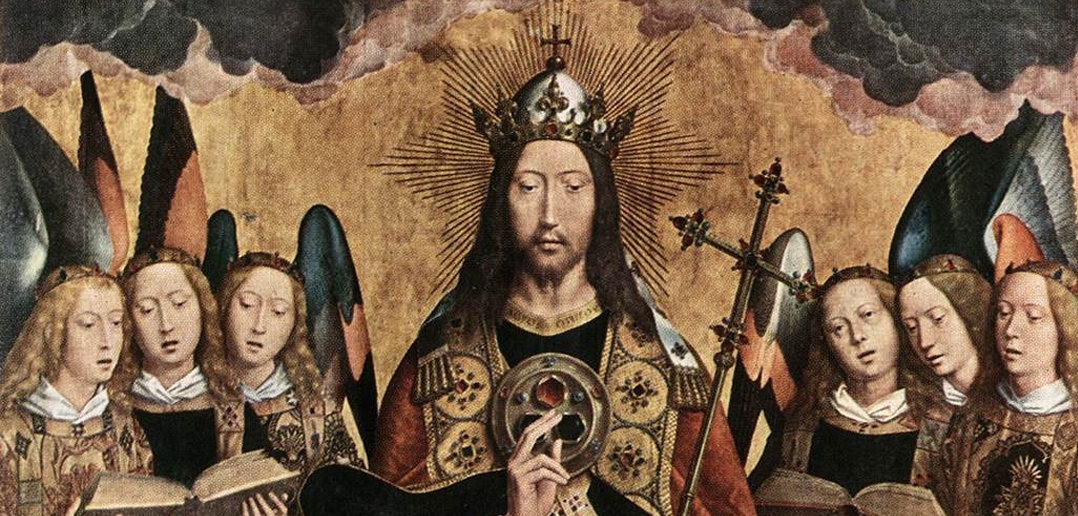

And there was war in heaven: Michael and his angels fought with the dragon, and the dragon fought, and his angels: And they prevailed not, neither was their place found any more in heaven. And that great dragon was cast out, that old serpent, who is called the devil and Satan, who seduceth the whole world; and he was cast into the earth, and his angels were thrown down with him.
— Apocalypse 12:7-9
Michael, Michael: Michael of the Mustering,
Michael of the marching on the mountains of the Lord,
Marshal the world and purge of rot and riot
Rule through the world till all the world be quiet:
Only establish when the world is broken
What is unbroken is the word.
—G.K. Chesterton, “St. Michael in Time of Peace.”
Once again the great feast of St. Michael is upon us. Now, as with everything else in our Faith, there is a human, cultural, social, and political element to devotion to the great Archangel. At first this might seem counterintuitive – after all, many a Saint has lived and/or died for a political cause linked to the Faith. But if the Kingship of Christ has had many a human defender, one must not forget that the great Archangel was the first paladin of the rights of God – though thankfully, not His last.
There is a great deal of disinformation about to-day regarding angels in general and St. Michael in particular (whom the Jehovah’s Witnesses believe to be Jesus Christ before His Incarnation). So before looking more closely into our topic, let us let Dom Guéranger guide us through this fascinating realm of Angelology, in his account of Michaelmas:
The glorious Archangel appears today at the head of the heavenly army: There was a great battle in heaven, Michael and his angels fought with the dragon, and the dragon fought and his angels. In the sixth century, the dedication of the churches of St. Michael on Monte Gargano and in the Roman Circus increased the celebrity of this day, which had however been long before consecrated by Rome to the memory of all the heavenly Virtues.
The east commemorates on the sixth of September an apparition of the victorious Prince at Chone (ancient Collossæ) in Phrygia; while the eighth of November is the solemnity of the angels, corresponding to our feast of today, and bearing the title: “Synaxis of Saint Michael prince of the heavenly host, and of the other spiritual Powers.” Although the term synaxis is usually applied only to religious assemblies here on earth, we are informed that in this instance it also signifies the gathering of the faithful angels at the cry of their chief, and their union eternally sealed by their victory.
Who, then, are these heavenly Powers, whose mysterious combat heads the first page of history? Their existence is attested by the traditions of all nations as well as by the authority of holy Scripture. If we consult the Church, she teaches us that in the beginning God created simultaneously two natures, the spiritual and the corporal, and afterwards man who is composed of both. The scale of nature descends by gradation from beings made to the likeness of God, to the very confines of nothingness; and by the same degrees the creature mounts upwards to his Creator. God is infinite being, infinite intelligence, infinite love. The creature is forever finite: but man, endowed with a reasoning intellect, and the angel, with an intuitive grasp of truth, are ever, by a continual process of purification, widening the bounds of their imperfect nature, in order to reach, by increase of light, the perfection of greater love.
God alone is simple with that unchangeable productive simplicity, which is absolute perfection excluding the possibility of progress; He is pure Act, in whom substance, power, and operation are one thing. The angel, though entirely independent of matter, is yet subject to the natural weakness necessary to a created being; he is not absolutely simple, for in him action is distinct from power, and power of essence. How much greater is the weakness of man’s composite nature, unable to carry on the operations of the intellect without the aid of the senses!
‘Compared with ours,’ says one of the most enlightened brethren of the angelic doctor, ‘how calm and how luminous is the knowledge of pure spirits! They are not doomed to the intricate discoursings of our reason, which runs after the truth, composes and analyzes, and laboriously draws conclusions from premises. They instantaneously apprehend the whole compass of primary truths. Their intuition is so prompt, so lively, so penetrating, that it is impossible for them to be surprised, as we are, into error. If they deceive themselves, it must be of their own will. The perfection of their will is equal to the perfection of their intellect. They know not what it is to be disturbed by the violence of appetites. Their love is without emotion; and their hatred of evil is as calm and as wisely tempered as their love. A will so free can know no perplexity as to its aims, no inconstancy in its resolutions. Whereas with us long and anxious meditation is necessary before we make a decision, it is the property of the angels to determine by a single act the object of their choice. God proposed to them, as He does to us, infinite beatitude in the vision of His own Essence; and to fit them for so great an end, He endowed them with grace at the same time as He gave them being. In one instant they said Yes or No; in one instant they freely and deliberately decided their own fate.’
Let us not be envious. By nature the angel is superior to us; but, to which of the angels hath He said at any time, ‘Thou art My Son?’ (Hebrews 1:5, Psalm 2:7) The only-begotten Son of God did not take to Himself the angelic nature. When on earth, He acknowledged the temporary subordination of humanity to those pure spirits, and deigned to receive from them, even as do His brethren in the flesh, and announcements of the divine will (Dionys. Areop. De cælesti hierarchia, 4:4; Matthew 2:13-15) and help and strength. (Luke 22:43) But ‘God hath not subjected unto angels the world to come,’ says the apostle. (Hebrews 2:5) How can we understand this attraction of God towards what is feeblest? We can only worship it in humble, loving faith. It was Lucifer’s stumbling-block on the day of the great battle in heaven. But the faithful angels prostrated themselves in joyous adoration at the feet of the Infant-God foreshown to them enthroned on Mary’s knee, and then rose up to sing: ‘Glory to God in the highest, and on earth peace to men of good will.’
O Christ, my Christ, as St. Denis calls Thee (Dionys. De cælesti hierarchia, 2:5) the Church today delightedly proclaims Thee the beauty of the holy angels. (Hymn of Lauds) Then, the God-Man, art the lofty height whence purity, light, and love flow down upon the triple hierarchy of the nine choirs. Thou art the supreme Hierarch, the center of worlds, controller of the deifying mysteries at the eternal feast.
Flaming Seraphim, glittering Cherubim, steadfast Thrones, court of honor to the Most High, and possessed of the noblest inheritance: according to the Areopagite, ye receive your justice, your splendor, and your burning love by direct communication from our Lord: (Dionys. ubi supra, 7:2) and through you, all grace overflows from Him upon the holy city.
Dominations, Virtues, and Powers; sovereign disposers, prime movers, and rulers of the universe: in whose name do ye govern the world? Doubtless in His whose inheritance it is; in the name of the King of glory, the Man-God, the Lord strong and mighty, the Lord of hosts.
Angels, Archangels, and Principalities; heaven’s messengers, ambassadors, and overseers here below: are ye not also, as the apostle says, ministers of the salvation wrought on earth by Jesus, the heavenly High Priest?
We also, through this same Jesus, O most holy Trinity, glorify Thee, together with the three princely hierarchies, which surround Thy Majesty with their nine immaterial rings as with a man-circled rampart. To tend to Thee, and to draw all things to Thee, is their common law. Purification, illumination, union: by these three ways in succession, or simultaneously, are these noble beings attracted to God, and by the same they attract those who strive to emulate them. Sublime spirits, it is with your gaze ever fixed on high that ye influence those below and around you. Draw plentifully, both for yourselves and for us, from the central fires of the Divinity; purify us from more than the involuntary infirmities of nature; enlighten us; kindle us with your heavenly flames. For the same reason that Satan hates us, ye love us: protect the race of the Word made Flesh against the common enemy. So guard us, that we may hereafter be worthy to occupy among you the places left vacant by the victims of pride.
In his account of the feast on May 8, Dom Guéranger enlarges upon St. Michael:
David foretold that the Emmanuel’s coming into this world would be greeted by the Angels, and that they would humbly adore him on his first appearing among us. We saw this prophecy fulfilled on the Night ever blessed, when Mary brought forth the Fruit of her womb. The Angelic choirs sang one of their heavenly hymns, which led the Shepherds to the Stable; we blended our songs with theirs, in homage to our Infant-God. The Resurrection of our Emmanuel was sure to be honored by the presence of these blessed Spirits, who had witnessed, with amazement and trembling, the humiliations and cruelties of his Passion. The moment he passed through the barrier that imprisoned him in his sepulcher, an Angel, with a face beaming as the sun, and garments white as snow, came and rolled back the Stone, and proclaimed to the holy Women that He whom they were seeking had risen. When they entered the cave of the Sepulcher, two other Angels, clad in white robes, appeared to them, and repeated the tidings of Jesus’ triumph.
Let us reverently honor these princely heralds of our deliverance, and consider how respectfully they cluster round Jesus their King and God, during the forty days after his Resurrection. They adore this glorified Humanity, which they are soon to see raised up to the highest heavens, and throned at the Father’s right hand. They rejoice with us in the happiness brought to us by this Paschal Feast, which restores immortality to us in the person of our Risen Savior; and thus, as St. Gregory told us a few days back, “it is the Feast of the Angels, because, by its recalling us to heaven, it fills up their number.” It was but right, therefore, that Paschal Time should devote one of its days to honoring the Angelic Spirits. Eight days previous to the Annunciation, we kept the feast of St. Gabriel, our Lady’s honored messenger; today, it is St. Michael, and Archangel and Prince of the heavenly host, that is to receive our love and praise. He himself selected this day by appearing on it and leaving us a pledge of his presence and protection.
The very name of Michael urges us to honor this glorious Spirit; it is a cry of enthusiasm and fidelity, for it signifies: ‘Who is like unto God?’ Satan trembles at hearing this name, for it reminds him of the noble protest wherewith the bright Archangel answered the call of the rebel angels. Michael proved his strength and prowess when he fought the great battle in heaven. On that account, he was made the Guardian and Protector of God’s people—of the Jews first, and afterwards, of the Christian Church, for the Synagogues forfeited all her honors. Michael now watches over Jesus’ Spouse, our mother; he supports her in her trials, and she wins no triumph in which he has not had some hand.
St. Michael is therefore first and foremost patron and protector of the Holy Catholic Church. But we must not think of that patronage extending only to the clerical side of Christendom. He is, together with St. George, patron saint of chivalry and now also of police officers, paramedics, and the military. Since Emperor Otto the Great won the Battle of Lechfeld against the Hungarians in 955, he became patron saint of the Holy Roman Empire and Patron of the Germans. Of course, in this, the Holy Roman Empire was simply catching up with its Byzantine equivalent; it made sense that St. Michael should be patron alike of Holy Church and Holy Empire – the matter and form, as it, were, of the One Christian People.
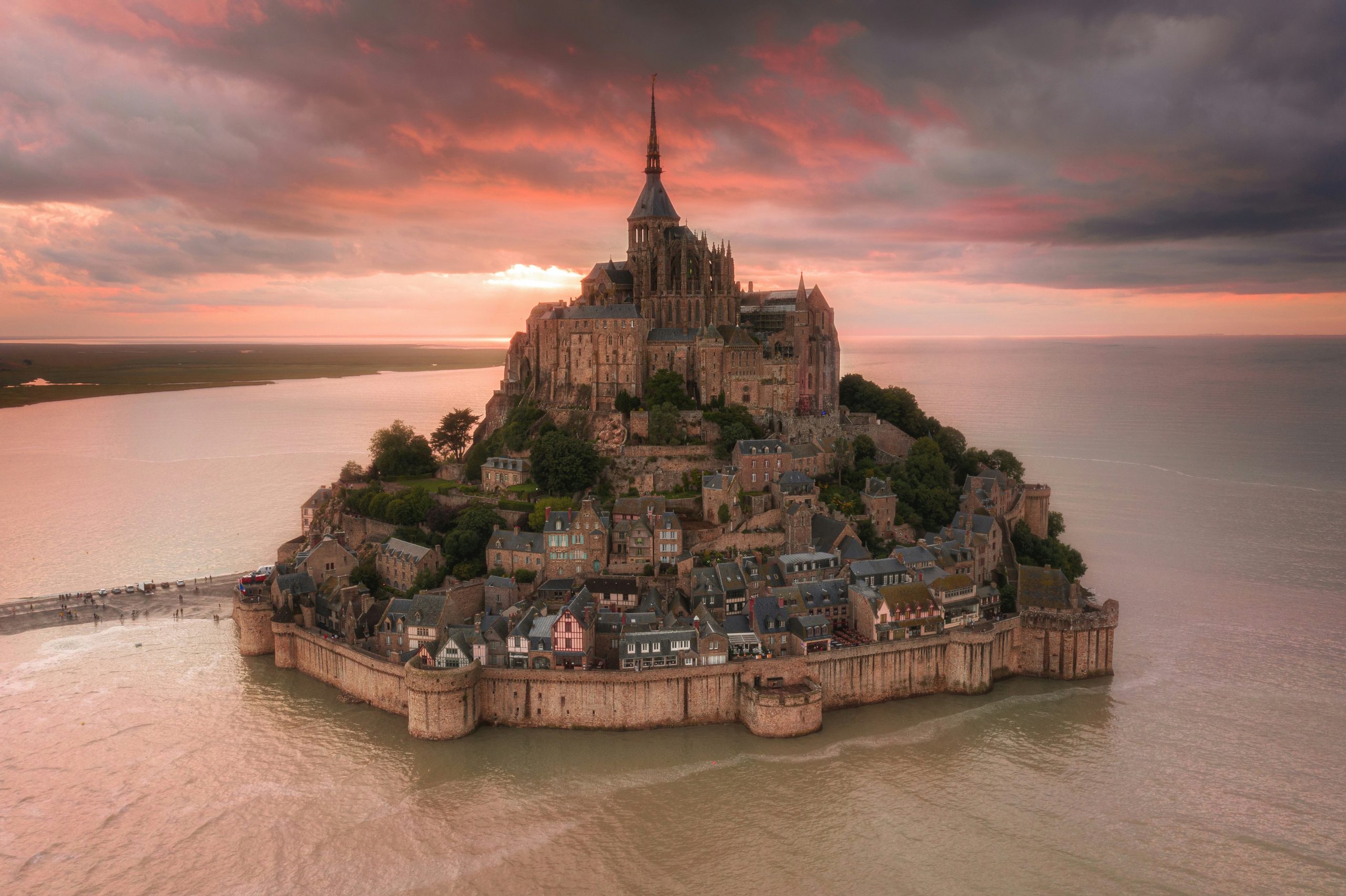
Junior only to the Holy Roman Empire – and through Bl. Charlemagne deeply connected to it – the French Monarchy also had a special tie to the bright Archangel, though his apparition at Mont Saint Michel. The local feast of that apparition is October 16, and for one last time we shall see Dom Guéranger’s eloquence on the matter:
We owe a memory to this feast so beloved by our fathers. The 8th century was inaugurating its glorious annals. ‘Almighty God was about to make the Frankish empire the sword and bulwark of his Church.’ It was the hour when, their impetuous adolescence tamed, the firstborn people echoed all the Saints who begot them to God, and cried out with one voice: ‘Give the sons of the Franks the light, so that they may see what must be done to establish your reign in this world, so that, seeing it, they may accomplish it in strength and love.’ To the people, therefore, who declared themselves the knights of God, Michael, prince of the angelic hosts, offered his covenant at that very hour. Through Saint Aubert, to whom the Archangel manifested himself, he took possession of the famous rock which rises in the middle of the ocean, near the shore of this France whose sword was preparing to continue on earth the great battle begun in the heights of heaven.
Our nation knew how to honor the heavenly partner in its earthly struggles; it transformed its rugged foothold into a dwelling place that could please the vanquisher of Satan: at once an incomparable fortress, and a sanctuary where endlessly the chants of the monks joined with the harmonies of the nine choirs; truly worthy of the name of marvel which was given to it; common meeting place of the people and kings coming to present their homage of thanksgiving and prayer to the protector of the nation.
For he too was faithful. As long as the monarchy lasted, the Archangel did not allow any banner other than that of the Most Christian King to fly near his own on his ramparts, even in the darkest days of foreign invasion or heretical rebellion. And when the English, soon to be masters everywhere, exhausted themselves in futile efforts against Mont Saint-Michel, who then came to tell Joan the Maid of the great pity that was in the kingdom of France, and sent her to restore the king’s kingdom? May 8th, the first feast day of the Archangel, saw the liberation of Orléans by the one in whom he himself had nurtured, during three years of angelic encounters, that devotion to country and that love of God which are united in every noble soul.
Thus, in the century of triumph, the creation of this Order of Saint Michael, established by the kings, was a worthy and just work: ‘to the glory and praise of God our almighty Creator and reverence of his glorious Mother, and commemoration and honor of Saint Michael the Archangel, first Knight, who for the cause of God victoriously battled against the dragon and brought him down from heaven; and whose place and oratory, called Mont Saint-Michel, has always surely guarded, preserved and defended, without being taken, subjugated or placed in the hands of the enemies of the kingdom.
Not just Mont St. Michel, but a large number of mountains were dedicated to St. Michael – not least because so many, especially in Germany, had been dedicated to pagan gods. So numerous mountain chapels of St. Michael appeared all over Germany. Glastonbury Tor’s iconic tower is dedicated to him, as is the Sanctuary of St. Michael (San Migel Aralarkoa), the oldest Christian building in Navarre. The Navarrese and Basques revere him as the defender of the Faith against paganism.
Interestingly enough, a straight line – often called St. Michael’s Line or St. Michael’s sword – links several of his major shrines. Skellig Michael, in Ireland; St Michael’s Mount, in Cornwall; Mont Saint-Michel, in Normandy; the Sacra di San Michele, in Piedmont; the Church of the Archangel Michael on the Isola Maggiore on the Lake Trasimeno; San Michele Arcangelo, in Perugia; the Sanctuary of Monte Sant’Angelo; Panormitis Monastery of the Archangel Michael on Symi Island; and the Stella Maris Monastery on Mount Carmel in Israel. This libe of shrines symbolises for many the sword wielded by St. Michael against the enemies of the Faith – and transcending nationality.
Indeed, one may look at all who fought for the Faith, from the various royal, chivalric, and military Saints to the various simple Catholic of all lands and degrees who fought politically or militarily to defend here as members of the same legion, commanded by St. Michael, the Marshal of the Heavenly Army. We must strive always to see the Catholics of all ages and places as members of one people, with one King – Jesus Christ, one Queen – Mary, and one General – St. Michael. Let this Mchaelmas remind us of this.