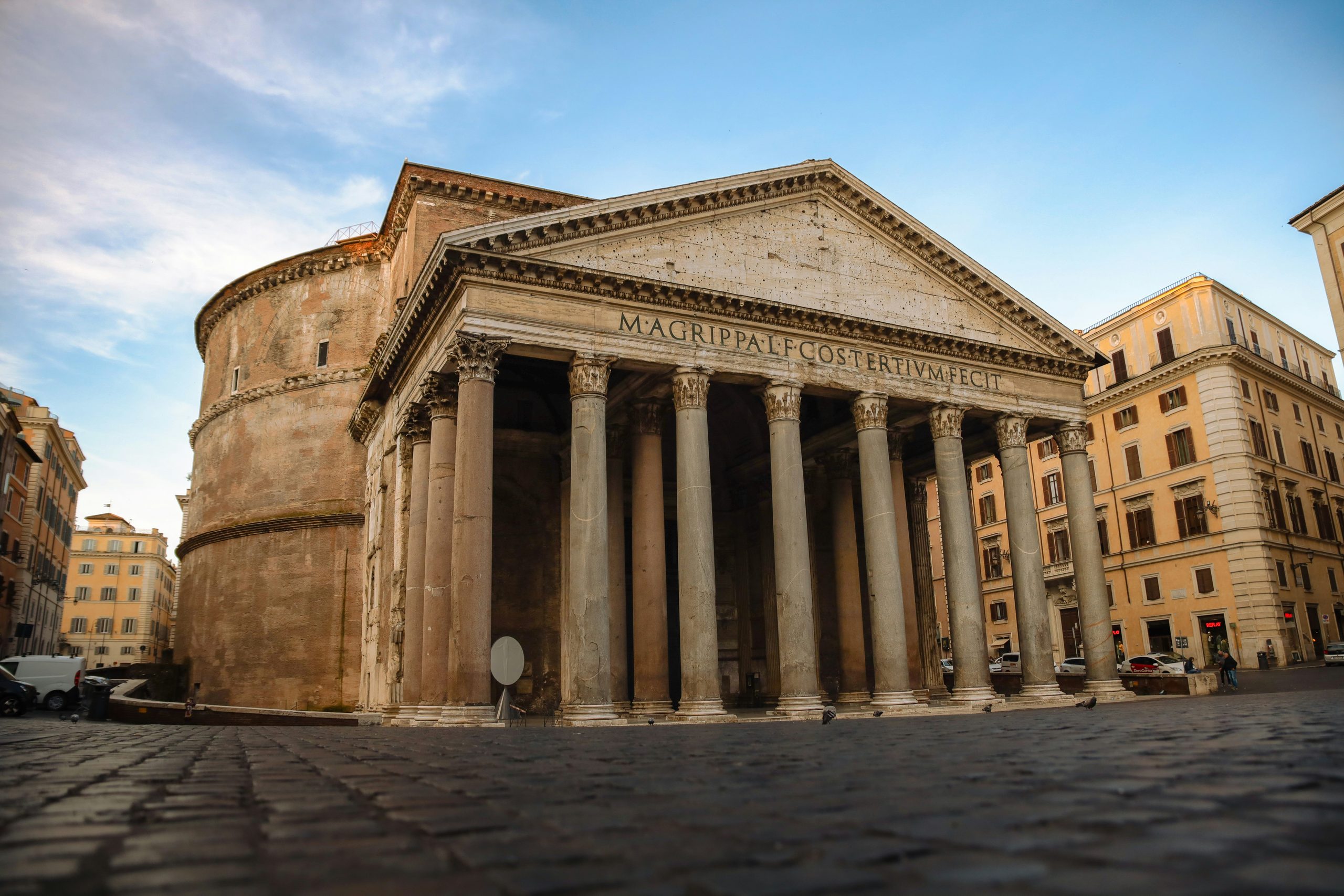
On September 23, 1926, the Pantheon in Rome—its vast dome casting a perfect circle of light through the oculus—welcomed a new voice: the Tamburini pipe organ no. 99. One hundred years later, that voice still resonates. More than a machine, this instrument became a bridge between centuries, uniting technical mastery with a space steeped in sacred symbolism. In 609, the Pantheon “was dedicated to Christian worship and named after the Virgin Mary and all the Martyrs: Sancta Maria ad Martyres. The temple of all the pagan divinities was thus converted to commemorate all those who, as the Book of Revelation (7:14) says, ‘have come out of the great tribulations; they have washed their robes and made them white in the blood of the Lamb.’”[1]
The Tamburini organ embodies the artistry and innovation of Italian organ building. Conceived by Giovanni Tamburini (†1942) during the Pantheon’s restoration (1925–1934), it was designed to serve both ceremonial grandeur and spiritual intimacy. By 1929, when the Pantheon became a Palatine Chapel following the burials of Italy’s first two kings, Victor Emmanuel II (†1878) and Umberto I (†1901), the organ had also acquired a distinct national symbolism.
Between 1929 and 1934, architect Alberto Terenzio (†1957), Superintendent of Medieval and Modern Monuments of Rome and Lazio, oversaw a meticulous restoration of the Pantheon. A towering scaffold rose to the oculus, allowing him to examine the ancient dome and its venerable cracks. His conclusion was reassuring: the fissures were ancient but stable, scars of history rather than signs of weakness. With delicate interventions—filling fissures, reinforcing key points, and inserting discreet supports—he preserved the building’s authenticity while ensuring its endurance.
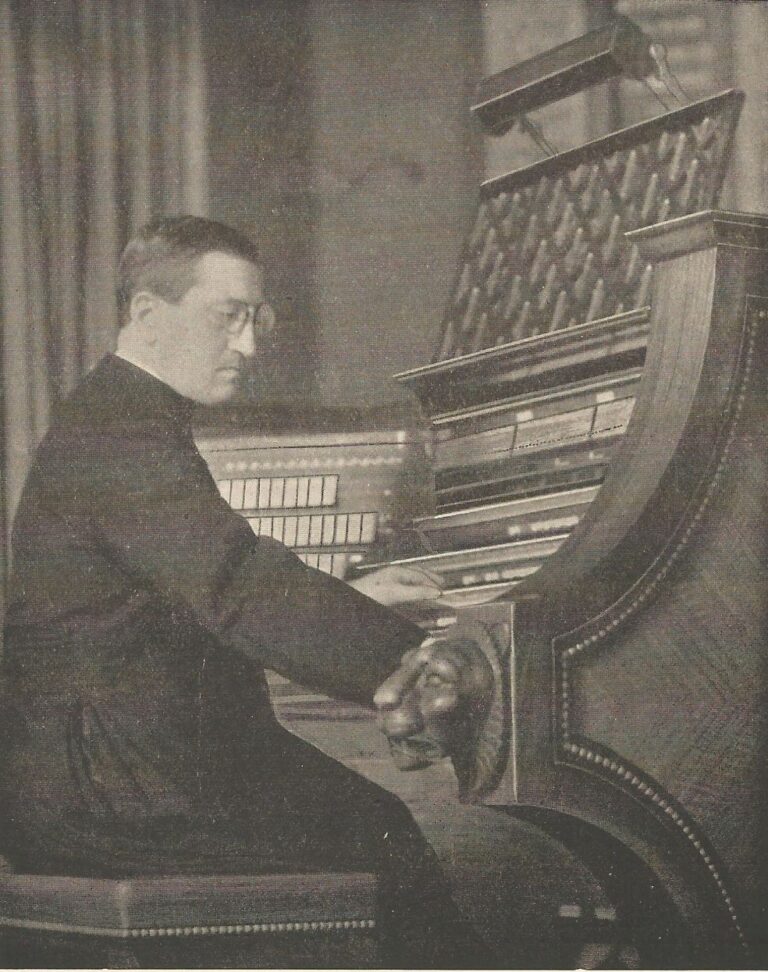
Before Tamburini’s instrument arrived, the Basilica housed a Morettini organ (no. 103), later likely transferred to the Sanctuary of the Madonna del Cerro in Sassoferrato, central Italy.[2] The inauguration of the new organ was entrusted to Reverend Raffaele Manari (†1933), a figure whose presence alone commanded attention. From the moment his hands touched the keyboards, the Pantheon seemed to awaken. Thanks to its electro-pneumatic cone-valve action and double-compartment windchest, the organ sang with a new clarity—capable of whispering gently or resounding powerfully—perfectly suited to the Romantic repertoire.
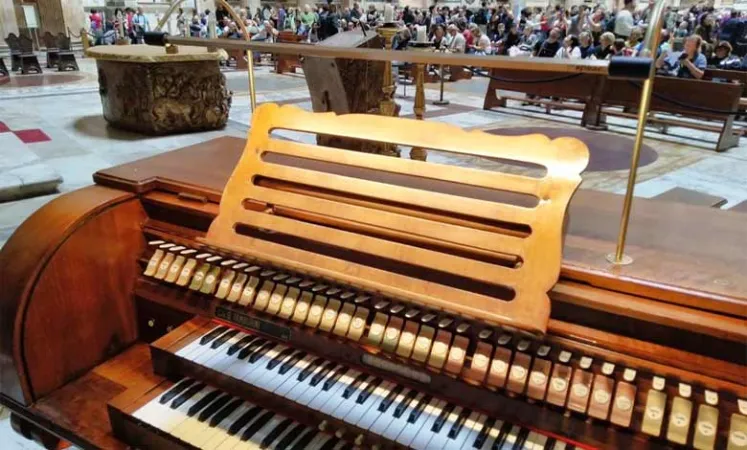
Though modest in size, the Tamburini organ is noble in character. Its ten stops are housed in an elegant wooden case nestled to the right of the apse. With its two manuals and pedalboard, the organist commands a kaleidoscope of colors: shimmering flutes, singing strings, and thunderous basses reverberating beneath the Pantheon’s dome.
Manari was a central yet long-overlooked figure in Italian organ culture, whose reputation has only recently begun to be restored. His enduring contribution lay in his conviction that the organ is not a museum relic but a living instrument: always in service to art, never confined by age or context.
Born in Carsoli, central Italy, Manari was ordained a priest and studied in Rome, where he absorbed the reforming spirit of Pope St. Pius X’s motu proprio on sacred music (1903). He trained under Raffaele Casimiri (†1943) and Remigio Renzi (†1938) at the Accademia di Santa Cecilia, graduating in 1914. From 1920 until his death, he served as organist of the Basilica of St. John Lateran and taught at the Pontifical Institute of Sacred Music. As a consultant, he advised on several major projects, including the Mascioni organ opus 438—still in the Institute’s Academic Hall—and the monumental Tamburini organ in Messina.
Although a prolific performer and teacher, Manari composed only four organ works: Fantasia siciliana, Concert Etude on “Salve Regina,” Legenda, and Scherzo. These concert pieces, rooted in the Italian tradition of late-19th- and early-20th-century “character works,” highlight both expressive depth and technical virtuosity, especially in the demanding pedal writing of the Salve Regina Etude.
His theoretical legacy is no less important. In his 1931 lectures at the Pontifical Institute—later published—he outlined a philosophy of registration: not rigid formulas, but principles guided by history, the composer’s intent, the nature of the instrument, and the performer’s intelligence. For Manari, historical awareness was never an end in itself but a tool for making choices that were both practical and aesthetically sound. His approach remains a valuable guide for reconciling fidelity to tradition with creative freedom in modern performance.
The organ’s builder, Giovanni Tamburini, was equally visionary. Born in Bagnacavallo, northeastern Italy, in 1857, he began repairing accordions before apprenticing with Pietro Anelli and Pacifico Inzoli, masters of 19th-century Italian organ craftsmanship. In 1893, he opened his own workshop in Crema, northern Italy, where artistry and technical mastery flourished. Renowned for innovations in pneumatic and electro-pneumatic action, Tamburini fused engineering precision with artistic sensibility. The Pantheon organ, with its double-compartment windchest, was among his crowning achievements, alongside commissions for the Milan Conservatory (1906), Santa Croce in Florence (1931), and Messina Cathedral (1930)—then the largest Italian organ ever built.
As with all instruments, time took its toll. By 1985, humidity and wear had compromised its action. A restoration in 2003 revived its voice, and in 2013 further work restored the console and reed stops. In 2019, a thorough overhaul by Salvatore Pronestì finally restored the organ’s reliability and brilliance.
Now, a century after its first notes resounded beneath the Pantheon’s dome, the Tamburini organ continues its dual mission: to sustain the liturgy and to enrich Rome’s cultural life. Each chord links past to present, craftsmanship to devotion, and music to faith. Its story—intertwined with Manari and Tamburini—celebrates not only Italian artistry but also the enduring magic of sacred music in one of the world’s most timeless spaces.
The centenary of this instrument is more than a commemoration. It is a call to stewardship, reminding us that beauty and tradition survive only when they are cherished. As long as the Tamburini organ resounds in the Basilica of Sancta Maria ad Martyres, the Pantheon will remain both a living witness to history and a promise of music yet to come.
Photo by Nelson Rodz on Unsplash
[1] Benedict XVI, Angelus, November 1, 2009.
[2] See L’Organo, Rivista di Cultura Organaria e Organistica, XIX 1985, p. 78.