
On November 4, 1575, Guido Reni was born in Bologna, earning the moniker “the new Raphael” for his relentless pursuit of aesthetic perfection. As a leading figure of the Italian Baroque, Reni sought to elevate painting to an ideal of harmony and grace, drawing constant inspiration from Renaissance masters, particularly Raphael († 1520).
After an initial apprenticeship in Bologna in the workshop of the Flemish painter Denis Calvaert († 1619), Reni entered the Accademia dei Carracci, also in Bologna, in 1595, where he quickly distinguished himself. His first major work, The Coronation of the Virgin and Four Saints, now housed in the National Art Gallery of Bologna, showcased his refined sense of composition and luminous color palette. Though celebrated until the Neoclassical period, his art later faced critical reassessment as tastes evolved. Initially influenced by the Carracci style and briefly drawn to Caravaggism, Reni ultimately forged an independent artistic path, striving for an ethereal beauty that fused naturalism with idealization. Dividing his career between Bologna and Rome—where he likely traveled at the close of the Jubilee of 1600—he produced masterpieces of extraordinary refinement, including The Massacre of the Innocents, The Portrait of His Mother, and his celebrated fresco, L’Aurora. He passed away in Bologna on August 18, 1642.
Music played a fundamental role in Reni’s life. His father, Daniele, was a musician in the service of the city government and the chapel of San Giacomo de’ Carbonesi, while his mother, Ginevra Pozzi, was the daughter of a music master. From this rich musical heritage, Reni developed a profound sensitivity to sound and rhythm, which manifested in the cadence and grace of his compositions.
According to his most authoritative biographer, Carlo Cesare Malvasia († 1693), Reni received an education that intertwined art and music, reflecting the theoretical innovations emerging from the Accademia dei Carracci. The concept of ut pictura musica (painting as music)—the idea that painting and music share a common pursuit of harmony and emotional depth—resonates throughout his work. Reni often accompanied his painting sessions with singing or harpsichord playing, though he was not a trained musician. Even in his final days, as illness consumed him, his friends arranged a chamber concert in his honor—a testament to his profound love of music. Malvasia even suggested that his passion for music surpassed his love of literature, though later scholars have nuanced this claim. The painter Giovanni Battista Passeri († 1679) similarly recalled Reni’s fondness for singing, reinforcing the idea that music was an essential aspect of his artistic life.
Leonardo da Vinci († 1519) famously wrote, “Music should be called nothing other than the sister of painting.”[1] Both arts, he argued, are governed by proportion and possess the power to move the soul. If poetry and music engage the intellect through sound, music is even closer to painting, as it can evoke multiple emotions simultaneously. This principle finds its perfect expression in Reni’s portrayals of Saint Cecilia, the patroness of music and sacred song.
Rather than focusing on his more conventional depictions of angel musicians or mythological figures with instruments, we honor Reni’s artistic legacy by contemplating his representations of Saint Cecilia. The Roman virgin and martyr has long been venerated as the patron saint of music, her story immortalized in an ancient antiphon: “Cantantibus organis, Cecilia Domino decantabat dicens: Fiat cor meum immaculatum, ut non confundar” (“The musicians played, and Cecilia sang unto the Lord, saying: Let my heart be undefiled, that I be not ashamed.”). Even today, the liturgy of her memorial day (November 22) echoes this sentiment, asking God, through Cecilia’s intercession, to make us worthy to sing His praises.
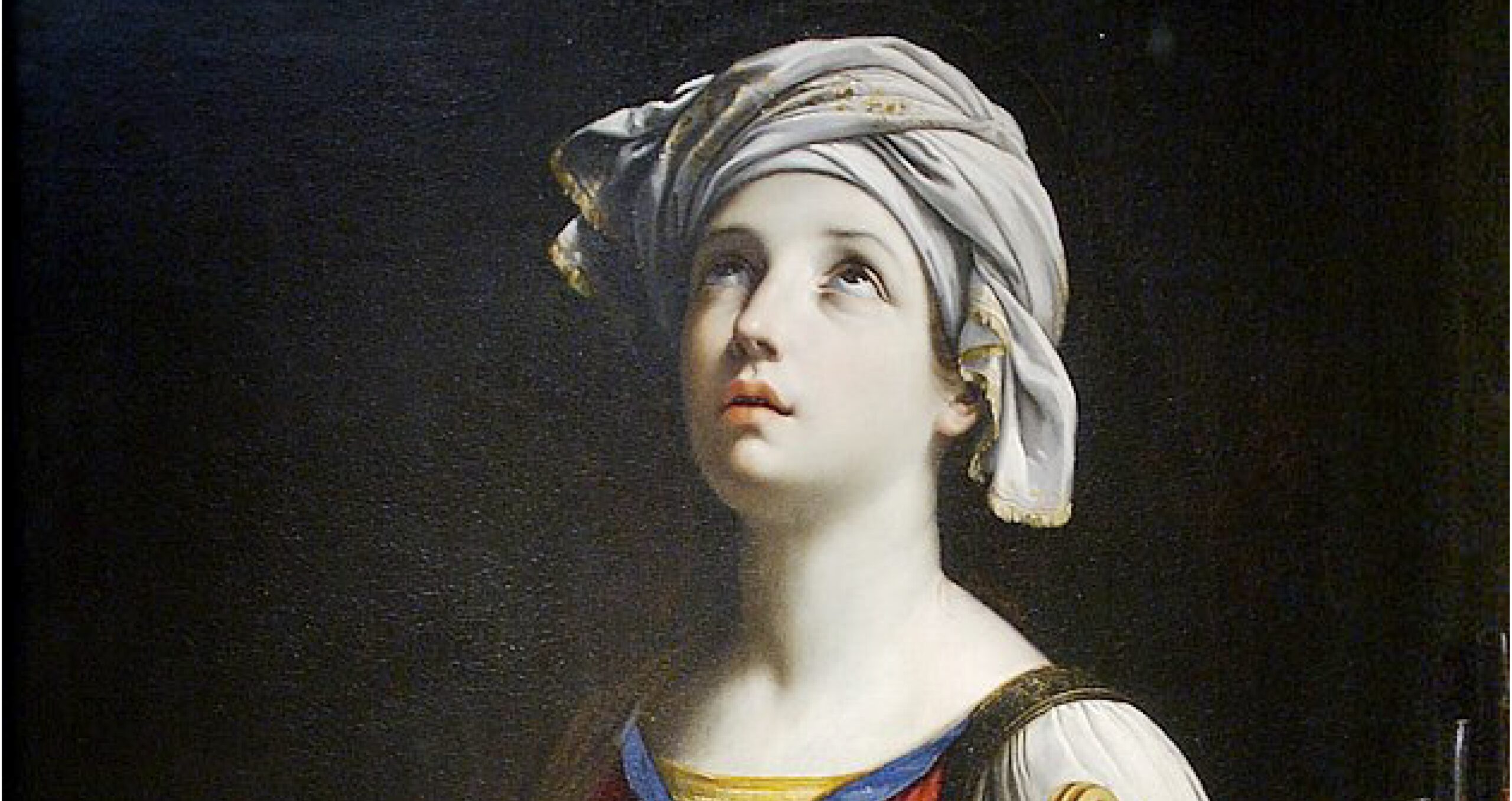
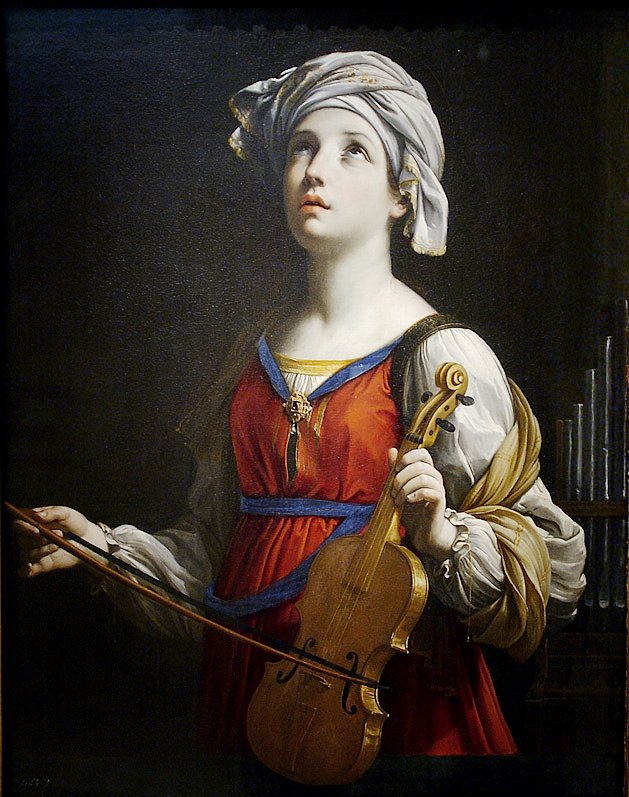
This spiritual and musical ecstasy is magnificently captured in Reni’s Saint Cecilia (1606), an oil on canvas now housed at the Norton Simon Foundation in Pasadena, California (pictured above). The esteemed art historian Giovanni Pietro Bellori († 1696) described the painting, noting that Reni portrayed Cecilia “la quale tira un’arcata di violino girando la testa e gli occhi all’armonia”—“who pulls a bow-stroke on the violin, turning her head and eyes to the harmony.”[2]
Commissioned in 1606 by Cardinal Paolo Camillo Sfondrati († 1618), titular of the Basilica of Saint Cecilia in Trastevere, Rome, and a devotee of sacred music, the painting passed in 1608 to Cardinal Scipione Borghese († 1633). Its refined chromaticism and ethereal grace contributed to its success, though for a long time it was mistakenly attributed to Domenichino († 1641).
Reni’s fascination with Saint Cecilia must be seen in its historical context. On October 20, 1599, her intact body was found in the Chapel of the Bath, sparking renewed devotion. Cardinal Sfondrati led the redecoration of her basilica and commissioned Reni—who had previously copied Raphael’s Ecstasy of Saint Cecilia (now in San Luigi dei Francesi, Rome)—to paint The Martyrdom of Saint Cecilia and the Coronation of Saints Cecilia and Valerian.
The ideals of the Council of Trent, which emphasized the instructive and devotional power of sacred art, found full expression in the works of Guido Reni. As stated in the Council’s twenty-fifth and final session (December 4, 1563):
The bishops shall carefully teach this,—that, by means of the histories of the mysteries of our Redemption, portrayed by paintings or other representations, the people is instructed, and confirmed in (the habit of) remembering, and continually revolving in mind the articles of faith; as also that great profit is derived from all sacred images, not only because the people are thereby admonished of the benefits and gifts bestowed upon them by Christ, but also because the miracles which God has performed by means of the saints, and their salutary examples, are set before the eyes of the faithful; that so they may give God thanks for those things; may order their own lives and manners in imitation of the saints; and may be excited to adore and love God, and to cultivate piety.
In this light, Reni’s paintings function not only as aesthetic triumphs but also as profound spiritual meditations. His art continues to inspire, embodying the divine ideals of beauty, harmony, and devotion.
[1] Treatise on Painting, Rome 1817, p. 27.
[2] M. Piacentini, Le vite inedite del Bellori, Rome 1942, p. 12.