

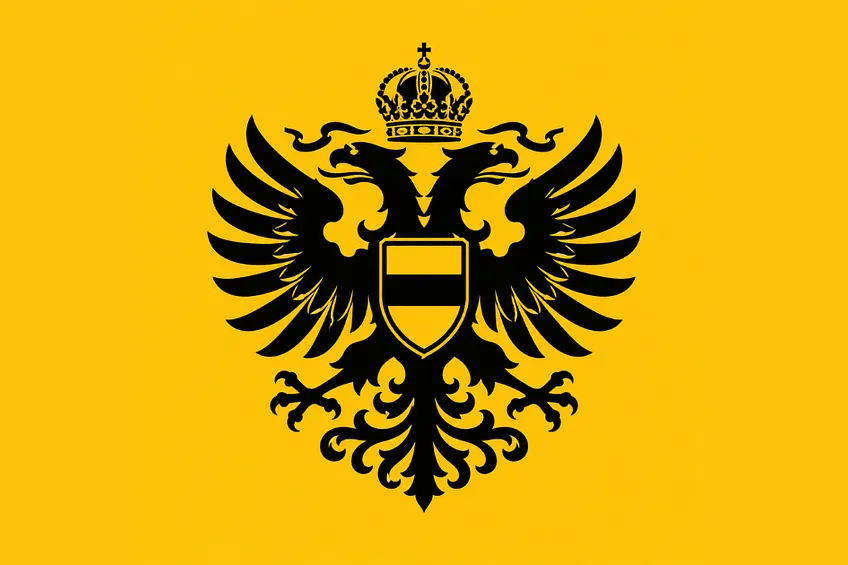
Editor’s note: learn more about Catholic lay nobility at The Habsburg Way from our new contributing editor, Archduke Eduard Habsburg.
God preserve, God protect,
Our Emperor, our Country!
Powerful through the support of the Faith,
He leads us with a wise hand!
Let us defend the Crown of his fathers,
Shielding it from every foe.
Forever with the Habsburg Throne,
Austria’s fate remains united.
As His Imperial and Royal Highness Archduke Eduard von Habsburg joins our OnePeterFive team, it is worthwhile recalling the accomplishments his family have achieved. Our new colleague comes from an amazing background, and it is not unfair to say that it acts as an inspiration for him and every living member of his clan, wildly diverse as their various efforts are. We have just celebrated the feast of his relative, Bl. Karl I, last Monarch of Austria-Hungary. But while many of us will know of that holy Emperor’s tragic yet uplifting story, as with the Archduke Eduard himself, the epic tale of the dynasty that gave birth to them both needs to be understood in some detail to understand either of them.

To begin with, we should note the most obvious thing about the Habsburgs – the insignia of the Double Eagle. Wherever they have been throughout Central Europe and the Americas, it can be found, somewhere or other. But they are not its only users: Russia, the Greek Army, the Eastern Orthodox Churches, the Byzantine Empire, Serbia, Albania, and a host of others use it as well. Since there are none of these creatures living or that have ever lived (save in Archduke Eduard’s delightful children’s book, Dubbie – which like all good children’s books can be read with profit by adults), one could be forgiven for thinking that it is in reality a heraldic symbol with a common origin. He would be right.

For its origins, we have to look back to the time of the Roman Emperor, St. Constantine the Great (I make no apologies for calling him a Saint; the Eastern Catholics do, and he has a local cultus in parts of Italy). Famous for making Catholicism legal by the Edict of Milan in 313; for convoking the First Ecumenical Council of Nicaea and so indirectly for the Creed we recite at Mass; for founding the Eastern Capital at Constantinople; for endowing St. Peter’s, St. John Lateran, Notre Dame de Paris, the Basilica at Trier, Hagia Sophia, the Basilicas of the Holy Sepulchre and the Nativity in the Holy Land, and a great many other famous churches besides; and so much else besides. It is he who gave the Roman Imperial Eagle two heads – to signify that it looks both East and West and encompasses both Church and State.
This was a vision that really began with Our Lord at the Last Supper, when He fused His Davidic Kingship – to which in His Human Nature, He was rightful heir – with the Communio of the Church. The symbol of this fusion is His Washing of the Feet. In future centuries, this would be a staple of the Maundy Thursday ceremonies of every Court in Christendom, as monarchs who aspired to participate in the Kingship of Christ considered it their duty. None would excel the Habsburgs in their performance of this custom.
But all that was in potentia at the Last Supper, and for the next few centuries in which the Church was a persecuted body whose members prayed for their rulers, fought and died in their armies, paid their taxes, and when called upon to worship them, often enough died instead. It began to be actualised in 302, when all of Armenia was baptised from king to peasant, rapidly followed by Georgia, Ethiopia, and then St. Constantine’s Edict of Milan. Evangelisation of the Empire proceeded rapidly, and in 380 Emperor Theodosius the Great made Catholicism the religion of the Empire and baptism entrance into Roman citizenship as well as the Church.
As the various barbarian tribes settled down on Roman territory and built the foundations of the modern European countries, they considered their various kingdoms to remain under the jurisdiction of both the Pope and the Emperor. This continued after 476 when the Empire in the West was ended by the Herulian King Odacer, who sent the Imperial diadem to Constantinople, saying that there was once again only one Emperor. Eighteen years later, Pope St. Gelasius I wrote the famous letter “Duo sunt” to Byzantine Emperor Gelasius I. This served for centuries to follow as the unofficial constitution of the Res Publica Christiana, the collection of Christian countries, East and West. Whatever quarrels there might be between Church and State or individual kings and the emperor – even those leading to bloodshed – there was a strong and universal understanding that it was all “one house,” so to speak. Outside lay the pagan enemies – and eventually the Muslims – either to be fought or converted or both. The Cross and the Double Eagle flew over the Christian Commonwealth, unruly though its denizens might be. Even mighty Justinian, reconqueror of much of the West, had a visiting Pope re-crown him in Constantinople, although he had already been anointed and crowned by that city’s Patriarch.
On Christmas Day, 800, Pope St. Leo III crowned Bl. Charlemagne as Emperor of a revived Roman Empire in the West (which we call to-day the “Holy Roman Empire”). Dom Guéranger, in his coverage of St. Leo III’s feast explains well that Pontiff’s motivations in this action:
Monarch as he is, Peter’s successor would be at liberty to choose from amongst the kings of the West (all of whom gloried in being his sons), one prince to whom he might confide the office of protector and defender of Holy Church. Head as he is of the whole spiritual army of the elect, Porter of heaven’s gates, Depository of grace and of infallible truth, he could invite the said prince to the honor of his allegiance. Sublime indeed would such an alliance be, the legitimacy whereof bears the palm over that of all treaties ever concluded between potentates. Such an alliance, inasmuch as it is intended to guarantee the rights of the King of kings, in the person of His representative, would entail solemn obligations, it is true, on the recipient; but at the same time, it would single him out to lofty privileges.
Intrinsically vain and powerless are nobility of race, vastness of territory, glory of arms, and brilliancy of genius, to exalt a prince above his peers; such a greatness merely springs from earth and outstrips not man’s limits. But the ally of Pontiffs would possess a dignity touching upon the heavenly; for such are the sacred interests whereof he would assume the filial guardianship. Without in the least encroaching on the domain of other kings, his compeers in other respects, or derogating from their independence, he must hold it his right, as accredited protector of his mother, the Church, to carry the sword, whithersoever the spiritual authority is aggrieved or requires his concurrence, in the accomplishment of the divine mission of teaching and saving souls. In this sense, his power must be universal, because the mission of Holy Church is universal. So real this power, so distinct from every other, that to express it a new diadem must needs be added to the regal crown already his by inheritance; and a fresh anointing, different from the usual royal unction, must manifest in his person, superiority over all other kings, chieftainship of the Holy Empire, of the Roman Empire renewed, ennobled and limitless, as the earthly dominion assigned to Jesus Christ by the Eternal Father.
Of course, this revival was not welcomed by the Byzantines. But both used the double eagle, both tried to act as temporal heads of Christendom within their respective spheres, and eventually both collaborated on the Crusades – the first pan-Christian defence of Christendom against an external threat. Sadly – thanks to the Fall-of-Man driven struggles which always roiled Christendom – only the First Crusade was mostly successful, thanks to both sets of Christians honestly collaborating with each other. One lasting result was the establishment of the Latin Kingdom of Jerusalem and of the Orders of Knighthood. But subsequent years saw such disgraces as the slaughter of the Latins and the Fourth Crusade. In any case, defence of the Holy Land and the war against the Muslims became an important motif of Christendom as a whole, and the imperial office in particular.
Meanwhile, a minor Swiss noble family was growing in local influence in their native Aargau. The first of any significance lived in the 900s, and bore the suggestive name of Gontram the Rich. In time, his descendants took their name from a Castle they owned: Schloss Habsburg. Nearby was Muri Abbey which they richly endowed, and which became their burial site. From this secure base they quietly prospered, loyal allies of the Hohenstaufen Holy Roman Emperors. In 1273, Count Rudolf IV of Habsburg was elected Holy Roman Emperor as Rudolf I, and the Habsburg adventure began in earnest; nine years later, he attached the Archduchy of Austria to his family’s hereditary possessions. “Habsburg” and “Austria” have been inseparable ever since – to the everlasting improvement of the latter.
In the centuries that followed, the House of Habsburg expanded their territories through judicious marriages, hence the old saying, “let other countries make war; you, oh happy Austria, marry!” In this way Tyrol, Bohemia, Hungary, Croatia, and a great many other thrones came to them; from 1452 until the Holy Roman Empire de facto (de jure is another matter) ended, with only two exceptions, every Holy Roman Emperor was a Habsburg. More marriages brought the family the Netherlands, Burgundy, Spain, large chunks of Italy, Spanish America and the Philippines. From an apex under Charles V in the 16th century (upon whose realms “the Sun never set”), they began a long slow decline, which ended in 1918 with the deposition of Bl. Karl at the hands of Woodrow Wilson and Karl Renner.
But in the meantime, they created an enormous legacy for the benefit of the entire world in many fields: political (their “Imperial Idea” was the near perfection of subsidiarity in action); cultural (they virtually created the Baroque, and their artistic, architectural, literary, and musical contributions through patronage are incalculable – hence the Council of Europe Cultural Routes of “On The Trail of The Habsburgs” and “Roads of Charles V”); and above all, religious.
More than anything, they were champions of the Catholic Faith, complete with an expression of devotion peculiar to themselves – the Pietas Austriaca. The Habsburgs were a huge motive force behind the Evangelisation of the Americas and Pacific through the Patronato Real, which firmly established the Faith in Peru, Mexico, the Philippines, and our own New Mexico, Florida, and Texas. They were the motive force – financially and politically – behind much of the Counter Reformation. Even after they were confined to Central Europe, they did the best they could. The Ruthenian, Romanian, and Ukrainian Byzantine and Coptic Catholic Churches owe either or both their origins and their subsequent development to the House of Habsburg. From 1800 until 1914, they heavily funded the Church in Scandinavia, Bulgaria, Albania, Egypt, Southern Sudan, and especially in the United States.
As Jonathan Singerton points out:
For over eighty years, the Leopoldine Society (Die Leopoldinenstiftung) promoted Catholicism in North American through raising donations and supporting missionary work. Named for the late Empress Marie Leopoldine of Brazil and the patron saint of Austria, the Society exerted a considerable influence over frontier communities in the American Midwest. Altogether the Leopoldine Society raised 4,250,000 Gulden (roughly €26,000,000 in today’s terms) for Catholic projects in the United States. Funds poured in from across the Austrian-Hungarian lands but the largest sums were raised from the Austrian archdioceses in the Tyrolean Alps and along the Danubian basin. Over three hundred clergymen left Austria-Hungary to missionise for the Leopoldine Society in the United States. The only male American saint [St. John Neumann] numbered among them.
The Leopoldine Society led to the construction of more than four hundred Catholic churches in the United States. In fact, within the first twenty-five years of the Leopoldine Society, churches in twenty-five American cities had been erected using Society funding. Rapid growth, monetary income, and pastoral determination supported the religious devotion of several Native American nations at a time when these nations were marginalized within American society and faced eviction from sovereign lands by the US government.
Although heavily subsidised by the Habsburg emperors of the time, this does not include the aid those emperors also gave the nascent Eastern Catholic churches in our country. Well indeed did our President Wilson repay them for all of this.
The recipient of this ingratitude was, however, perhaps the greatest single gift the House of Habsburg has given the Church thus far: Blessed Emperor Karl (his wife, Empress Zita, is also a Servant of God). The Kaiser Karl League of Prayer promotes his canonisation. But even after the debacle of 1918, Bl. Karl’s son and grandson continued and continue to do their best to contribute the treasures of their family’s heritage to a modern world in ever greater need of it. This is true of many other living members of the House, not least of whom is our new colleague, the former Ambassador of Hungary to the Holy See.
True to the traditions of his house, His Imperial and Royal Highness the Archduke Eduard von Habsburg has not merely a Pan-European, but a global and integrally Catholic vision to his work. I have no doubt that shall include his efforts with OnePeterFive. And so it is that I welcome him to our ranks with glad heart, and know that we all shall do likewise!