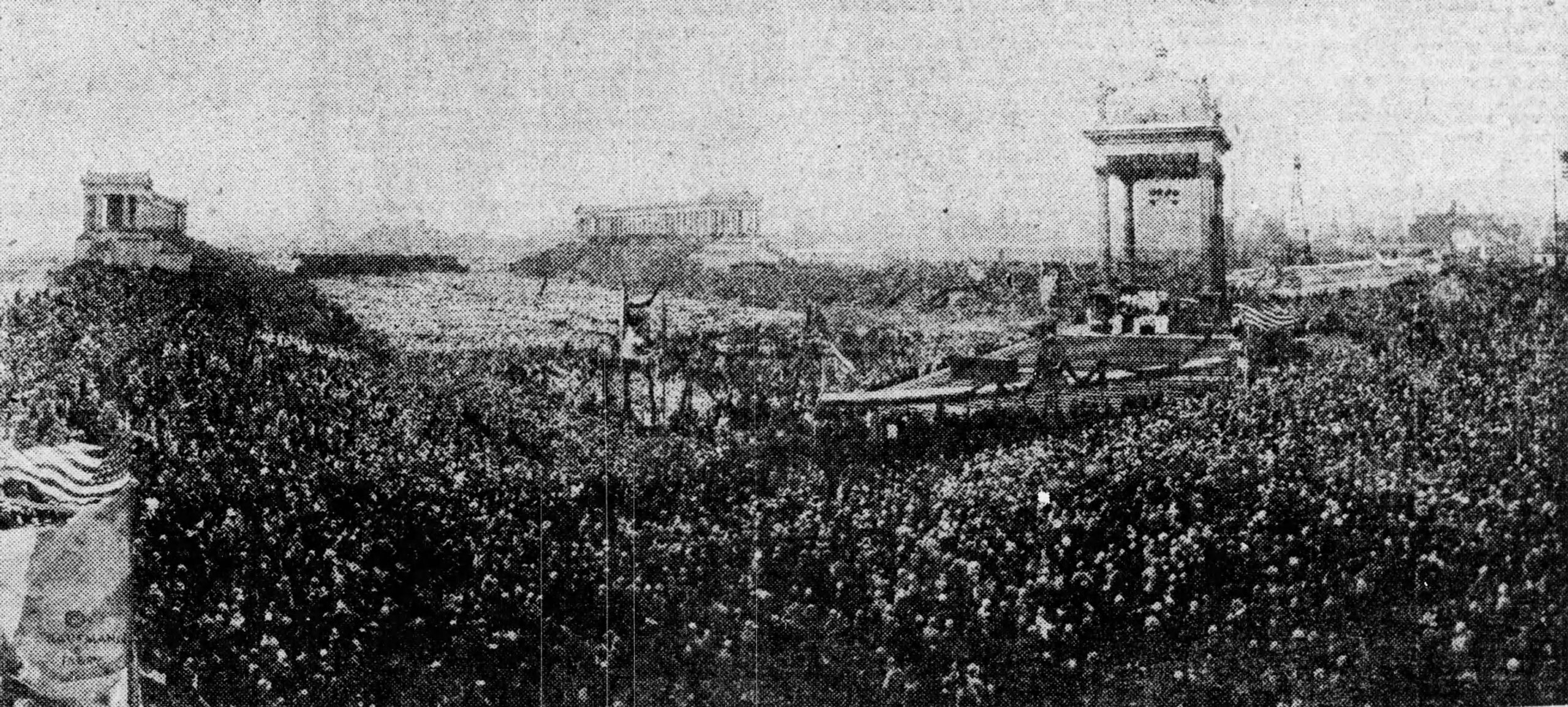
Above: the open air Mass at Soldier Field in Chicago, 1926.
A hundred years ago, on June 20, 1926, Chicago became, for five extraordinary days, the beating heart of world Catholicism. Along the sparkling shores of Lake Michigan, clergy, religious, and faithful gathered in a united response to the call to better know, love, and serve Our Lord Jesus Christ in His Eucharistic Mystery—the very center of the Church’s life and her mission of universal salvation. The Roman Ritual defines a Eucharistic Congress as “a gathering (statio) to which a local church invites the other churches of the same region or of the same nation or of the whole world.”[1]
It was the 28th International Eucharistic Congress—and the first ever held in the United States. The New York Times called it “the largest religious meeting in the history of the Catholic Church in America”[2]—a landmark moment in which the U.S. Church, still a minority often regarded with suspicion, displayed both its unity and its maturity.
The vision for an International Eucharistic Congress in America was born in 1925 in the mind of Cardinal George Mundelein (†1939), Archbishop of Chicago—a leader whose charisma matched his administrative genius. Already renowned as the founder of St. Mary of the Lake Seminary in Mundelein, set on a vast 600-acres estate, he saw Chicago as an ideal host: one million faithful, 240 multi-ethnic parishes, and a vibrancy of Catholic life unmatched in the nation.
In the 1920s, Chicago was more than a Midwestern powerhouse—it was the second-largest city in the United States, the fourth largest in the world, and a symbol of America’s meteoric rise. Railways and shipping companies arranged special trains to bring pilgrims from across the country. Streets were decked with banners and flags; parishes held vigils; and the arrival of the papal legate, Cardinal Giovanni Bonzano (†1927), was celebrated with parades, bells, and cheering crowds. Even the famed “Red Train”—the Cardinals’ Special Train—carried the Legate and prelates from New York to Chicago on June 16–17, greeted at every stop by throngs of the faithful.
The Congress began as it would end—in prayer and music. Across the archdiocese’s 367 churches, Masses and all-night adorations filled the hours, with over a million Holy Communions distributed. The inaugural Mass at Holy Name Cathedral brought together 10 cardinals, 300 bishops, and more than 5,000 priests hearing confessions—a scene almost unimaginable today.
The principal venue was Soldier Field, a vast amphitheater capable of holding 300,000 people. Thanks to a cutting-edge loudspeaker system, even those farthest from the altar could hear the liturgy—and the choirs and orchestras that transformed the stadium into a “cathedral of sound.”
From the start, the Congress revealed its musical ambition. The inaugural Mass featured 50 musicians from the Chicago Symphony Orchestra, joined by the choirs of St. Mary of the Lake Seminary and Quigley Preparatory Seminary, in a performance of Pietro Yon’s (†1943) Missa Solemnis.
On June 21, Children’s Day, 62,000 schoolchildren, dressed in white and yellow, sang the so-called Missa de Angelis, the eighth and most popular of the Gregorian chant Masses, filling the air with a pure and innocent wave. On June 22, Women’s Day, two choirs—6,000 religious sisters and 3,500 parish singers—filled Soldier Field with Vito Carnevali’s (†1960) Missa Rosa mystica, a composition of luminous serenity. On June 23, Higher Education Day, 3,000 high school and college students performed a Mass by Johann Baptist Singenberger (†1924), fusing youthful vigor with the solemnity of sacred ritual. On June 24, for the closing at St. Mary of the Lake, choirs from the Seminary and Quigley joined 80 musicians from the Chicago Symphony Orchestra for Licinio Refice’s (†1954) Missa Choralis. The celebration ended with the Gregorian O Salutaris and Tantum Ergo, sung in unison by all present—a sound that seemed to bind earth and heaven.
The pairing of Yon for the opening and Refice for the closing was no accident. Both masters bridged tradition and modernity, giving the Congress a sonic identity that was both Roman and American.
Yon, assistant organist at the Vatican Basilica from 1905 and appointed by Pope Benedict XV (†1922) as titular organist ad honorem in 1920, had emigrated to New York in 1907. He became assistant organist in 1926 and, in 1929, director of music and titular organist of St. Patrick’s Cathedral. His Gesù bambino (1917), originally composed as an organ piece, remains a beloved Christmas song in America.
Refice, who led the Liberian Chapel at St. Mary Major in Rome from 1911 to 1947, was—alongside Lorenzo Perosi (†1956)—a leading force in the renewal of Italian sacred music. Pope Pius XII would later praise him as “the author more than any other capable of edifying the soul of the crowds, to raise them to the superior harmonies of faith.”[3]
The final day saw between half a million and a million faithful process toward St. Mary of the Lake. A sudden thunderstorm failed to scatter the crowd; instead, soaked but singing, they received the Eucharistic blessing. For many, this moment—rain giving way to sunlight—became the enduring symbol of the Congress: faith shining all the brighter after trial.
The American press—Catholic and secular alike—praised the event’s purely religious character and the warm welcome even from non-Catholics. For Cardinal Mundelein and Bishop Thomas Louis Heylen (†1941), President of the Pontifical Committee for International Eucharistic Congresses, it was not only the largest Congress ever held but also the most fervent.
A century later, the vision endures: a stadium as cathedral, children singing Gregorian chant, processions winding through an industrial metropolis—proof that the Gospel can resound in the very heart of modern life.
And today, the music of Yon and Refice, which crowned those opening and closing liturgies, still finds a home in Chicago—particularly at St. John Cantius Church in Chicago, where the author of this article has served as music director for nearly six years. In that same city once called “the city of Catholics,” the notes of those masters still echo—a hundred years on.
[1] De communione et de cultu mysterii eucaristici extra missam, 1973, n. 109.
[2] G. Kahover, Mundelein Seminary, Charleston, SC, 2014, p. 41.
[3] Bollettino ceciliano, vol. 64, Roma 1969, p. 101; our translation.