

When gourds are mellow-yellow on the vine,
When mums and asters wither in the weeds,
When death rides heedless in the dewfrost night,
Madonna, shield me as I say my beads.When serpents slither through the slushy meads,
When sin pervades the caverns void of light,
When death directs her melancholy note,
O, blessed Lady, mantle me from fright.When nature waits the nestling robe of white,
When Satan stokes the furnace fiery-red,
When ghostlike shadows shroud the moon in gray,
O Holy Lady, mantle me from dread.When autumn fields with films of frost lie dead,
When mums and asters wither in the weeds,
When death rides heedless in the dewfrost night,
Madonna, shield me as I say my beads.
—Liboria E. Romano, “All Souls.”
Halloween is once more upon us. The autumn leaves are coloured and falling, there are pumpkin, aster, and Indian corn displays – and scarecrows of all sizes – everywhere. Depictions of ghost, witches, and the omnipresent Jack O’Lanterns are everywhere, and that annual bane of mothers and joy of children – candy corn – is present in all the drug stores. Certain parts of the country, such as Salem, Massachusetts and Sleepy Hollow, New York, are already entering their annual bacchanales, based upon their real and imagined history. Followers of Wicca, an age-old religion invented in the 1920s, are gearing up for what they have claimed as their major holiday. Neo-Puritans of Protestant and Catholic persuasion alike are once more – in an annual ritual reminiscent of the struggle between Christmas and “Holiday” or Midwinter – gearing up to denounce the observance as Satanic – thus unconsciously uniting with Neopagans of all varieties. Meanwhile, a great many strange folk are readying themselves to celebrate their aberrations in parades on that night in Greenwich Village, West Hollywood, San Francisco, and elsewhere.
More normal folk are readying their children for the rite of Trick or Treating – purchasing or making costumes, planning parties, and otherwise. Many Catholics will insist that their children dress as Saints – which is not a practice one could object to. There will be parties – some few actually featuring bobbing for apples, and certainly costume contests (in the interests of transparency, I have already attended one such, and won Third Prize for my guise – I came as The American Voter). There will be Haunted Houses and Hayrides to give a quick fright. Most folk will go through it as they do Memorial Day or Thanksgiving – an observance filled with fun, with a quick thought as to what else might be connected to it.
For myself, it is tied to childhood memories of the holiday’s heyday in the 1960s, before false rumours of poison candies and razor blades in apples took away a great deal of the fun in the following decade. My first such outing was in Mount Kisco, New York in 1964 – I wore a Heckle and Jeckle costume. It has long been a joke in my family that Halloween and April Fools are the only days we Coulombes can truly be ourselves. When I got older, and had my own home in the United States, I happily distributed bundles of candy to trick or treaters – with little notes asking for prayers for my dead, in keeping with spirit of the season. Every year a few would assure me that they intended to do exactly that, remembering my notes from previous years. Were I sending out children of my own, I would insist that we pray for deceased friends and relations of all who had given candy before we ate any – thus returning the practice to the original concept of “Souling,” as was done in Catholic Days throughout the British Isles.
For, of course, Halloween, or Hallowe’en, is All Hallows Eve – the Vigil of All Saints, the first day of the Triduum, with All Saints, and All Souls’, of Hallowtide. To really understand the observance, as our Catholic ancestors (rather than either Neo-Pagans or Neo-Puritans) did, we must start there. The Octave of All Saints is the time for gathering plenary indulgences for our beloved dead by visiting cemeteries and praying for them. November is the Month of the Holy Souls; and there is truly something uncanny about the whole period. Even though the phrase, “the veil between the Worlds is very thin this time of year” has been done to death by New Agers, it is not entirely untrue.
It is, to begin with, a very important time to meditate on Purgatory. There are innumerable approved prayers, like “The Daily Pilgrimage to Purgatory,” by which we can make a real difference in their afterlife – as they will for ours. The second offering in Robert Schauffler’s classic book, Hallowe’en, “Halloween and All Souls’ Day Customs” is a really good overview of Catholic folk customs form the Catholic World of November 1930. Fr. Schouppe’s Purgatory as Illustrated by The Lives and Legends of the Saints is a classic in this area.
But this of course opens up the whole issue of ghosts. As Catholics, we are forbidden to attempt contact or summon the dead – as we see from the story of the Witch of Endor. Nevertheless, hauntings occur. As Sir Shane Leslie tells us in his Ghost Book, the Church has taught that, when there appears to be an intelligence behind such phenomena, it is either a demon pretending to be the deceased; a damned soul; or a soul in Purgatory appearing to give needed information to the living and/or to ask for prayers and Masses. There is a display in Rome featuring artefacts marked by such, in the Church of Sacro Cuore dell’Suffragio.
But what of the fairies, who so many of Catholic father thought might intrude upon our space at this time of year? Probably the best Catholic work is by the Dominican Friar, Ludovico Sinistrari. For the rest of the bizarre, Occult Phenomena on the Light of Theology by the Cistercian Abbot, Alois Wiesinger is the best. I would also recommend my late lamented friend Joan Carroll Cruz’s book, Angels and Devils.
Now, at this point, it may well be asked what the point is for a Catholic to delve into all of this dark stuff? What use is the scary? Because alongside the need to pray for the dead at this time of year – and all the year, really – is the need to realise that spiritual evil does indeed exist in this world, and sometimes more openly than merely in temptations. But we also must be aware that God and His Church are far more powerful than they – and nowhere is this power against the dark more obvious than in the use of sacramentals, and especially the St. Benedict Medal. There is no better time of year than to reflect in these truths – and that if a Catholic regularly avails himself of the Sacraments, practises the standard devotions, and makes use of the sacramentals, the chance of his being plagued with this sort of thing is extremely remote. Then the devil and his minions are pretty much restricted to attending to us via the usual dull temptations.
Most horror films are way off-base theologically. As one popular example, the vampire in folklore is nothing like the glamourous figure of film – instead it is a rather disgusting demon-possessed corpse. But I did see many years ago a film called Blood on Satan’s Claw – which I cannot recommend for its sexuality and intensity. But ironically, it did have one perhaps unconscious testament to truth. As a demonic evil spreads over a hapless early 18th century English village, the one character who seems to have any idea of what is really going on is the Judge (played by the late Richard Wymark). Early on, it is revealed (he secretly toasts “His Catholic Majesty, James III”) he is a crypto-Catholic and Jacobite. Early in the film, after realising what is happening, he departs for London, leaving the Squire with this grave advice: “I shall not forget you. I shall return when the time is right. But you must have patience. Even while people die. Only thus can the whole evil be destroyed. You must let it grow.” He does indeed return in the nick of time, and saves the day. It is an oblique reminder that while one of the Church’s missions is to provide us the indispensable means of salvation, the other is to drive off the dark.
It would be wise to turn once more to the work of Dom Prosper Guéranger in The Liturgical Year. In his entry for the Vigil of All Saints, he tells us in preparation for the following day’s feast,
Let us prepare our souls for the graces heaven is about to shower upon the earth in return for its homage. Tomorrow the Church will be so overflowing with joy that she will seem to be already in possession of eternal happiness; but today she appears in the garb of penance, confessing that she is still an exile. Let us fast and pray with her; for are not we too pilgrims and strangers in this world, where all things are fleeting and hurry on to death? Year by year, as the great solemnity comes round, it has gathered from among our former companions new saints, who bless our tears and smile upon our songs of hope. Year by year the appointed time draws nearer, when we ourselves, seated at the heavenly banquet, shall receive the homage of those who succeed us, and hold out a helping hand to draw them after us to the home of everlasting happiness. Let us learn, from this very hour, to emancipate our souls, let us keep our hearts free, in the midst of the vain solicitudes and false pleasures of a strange land: the exile has no care but his banishment, no joy but that which gives him a foretaste of his fatherland.
He then goes on to point out how, in the Traditional Latin Rite, the second Vespers of All Saints was immediately followed by the first Vespers of All Souls. This necessitated an immediate change of both the tone of the prayers and the vestments of the officiating priest. Dom Guéranger comments upon this change thusly:
This Antiphon which expresses at once an unspeakable delight and a patient longing, closes the solemnity of the Saints. But the Church’s day is not yet ended. Scarcely has she given the last salute to her glorious sons disappearing in their white robes in the train of the Lamb, when an innumerable crowd of suffering souls surrounds her at the gate of heaven; and to these she at once lends her voice and her heart. The glittering vestments, which reminded her of the snowy garments of the blessed, are changed for the colour of mourning; the ornaments and flowers disappear from the Altar; the organ is hushed; the bells ring a plaintive knell. Without any transition, the Vespers of All Saints’ are followed by the Vespers of the Dead.
These concluded, he says:
Truly this day is grand and beautiful. Earth, midway between heaven and purgatory, has united them together. The wonderful mystery of the communion of saints is revealed in all its fullness. The immense family of the sons of God is shown to be one in love, while distinct in its three states of beatitude, trial, and purifying expiation: the trial and expiation being but temporary, the beatitude eternal. It is the fitting completion of the teaching given us through the entire year; and every day within the octave we shall see the light increase.
Meanwhile, every soul is recollected, pondering over the dearest and noblest memories. On leaving the home of God, let our thoughts linger lovingly upon those who have the best claim to them. It is the feast of our beloved dead. Let us hear their suppliant voices in the plaintive tones that, from belfry to belfry throughout the Christian world, are ushering in this dark November night. This evening or to-morrow they will expect us to visit them at the tombs where their mortal remains rest in peace. Let us pray for them; and let us also pray to them: we need never be afraid to speak to them of the interests that were dear to them before God. For God loves them; and, as his justice keeps them in an utter inability to help themselves, he makes amends to his goodness by hearing them all the more willingly on behalf of others.
He refers to the custom – upheld even today in such culturally Catholic parts of the United States as Louisiana – whereby people visit graves and light candles on the night of All Saints. An official explanation of the status of the holiday is
Additionally, All Saints’ Day on November 1st is observed in a unique way in the predominantly Catholic state of Louisiana. Families visit cemeteries to clean and decorate the graves of their departed loved ones with flowers, candles, and other offerings. This tradition reflects the strong cultural and religious ties that many in Louisiana have to their families and ancestors.
Dom Guéranger, in considering All Souls’ Day gives us very fine advice regarding praying for the dead on this day:
Although the poor suffering souls are sure of their eternal blessedness, yet they entered upon this road to heaven at a moment of utmost peril: the supreme effort of the devil in his last assault, and the agony of the judgment. The Church, therefore, extending her prayer to every stage of this painful way, does not forget its opening. Nor is she afraid of being too late; for to God, who sees all times at one glance, this day’s supplication was present at the moment of the dread passage, and obtained assistance for the straitened souls. This same prayer follows them also in their struggles with the powers of hell, when God permits these, according to the revelations of the Saints, to be the ministers of his justice in the place of expiation. At this solemn moment, when the Church is offering her gifts for the tremendous and all-powerful Sacrifice, let us redouble our prayers for the faithful departed. Let us implore their deliverance from the jaws of the infernal lion. Let us obtain from the glorious Archangel, whom God has set over Paradise and appointed to lead souls thither, that he would bear them up to the light, to life, to God, who is himself the reward promised to all believers in the person of their father Abraham.
As Halloween is upon us, then, let us not think merely of candy and costumes – enjoyable though they are. Let us prepare to celebrate Hallowtide as the Church has always celebrated it, mindful of past, present, and future. May the darkness of these nights remind us that the Eternal Day will dawn; may we and all whom we love be part of it.
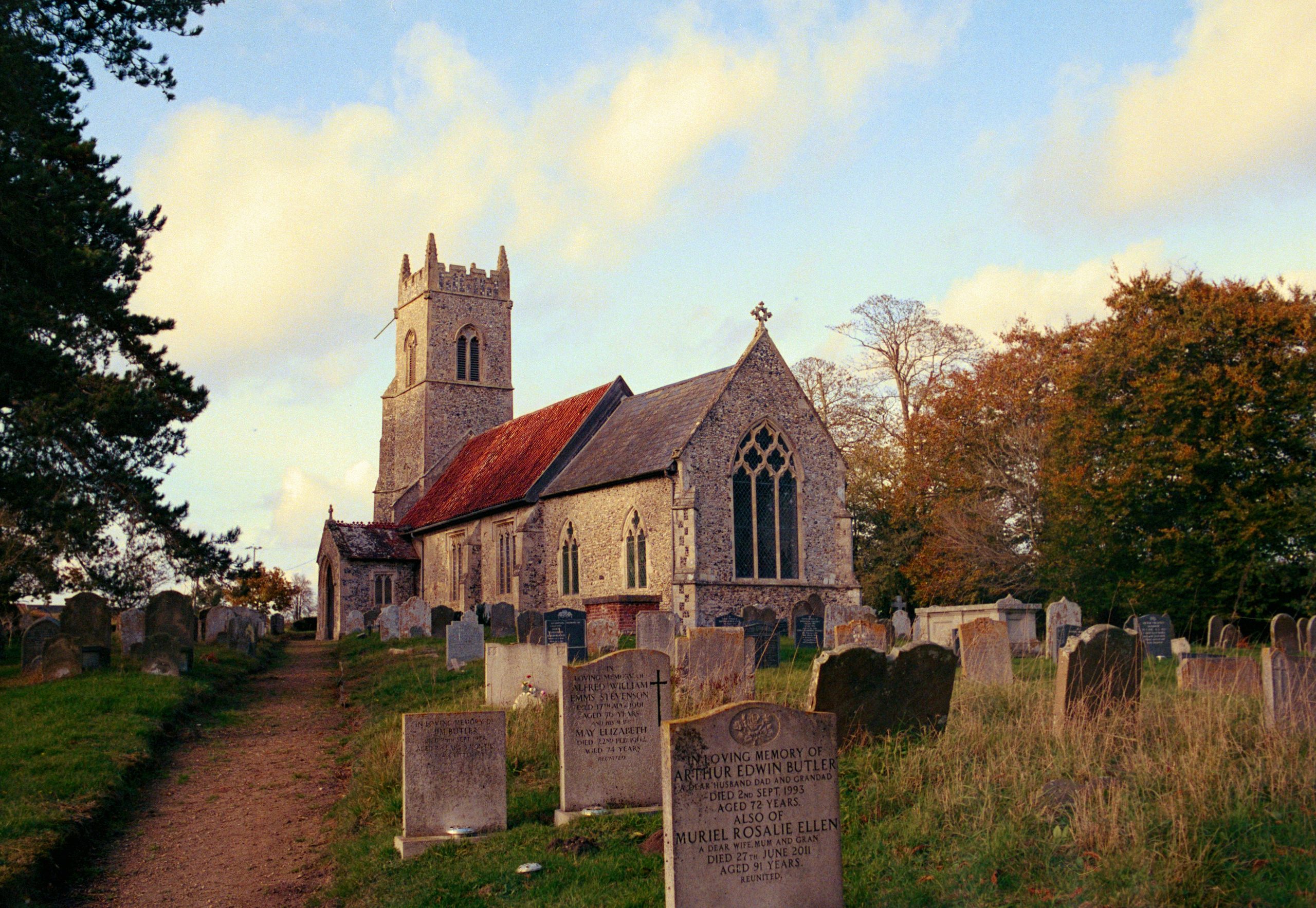
Photo by Barney Goodman on Unsplash