
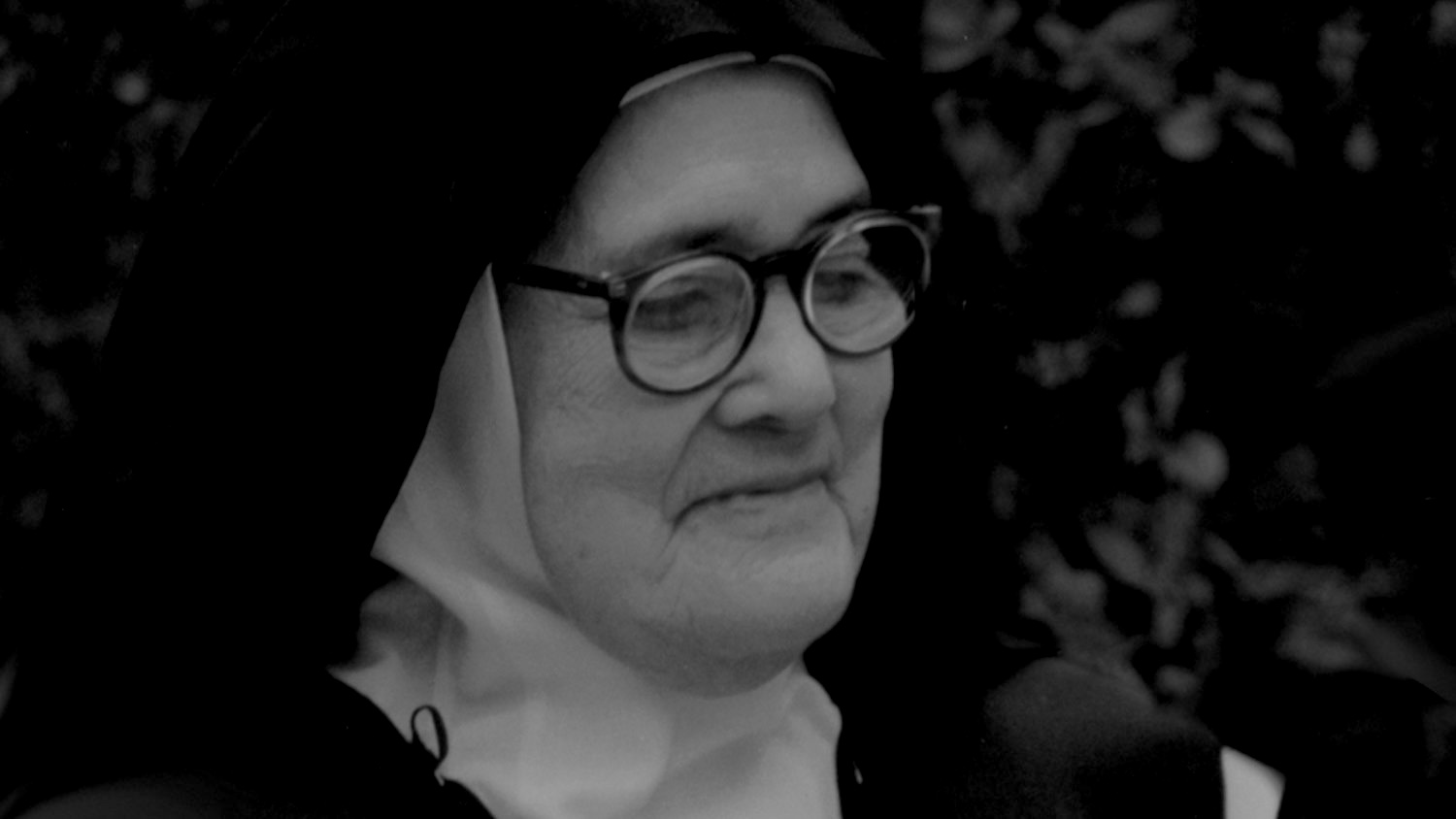
We got every single picture we could find of Sr. Lucy, or videotape, or handwriting sample together and submitted them to the experts.
–Dr. Peter E. Chojnowski, September 21, 2026
Editor’s note: Mr. K. Symonds has published a companion video explanation to this article here.
One of the earliest presentations brought forth by Sister Lucy Truth (SLT) in favor of the Fake Lúcia Hypothesis (FLH) was the handwriting of Sr. Lúcia. The organization published between January and August of 2019 various declarations of Bart Baggett, a handwriting analyst from California.[1] Basing himself upon materials sent to him by SLT, Baggett wrote several “declarations” wherein he issued the astonishing conclusion it was “highly probable” certain documents sent to him by SLT were not written by Sr. Lúcia.
Establishing the Declarations
Before going into a formal analysis, it is necessary to provide some explanation of Baggett’s declarations. There were three iterations: December 21, 2018[2], June 26, 2019[3], and August 8, 2019.[4] There were three separate declarations (Reports 1-3) within the June 26, 2019 declaration referenced either on Dr. Chojnowski’s personal blog RadTrad Thomist (RTT)[5], or on the SLT website.[6] The website features a kind of overview of the declaration(s) and provides the reports via PDFs. Also provided are the sources used for the analyses (more on this below). For our purposes, we will mostly (although not exclusively) rely on the August 8, 2019 declaration as it is the most complete.
Given various versions of the declarations, how did SLT organize and collate information before submitting material to Baggett? How comprehensive was the search for information and processing beforehand? Did Baggett possess enough information from SLT to make informed decisions in his declarations?
Origin of the Material
SLT created a “packet” of samples of Lúcia’s handwriting for Baggett. They were samples of her signature, selections of major texts from her Memoirs, selections fromher private diary O Meu Caminho (OMC), four images of the text of the third part of the Secret of Fátima, and some letters.[7] SLT largely depended upon two sources[8] for these texts: the book Memórias e cartas da Irmã Lúcia by Fr. António María Martins (1973), and Um caminho sob o olhar de Maria (2013) by the Carmel of St. Teresa in Coimbra (English edition A Pathway Under the Gaze of Mary, 2015). Fr. Martins’ book contained facsimile reproductions of Lúcia’s documents.[9] Digital stills from an RTP Arquivos video containing images of the Memoirs was also used.[10]
The origin of the four images of the third part of the Secret of Fátima derived from an exposition that took place at the Santuário de Fátima in 2014 entitled “Segredo e Revelação.”[11] They were reproduced on the Spanish website Un Catolico[12], and it was from this site that SLT found the images.[13] Whether other samples of Lúcia’s handwriting made available on the exposition’s official website[14] were given to Baggett is not clear.
Classifying the Material
The series of documents provided to Baggett have a letters and numbers classification system.[15] There are two main categories: the “Known Documents” and the “Questioned Documents.”[16] Baggett labels the text of the third part of the Secret as “Q1-Q4.” One of the letters is dated December 27, 1969, addressed to Dr. Alcino Magalhães, Lúcia’s doctor, and labeled “Q5.” Another letter is dated to April 13, 1980, written to Fr. Umberto Pasquale and labeled “QB3.” Two other “questioned” documents were excerpts from Lúcia’s personal OMC diary that appeared in Um caminho sob o olhar de Maria. They are labeled as “QB1” and “QB2.” Lastly, two signatures were also within the “Questioned Documents” category, the ones appearing at the end of the 1969 letter to Dr. Magalhães, and another said to be a letter from 1967.[17] Baggett labels them as “QC1” and cites his source as coming from page 450 of Fr. Martins’ Memórias.[18]
Baggett was tasked by SLT to determine whether the same hand wrote the documents in the “Questioned Documents” category. He was to compare them with earlier documents from 1955 on back (considered to be authentic by SLT). Ultimately, Baggett concluded with high probability that for QB1-3, Sr. Lúcia “did not write the questioned documents.” He said much the same for Q5 and likewise concluded with a high probability that Lúcia “did not sign the signatures on the questioned documents, QC1.” The text of the third part of the Secret (Q1-4) was considered to have been authored by Lúcia.[19] Baggett provides his reasons in his declarations, and readers are encouraged to read them for themselves. We will here cover some of the more notable statements.
Omission of Samples
The emphasis upon Fr. Martins’ Memórias book for a significant portion of the handwriting samples is not without merit. This book was the first to reproduce the entire text of the I-IV Memoirs of Sr. Lúcia. It was done without her permission, and it is a little-known fact that she had been encouraged by some people to press legal charges against Fr. Martins.[20] The book suffered imperfections, as indicated by the lengthy errata sheet that was printed with the book[21], but also by the admission of Fr. Martins himself.[22] Later editions were published in 1976 (Documentos de Fátima) and in 1984 (Novos Documentos de Fátima).
Absent from consideration for Baggett is some of the earliest material from Lúcia’s own hand. One example is a document Fr. Martins printed in the 1976 Documentos de Fátima book dated January 5, 1922 and concerns the apparitions of 1917.[23] Not even the signature at the end appears to have been provided to Baggett as it is unaccounted for in KC1. This is most odd because SLT was aware of Documentos as early as August 2018. Another document was written in 1927 that detailed the apparition of December 10, 1925.[24] A few years later, this document was also reproduced by the Postulation Center in Fátima in the book Fatima in Lucia’s Own Words.[25] It was a much cleaner copy than the one in Martins’ books.
When we look at the signatures reviewed by Baggett, one was from Lúcia’s July 24, 1927 letter to her mother (KC1). This letter appeared between pages 402-403 of Memórias. Outside of the signature on this letter, the text of the letter itself does not appear in the list of documents consulted by Baggett. Moreover, the 1927 document about the apparition of 1925 was on the two preceding pages from the July letter means SLT had ample opportunity to be aware of the existence of the document. Why are these two documents absent from consideration by Baggett? Meanwhile, the 1927 letter to Lúcia’s mother was recently featured at a new exposition at the Santuário de Fátima in late 2025 entitled “Refúgio e Caminho.”[26] A friend took pictures for me:
Lúcia’s 7-24-1927 Letter to Her Mother
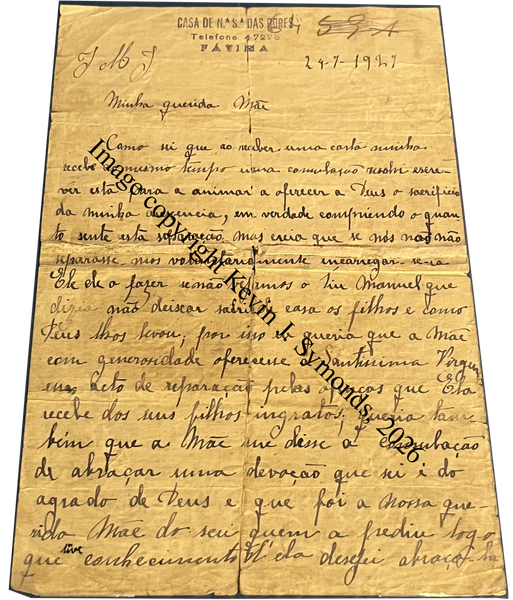
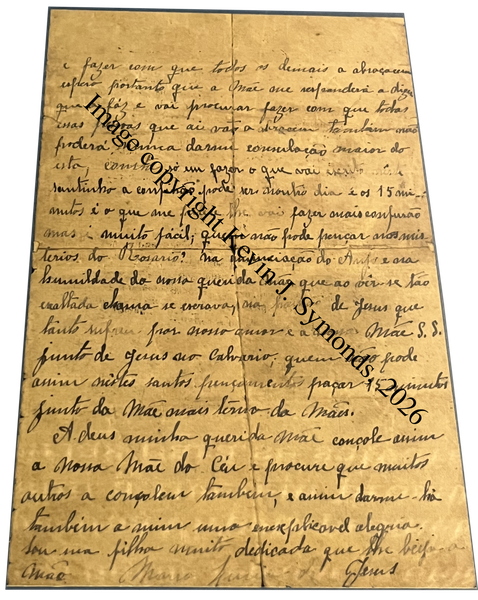
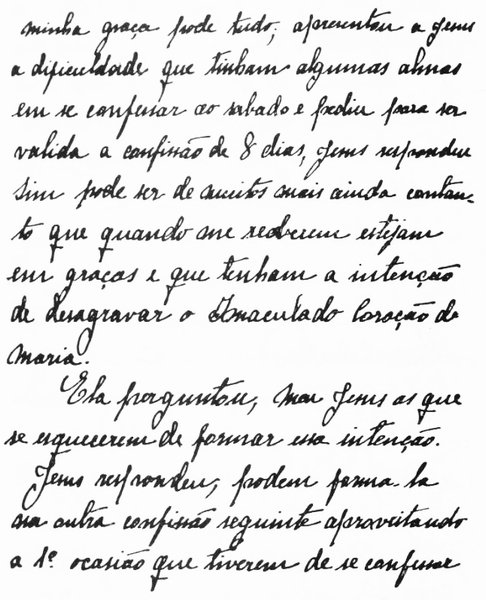
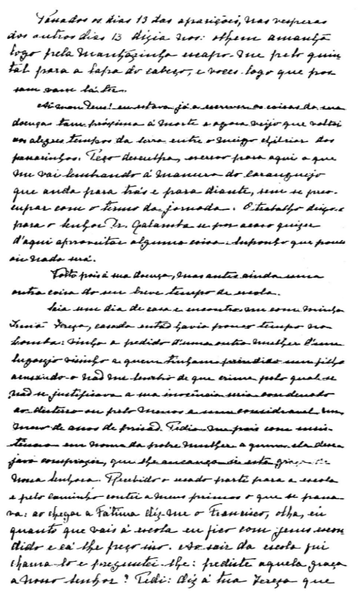
The above observations are important because the handwriting is notably distinct from the text of the four Memoirs. We also note the crease down the middle and the faint signature. These texts are very early from Lúcia, who had only begun to learn to read and write some years prior. Their lack of having been considered in Baggett’s analysis creates a gaping hole in his work (even if through no fault of his own). Baggett does acknowledge in his various declarations’ “Basis of Opinion” sections that one’s handwriting can be fluid and there are individual characteristics.
At present, and for the sake of comparison, here are two samples of Lúcia’s writing, taken from Fr. Martins’ Memórias book. The first is the 1927 document about the December 1925 apparition, and the second is from the Fourth Memoir in 1941 (click to enlarge):
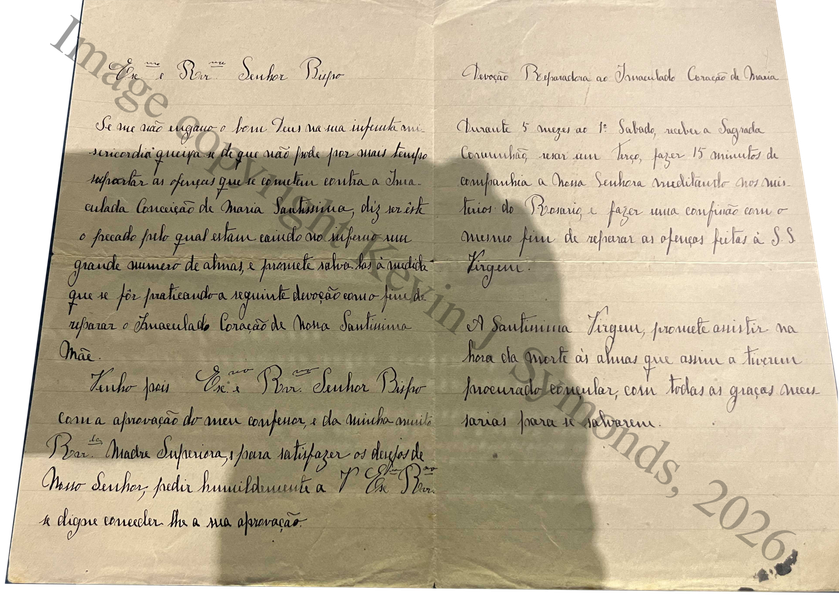
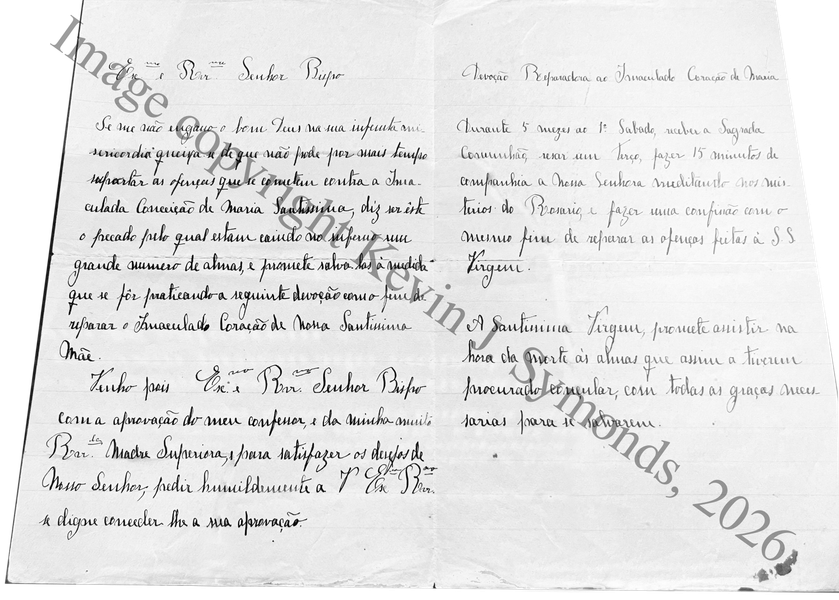
There exists another letter from these early years that seems worthy of our consideration. It is a letter of Lúcia to Bishop José da Silva (Leiria), dated October 2, 1928 and was labeled as Exhibit 50 during the exposition. Even though it was likely unknown to Baggett, this letter was made available for public display at the December 2025 exposition. I present it here for a further comparative handwriting sample of these early years:
The Signature of Sr. Lúcia
While Baggett’s declarations might suffer from a lack of information provided to him, it is also noteworthy that there are discrepancies and/or inconsistencies between his declarations. A notable one concerned the discussion of Sr. Lúcia’s signature. In the third report of June 29, 2019, Baggett examines the 1969 letter to Dr. Magalhães (Q5). He wrote:
The first name in the questioned signatures is not written as Maria, as shown in the known signatures. The writer uses the prefix ‘Sr’ which is most likely a truncated version of the word ‘Señorita’. While this would be a reasonable option for an unmarried woman, the use of the ‘Sr.’ prefix is not found in the comparative signatures.[27]
Based upon this observation, Baggett then stated on lines 14-15 “Therefore, the formation and stroke features of the letter ‘S’ have no comparative value in this side-by-side analysis.” He extends his observation between lines 16-21.
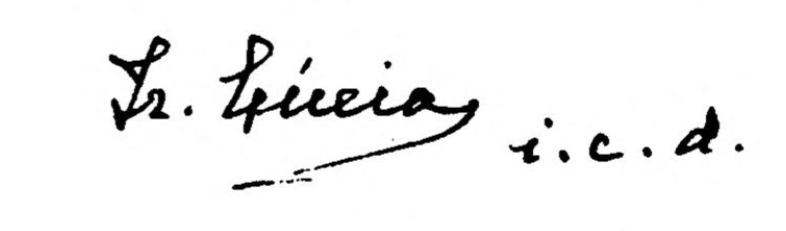
December 27, 1969 letter to Dr. Magalhães
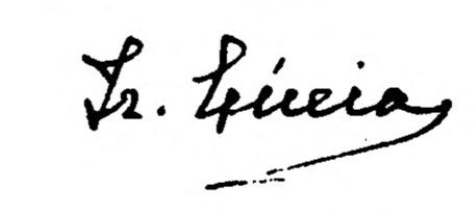
A female religious’ title is “Sister,” which, in English, is typically abbreviated as “Sr.” However, the Portuguese word for “Sister” is “Irmã,” and its abbreviation is “Ir.” Thus, the signature is “Ir” and not “Sr.”[28] Moreover, interpreting it as “señorita” would not make any sense as this word is Spanish (Portuguese: senhorita). As Baggett’s own text notes the problem, why is this matter not more critically reviewed?
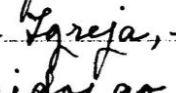
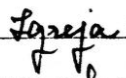
Curiously, this discussion of “señorita” remains in Baggett’s August 8, 2019 declaration, but with a notable change: the “Sr.” now reads “Ir.”[29] Despite this change, the rest of the text in question remained the same with “señorita,” along with the discussion about the letter ‘S’ and its formation. This discussion makes no sense once the S to I mistake is noted, and the knowledge of a religious sister’s title is applied. Additionally, within the 1969 letter, there are no less than two examples of a capital letter “I” on lines 10 and 15 (starting from the top) with the word Igreja (Church) and they clearly match the signature. The following table shows the letters:
Formation of a Phrase
In his original declaration of December 31, 2018, Baggett discussed a phrase that is found within the 1969 letter to Dr. Magalhães: “The words printed in lowercase in the 11th line from the bottom on Q5 (which contains the word ‘Esperanca’) is a variation in writing formation within the questioned document that is unaccounted for. The printed letters do not match the writer of the rest of the questioned document.”[30] The full Portuguese phrase is “…Fé, na Esperança, e na caridade…” (“…Faith, in Hope, and in charity….”) This phrase is not written with cursive handwriting, as evidenced the following visual from Memórias:

Baggett calls this text a “variation” and “unaccounted for.” So, why the sudden change to print? Is this a stylistic choice of Lúcia or the work of a fraudulent ghostwriter? If it is the former, then it would be helpful to show consistency with previous writings.
Variation Unaccounted For?
Let us turn to the Carmelites’ 2013 biography about the text from Sr. Lúcia’s OMC diary about the January 1944 vision of Our Lady to Sr. Lúcia.[31] This text was reviewed by Baggett (QB1). The cursive-print-cursive (CPC) style appears in this text. While describing the events themselves preceding the apparition of 1944, Sr. Lúcia writes in cursive. There is a printed quotation mark («) followed by Our Lady’s words in print handwriting. At the end of these words, Lúcia returns to cursive for several words before she returns to print again. This time, she is not quoting. Rather, she is describing a vision that she experienced after receiving the clarification from the Virgin. At the end of this description, Lúcia goes back to cursive. It appears that not only does she use the CPC style for direct quotations, but also for descriptions involving serious matters.
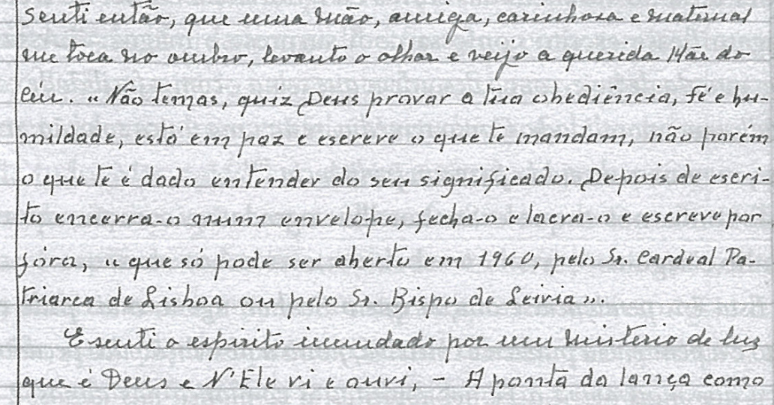
The CPC style also appeared in the reproduction of page 139 of Sr. Lúcia’s OMC diary and which was reviewed by Baggett (QB2). This text is dated May 29, 1941. Most of this document is in cursive but the last several lines are in print. These lines appear to be a quote, indicated by a printed double angle printed quotation mark («) preceding the text, which is standard in Continental European usage. It is likely that Sr. Lúcia is using Psalm 149, at least in part, to compose a prayer to the Lord.
In both documents, we clearly have earlier texts containing the CPC style. Curiously, Baggett says nothing about this style being present in these earlier documents. It is also most unfortunate that SLT’s founder, Peter Chojnowski, labels these documents as frauds.[32] (Doing so cuts off people from learning something previously not well known about the development of Lúcia’s writing style.) Nevertheless, what we have observed here about the CPC style and early dates in other documentsreviewed by Baggettis notable information. Why is this fact not highlighted?[33]
Being aware that the CPC style appears in earlier documents is not a negligible matter. It both establishes consistency and questions the thoroughness of the material furnished to Baggett.[34] Baggett possessed examples of the CPC style of Sr. Lúcia dating back to 1941. He did not say much about it except it is “unaccounted for” in the rest of the 1969 letter to Dr. Magalhães. He offers no interpretation, yet neither did he state in his declarations that the same CPC style appeared in the OMC diary. Did anyone ask questions about the origin or provenance of this style? If so, why was this fact not published? If no questions were asked about it, why?
Printed Letters Do Not Match?
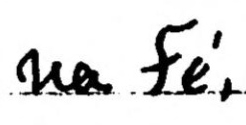
There is another observation to make in Baggett’s assertion about the CPC style. Concerning the “Faith, Hope and Charity” phrase in the 1969 letter, Baggett stated, “The printed letters do not match the writer of the rest of the questioned document.” On line 6 (starting from the beginning paragraph), the word “Fé” (Faith) appears. It appears to be in print, not cursive. Here is how the word appears on line 6 (left) in comparison with line 14 (right):

The CPC Style: The Prioress Explains
Having said all the above, we must still answer why Sr. Lúcia would use a CPC style.To this point, I wrote to the Prioress of the Convent of St. Teresa in Coimbra on January 26, 2019 via E-mail and asked: “the text is mostly cursive, but parts of the text appear in print (non cursive). Was this a particular style for Irmã Lúcia? If so, what was the reason for it?” The Prioress wrote back on February 7 and confirmed that this was Sr. Lúcia’s style “to distinguish what were her words and what was [a] quote.” Put another way, it would be analogous to using Roman type and italic type for the same distinction in a printed work.
Problem with Copy/Paste?
On a final note, regarding the CPC phrase of the 1969 letter, if we return to Baggett’s text, it changed slightly after his December 31, 2018 declaration. In every subsequent document wherein the matter is mentioned, the word “Esperança” is incorrectly spelled. Here are the texts side by side for comparison:
| First Report of June 26, 2019[35] | Second Report of June 26, 2019[36] | Declaration of August 8, 2019[37] |
| The words printed in lowercase in the 11th line from the bottom on Q5 (which contains the word “Esperrazza”) is a variation in writing formation within the questioned document that is unaccounted for. The printed letters do not match the writer of the rest of the questioned document. | The words printed in lowercase in the 11th line from the bottom on Q5 (which contains the word “Esperrazza”) is a variation in writing formation within the questioned document that is unaccounted for. The printed letters do not match the writer of the rest of the questioned document. | The words printed in lowercase in the 11th line from the bottom on Q5 (which contains the word “Esperrazza”) is a variation in writing formation within the questioned document that is unaccounted for. The printed letters do not match the writer of the rest of the questioned document. |
Baggett spells the word “Esperança” as “Esperrazza.” One can only surmise that the error was made in the first declaration of June and was subsequently copied and pasted into the other declarations. How was the word correctly spelled in the original December 2018 declaration and then consistently misspelled in the subsequent declarations?
A Notable Admission
What has been said up to now must be tempered with information very recently made public. As the canonization cause of Sr. Lúcia progresses, the public is learning more information about her life. In early 2025, the vice-postulator for her cause, Sr. Ângela Coelho, published a book co-authored with the French Carmelite writer Fr. François-Marie Léthel, Viver na luz de Deus (To live in the Light of God).[38] This book is based primarily upon Sr. Lúcia’s OMC text. In Viver, we learn that someletters to Sr. Lúcia were answered by other sisters:
Lúcia also suffered greatly because of correspondence: until 1977, many letters were not delivered to her, they always arrived opened (a common practice in religious life at that time) and many were read and answered by other sisters. Only at the end of 1977, after many difficulties and the intervention of superiors, did correspondence finally begin to be delivered to her entirely and sealed. Consider the following intimate notes where she addresses the question and shows how it was gradually resolved, in everything always renewing her Yes.[39]
The two authors then provide the following quotes from Lúcia’s OMC diary:
Our Mother [the Prioress] came to bring me the correspondence accumulated since the month of October. It is the first time that, since I left my parents’ house, at 14 years old, now I am 70, correspondence is delivered to me sealed; not even the letters from my mother, while she lived. I have endured for love of the Lord, fulfilling my “Yes”. “Do you wish to offer yourselves to God to bear all the sufferings that He may wish to send you…?” “Yes” (December 14, 1977).
Our Mother came to tell me that, from this point forward, the offerings that come in the correspondence are destined to pay the expenses of the same correspondence and, what remains, is given to the poor. I was content (January 1, 1978).[40]
Léthel and Coelho reveal that for fifty-six years, letters to Lúcia had been opened and read by others before (and if) they reached her. Many letters were read and answered by other sisters. This system was in place until late 1977, making difficult a more objective examination of the facts. At the same time, the disclosure neutralizes any suspicion behind the matter of the handwriting. As already mentioned, opening and reading letters was a common practice within religious life at that time. An argument from traditional religious life should not be a cause for scandal to SLT.
So, even though we learn that other sisters responded, we are not told if that correspondence was given to Sr. Lúcia for her approval and signature. Thus, what letters were by Sr. Lúcia’s own hand and which ones were not? Were the disputed 1967 and 1969 letters written by Lúcia or another sister? Moreover, did other sisters respond under their own name for Sr. Lúcia? Léthel and Coelho are sparing on the details of this matter, and the texts quoted from Lúcia’s OMC diary say nothing about sisters answering letters for her. Some clarification on the matter would greatly assist the public’s understanding. Until such a clarification is given, we can say that Léthel and Coelho’s disclosure does not provide ipso facto proof of fraud.
Conclusion
For now, it is enough to say the considerable amount of evidence suggests the declarations of Bart Baggett on Sr. Lúcia’s handwriting were questionably edited and based upon information selected by Sister Lucy Truth. A discussion by the organization on the totality of evidence would have balanced out the presentation. We also must leave it to the postulation for Sr. Lúcia’s cause to address more clearly the matter of how exactly other sisters at the Carmel of St. Teresa answered on the Venerable’s behalf.
[1] Bart Baggett Official Website. Biography here, and credentials here. See also LinkedIn and Instagram.
[2] “Handwriting Analysis.” Sister Lucy Impostor (2019). This entry is from the June 4, 2019 entry on the Internet Archive Wayback Machine and refers to Bart Baggett’s first declaration of December 2018.
[3] Ibid. This entry is from the July 19, 2019 entry on the Internet Archive Wayback Machine and refers to Bart Baggett’s June 26, 2019 declarations.
[4] Ibid. This entry is from the November 18, 2019 entry on the Internet Archive Wayback Machine which updates the page with the August 8, 2019 declaration.
[5] Dr. Peter Chojnowski. “Announcement 2019: Sworn Declaration.” RadTrad Thomist (January 1, 2019); “Revised and Updated Edition of Handwriting Analysis Declaration.” (June 29, 2019); Ibid. “New Handwriting Analysis Report Shows.” (June 29, 2019); Ibid. “Long-Standing Fatima ‘Consecration of Russia’ Narrative Implodes.” (June 29, 2019): Ibid. “ALERT: World-Class Handwriting Analyst.” (July 2, 2019). Interestingly, there appears to have been no reference to the August 2019 declaration on the RadTrad Thomist site.
[6] At the time, the official website was www.sisterlucyimpostor.org. Today, this URL automatically redirects to www.sisterlucytruth.org. There is also a third website (https://sisterlucytruth.com).
[7] For our purposes, it is not necessary to go through every detail of this classification system. Readers are encouraged to see for themselves the classifications within the declarations.
[8] The source for the April 13, 1980 letter is not entirely clear from within the declarations and packets.
[9] Fr. António María Martins, S.J., Memórias e cartas da Irmã Lúcia (Porto: L.E. Simão Guimarães, 1973). Readers are encouraged to view this book as we go through the material used by SLT/Baggett.
[10] Cf. Teresa Pacheco de Miranda. “Morreu a Irmã Lucia.” RTP Arquivos (February 14, 2005), 00:51 – 01:06.
[11] “Segredo e Revelação.” Santuário de Fátima (2014).
[12] “Manuscrito original del tercer secreto de Fatima.” Un Catolico (2014).
[13] Cf. Dr. Peter Chojnowski. “RadTrad Thomist Withdraws.” RadTrad Thomist (December 27, 2018); Ibid. “We have found a Very Good Copy.” (December 28, 2019); Ibid. “Photo of the Third Secret.” (December 29, 2018). We draw readers’ attention to the fact that these posts appeared between December 27-29, 2018—i.e., within five days of Baggett’s first declaration dated to December 31, 2018. Did Baggett originally work with the reproductions on the Vatican’s website (published in 2000)?
[14] Segredo e Revelação: Galeria.” Santuário de Fátima (2014).
[15] Chojnowski. “Handwriting Analysis.” Sister Lucy Truth (2019).
[16] Declaration of Bart Baggett (August 8, 2019), page 1, lines 16-19. We will not here focus too much upon the “Known Documents.” It is enough to say that they are various letters, signatures and samples from Lúcia’s Memoirs largely taken from the video digital stills and Fr. Martins’ Memórias book. They are labeled K1-K101, KC1-KC4 by Baggett (Declaration of Bart Baggett [August 8, 2019], page 2, lines 6-20). They were used as the baseline to judge the “Questioned Documents” material.
[17] In Martins’ Memórias book, this letter appears to the left of the 1969 letter to Magalhães. Interestingly, it is not dated, so how Baggett and SLT concluded that it is from 1967 is not clear.
[18] The information provided in this paragraph can be found in the August 8, 2019 declaration of Bart Baggett, pages 1-2, lines 21-28, and 1-5 respectively.
[19] Declaration of Bart Baggett (August 8, 2019), page 8, lines 17-27 through page 9, lines 1-6.
[20] Fr. Robert J. Fox and Fr. Antonio Maria Martins, The Intimate Life of Sister Lucia (Alexandria, South Dakota: Fatima Family Apostolate, 2001), 74-75.
[21] The online copy of the book available at the Internet Archive Wayback Machine reproduced the errata sheet.
[22] Ibid., 74.
[23] Fr. António María Martins, SJ., Documentos de Fátima (Porto, 1976), 468-476.
[24] Martins, Memórias e cartas da Irmã Lúcia, 400.
[25] Fr. Luis Kondor, SVD, Fatima in Lucia’s Own Words (Fatima: Postulation Center, 1976), 189-196.
[26] “Shrine of Fátima Inaugurates Unprecedented Exhibition.” Santuário de Fátima (November 30, 2025).
[27] Baggett. “Handwriting Analysis of IRMA LUCIA Packet: Report 3,” in Sister Lucy Truth (June 26, 2019): page 2 (15 of the PDF file), lines 10-13.
[28] Baggett refers to Lúcia as “IRMA LUCIA” throughout the declarations. In the earlier letters reviewed by Baggett from the mid-1950s, “Ir.” is used.
[29] Declaration of Bart Baggett (August 8, 2019), page 6, lines 12-27 through page 7, lines 1-7.
[30] Declaration of Bart Baggett (December 31, 2018), page 4, lines 16-19.
[31] Carmelo de Santa Teresa – Coimbra, Um caminho sob o olhar de Maria, 269.
[32] Cf. Chojnowski. “On Centenary of the Death of Francisco of Fatima.” RadTrad Thomist (April 3, 2019). In particular, he wrote, “The latest […] helps to identify both the fraud of the 1967 and after ‘Sister Lucy’ but also directly implicates the Carmel at Coimbra in the coverup and substitution of an imposter for the real Sister Lucy. Soon to be published information, with the accompanying analysis and texts, prove that source texts attributed to Sister Lucy, from which the ‘Pathways’ book, published by the Carmel of Coimbra, is drawn, is an example of forgery.”
[33] The CPC style also appears in a letter written by Sr. Lúcia on April 12, 1970 (cf. Martins, Documentos de Fátima [1976], 452).
[34] As to why Baggett himself did not note it, perhaps it is out of his purview as a handwriting analyst to show correlation. After all, a true forensic examination is performed according to the rules of the discipline at hand and does not venture into areas outside its domain (see Gregor Čavlović. “We’ve Been Using the Wrong Science in Court For 50 years.” Veritasium YouTube Channel [June 22, 2026]). While it is true that a forensic examination must adhere to the rules of its discipline, there is a principle that must also be applied: the totality of evidence. In our case, differences in handwriting do not necessarily equate to a forgery or the work of a ghostwriter. Sometimes a little historical knowledge goes a long way, such as Lúcia’s very rudimentary education and continued writing development over the years, also the conditions under which she wrote various documents such as her Memoirs (see Kevin J. Symonds. “On the Third Part of the Secret of Fátima: Introduction to Recent Scholarship.” OnePeterFive (July 6, 2026). All of these things and others must be factored before arriving at a conclusion.
[35] First Report of Bart Baggett (June 26, 2019), page 4, lines 18-21.
[36] Second Report of Bart Baggett (June 26, 2019), page 3, lines 9-12.
[37] Declaration of Bart Baggett (August 8, 2019), page 5, lines 4-7.
[38] François-Marie Léthel, OCD and Ângela de Fátima Coelho, ASM, Viver na luz de Deus (Águeda, Portugal: Edições Carmelo, 2025).
[39] Ibid., 286.
[40] Ibid., 287, citing Lúcia de Jesus, Meu Caminho IV p. 12.