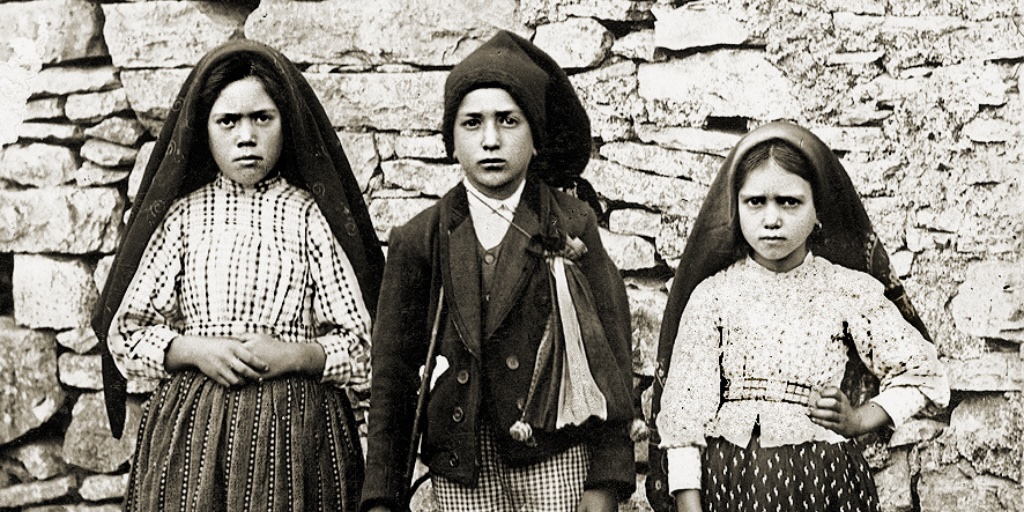
Above: (left) Servant of God Sr. Maria Lucia of Jesus and of the Immaculate Heart as a young child, with Ss. Francisco and Jacinta Marto, the children of Fatima.
Part I: Summary of Biographical Details and Documentation
The third part of the Secret of Fátima has been one of the most controversial aspects of the message of Our Lady at Fátima. This controversy has been largely due to a shroud of mystery and intrigue that grew up around the text. I’d like to dive into and demystify some of this history so as to arrive at a surer grasp of the facts and better understand Our Lady’s message.
The mystery and intrigue surrounding the third part is rooted in human nature. The first line of Aristotle’s Metaphysics explains it well: “All men by nature desire to know.”[1] When the Secret was communicated to the three children (Lucia, Francisco and Jacinta) on July 13, 1917, the children did not hide the fact that there was something Our Lady had told them. It was impossible to hide because the vision of hell had frightened Lúcia so much that she had a visible reaction about which onlookers later asked her.[2] From this event, word had spread of the Secret and even the local administrator, Arturo dos Santos, made it a part of his interrogation of the children in August of 1917.[3]
Having been bound to silence on the Secret by Our Lady, the children maintained that silence (even against the threat of bodily harm). They talked about it amongst themselves when they were in private, but that was it. After the deaths of Francisco and Jacinta in 1919 and 1920 respectively, Lúcia remained to make Jesus and Mary more well-known and loved. She did this first as a Dorothean sister from 1925-1948 and then as a Carmelite nun from 1948 to her death in 2005.
Lúcia had the supernatural experiences of her childhood at the foundation of her formation. They did not make her a saint. As a nun, she was now learning the vow of obedience and how to practice it. This vow was emphasized by a personal vow of perfection she also made, but which is a little-known fact in her biography.[4] Having thus bound herself to perfection (and thus obedience) in a strict fashion, Lúcia practiced it very notably and this practice has an effect upon the writing down of the Secret, especially the third part.
Lúcia had been commanded by the Bishop of Leiria (Fátima), José da Silva, to write down her memories of Jacinta and Francisco. From this order arose what are arguably the most famous of Lúcia’s writings, her I-IV Memoirs. In the first two, Lúcia tread carefully around the matter of the Secret. It wasn’t until the third Memoir that she wrote about it more in depth, and only because a supernatural intuition had been given to her by heaven that gave her permission to do so.
Lúcia wrote in the third Memoir that the Secret was comprised of three parts. The first was a vision of hell. The second was the devotion to the Immaculate Heart of Mary. The third, however, Lúcia said she did not have permission to write it down and so she would not say anything about it. Later, in the fourth Memoir, Lúcia provided a little more detail about the Secret, including a line that ended the second part of the Secret, and which later became quite famous: “In Portugal, the dogma of the Faith will always be preserved etc.”[5]
The Memoirs themselves were written under less-than-ideal circumstances. Lúcia’s role within the Dorothean religious community was that of a “coadjutrix sister.” Before the Second Vatican Council, it was common for religious orders to have two sets of members. One set did a lot of the grunt work while the other set handled a lot of the administrative and sacramental (in male religious communities) work. This distinction has largely fallen into abeyance after the Second Vatican Council’s decree Perfectae caritatis ordered that within communities of women, “care should be taken that there be only one class of Sisters.”[6]
As a coadjutrix sister, Lúcia was relegated to a lot of the housework or any other task to which she had been ordered by her superiors. Dorothean coadjutrix sisters were not expected to do a lot of writing. Their education was also not the most rigorous. Lúcia, however, was the seer of Fátima. As such, she was in demand by religious authorities and others. Being in such demand strained Lúcia’s religious life and observance. Moreover, the Dorotheans permitted letter-writing only on Sundays.[7] Any other document, if Lúcia had permission, had to be done away from the attention of the other sisters. Balancing the writing with her daily chores meant that Lúcia was often up late at night. She found an out of the way attic space with barely enough light to see.
Lastly, Lúcia never intended the Memoirs themselves for publication. They were written at Bishop José’s order so that there would be a record for authorities from which to draw details. Parts of them could be (and were) published, but the original intent was not for complete publication. They were eventually published in full in 1973 by the Jesuit priest Fr. António María Martins in the book Memórias e cartas da Irmã Lúcia. Sr. Lúcia had not given her permission, and she had been recommended to press legal charges against Fr. Martins. The two met and reconciled.[8]
Such are the conditions under which Lúcia wrote her Memoirs as well as the original intention behind them. The first two parts of the Secret are intimately connected with these conditions and are better understood within this context. In the next article, we’ll dive into the specifics of how the third part was composed.
[1] W.D. Ross (edit.), The Student’s Oxford Aristotle Vol. IV: Metaphysics (London: Oxford University Press, 1942), 980a.
[2] Cf. Fr. António María Martins, S.J., Memórias e cartas da Irmã Lúcia (Porto, Portugal: Simão Guimarães, Filhos, LDA, 1973), 339.
[3] Ibid., 51-53, 145, 149-151, 155-157.
[4] Fr. Robert Fox and Fr. António María Martins, S.J., The Intimate Life of Sister Lucia (Alexandria, South Dakota: Fatima Family Apostolate, 2001), 155-186.
[5] Martins, Memórias e cartas da Irmã Lúcia, 341.
[6] Perfectae caritatis, 15.
[7] Carmelo de Santa Teresa – Coimbra, Um caminho sob o olhar de Maria: Biografia da Irmã Lúcia de Jesus e do Coração Imaculado, O.C.D. (Coimbra, Portugal:Edições Carmelo, 2013), 274.
[8] Cf. Fox and Martins, The Intimate Life of Sister Lucia, 12, 74-76; see also Fr. Luis Kondor, SVD (edit.), Fatima in Lucia’s Own Words, Volume II 5th and 6th Memoirs (Fátima: Santuário de Fátima, 2004), 8.