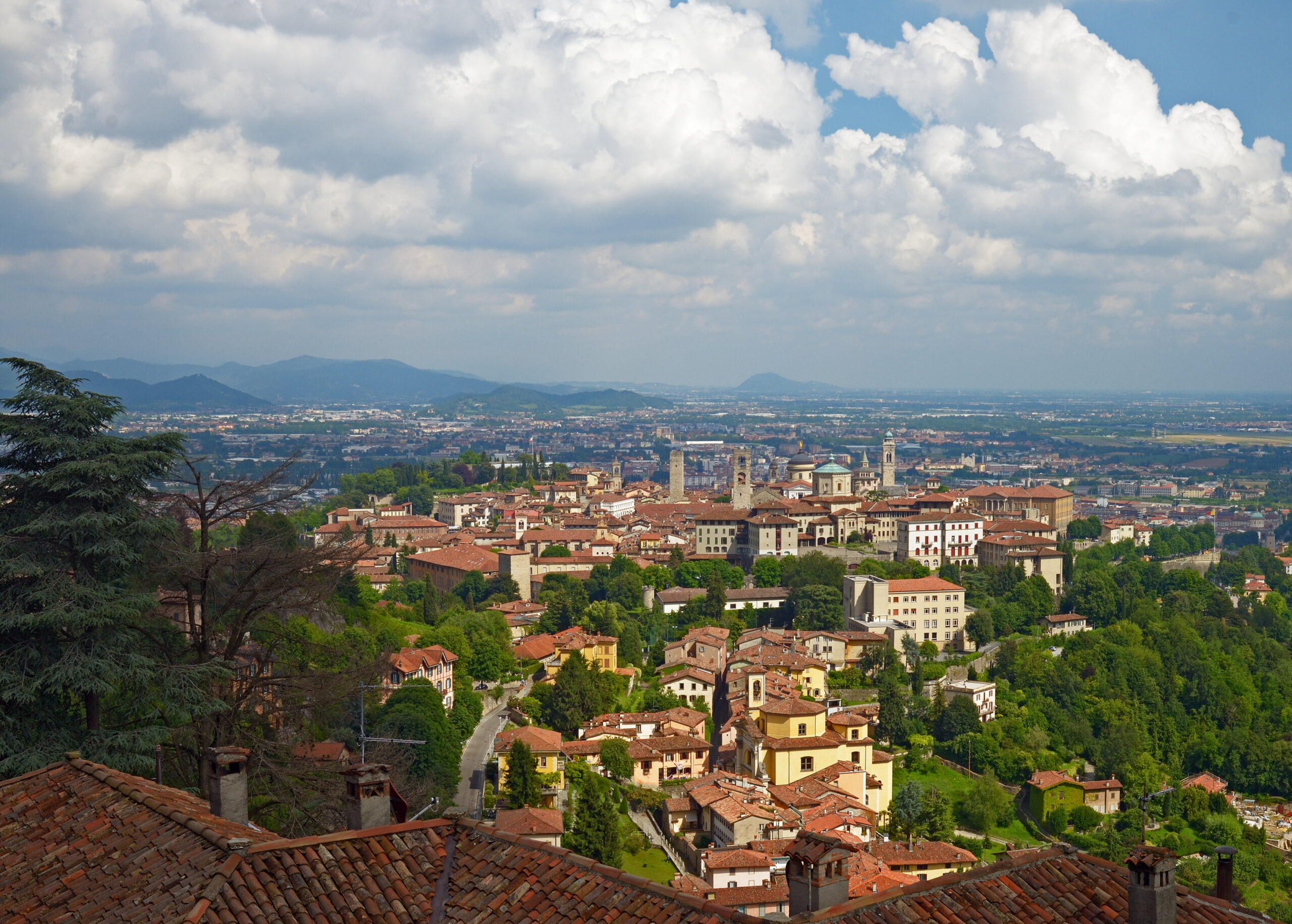
Above: modern Bergamo.
On August 12, 1626, in the mountain town of Clusone near Bergamo, northern Italy, a child was baptized whose name is rarely heard today, even among music lovers: Giovanni Legrenzi. His exact birth date has been lost, but his legacy has not. Over the course of sixty-three years, he became one of the central architects of the Venetian Baroque—a composer whose music resonated across Europe, influencing giants such as George Frideric Handel (†1759) and Johann Sebastian Bach (†1750).
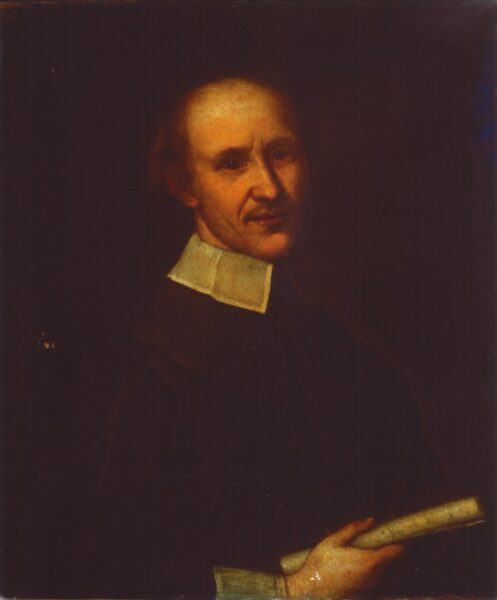
The son of a violinist, Giovanni Maria Legrenzi, young Giovanni was immersed in music from the start. By nineteen, he had become organist at the Basilica of Santa Maria Maggiore in Bergamo, the city of his youth. Six years later, he was ordained a priest, serving as “simple chaplain” of the same church, “with the obligation, that is, of celebrating Mass, but without the obligation of choir residency.”[1]
In 1657, Legrenzi’s talent earned him the post of maestro di cappella at Ferrara’s Academy of the Holy Spirit. There he unveiled his first stage works—early signs of the versatility that would define his career.
Venice, however, was his true stage. Arriving in 1671, he entered the beating heart of European music. He directed the choir at the Ospedale dei Mendicanti (1676–1683), one of the four famed Venetian conservatories-orphanages for girls, renowned for their exceptional musicianship (including the Ospedale della Pietà, later associated with Antonio Vivaldi, about which we have spoken here). In 1681 he became second maestro at St. Mark’s Basilica, and by 1685 he had reached the pinnacle of his profession: maestro di cappella of San Marco, succeeding Francesco Cavalli (†1676).
Under Legrenzi, St. Mark’s musical forces expanded to an unprecedented size: 36 singers and 34 instrumentalists, compared with just 16 documented in 1650. A contemporary inventory lists the instruments available: “8 violins, 11 viole, 2 violas da braccio, 3 violoni, 4 theorbos, 2 cornetti, 1 bassoon, and 3 trombones.”[2] This orchestral wealth reads like a snapshot of Venetian grandeur, capable of filling the basilica with solemnity, brilliance, and color—a testament to the Venetian style at its peak: majestic, polychoral, and deeply resonant.
Legrenzi’s influence radiated far beyond Venice. His pupils included Antonio Lotti (†1740) and Antonio Caldara (†1736), both leading composers of the next generation. Across the Alps, Handel borrowed one of his themes for Samson, while Bach transformed another into the dazzling Fugue in C minor for organ, BWV 574 (c. 1708). The reach of his music is proof of its enduring power.
A prolific and inventive composer, Legrenzi wrote operas—among the most brilliant of the Italian Baroque—eight oratorios (three of which survive), sacred music (masses, psalms, and motets often with concerted instruments), chamber works, and a rich body of instrumental pieces. His sacred output spans the full spectrum of 17th-century style, from intimate concerted motets to monumental polychoral works such as the Dies irae for eight voices in two choirs with four violas, as well as a cappella masses rooted in older traditions, including the Missa Lauretana quinque vocibus (1689).
A Venetian chronicle of January 1, 1687, captures the grandeur of his music. During a solemn Eucharistic exposition at St. Mark’s, Legrenzi’s Intret in conspectu tuo, Domine for six voices and continuo was performed.
A Venetian periodical reported:
It is customary in these first three days [of the year: January 1687] to hold exposed the King of kings for public devotion, always rich and pompous; but this year in particular, since it seemed to this Most Serene and devout Prince [Marc’Antonio Giustiniani] that the victories granted from heaven required some singularity […] On the first evening around the 23rd hour a motet for 20 voices was sung, beginning with Intret in conspectu tuo, Domine gemitus populi tui, composed by Signor Legrentii.[3]
Among his surviving oratorios, La morte del cor penitente (1673) stands out. Composed during Legrenzi’s early Venetian years as maestro di cappella at Santa Maria della Consolazione (known as “della Fava”), home to the Oratorians, it exemplifies spiritual edification.
The plot follows the Sinner, moving from torment and remorse to penance and redemption—an allegorical journey reflecting the principles of the Catholic Reformation after the Council of Trent (1545–1563). The text, rich in personifications—Sorrow, Penance, and Hope—lends itself to fluid music alternating recitatives, ariosos, and short arias, in line with 17th-century monody.
The protagonists are three: the Sinner (tenor), Penance (soprano), and Hope (soprano), joined by a five-part chorus that also functions as the “chorus of sorrows.” The oratorio opens with an intense monologue by the Sinner, who invokes inner death as purification. Penance exhorts him to repent, while Hope urges trust in divine mercy. Yet the Sinner rejects all comfort, choosing the path of suffering.
The score—also performed in Vienna in 1705 at the imperial chapel—blends the legacy of Claudio Monteverdi (†1643) and Cavalli with refined contrapuntal writing. Its sobriety does not diminish expressiveness: rhetorical figures, powerful choral passages, and the constant tension between pain and hope make the oratorio Baroque music at its most spiritual—a catechesis in sound.
Legrenzi’s music was not merely skillful; it was formative. He forged a Venetian style that gave splendor to the Republic’s liturgy and inspired future generations. Without him, Handel and Bach might have sung a different tune.
Yet his name has too often lingered in the shadows, eclipsed by Cavalli, Vivaldi, or Corelli. As the Book of Sirach reminds us, “Their bodies are buried in peace, but their name lives on and on” (Sir 44:14). So it should be for Giovanni Legrenzi—a composer who, though neglected, left a profound mark on European music.
To listen to him today is to rediscover a voice that shaped the Baroque—a voice that still speaks with grandeur, eloquence, and faith.
[1] Cit. in R. Emans, Die einstimmigen Kantaten, Canzonetten und Serenaden Giovanni Legrenzis, Bonn 1984. p. 14; our translation.
[2] Cit. in R. Emans, Ibidem. p. 53.
[3] Cit. in E. Selfridge-Field, Pallade veneta. Writings on music in Venetian society, 1650-1750, Venice 1985, pp. 133-134.