As a parish priest I find that the German Synodal Way and the like is not so much a source of confusion to people as a source of scandal. Certainly for those who love Christ and his Church it is a great source of suffering, that is part of what it means to belong to the Body of Christ. Nevertheless, in my experience, people who attend Mass might be disturbed, wondering why the Church allows this to go on, but they don’t think that what is being approved, or seems approved, is good. Of course, I do not live in Germany, but I know of one German parish priest who manages quite well in a position of great responsibility and I have a friend who recently spent a few years living in Germany and had access to a decent Mass and a good priest. The noise of the blogosphere often hides the quiet good work going on even when surrounded by great disorders.[1]
On the other hand, I have found the SSPX and the SSPX-sympathetic rhetoric is a source of confusion and division on a very practical plane. Apart from the blogosphere, there are two SSPX chapels that impact pastoral ministry in my diocese.
Recently, I saw part of a video in which an SSPX priest, after acknowledging that Canon Law had good reason for forbidding the consecration of bishops without a papal mandate, went on to explain the SSPX necessity to do what is forbidden in order to “resist Vatican II.” This seems to be representative of the position of the SSPX. We are not speaking here of a moderate and legitimate critique, but of an outright rejection of the Council.[2]
I am very sympathetic to laity who desire to have access to the TLM, especially to nourish their children on the richness of the traditional liturgy. Nevertheless, when the TLM becomes emblematic of resistance to Vatican II it begins to become a vehicle for schismatic tendencies. It is no longer merely worshipping as our ancestors did but becomes a weapon of war against the Church herself. This undermines those who legitimately desire to benefit from the traditional liturgy.
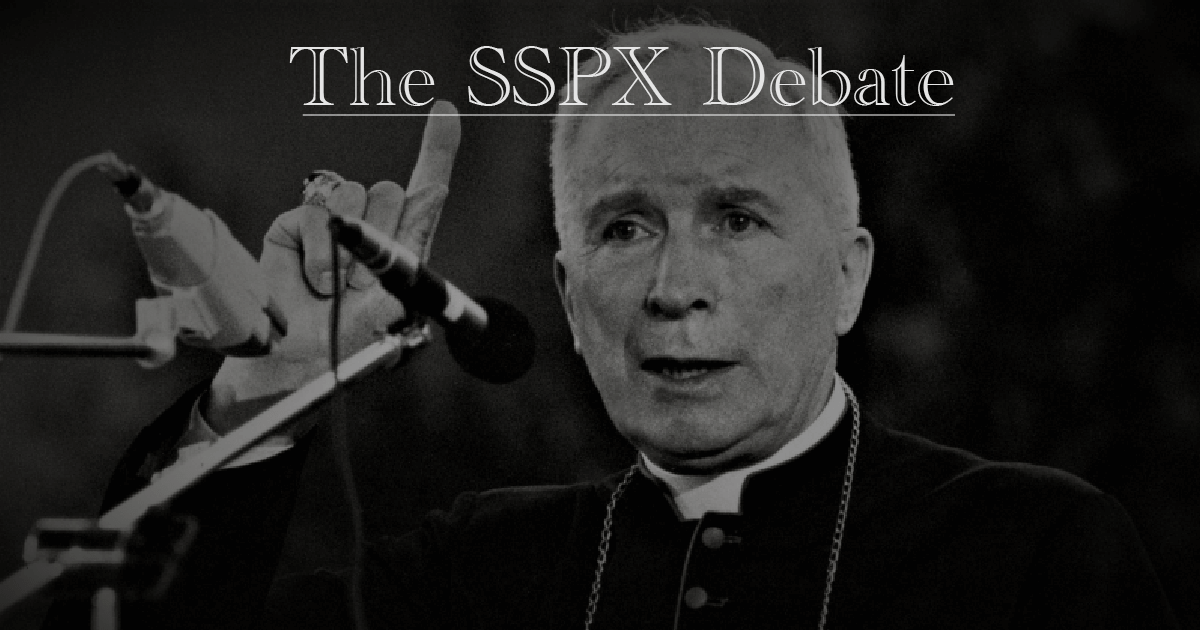
On May 14, 2026, in response to Cardinal Fernández’s warning against the “schismatic act” of consecration bishops against the orders of the Pope and the consequent penalty of excommunication, Fr. Davide Pagliarani, the Superior of the SSPX, published a “Declaration of Catholic Faith” directed to Pope Leo XIV.
On face value the Declaration, while by no means complete since it does not follow the trinitarian format and has nothing really to say about either the Trinity or creation, would appear to be nothing more than an affirmation of dogmas, commonly rejected today, but taught by the Catholic Church and so to be believed by all Catholics. Nevertheless, the context of the Declaration tends to distort the meaning of the very truths professed.[3] Context matters: while context does not determine meaning (that is the error of historicism) it most certainly does shape meaning. Words said in one context can mean something quite different when repeated in a different context.
Besides affirmations of faith the Declaration also contains certain practical judgments that cannot be a matter of faith. Further, in the phrasing of dogmatic teaching it selects and phrases matters in a way that implicitly conveys the SSPX rejection of Vatican II.
In rejecting certain practical judgments of the Council, the SSPX shows that it is rejecting also certain elements of its teaching, rooted indeed in Tradition, that lie at the root of, but do not necessitate, those practical judgments. While faith and action are intimately linked and it has become common to separate pastoral action from doctrinal faith, the SSPX in its own way seems to confound pastoral action with doctrinal faith.
Very often, in this whole debate, the SSPX is given a “free pass” on matters of faith. Nevertheless, they are not only in danger of schism, but they are in danger of so distorting Catholic teaching as to run the risk of heresy.
In this review, I will move paragraph by paragraph through their supposedly “ironclad” declaration of faith. The text is in italics.
In the Name of Our Lord Jesus Christ, divine Wisdom, the Word Incarnate, Who willed one sole religion, Who rendered the Old Covenant definitively null and void, Who founded one sole Church, Who triumphed over Satan, Who conquered the world, Who remains with us until the end of time and Who shall come again to judge the living and the dead.
Is “rendered the Old Covenant definitively null and void” truly a dogma of faith? Is the truth that the SSPX intends to profess by this phrase accurately expressed given that Our Lord himself declared that he came not to abolish the law but to fulfill it (cf. Mt 5:17)? Does not “null and void” suggest too radical a break between Israel of old and the Church? Further, what does this extreme expression say about the Jewish people today? Granted that there have been interpretations of Nostra Aetate that would propose two valid covenants today, one for the Jews and one for the Gentiles, does the SSPX wish also to reject the teaching of Vatican II that the Jewish people remain dear to God “for the sake of their Fathers” or, likewise contrary to the Council, do they want to affirm that God has repented of election of the Jewish people, or that the Jewish people are today “rejected or accursed by God”? (Nostra Aetate, 4)
Who founded “one sole Church.” This is affirmed by Vatican II (“This is the one Church of Christ” [Lumen Gentium, 8]) and reaffirmed in the Catechism of the Catholic Church (816). Still, we must ask, does the SSPX wish to deny that there are “many elements of sanctification and of truth are found outside of its visible structure?” (Lumen Gentium, 8) Does the SSPX recognize the Orthodox Churches possess valid sacraments? Or does the SSPX affirm that, though the Orthodox Churches possess valid sacraments, because of the objective status of schism they never serve as “elements of sanctification?” As for the Protestants, do any of them retain any elements of Catholic truth that they receive as revealed by God? If their baptism is valid, as is often the case, is this foundational sacrament without any effect? Does the SSPX wish to deny that “the children who are born into these Communities [Orthodox and Protestant] and who grow up believing in Christ cannot be accused of the sin involved in the separation?” (Unitatis Redintegratio, 3) In sum, does the SSPX in its affirmation of “one sole Church” wish to reject any validity to the concept of “partial communion”?
None of these questions bear on actual ecumenical practice but on possible distortions of the SSPX understanding of “one sole Church.”
Something important about the statement of principles and their right understanding is involved here. It is natural for a principle first to be stated without qualification and later, as understanding develops, the implicit qualifications are brought out.
This is true of the most fundamental law both of the human mind and of reality, the principle of non-contradiction. There first natural way of affirming the principle would simply be: “A thing cannot both be and not be.” What the mind first grasps in this principle is the opposition between being and non-being. Yet, recognizing the complexity and variety of being a qualification quickly needs to be added, “at the same time and in the same respect.” Someone who denied the qualification would have a distorted and even false understanding of the principle.
This same characteristic of the human mind is involved in the development of doctrine. Early formulations of principles like “no salvation outside of the Church,” or expressions regarding the unicity of the Church or the unicity of baptism were made without qualifications. Through the course of history, often over centuries, implicit qualifications were drawn out and made explicit. To deny the qualifications that were later made explicit distorts the meaning of the original affirmation.
He, the perfect Image of the Father, the Son of God made man, was appointed the sole Redeemer and Saviour of the world through the Incarnation and the voluntary offering of the Sacrifice of the Cross. Our Lord satisfied divine justice by shedding His Most Precious Blood, and it is in that Blood that He established the New and Eternal Covenant, abolishing the Old. He is therefore the sole Mediator between God and men and the sole way to come to the Father. Only he who knows Him knows the Father.
Again we have the insistence on the expression “abolishing the Old.” Yes, “Our Lord satisfied divine justice by shedding His Most Precious Blood” but does the SSPX also want to acknowledge divine mercy in its profession of faith?
It must, however, be acknowledged, that contemporary ecclesial culture has a problem in speaking of divine justice and therefore a problem with the concept of atonement. This is not a heresy as such, because it is not a denial of the truth, which is not understood.[4] Rather, it is an overreaction to the poison of Jansenism. That is to the mind of many Catholics, the language of atonement or expiation or satisfaction, conveys an horrific image of a cruel God punishing his Son for our sins. They seek some other way to express the reality but fall short. On the other hand, the mere verbal affirmation of Christ “satisfying divine justice” without an awareness of how that language is distorted, without any attempt to explain it in relation to God’s mercy, easily leads back to a sort of neo-Jansenism.
By divine decree, the Most Holy Virgin Mary has been directly and intimately associated with the entire work of Redemption; to deny this association — in the terms received from Tradition — is therefore to alter the very notion of Redemption as willed by divine Providence.
Is this meant to be a stab at the DDF’s “Mater Populi Fidelis”? The foundation of Marian co-redemption and mediation was expressed at Vatican II:
The Blessed Virgin … presented Him to the Father in the temple, and was united with Him by compassion as He died on the Cross. In this singular way she cooperated by her obedience, faith, hope and burning charity in the work of the Saviour in giving back supernatural life to souls. Wherefore she is our mother in the order of grace. This maternity of Mary in the order of grace began with the consent which she gave in faith at the Annunciation and which she sustained without wavering beneath the cross, and lasts until the eternal fulfillment of all the elect. Taken up to heaven she did not lay aside this salvific duty, but by her constant intercession continued to bring us the gifts of eternal salvation (Lumen Gentium, 61-62)
Nor did the DDF deny either the reality of co-redemption or mediation. Their only concern, rightly or wrongly, was with possible misunderstanding of the titles.
The SSPX, however, appears to be insisting that the title “Co-Redemptrix” is a necessary “term” received from “Tradition.” While the title has been used by Popes is it really so authoritative that to reject the title “Co-Redemptrix,” while accepting the reality, is “to alter the very notion of Redemption”?
The late Msgr. Arthur B. Calkins, staunch proponent of the “threefold dogma” (Co-redemptrix, Mediatrix, Advocate), who would certainly have detested the DDF document, would nevertheless have recognized that it was merely about secondary matters, words rather than realities. Indeed, he once wrote, “The question of whether one calls Mary’s ‘sharing in Christ’s redemptive work’ co-redemption or something else is quite secondary.”[5]
There is only one Faith and one Church by which we may be saved. Outside the Roman Catholic Church, and without the profession of Faith that she has always taught, there is neither salvation nor remission of sins.
In affirming the necessity of the Catholic Church for salvation and the remission of sins, does the SSPX wish to deny the possibility of salvation through incorporation into the Paschal Mystery of Christ, in ways known to God, for those laboring beneath invincible ignorance, or infants before the age of reason? (Cf. Lumen Gentium, 14-16, CCC 1260-1261) The doctrine of invincible ignorance was a doctrine taught before Vatican II. Does the SSPX wish to elevate the doctrine of limbo to the status of a dogma?
Consequently, every man must be a member of the Catholic Church in order to save his soul, and there is but one baptism as the means of being incorporated into her. This necessity concerns the whole of humanity without exception and embraces without distinction Christians, Jews, Muslims, pagans, and atheists.
Again, does the SSPX recognize “invincible ignorance”? Is the power and mercy of God bound to the sacraments? Is baptism salvific simply because Christ commanded it, or did he command it as the normal means by which a person should be joined to the power of his death and resurrection, the “Paschal Mystery?” Should we not consider that there is what God has revealed, the necessity of baptism by water as the ordinary means of salvation, and what God has not clearly made known, though over time the Church has recognized baptism of blood and baptism of desire, namely the fate of those who through no fault of their own were not baptized? In the latter regard one could err either in assuming that because God provides some means for their “incorporation not the Paschal Mystery” their salvation is certain or in assuming that their salvation is impossible. In both cases the human mind appears to seek a greater certainty that God has given us.
The mandate received by the Apostles, to preach the Gospel to every man and to convert every man to the Catholic Faith, remains binding until the end of time and responds to the most absolute and most pressing necessity in the world. “He that believeth and is baptized, shall be saved: but he that believeth not shall be condemned.” Therefore, to renounce the fulfilment of this mandate constitutes the gravest of crimes against humanity.
It is in human power to preach the Gospel, but it is not in human power to convert a single soul. Further, one might note that true conversion is not a one-time affair, but a lifetime process. A person could spend a year memorizing the catechism and quite apart from the question of practice require many years to assimilate the teaching such that it shapes his way of thinking.
Further, to speak of the mandate received by Apostles as “the most absolute and pressing necessity in the world” is a move from the contemplative order of the profession of faith into the practical order of action. In doing so the exaggeration of language would suggest that everything else be set aside. It would seem not to allow for preparatory stages. It would perhaps not allow works of charity that are not immediately and expressly for the purpose of “converting every man to the Catholic Faith.” It would not seem allow for prioritization. Must one equally seek to convert a devout Orthodox Christian as an Atheist? Finally, though, is it true? Would not the “most absolute and pressing necessity in the world” be to seek to live in the grace and charity of Christ?
The Roman Church alone possesses simultaneously the four marks that characterize the Church founded by Jesus Christ: Unity, Holiness, Catholicity, and Apostolicity.
It has become customary to distinguish the “Roman Catholic Church” from say the “Ruthenian Catholic Church” or the “Ukrainian Catholic Church” or the “Syro-Malabar Catholic Church.” The point being not that there are many Catholic Churches but that the one Catholic Church subsists in many distinct “ritual Churches,” all under the rule of Peter. Yes, the Pope is the Bishop of Rome, but ecclesial courtesy these days recognizes that while the other ritual Churches are under the Bishop of Rome, they are not otherwise “Roman” as is the “Roman rite.”
As for the four marks that characterize the Church, they certainly do not belong to the SSPX but to the Catholic Church under Pope Leo XIV together with all the bishops of the world. I never cease to be amazed that people who hold strongly to “no salvation outside the Catholic Church” would put themselves in such an adversarial position vis-à-vis what is evidently the Catholic Church.
Her unity flows essentially from the adherence of all her members to the one true Faith, faithfully preserved, taught, and handed down by the Catholic hierarchy throughout the centuries.
The statement on the source of unity in the adherence of the faithful to “the one true Faith” is curiously activist, almost Pelagian, because it makes the unity of the Church arise from our act of faith. Compare the teaching of Vatican II:
Jesus Christ, then, willed that the apostles and their successors – the bishops with Peter’s successor at their head – should preach the Gospel faithfully, administer the sacraments, and rule the Church in love. It is thus, under the action of the Holy Spirit, that Christ wills His people to increase, and He perfects His people’s fellowship in unity: in their confessing the one faith, celebrating divine worship in common, and keeping the fraternal harmony of the family of God. … This is the sacred mystery of the unity of the Church, in Christ and through Christ, the Holy Spirit energizing its various functions. It is a mystery that finds its highest exemplar and source in the unity of the Persons of the Trinity: the Father and the Son in the Holy Spirit, one God. (Unitatis Redintegratio, 2d,f, emphasis added)
Adherence to the one true faith is included, but there is also the unity of worship and “fraternal harmony of the family of God.” The hierarchy not only hands on the deposit of faith, but administers the Sacraments, and rules the Church. There are bonds of faith, of Sacraments, and of a fraternal life under the governance of the hierarchy. Nevertheless, above all this is the action of Christ through the Holy Spirit. Above all this is the highest exemplar and source in the unity of the Persons of the Trinity.
It seems that the SSPX would reduce all of this to the mere adherence to the creed. That is certainly fundamental, but the unity of the Church is a much deeper and fuller reality.
The denial of even a single truth of the Faith destroys faith itself and renders radically impossible all communion with the Catholic Church.
One must distinguish between the obstinate denial of a single truth of faith that formally constitutes heresy, the ignorant denial of a truth of faith, and the ignorance of a truth of faith. Further, a truth of faith might be denied verbally, because the words are not understood as they have been taught by the Church, or a truth of faith might be affirmed merely verbally, because the truth of faith is not affirmed as it has been taught by the Church. Finally, it is neither the affirmation nor the denial of individual truths of the faith, but the adherence to all that is proposed for belief by the Catholic Church as revealed by God that constitutes divine and Catholic faith, while it is the denial of individual truths in spite of their being proposed by the Church that destroys faith.
The only possible path to restoring unity among Christians of different confessions consists in the urgent and charitable appeal addressed to non-Catholics to profess the one true Faith within the one true Church.
“The only possible path” speaks of a practical application, a matter of prudence, that cannot possibly be a matter of faith. It is not enough merely to propose the content of the one true faith verbally, the one true faith must be proposed in a manner that will render it worthy of belief by the hearer, which means the potentially infinite circumstances of hearers, including their psychology, must be taken into account, insofar as possible. The SSPX here engages in a mere gratuitous assertion regarding the means to Christian unity.
The Catholic Church can in no way be regarded or treated on an equal footing with a false form of worship or a false church.
At the same time, one must note that absolute falsehood does not exist, nor does absolute evil. To speak of false forms of worship or false churches implies that other religions are nothing but frauds and that the Orthodox Churches and Protestant communities are nothing but frauds.
Consider St. Paul’s words to the Athenians who does not attribute the origin of world religions purely to demonic deception when he affirms that God allowed the peoples of the earth to seek God, in the hope that they might feel after him and find him. (Acts 17:27) That time of indulgence passes once the Gospel is proclaimed, yet we cannot say that even today adherents of other religions have heard and rejected the Gospel.
Even if they have heard of Jesus in some nominal fashion have they heard the Gospel proclaimed with sufficient “motives of credibility?” Are the four marks of the Church, as possessed by the Catholic Church, evident to Orthodox and Protestants? Surely anyone who seeks with sincerity beyond their religion or deficient form of Christianity will find, but why should they seek beyond in the first place? Will they be more drawn to the Catholic Church by the Pope exalting himself on his lofty throne and declaring, “Repent or be damned” or by the Pope setting aside his robes of splendor and humbly treating with them on a level of mutual respect? We could recall the famous saying of St. Francis de Sales: “One can catch more flies with a spoonful of honey that with a hundred barrels of vinegar.”
In speaking of the Church’s social doctrine, Pope Leo XIV made a claim that disturbs some people: “The Church does not claim to possess a monopoly on truth.”[6] This is certainly true in the natural order, but even in the matter of revealed truth Orthodox and Protestants possess some measure of revealed truth and even unique insights.
The Roman Pontiff, the Vicar of Christ, is the sole possessor of supreme authority over the whole Church. He alone directly confers on the other members of the Catholic hierarchy jurisdiction over souls.
I wrote about this more in detail my previous article on the futility of the SSPX’s schism defense.
Briefly, as taught by Pope Pius XII, all jurisdiction comes from the Roman Pontiff, but the SSPX misrepresents the teaching of Vatican II as contradicting Pius XII. In doing so they miss the more developed teaching on the episcopacy as the fulness of orders. Lumen Gentium 21b affirms that through ordination bishops come to share in the triple munus of Christ, sanctifying, teaching, and ruling. The SSPX appears to identify at least the royal munus of the bishop with jurisdiction. This is a gross misinterpretation, prevented by the well-known Nota Previa. The import of sharing in the triple munus is that, as regards ruling, the bishop is ordained to share in the rule of the Church, it is part of the very purpose of the Sacrament of holy orders. The bishop has no right or authority to rule in the Church until the power he received in ordination is specified by the Pope through a grant of jurisdiction. This is very pertinent to the status of the SSPX since their bishops effectively function as mere Sacramental machines, as though devoid of any share in the royal and prophetic munus. Since they need Sacramental machines, therefore they find themselves compelled to disobey the Pope and consecrate bishops against his express command.
The Holy Ghost was not promised to the successors of Peter that they might make known, by His revelation, a new doctrine, but that, by His assistance, they might inviolably keep and faithfully expound the revelation transmitted by the Apostles, that is, the Deposit of the Faith.
Well and good, Vatican I and Vatican II are in complete agreement.
The task of authentically interpreting the word of God, whether written or handed on, has been entrusted exclusively to the living teaching office of the Church, whose authority is exercised in the name of Jesus Christ. This teaching office is not above the word of God, but serves it, teaching only what has been handed on, listening to it devoutly, guarding it scrupulously and explaining it faithfully in accord with a divine commission and with the help of the Holy Spirit, it draws from this one deposit of faith everything which it presents for belief as divinely revealed (Dei Verbum, 10).
Of course that means the task has not been entrusted to the SSPX.
To a unique Faith there corresponds a unique form of worship, the supreme, authentic, and perfect expression of that same Faith.
The worship of the Mass can be called the supreme, authentic, and perfect expression of faith only its substance as established by Christ, not in the various rites that have developed in the history of the Church, as noble and beautiful as these rites might exist in their developed state under the providential guidance of the Holy Spirit.
The Holy Mass is the perpetuation in time of the Sacrifice of the Cross, offered for many and renewed upon the altar. Although offered in an unbloody manner, the Holy Sacrifice of the Mass is essentially expiatory and propitiatory. No other form of worship offers perfect adoration. No other form of worship that is not ordered to it is pleasing to God. No other means is sufficient for the sanctification of souls.
Of course, “for many” is proper for the consecration. The English translation originally employed “for all” which while it opened the door for a false idea of universal salvation, also had a legitimate meaning, though perhaps not appropriate for the consecration. In any case, Christ did die “for all.” This was authoritatively taught against the Jansenist attempt to restrict the scope of Christ’s redemptive work (Cf. Innocent X, Cum occasione, May 31, 1653). Together with the affirmation that Christ died “for all” the Church has affirmed as a consequence that God gives all men grace sufficient for their salvation. Salvation is not universal, but grace touches the lives of everyone. At times it seems to me that the SSPX inclines towards a neo-Jansenism, reacting to the common error of universal salvation, by wanting to restrict the scope of Christ’s redemptive work and the universality of the workings of grace.
The SSPX also appears to overstate the case when it declares that “no other form of worship that is not ordered to it [the Mass] is pleasing to God.” How about the prayer of validly baptized Protestants? Is such prayer, if the person is in a state of grace, which is possible, not pleasing to God?
Consequently, the Holy Sacrifice of the Mass can in no way be reduced to a mere commemoration, to a spiritual meal, to a sacred assembly celebrated by the people, to the celebration of the Paschal mystery without sacrifice, without satisfaction of divine justice, without expiation of sins, without propitiation, and without the Cross.
Well, yes, the Holy Sacrifice of the Mass must not be “reduced” to one or another aspect that does indeed belong to it, especially when it is not the primary and constitutive element. Yet it is strange to incorporate into a profession of faith the expression of celebrating “the Paschal mystery without sacrifice” in such a denigrating fashion. Certainly, the SSPX is aware that the expression “Paschal Mystery” is part and parcel of the language of the Church today. Are they suggesting that this is an illegitimate development? Are they suggesting that the expression “Paschal Mystery” excludes the notion of sacrifice? This would be strange indeed given the Communion Antiphon for Easter Sunday, taken straight from 1 Cor 5:7: Pascha nostrum immolatus est Christus. The notion of sacrifice is inseparable from the notion of the Paschal Mystery! The language of the Paschal mystery tells us that the redeeming work of Christ was completed not only on the Cross, but also through his resurrection and ascension into heaven, while at the same time speaking of his redemptive work as the fulfillment of the ancient Passover and the pledge of our future glory.
Now, the language of the Paschal mystery is clearly sacrificial, but the language of atonement is not front and center, except insofar as it is implied in the Blood of the Lamb (cf. Lev 17:11). The language of the Paschal Mystery also takes the focus off the fulfillment of the Jewish Day of Atonement, which is the basis of the elaboration of Christ’s priesthood and sacrifice in St. Paul’s Letter to the Hebrews.
For all that, I would argue that the loss of the sense of the expiatory character of the sacrifice of the Mass has less to do with the rite of the Mass, much less with the language of the Paschal Mystery, and much more to do with the aforementioned ecclesial culture, that in reaction to the Jansenist poison has a hard time speaking of God’s justice and therefore a hard time speaking of atonement, expiation, or satisfaction.
The help afforded to souls by the Sacraments of the Catholic Church is sufficient in every circumstance and in every age to enable the faithful to live in a state of grace.
The moral law contained in the Decalogue and perfected in the Sermon on the Mount is the only one practicable for obtaining the salvation of souls. Every other moral code — founded, for example, on respect for creation or on the rights of the human person — is radically insufficient to sanctify and save souls. In no way can it replace the one true moral law.
Does the SSPX think that Francis is still Pope? Maybe there are some people in the Church that want to substitute “respect for creation” or “the rights of the human person” for the Decalogue, but does the SSPX have such a lack of confidence in Christ’s presence to his Church to think they will ever succeed?[7]
In any case, “respect for creation” and the “rights of the human person” as such could be brought back to the Decalogue. “Respect of creation” would at least fall under the virtue of temperance and it might also connect to the seventh commandment insofar as degradation of the environment defrauds others, including future generations, of the goods of the earth. As for the “rights of the human person,” the supreme law is charity, which includes love of neighbor, which can hardly be practiced without respect for his true dignity and the rights that belong to him on account of his dignity. Indeed, the second table of the Decalogue, as well as the Sermon on the Mount, can be seen as pointing to the dignity of the human person and the goods that belong to him, as something to be honored.[8] You cannot love someone and hold them in contempt and strip them of their dignity.
Following the example of St. John the Baptist, true charity obliges us to warn sinners and never to renounce the means necessary to save their souls.
While true charity, in general, obliges to “warning sinners,” that must be concretely exercised according to the virtue of prudence, taking into account circumstances of time, place, and person. Positive precepts do not oblige always and everywhere.
He who eats the Body of Our Lord and drinks His Blood whilst in a state of sin eats and drinks his own condemnation, and no authority can alter this law contained in the teaching of St. Paul and in Tradition.
Again, the SSPX seems to have Pope Francis in mind here, in particular Amoris Laetitiae. Without in any way questioning the traditional discipline of the Church, which forbids giving communion to those who “obstinately persevere in manifest grave sin,” (CIC 915) some comments are called for here.
First, we cannot proceed demonstratively from moral teaching to the state of person’s soul. The adulterer has committed what objectively is a grave sin; whether he has done so subjectively, we do not know. The allowance of communion to the divorced and remarried misapplies this principle.
St. Thomas Aquinas, in speaking of an erring conscience gives a curious illustration. He writes:
If erring reason tells a man that he should go to another man’s wife, the will that abides by that erring reason is evil; since this error arises from ignorance of the Divine Law, which he is bound to know. But if a man’s reason, errs in mistaking another for his wife, and if he wish to give her her right when she asks for it, his will is excused from being evil: because this error arises from ignorance of a circumstance, which ignorance excuses, and causes the act to be involuntary (IaIIae q.19 a.6).
Now, in the 13th century Europe, when St. Thomas Aquinas was writing, ignorance of the 6th commandment would indeed have to be crass and supine. At all times, it would seem that some natural knowledge of “thou shalt not commit adultery” will be present, but the precise meaning becomes more or less obscured in certain degraded cultures. Such would be the case where polygamy is practiced. In that case, a man thinks that indeed he should not approach another man’s wife, but he mistakenly thinks that multiple women are all his wives. This has also come to be the case with the serial polygamy of the modern west. The divorced and remarried man thinks that this woman whom he has “married” after being divorced is his wife. Indeed, were he to have relations with his first wife, he would probably think he was committing adultery. On a level of an even more degraded conscience, the requirement of marriage is lost, but the sense that there should be only one woman at a time, and that in a “committed relationship,” might still be retained. So, the man in the “committed relationship” violates his conscience if he sleeps with another woman but does not think there is anything wrong with the “committed relationship.”
Next, we have to realize that while the conscience of a Catholic should be formed by the teaching of the Church, many Catholics have had their conscience actually formed by the secular world. Given the power of the media and public education this should hardly be surprising. As a result, Church teaching seems to them no more than an arbitrary set of “Church rules.” While he may have handled it wrongly, it is important to recognize that in Amoris Laetitia, Pope Francis was grappling with the reality of confused consciences and the disconnect between the confused conscience of a Catholic and the teaching of the Church. Such a confused conscience should not be met with “judgmentalism” or a presumption of bad will.
The public correspondence between state of life and visible Sacrament must be upheld because both belong to the objective, not the subjective order. Yes, it is possible that a divorced and remarried Catholic might approach communion in ignorance and possibly even a state of grace. Nevertheless, just as we cannot judge that the adulterer is subjectively in a state of sin, neither can we judge him to be subjectively in a state of grace so as to allow him to receive communion.
The order of Church discipline needs to be restored, but Pope Francis was right at least in seeing that this requires not merely laying down the law but bringing those to whom the Church teaching seems a mere “set of rules” to the point in which they accept and allow themselves to be formed by the teaching. That really cannot take place, though, without both insisting on the discipline and teaching the reason, while understanding that the confusion does not come from pure malice.
For all that, if we consider Amoris Laetitia in light of Vatican II, the Council put a great deal of “pastoral” emphasis on subjective considerations while Amoris Laetitia pushed the subjective side of things to the extreme. In themselves, however, the subjective considerations are valid. The SSPX it seems, reacting to the distorted practical applications of subjective considerations, appears to have gone to the opposite extreme of emphasizing the objective to the point of rejecting the validity of the subjective, thereby distorting the objective understanding.
Sins of impurity that are against nature are of such gravity that they always and in every circumstance cry to God for vengeance, and are radically incompatible with every form of authentic Christian love. Such a ‘lifestyle’ can therefore in no way be recognized as a gift from God. A couple practising this vice must be helped to free themselves from it, and can in no way be blessed — formally or informally — by ministers of the Church.
First, I think it would be proper to say that a sin can only cry to God for vengeance if it is committed out of malice. Further, the statement seems too broad. Masturbation is a sin of impurity against nature. I have never seen it listed as a sin that cries to God for vengeance.
Then, we come again to the ghost of Pope Francis. Regardless of what Fiducia Supplicans actually said, it was subsequently interpreted by both Pope Francis and Cardinal Fernández as referring to blessing individuals, which always implies a call to conversion. Again, both discipline and clarity of teaching need to be restored. Despite the weak clarification, the document is still being abused.
The submission of institutions and nations, as such, to the authority of Our Lord Jesus Christ flows directly from the Incarnation and the Redemption. Therefore, secularism of institutions and nations constitutes an implicit denial of the divinity and universal kingship of Our Lord.
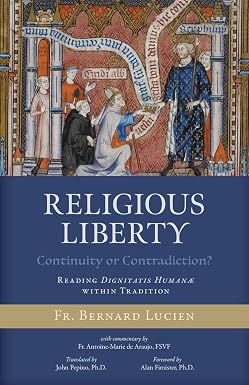
What I will observe here is that this remains implicit in the teaching of Vatican II. “The laity, by their very vocation, seek the kingdom of God by engaging in temporal affairs and by ordering them according to the plan of God” (Lumen Gentium, 31); “That ominous doctrine which attempts to build a society with no regard whatever for religion, and which attacks and destroys the religious liberty of its citizens, is rightly to be rejected” (Lumen Gentium, 36). The last statement would require explaining how the Council’s teaching on religious liberty is actually continuous with the Church’s tradition including the 19th century Popes, but that would be another story. Nevertheless, the SSPX would do well to consider the work of the Monks of LeBarroux or for that matter the work of their one time member, Fr. Bernard Lucien.[9]
Christendom is not a mere historical phenomenon, but the only order willed by God among men.
If by Christendom one means the order of medieval Europe this is false. If by Christendom one means only a society in which the secular order is subordinate to the sacred order of the Church this is true, but not always feasible. Politics, it is said, is the art of the possible. It is not the will of God that the Church establish “Christendom,” rather it is the will of God that the Church preach the Gospel. If men believe and are converted, Christendom will follow. That is how the first Christendom was established.
It is not for the Church to conform herself to the world, but for the world to be transformed by the Church.
For the Church to transform the world the Church must first persuade the world to faith; the Church herself as a “motive of credibility” must shine forth.
It is in this Faith and in these principles that we ask to be instructed and confirmed by Him Who has received the charism to do so. With the help of Our Lord, we would rather die than renounce them. It is in this immutable Faith that we desire to live and die, in the hope that it may give way to the direct vision of the immutable eternal Truth.
The reality of the Holy Trinity is immutable. The exposition of the dogma cannot be altogether immutable because it must face new questions, new challenges, and even changes in language. Not even the Latin language is immune. While one must continue to affirm the unchanging truth “three persons, one God,” one must also clarify the meaning of “person” in relation to modern conceptions. Indeed, in contemporary English “person” is often used as a synonym for “human being.”
Finally, is it for the SSPX to define the Faith to the Pope or to receive the definition of the Faith from the Pope? When I read the SSPX declaration of faith I do not see a robust proclamation of the Catholic faith, but a rather a set of truths set forth in a truncated and partial manner, mixed in with questionable judgments and an implied polemic against Vatican II. In the end, it is at best an impoverished distortion of the Catholic faith.
Cardinal Müller suggests that the situation of the SSPX is a bit like the Monophysites who claimed fidelity to the Council of Ephesus and St. Cyril of Alexandria but rejected the Council of Chalcedon. The comparison is apt precisely because the denial of the later development distorts the adherence to the already defined truth.
[1] Certainly the situation with the German Synodal Way is very grave and needs to be addressed. Fr. Albert Jacquemin, formerly of the SSPX, explains the difference of the situation between the SSPX and Germany: “The SSPX Is Explicitly Developing an Ecclesiology of Substitution Foreign to Catholic Tradition” Rorate (May 16, 2026).
[2] Paul VI in a letter to Archbishop Lefebvre, after his 1974 declaration, after his suspension a divinis for ordaining priests without dimissorial letters, after his personal meeting with the Archbishop, clearly sees the issue as a matter rebellion, manifested in his 1974 declaration and never retracted. “What is indeed at issue is the question—which must truly be called fundamental—of your clearly proclaimed refusal to recognize in its whole, the authority of the Second Vatican Council and that of the pope. This refusal is accompanied by an action that is oriented towards propagating and organizing what must indeed, unfortunately, be called a rebellion. This is the essential issue, and it is truly untenable.” He addresses the Archbishop’s stance towards the Council more particularly: “You cannot appeal to the distinction between what is dogmatic and what is pastoral to accept certain texts of this Council and to refuse others. Indeed, not everything in the Council requires an assent of the same nature: only what is affirmed by definitive acts as an object of faith or as a truth related to faith requires an assent of faith. But the rest also forms part of the solemn magisterium of the Church to which each member of the faithful owes a confident acceptance and a sincere application.” So: “We cannot therefore take your requests into consideration, because it is a question of acts which have already been committed in rebellion against the one true Church of God.” Paul VI, letter to Marcel Lefebvre (October 11, 1976). Fr. De Blignieres of the FSVF recently recalled what Archbishop Lefebvre signed and then reneged on before the 1988 consecrations. That included: “Regarding certain points taught by the Second Vatican Council or regarding later reforms of the liturgy and of canon law, which seem to us difficult to reconcile with Tradition, we commit ourselves to having a positive attitude of study and communication with the Apostolic See, avoiding all polemics.” Louis-Marie de Blignières, “Separatism Is Not a Catholic Solution,” Rorate (June 3, 2026).
()
[3] Walker Larson gives a more irenic take on the SSPX Declaration of Faith on the Crisis website. He proposes that it reveals common ground that can serve as a basis for dialogue. He provides some excellent material bearing witness to the continuity between the pre-conciliar Church and the Council. Alas, dialogue was proposed to the SSPX and they rejected the offer; it seems to me the real issue is rooted in the Archbishop Lefebvre’s “scorched earth” declaration of 1974, codified in the oath taken by their candidates for the priesthood. (Cf. my critique of the oath) These are matters that call not for dialogue, but for repentance on the part of the SSPX.
[4] The Catechism of the Catholic Church, though it does not use the word “justice” in speaking of the redemptive meaning of Christ’s death, does make it clear that “Man’s sins, following on original sin, are punishable by death” (CCC 602), and that Christ’s sacrificial offering “atoned for our faults and made satisfaction for our sins to the Father” (CCC 615, citing the Council of Trent in the footnote), and that his sacrifice has “value as redemption and reparation, as atonement and satisfaction.” (CCC 616) The primary emphasis of the Catechism is Christ embracing the Father’s plan of redeeming love (Cf. CCC 604, 607, 609, 614, and 616). The ecclesial culture, which shies from the language of atonement, does not conform to the actual teaching manifested in the Catechism.
[5] Arthur B. Calkins,Totus Tuus: Pope John Paul II’s Program of Marian Consecration and Entrustment (Academy of the Immaculate, 2017), 350.
[6] Address of his Holiness Pope Leo XIV to Members of the “Centesimus Annus Pro Pontifice” Foundation, Saturday, May 17, 2025; Cited again in Magnifica Humanitas,25.
[7] Since the beginning, trust in Church authorities has been perhaps the key practical issue for the SSPX. The scandal provoked by the bishops who conducted the 1974 Apostolic Visitation of Ecône provoked Archbishop Lefebvre’s “Declaration” opposing eternal Rome to modernist Rome, which “Declaration” seems to have defined the SSPX ever since. Distrust is the reason why in 1988 the Archbishop reneged on the Protocol he had signed with the Vatican and went ahead to consecrate bishops against the command of the Pope. While certainly there is plenty of occasion to be distrustful of some ecclesiastics, our trust should never be in ecclesiastics, however good or bad, but in Christ’s promise to his Church, the gates of hell shall not prevail. When we put our focus on ecclesial politics we tend to lose sight of the supernatural reality and view the Church as a mere human institution.
[8] Cf. St. John Paul II, Veritatis Splendor.
[9] Bernard Lucien,Religious Liberty: Continuity or Contradiction? (Arouca Press, 2025)