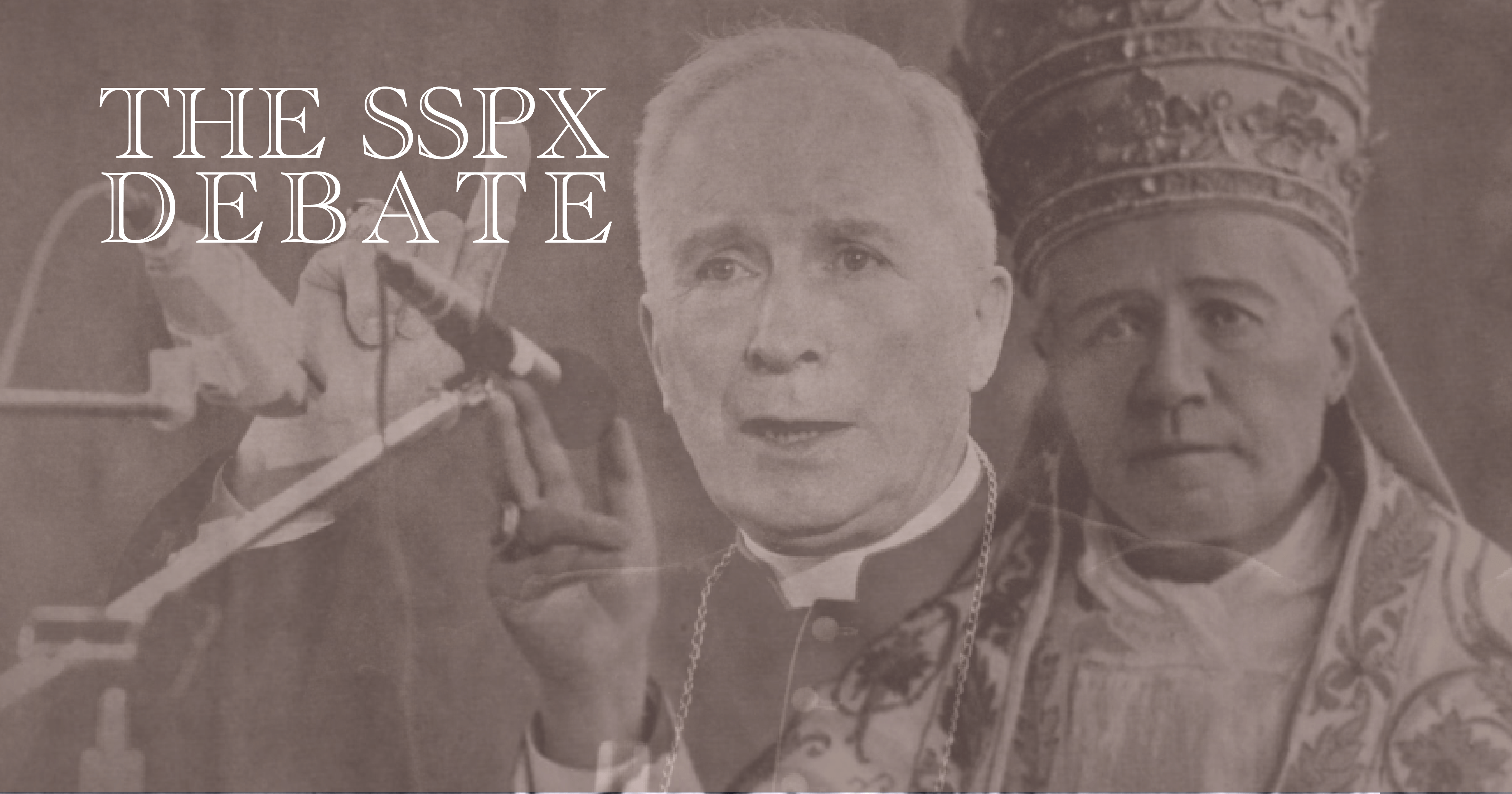
On March 20, 2026, OnePeterFive published the SSPX oath of fidelity, translated from the French edition of Yves Chiron’s history of traditionalism. First I will reproduce, in its entirety, the oath made by candidates as a condition for priestly ordination in the SSPX, then I will offer a few comments.
Declaration of Fidelity to the Priestly Fraternity of St. Pius X
I, the undersigned (N.),
Recognize (N.) as pope of the Holy Catholic Church. That is why I am prepared to pray for him publicly as Sovereign Pontiff.
I refuse to follow him when he departs from Catholic Tradition, especially in matters of religious freedom and ecumenism, as well as in reforms that are harmful to the Church.
I admit that not all Masses celebrated according to the new rite are invalid. However, in view of the poor translations of the Novus Ordo Missæ, its ambiguity, which favors its interpretation in a Protestant sense, and the plurality of the ways in which it is celebrated, I recognize that the danger of invalidity is very great.
I affirm that the new rite of the Mass does not actually formulate any heresy expressly, but that it “departs impressively, on the whole as well as in detail, from the Catholic theology of the Holy Mass,” and that for this reason this new rite is in itself evil.
Therefore, I will never celebrate Holy Mass according to this new rite, even under threat of ecclesiastical penalties; nor will I ever positively advise anyone to actively participate in such a Mass.
Finally, I accept as legitimate the liturgical reform of John XXIII. I therefore receive all of its liturgical books as Catholic: the Missal, Breviary, etc., and I commit myself to use them exclusively, according to their calendar and rubrics, especially for the celebration of the Mass and for the common recitation of the breviary.
In so doing, I wish to manifest the obedience that binds me to my superiors, as well as that which binds me to the Sovereign Pontiff in all his legitimate acts.
If the SSPX does indeed require this oath before ordination to the priesthood, I think that is a very serious problem. I would wonder if ecclesiastics, like Bishop Athanasius Schneider, who readily cites his role in the Apostolic Visitation of the SSPX, have been aware of this oath. Even so, the oath should not be surprising as it really does no more than codify Archbishop Lefebvre’s radical declaration of November 21, 1974.
Starting then with the recognition of the current Pope, it is not enough merely to recognize him and pray for him. The 1983 Code of Canon Law, in continuity with the 1917 Code and the First Vatican Council declares:
The bishop of the Roman Church, in whom continues the office given by the Lord uniquely to Peter, the first of the Apostles, and to be transmitted to his successors, is the head of the college of bishops, the Vicar of Christ, and the pastor of the universal Church on earth. By virtue of his office he possesses supreme, full, immediate, and universal ordinary power in the Church, which he is always able to exercise freely (CIC 331).
The place of this Canon in the 1983 Code means accepting and submitting to the 1983 Code as an exercise of papal jurisdiction.
The oath continues, then, to justify the SSPX: “I refuse to follow him when he departs from Catholic Tradition, especially in matters of religious freedom and ecumenism, as well as in reforms that are harmful to the Church.”
On the one hand, this sounds reasonable, since the Pope is not above Catholic Tradition, but is its servant (cf. DV 9). Nevertheless, the Pope, not the SSPX, is the authoritative interpreter of Tradition. By this phrase, the SSPX sets itself in judgment over not just a single Pope, but a series of six Popes for a matter of fifty years. This is not just a matter of discipline, but of doctrine. The question really is whether or not a positive interpretation can be given to ambiguous statements, especially those carrying weightier authority. If they can’t be so interpreted, then how does one explain this massive failure of the Magisterium. The sedevacantists do it by affirming that it is not truly the Magisterium; they are not truly Popes and so the bishops in union with him are at best heretical bishops, adhering to an anti-pope. Nor does the argument that it is only “non-infallible” Magisterium work.
This religious submission of mind and will must be shown in a special way to the authentic magisterium of the Roman Pontiff, even when he is not speaking ex cathedra; that is, it must be shown in such a way that his supreme magisterium is acknowledged with reverence, the judgments made by him are sincerely adhered to, according to his manifest mind and will. His mind and will in the matter may be known either from the character of the documents, from his frequent repetition of the same doctrine, or from his manner of speaking (LG 25).
This passage is by no means an innovation of the Council. This line of thinking was clearly developed by Cardinal Franzelin in the 19th century.[1] At the very least it means that the default position of the Catholic is acceptance of the papal teaching, in light of Tradition, seeking reconciliation of difficulties. The SSPX has established rejection and judgment as their default position; everything must first be submitted to careful examination before being accepted.
The oath continues: “I admit that not all Masses celebrated according to the new rite are invalid. However, in view of the poor translations of the Novus Ordo Missæ, its ambiguity, which favors its interpretation in a Protestant sense, and the plurality of the ways in which it is celebrated, I recognize that the danger of invalidity is very great.”
This passage is very problematic in its implication that most Novus Ordo Masses are invalid. There have been invalid Masses on account of improper matter (e.g. homemade bread with added ingredients like honey) but that was never your typical parish Mass. The oath does not go into specifics, but the chief argument I have seen is along the lines that a heretical priest, who does not believe that the Mass is a propitiatory sacrifice, might have a defective intention. This argument requires a more specific intention than the Church has ever required, which is no more than “to do what the Church does,” which is presumed by a serious (e.g. not joking or play-acting) fulfillment of the Church’s rite by a valid minister. The oath, however, suggests that a poor translation, leading to a wrong understanding (by the priest?) would invalidate the Mass. Really, the only part of the translation that bears directly on the validity would be the words of consecration. Does the SSPX suggest that the translation “for all” invalidated the consecration? While the translation is incorrect, it does not contain a false meaning; Christ did die for all, even if all do not benefit. That was defined by the Church against the Jansenists.[2]
It is worth noting here that the SSPX rightly criticizes the pervasiveness of the heresies of Neo-Modernism and universal salvation. Though it typically paints with an overly broad brush, it is generally taken for granted, at least among traditionalists, that the SSPX is doctrinally pure. They must be orthodox because they only hold on to what has always been taught. Yet, without making an outright accusations of heresy, I would wonder if their oath does not reveal certain Jansenist tendencies, together with an incipient Donatism.
The oath continues: “I affirm that the new rite of the Mass does not actually formulate any heresy expressly, but that it ‘departs impressively, on the whole as well as in detail, from the Catholic theology of the Holy Mass,’ and that for this reason this new rite is in itself evil.”
The quote, “departs impressively…” comes from the infamous Ottaviani intervention, drafted by a group of theologians and signed by Cardinal Ottaviani, who at the time was no longer head of the Holy Office. In other words, it is no more than a private opinion, mere human argumentation set against not only the authority of Pope Paul VI, but of every subsequent Pope. Most remarkably, the oath, while admitting that the new rite formulates no heresy, declares that it is “in itself evil.” I would dare say that these words make the oath “in itself evil,” setting human judgment against the authority of the Church, affirming that the Church in a universal disciplinary decree, that bears on the heart of the Church’s life, the celebration of the holy sacrifice of the Mass, has not merely made some passing mistakes but has promulgated something intrinsically evil. Really, how can this square with the indefectibility of the Church? If the Church has foisted on the faithful such a vast evil, vitiating the heart of the Church’s life, how can anyone ever trust the authority of the Church? Indeed, this does not touch upon the Roman Rite alone, since priests, bishops, and patriarchs of every other rite concelebrate in the Roman Rite.
It is not that the SSPX is wrong to criticize certain aspects of the post-Conciliar Church, or of the Novus Ordo Mass, rather it is that they have effectively formed a global judgment that puts the entirety of the Church in parenthesis, except insofar as approved by the SSPX.
“Therefore, I will never celebrate Holy Mass according to this new rite, even under threat of ecclesiastical penalties; nor will I ever positively advise anyone to actively participate in such a Mass.”
Well, this is a logical consequence of declaring the new rite intrinsically evil, but if that claim is overblown, then the protest is likewise overdone.
Now, if truth be told, the priests of the FSSP and, I suppose, the ICKSP, are resolved not to celebrate the Holy Mass according to the new rite, even though in the late 90s they were told by the Pontifical Commission Ecclesia Dei that they could not publicly forbid their priests to do so. The rationale for the prohibition was that the new rite is now the normative form of the Roman rite. Nevertheless, such “formerly Ecclesia Dei” priests attend the Chrism Mass in choir and receive communion.
It sounds nice and brave to resist even under the threat of ecclesiastical penalties; the SSPX seems to wear the badge of ecclesiastical censure with the same sort of pride that Modernist pro-women’s ordination Catholics have done. Well, one reason the Church has been so powerless to correct errors (errors bewailed by the SSPX) has been the reigning contempt of ecclesiastical discipline. It seems that the SSPX shares this contempt.
“Finally, I accept as legitimate the liturgical reform of John XXIII. I therefore receive all of its liturgical books as Catholic: the Missal, Breviary, etc., and I commit myself to use them exclusively, according to their calendar and rubrics, especially for the celebration of the Mass and for the common recitation of the breviary.”
Well, and good, unlike the sedevacantists, the SSPX accepts the validity of John XXIII. After that, they accept the Popes only nominally. The Magisterium has been frozen in time.
“In so doing, I wish to manifest the obedience that binds me to my superiors, as well as that which binds me to the Sovereign Pontiff in all his legitimate acts.”
Well, it seems that the SSPX, while accepting the Popes since John XXIII has set itself as the judge of the legitimacy of their acts. What papal acts might the SSPX consider legitimate? Canonization of saints? Reform of the liturgical calendar? Why would that one be illegitimate? Promulgation of the Code of Canon Law? Promulgation of the Catechism of the Catholic Church?
Finally, this oath allows for no solution except “unconditional surrender” on the part of the Pope. It reflects Archbishop Lefebvre’s meeting with St. Paul VI and latter’s words to the Archbishop, “You condemn me, so what should I do? Should I resign and then you take my place?”[3] It reflects the excessive global condemnation of Archbishop Lefebvre’s “Declaration”: “This Reformation, born of Liberalism and Modernism, is poisoned through and through; it derives from heresy and ends in heresy, even if all its acts are not formally heretical. It is therefore impossible for any conscientious and faithful Catholic to espouse this Reformation or to submit to it in any way whatsoever.” (Emphasis added) So the whole Church, except the SSPX, which insists that it is part of the Church, is poisoned by heresy. In the last analysis, the whole existence of the SSPX is predicated on the “state of emergency” that results from a theologically unexplainable failure of the Magisterium that has now endured for half a century with no end in sight.
Traditionalism needs to be a part of the Church, recognizing the legitimacy of the whole, sharing in the whole, working together with the whole, rejoicing with the good, suffering the bad, while rendering the service of bearing witness to the material continuity of Tradition. The SSPX vitiates traditionalism by making it a real “ism” set in opposition to the catholicity of the Church.
[1] John Baptist Cardinal Franzelin, On Divine Tradition, trans. Ryan Grant (Sensus Traditionis Press, 2016), 178-211.
[2] Cf. Innocent X, Constitution cum occasione, May 31, 1653, (Denzinger 43rd Ed, 2005); Decree of Holy Office, December 7, 1960, (Denzinger 2304).
[3] Yves Chiron, Between Rome and Rebellion: A History of Traditionalism, trans. John Pepino (Angelico Press, 2022), 251.