
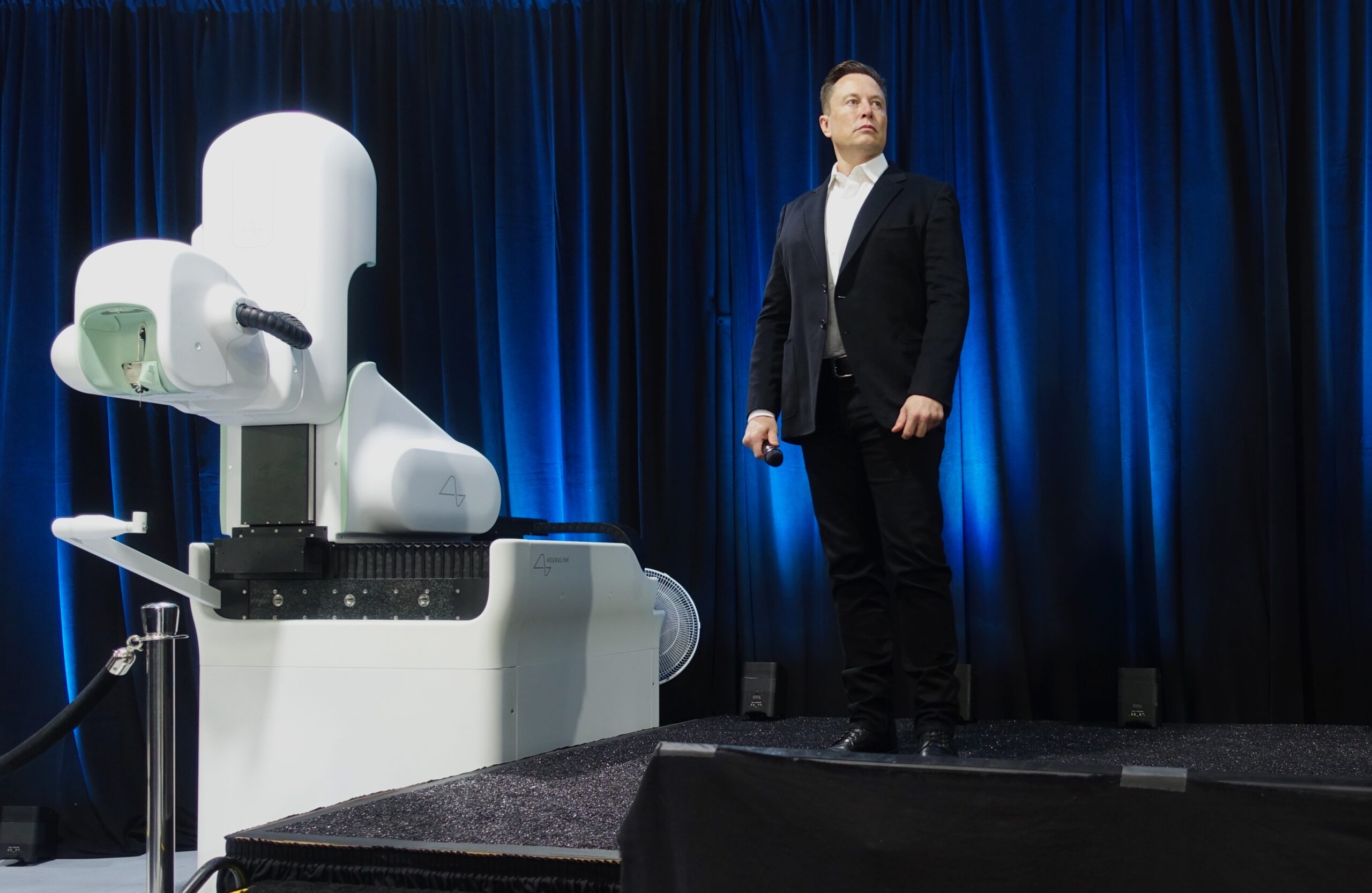
Above: Mr. Elon Musk discussing a Neuralink device during a live demonstration in 2020.
A leading figure in the development of artificial intelligence, Elon Musk, a decade ago, shared the beliefs of those who warned of a technological apocalypse: AI could cause an unprecedented catastrophe. Listening to him, it is unclear whether his publicly expressed opinions are merely another form of marketing or the result of reading classics of science fiction literature, such as the works of Isaac Asimov, Arthur C. Clarke, and Robert Heinlein. What is clear is that he has repeatedly issued warnings, such as the one in 2014:
But time has passed and his discourse has changed. Not only is he investing in the development of these technologies based on the macro-scale instrumentation of information, but he seems downright confident in the future. In other tweets of his, much more recent, as well as in certain interviews, he states that AI/robotics will solve the problem that troubled the bearded Marx: poverty. What he is saying now is simple. If technological progress results in the loss of jobs in certain fields, AI is the saving solution. Here is a tweet of his from April 17, 2026:
For more details we need to read a 2025 Interview with Katie Miller, the CEO of media company Axel Springer, where we find a more extensive explanation:
Assuming the current trend of AI and robotics continues, which seems likely, the AI and robots will be able to do anything that humans want them to do, essentially, so hopefully not more than that, but AI and robotics will be able to provide us all the goods and services that anyone could possibly want so you wouldn’t need to work. People will be able to [do] wherever they want with their free time. Work will be optional. [CLIP of this quote]
The ending electrified me. It sounded like the futuristic textbooks of Marxist-Leninists describing the bright future of humanity. Musk, a Marxist? No way! And yet how do you explain such ideas coming from the speech of the most Capitalist of Capitalists? Before exploring possible answers, it is worth easing the tension with a typically Italian anecdote. I learned it from my brother-in-law, a Veronese by birth, with whom I had discussed the political situation on the peninsula. That is how I learned one of the most sympathetic explanations. The formula is simple and remarkable: “Although we have many politicians with a Socialist-Communist mindset, they all have their pockets on the right.” I laughed out loud when I understood the humorous suggestion that aims for the “harmony” (in fact, the compromise) of extremes: when it comes to money and privileges, the “left” and “right” of today’s leaders become relative values. As the old hit says, “Money talks.”
In the same ironic spirit, we could say that in Musk’s case we have something different, no less funny: a Capitalist leader with his mind oscillating between Left and Right. And yet the question remains: where do the ideas about universal income and optional work (which would be the result of the AI revolution), come from? Born and raised in a country under the yoke of the Marxist-Leninist dictatorship of the proletariat, I’ve heard countless times the story of a society in which work would become optional and money unnecessary. It couldn’t be otherwise, since the “multilaterally developed Socialist/Communist society” promised the eradication of poverty, disease, and even death. In his mausoleum in Moscow, Lenin is already immortal, isn’t he? The broadest form of such ideas regarding the unprecedented development of the “means of production” is found in a famous critical comment by Karl Marx expressed in 1875:
In a higher phase of communist society, after the enslaving subordination of the individual to the division of labour, and therewith also the antithesis between mental and physical labour, has vanished; after labour has become not only a means of life but life’s prime want; after the productive forces have also increased with the all-round development of the individual, and all the springs of co-operative wealth flow more abundantly—only then can the narrow horizon of bourgeois right be crossed in its entirety and society inscribe on its banners: From each according to his ability, to each according to his needs![1]
Replace the notion of “productive forces” used by Marx with that of “AI,” and you get something very similar to Musk’s idea. If we didn’t know that Marx’s ideas are more than 150 years old, we might not even know who influenced whom. However, don’t think I’m implying that Elon Musk is a disciple of Marx—nothing of the sort. Honestly, I don’t believe the owner of Tesla, SpaceX, X, and xAI secretly reads the works of the author of Capital. And yet, the similarities seem striking. So what could be the explanation?
If I mentioned at the beginning Musk’s passion for science fiction literature, it was not by accident. Marxists from various countries in the Soviet bloc had a strong passion for science fiction. I have written extensively about what things looked like in Nicolae Ceaușescu’s Romania.[2] The essence of this passion lies in the techno-prophetic character of many works in this para-literary genre. Numerous authors—and especially many cinematic creations, among which the Star Trek series holds a prominent place—put forward visions of the future that embody the Communist ideal of a classless society without private property, without money, and without the “slavery of labor.” This could be the main source of Musk’s ideas.
Persuaded by stories of galactic worlds and superintelligent robots by Asimov, he “absorbed,” along with the futuristic technological landscape, the ideas of The Communist Manifesto. Yet the foundation of such a “temptation” is something else: the desire to propose a world in which the problem of poverty is definitively solved. And the root of this desire is none other than egocentrism manifested as a will to power—whether political or technological. Undoubtedly, a (pseudo-)messianic desire.
The one who understood very well the underlying nature of such desires was the most important and exotic modern philosopher to convert to Catholicism: Vladimir Solovyov (1853–1900). In a prophetic text titled War, Progress, and the End of History: Three Conversations, Including a Short Story of the Anti-Christ, published in 1900, he dared to propose perhaps the most formidable psychological analysis imaginable. If the great masters of world literature never hesitated to descend into the abyss of profoundly malevolent characters, Solovyov surpassed them all. For the one whose inner turmoil he describes is none other than the Antichrist himself.
Drawing on vast erudition grounded in knowledge of Hebrew, Greek, and Latin, as well as the writings of all the Greek and Latin Church Fathers, Solovyov proposed a figure of astonishing depth. His Antichrist is a doctor of biblical studies from the University of Tübingen. This detail is so striking that it has astonished many readers. Yet the second detail is just as significant.
For the great adversary of Our Lord Jesus Christ is an economist—yes, a genius economist who has discovered the universal and perfect solution for the definitive eradication of poverty. Indeed, this discovery is presented in a monumental book titled The Open Way to Universal Peace and Well-being. If we were to mention a third characteristic, we would necessarily point to Ecumenism. In short, the Antichrist has managed, like no one else in history, to solve all the problems of humanity: poverty, war, divisions, and the lack of harmony among people—in a word, everything. One can hardly understand why such a figure would be the enemy of Christ the Savior. The answer is hidden in Solovyov’s text: because he has solved them here, in this world. At the same time, he hates the Christian message that promises happiness and the resolution of evil—not here, but in the eternal Kingdom of God, in the (other) world to come.
Here lies the central issue, based on a teaching opposed to the Gospel. This teaching claims that the problem of evil in the fallen world can be solved here and now by human beings. Present throughout postlapsarian history, it has manifested in various forms, asserting that wars, poverty, and divisions that generate hatred among people and nations can be eliminated. The entire Marxist-Leninist propaganda is based on this premise. The problem, however, is that God Himself, in the Gospel, taught the opposite: human beings cannot resolve any of the dominant evils.
Thus, while the Apostle John tells us that “the whole world lies in wickedness” (1John 5:19), Our Lord Jesus Christ clearly stated that “the poor you will always have with you” (John 12:8). This “always” clearly indicates that, until the end of the world, the presence of the poor and of poverty will be perpetual. No one, ever, will be able to completely eliminate manifestations of evil from the world. Although all Christians are called to fight against them through acts of charity, they will never be able to create a perfect world. Actually, there is a deep contradiction between the notion of “fallen world” and that of “perfect world.” If it is truly fallen – and, yes, it is (through the original sin committed in Eden by Adam and Eve) – this world will never be perfect.
For this reason, the Church has always rejected the temptation of various forms of “millenarianism”—doctrines that proclaim, in different ways, the existence of a thousand-year period of peace, prosperity, and the definitive eradication of poverty here, in this transient, perishable world. In fact, just as illness, old age, and death will never be eliminated, neither will poverty be eradicated. This is why all those who are powerful and wealthy, and who sell us such illusions, should be encouraged to reflect seriously on the teachings of Holy Scripture. Otherwise, they will be nothing more than propagandists of ideologies which, disguised under the appearance of good, continue to produce victims.
[1] Karl Marx, Critique of the Gotha Programme (1875). [Accessed: 16 July 2026].
[2] See “The Communist Extraterrestrial,” on Kmita’s Library.