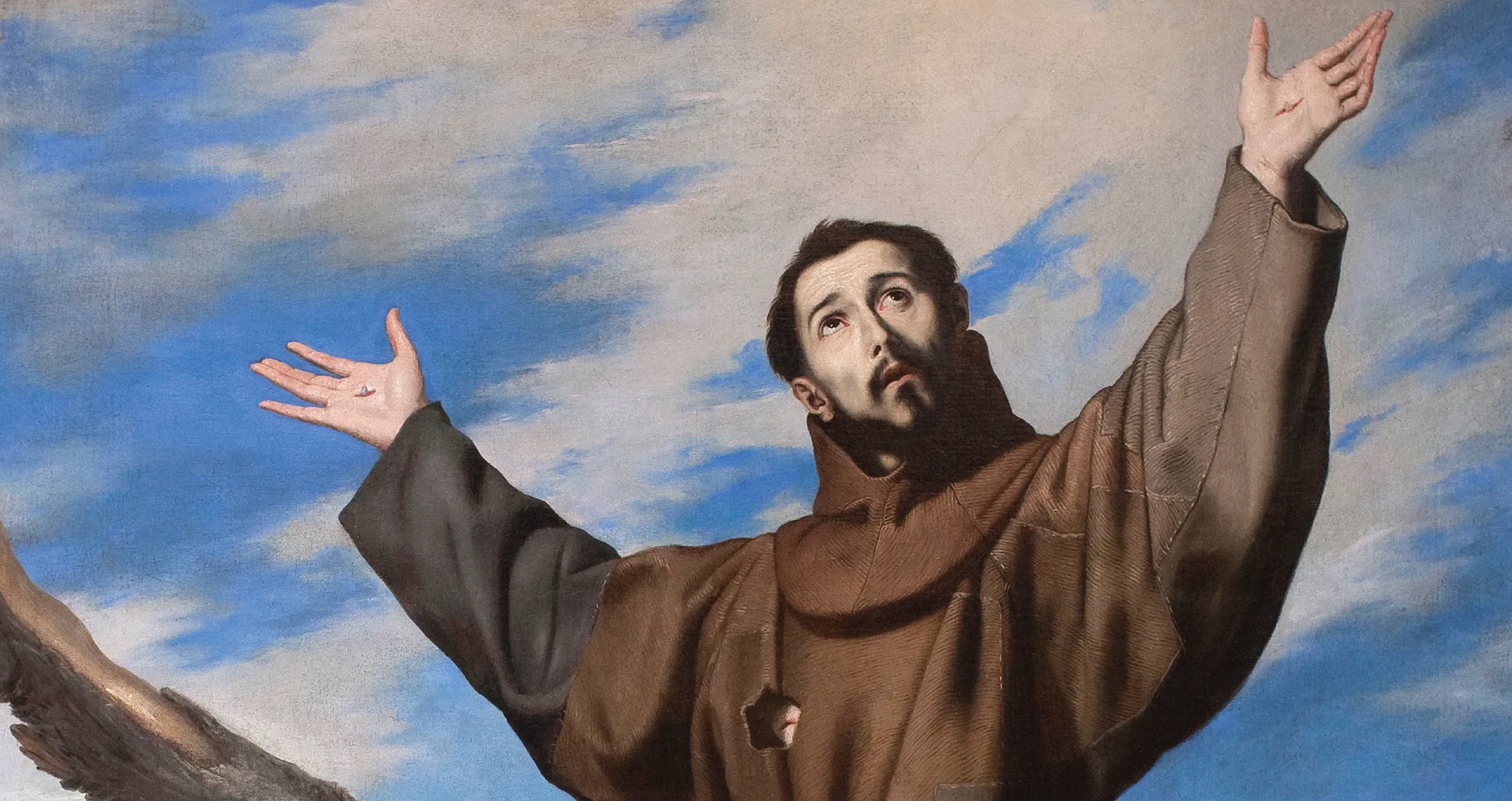
On the evening of October 3, 1226, as his body yielded to death, Saint Francis of Assisi found his final words in prayer. His last breath was steeped in Psalm 141, which he recited with unwavering devotion. St. Bonaventure (†1274) recounts:
He broke forth in the exclamation of the Psalm: ‘With my voice I cry to the Lord; with my voice I entreat the Lord,’ and he recited it until the final verse: ‘The righteous shall wait for me, for the moment when You will give me reward.’[1]
Eight centuries later, Francis shines not only for his radical embrace of the Gospel but also for a less-noticed yet decisive dimension of his life: his relationship with music.
This was no marginal detail. From the earliest hagiographers onward, tradition emphasizes that Francis gave song and music an essential role in his preaching. He called his friars “minstrels of the Lord,” for, like the wandering storytellers of his time, they carried melodies, praises, and words through towns and villages, opening hearts to evangelical joy. In this, Francis unexpectedly bridged the troubadour tradition that, from the late twelfth to early thirteenth century, enlivened Italian courts and spread the art of singing and composing poetry in Provençal.
Francis’s first biographer, Thomas of Celano (†1260), offers a vivid portrait of the saint translating spiritual fervor into music:
Sometimes Francis would act in the following way. When the sweetest melody of spirit would bubble up in him, he would give exterior expression to it in French, and the breath of the divine whisper that his ear perceived in secret would burst forth in French in a song of joy. At times, as we saw with our own eyes, he would pick up a stick from the ground and, putting it over his left arm, would draw across it, as across a violin, a little bow bent by means of a string; and going through the motions of playing, he would sing in French about his Lord.[2]
The image is striking: a saint improvising, transforming a simple stick into a musical instrument, like a wandering minstrel. It is no accident that he sang in French. His father, a prosperous merchant, often traveled to Provence, and to mark that connection he renamed his son Francesco—“the Frenchman.”
Julian of Speyer (†1250), Bonaventure, and other witnesses agree: Francis loved to sing praises in the language of France—“laudes Domino lingua Francorum vir Dei Franciscus decantaret cum iubilo.”[3]
For Francis, music was never a mere liturgical ornament; it was a theological and pastoral instrument. We glimpse him in the woods, praising God; we glimpse him on his deathbed, intoning psalms that transfigure suffering.
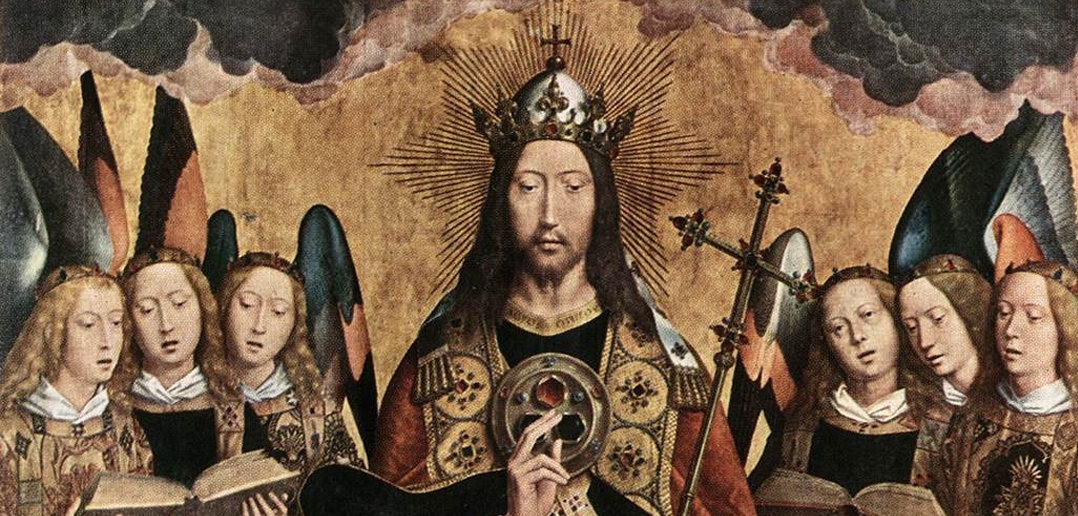
One especially evocative episode is the vision of the “angelic cithara,” related by Thomas of Celano. During a painful eye illness, Francis asked a friar—formerly a cithara player—to play for him. The friar, scrupulous, declined. That night, Francis heard a “most sweet, invisible melody,” as if from a heavenly instrument. He remarked:
The Lord, who consoles the afflicted, has never left me without consolation. See, since I could not hear the lutes of humans, I have heard a more delightful lute.[4]
Here music becomes revelation: a foretaste of paradise, a mystical consolation for body and soul.
The most celebrated work associated with Francis remains the Canticle of Brother Sun, or Laudes Creaturarum, composed between 1225 and 1226 at San Damiano during his illness. Tradition attributes not only the text but also the melody to him—though the latter is sadly lost. (See our discussion here.)
Alongside the Canticle of the Creatures, another song is credited to Francis, Audite poverelle dal Signor vocate, written for the nuns of San Damiano when illness prevented him from visiting. Preserved in two Veronese manuscripts, it carries the rubric Haec verba fecit beatus Franciscus in vulgari. Scholarly studies[5] support the attribution, noting how the text meets the sisters’ need for consolation.
If authentic, it reveals Francis not only as a poet but also as a musician attentive to the communal—and feminine—dimension of prayer.
No written record of the early Franciscan melodies survives. Manuscript 338 of the Assisi Municipal Library, which transmits the Canticle, leaves a space for musical notation that was never filled. Over time the tunes simply ceased to be sung:
It is no coincidence that the text of the Canticle of Brother Sun remains preserved in written form on the parchment pages of manuscripts, no longer used at the end of the friars’ sermons, to the point that even the memory of the melody that Francis would have composed himself is lost. Indeed, no one sang it aloud anymore.[6]
Yet the silence of the manuscripts cannot erase history. Francis understood music’s power as a force for evangelization, consolation, and reconciliation. In his songs, the joy of the Gospel found an immediate, popular voice capable of rivaling the troubadours and reaching the hearts of ordinary men and women.
Eight centuries after his death, Francis’s musical legacy still resonates. In a world marked by conflict and dissonance, he reminds us that music is more than art: it is a spiritual and social language that unites and heals. Singer in French, minstrel of God, composer of hymns, Francis of Assisi stands before us not only as the saint of poverty and fraternity but also as the saint of music—“unshaken and happy, and he sang songs of happiness in his heart to himself and to God.”[7]
[1] Bonaventure, Legenda maior Sancti Francisci, XIV, 5, p. 51; our translation.
[2] T. Celano, Vita secunda 127, in M. A. Habig, ed., St. Francis of Assisi: writings and early biographies; English omnibus of the sources for the life of St. Francis, Chicago 1973, p. 467.
[3] Bonaventure, Legenda maior Sancti Francisci, II, 5, 3-4, p. 6.
[4] T. Celano, Legenda Secunda Beati Francisci, LXXXIX, 126, in Francis of Assisi: early documents, New York 2001, p. 330.
[5] G. Boccali, Parole di esortazione alle “poverelle” di San Damiano, Forma Sororum 14, Perugia 1977, pp. 54-70; A. Menichetti, Una “prosa” volgare di San Francesco, Studi e problemi di critica testuale 19, Bologna 1979, pp. 5-10.
[6] R. Rusconi, “Il Cantico di frate Sole: testo, tradizione, funzione”, in Studi Francescani, 78, Florence 1981, pp. 5- 30; our translation.
[7] T. Celano, Vita prima, II, 93, in St. Francis of Assisi : first and second life of St. Francis, with selections from Treatise on the miracles of Blessed Francis, Chicago 1963, p. 49.