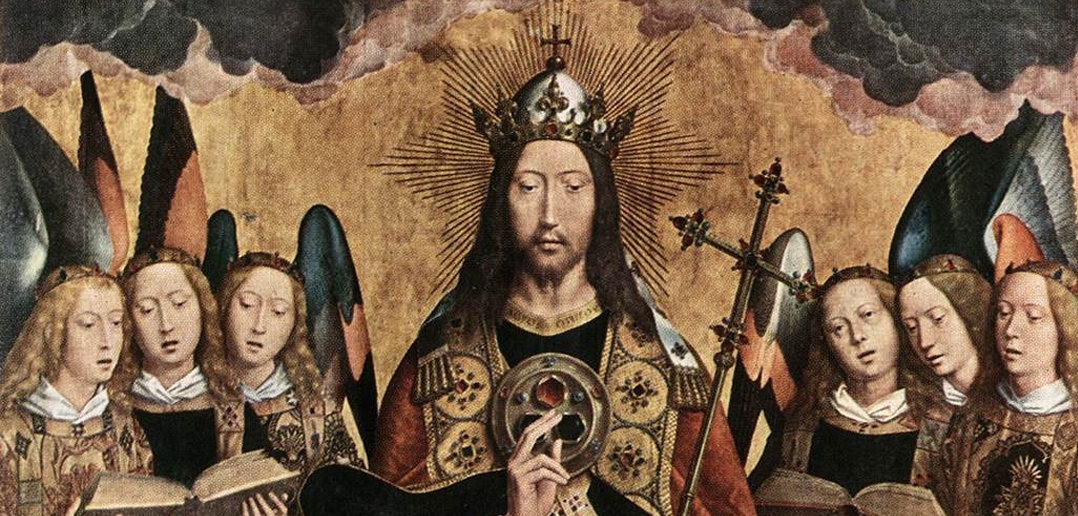


France’s great patron, St. Dionysius or Denis, requires a great deal of defending to-day, as shall be seen – a defender in need of defence. Like St. Patrick his feast day reminds of cooler weather – although in his case, it is in the Autumn (October 9) rather than the Spring. But his problem is one of identity.
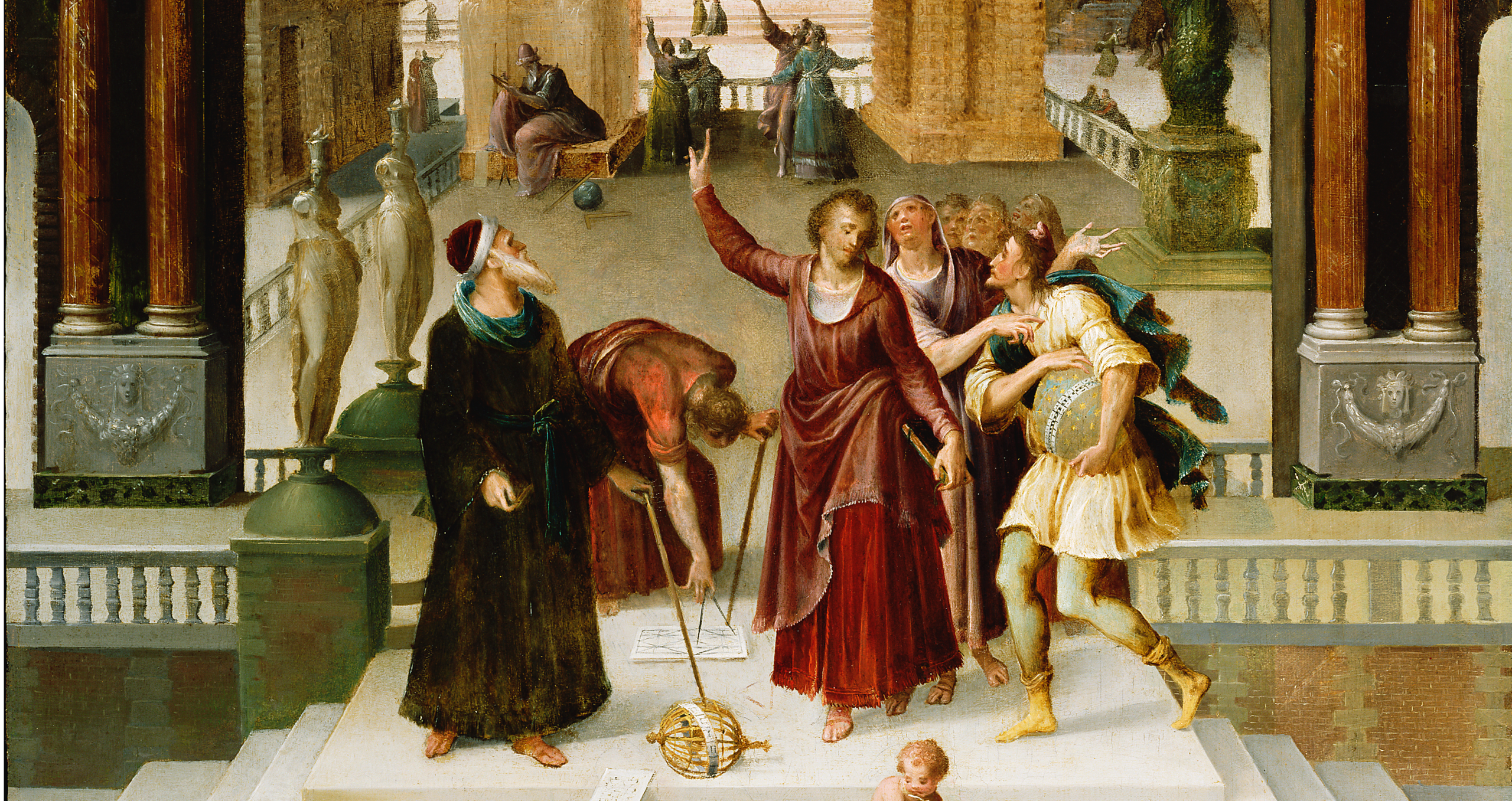
Now, everyone admits that St. Dionysius the Areopagite is first mentioned in the New Testament. In the Acts of the Apostles (Acts 17:34), he is converted by St. Paul the Apostle’s preaching at the Areopagus: “Howbeit certain men clave unto him, and believed: among the which was Dionysius the Areopagite, and a woman named Damaris, and others with them.” It is almost as generally accepted that he was the First Bishop of Athens. It is after this indisputable bit of biography that views diverge.
In the Christological and other controversies of the 4th century, four theological treatises were used extensively by the various combatants: Divine Names (Περὶ θείων ὀνομάτων); Celestial Hierarchy (Περὶ τῆς οὐρανίου ἱεραρχίας); Ecclesiastical Hierarchy (Περὶ τῆς ἐκκλησιαστικῆς ἱεραρχίας); and Mystical Theology (Περὶ μυστικῆς θεολογίας). Each claim to be authored by St. Dionysius the Areopagite. They were held in deep reverence throughout the Middle Ages, and St. Thomas Aquinas quoted them and relied upon them extensively.
But in later times, and especially after the Protestant Revolt, this was questioned – and to-day most theologians of whatever denomination dismiss the author of these books and ten epistles as “Pseudo-Dionysius.” This has even made its way into the Catechism of the Catholic Church, whenever St. Thomas Aquinas is quoted quoting him. But as Wikipedia informs us, there is a spirited defence of him even to-day:
Some modern scholars, including recent contributor Evangelos Nikitopoulos, Romanian professor Dumitru Stăniloae, and English translator John Parker, argue in favor of a traditional composition date in the late first to early second century. Their case draws upon harmonizations with alleged anachronisms, contemporary lexical parallels and idiosyncrasies, and internal literary and historical consistency. Most significant are the pre-Proclean references to the corpus by figures such as John Chrysostom and Juvenal of Jerusalem, and especially by members of the Alexandrian tradition—Pantaenus, Origen, Gregory Nazianzus, and Jerome—who demonstrate familiarity with the Corpus Dionysiacum. Even Proclus himself, who admitted to ‘summariz[ing] the observations rightly made… by some of our predecessors’ such as Origen, appears to cite an external source for the euphemism ‘flowers and supersubstantial lights’—a phrase explicitly found only in Dionysius. Linguistic analyses further suggest that nearly two-thirds of Dionysius’ terminology lacks precedent in any known pre-sixth-century Christian or Neoplatonic text, while another quarter can be traced to ante-Nicene philosophical sources such as Platonic dialogues. Nikitopoulos argues that this primitive theological vocabulary aligns with the intellectual profile reconstructed for another second-century Eastern convert with a pagan Greek education: Justin Martyr.
We shall return to this question presently.
But another layer was added later. It was held in the Middle Ages that St. Dionysius, having finished his work with Athens, was sent to be Bishop of Lutetia (modern Paris). There he suffered and he was martyred during the persecution of Emperor Domitian (reigned 81-96 AD). The saint was beheaded on the hill now called Montmartre – “Mountain of the Martyr.” But a miracle not unknown in the lives of the saints occurred. The lifeless body arose, took his head, and walked a few miles north to where the site of the Basilica of Saint Denis is now. There he stopped. The local Christians (whose numbers were understandably swelled by witnesses of the wonder) entombed him. Later generations would claim that this occurred in the 3rd century, and so was a different St. Dionysius.
But the traditional account has some powerful defenders. In his account of the feast in the Liturgical Year, Dom Prosper Guéranger, after a number of quotes from St. Dionysius’ works, describes him thusly:
Meanwhile, Rome will tell us how the revealer of the heavenly hierarchies, coming from Athens into the west, watered with his generous blood the seed he sowed in the future capital of France. Enriched with his sacred body, the humble borough now known as Saint-Denis long surpassed in renown its neighbor Lutetia (Paris). France repaid her apostle’s devotedness by the glory wherewith she surrounded him; it would seem as if, by a chivalrous inspiration, she had undertaken to compensate him for having abandoned his native country for her sake. Immense was the concourse of people to his holy tomb; and still greater was the piety of the kings. The martyr’s banner, the oriflamme, was their standard, Mountjoy St. Denys their battle cry, in every clime whither victory led them. As in life they never quitted the kingdom without entrusting it to the protector of France in his abbey, so at death they bequeathed to him their mortal remains. In spite of sacrilegious profanations, what a sublime spectacle will the holy necropolis present to the world on the last day, when, before the eyes of Adrian and his prefects, he whom they executed at Montmartre and condemned to infamy, will rise from his tomb escorted by three dynasties of monarchs proud to form, at the resurrection, the court of him whom they deemed it an honor to surround in death. Thy friends, O God, are made exceedingly honorable!
The learned Benedictine goes on to pray to the Areopagite:
Honor to thee on this day of thy triumph! Honor to the apostle of the Gentiles, who comes to meet thee, as his noble conquest, on the threshold of eternity. From early youth how thy soul yearned for that unknown God, whom the apostle at length revealed to the longing aspirations of thy grand, upright nature! To the darkness of polytheism, to the doubts of philosophy, to the vague glimmers of confused traditions, suddenly succeeded the light of truth; and its triumph was complete. Thou, O Christian Plato, didst enlarge the horizon of philosophy, and didst so rectify its formulas that in them truth could be fittingly clothed. Thou, in thy turn, didst become an apostle; the distinction of Greek and barbarian, that law of the ancient world, was lost in the common origin assigned by St. Paul to all peoples; to the eyes of thy faith, slaves and freemen were equal in that nobility which makes the human race the race of God; while the charity, which overflowed in thy heart, filled it with the immense pity of God Himself for the long ages of ignorance in which mankind had been plunged.
Thus in thy zeal, obeying the inspiration of the Holy Ghost, thou, like a cloud laden with the blessings of the Lord, didst bring fertility to the far west. The people of Gaul learned from thee to seek God, to find Him, and to live in Him; and this new church had no reason to envy the earlier ones built on the foundations of prophets and apostles. O chosen stone, good for the foundations, so intimately united to the Corner-Stone that every construction thou upholdest becomes a holy temple of the Lord: the church of France built upon thee, is also the house of God.
O Dionysius, quicken again the divine seed thou didst sow. Restore to Paris and to France their traditions, now forgotten in the fever of gain and pleasure. Bring back Athens to the communion of Christ’s vicar, the indispensable condition of union with our Lord. For every church under heaven obtain such pastors as thou didst describe in the following lines which reveal thyself: ‘By the holy love which draws us to Him, Jesus calms the tempest of distracting cares; and recalling our souls to the unity of the divine life, He confirms us in the permanent fruitfulness of this noble ministry. Soon, by the exercise of the sacred functions, we draw nigh to the angels, striving to set ourselves, like them, in the fixed state of unchangeable holiness. Thence, gazing upon the divine splendors of the blessed Jesus, and enriched with the profound knowledge of mystical contemplation, we become fitted to be ourselves consecrated in order that we may consecrate, to receive light in order to communicate it, to become perfect in order to lead others to perfection.’
Now, lest it be thought that the learned Benedictine was simply being hagiographical, the learned and martyred Archbishop Darboy, in his introduction to the works of St. Dionysius, after laboriously defending with many evidences his predecessor’s authorship of the works in question, summarises the arguments in favour of his coming to Paris, becoming bishop, and suffering martyrdom there:
Those who believe in the identity of the two figures named Saint Dionysius, whom history places in the episcopal sees of Paris and Athens, first observe that when the present controversy first arose under Louis the Pious, the French and the Greeks agreed that Dionysius the Areopagite, initially Bishop of Athens, later went to Gaul, where he founded and governed the Church of Paris. Secondly, noting the scarcity of information about Saint Dionysius the Areopagite in the writings of early Greek authors, they believe he left his homeland and that the silence of Eastern historians regarding such a great man can only be explained by his travels in the West. Thirdly, they cite the accounts of Simeon Metaphrastes, Nicephorus Callistus, and several other hagiographers to demonstrate that Saint Dionysius did indeed come to Rome, where he received an apostolic mission to Gaul from Pope Saint Clement. They commend their sense of the authority of historians, chroniclers or annalists, Vincent of Beauvais, Saint Antoninus, Genebrard, Mariana, and Baronius. They cite several biographies and certain entries in the Roman martyrology, where saints who lived in apostolic times, or at least in the early years of the second century, and whose labours and glory were exclusively in Gaul, are named companions of Saint Dionysius the Areopagite. They also cite the Greek menologies, the very ancient book on the martyrdom of Saint Dionysius and his mission in Gaul, and several Gallican breviaries, missals, and martyrologies from a very early period.
In any case, the Merovingians built the first Basilica over his tomb, and he was regarded as patron saint of the French. That basilica became and remained the burial place of the French Kings. In the 13th century, after St. Louis IX had be laid to rest among his ancestors, the newcomer became the patron of the monarchy and royal dynasties in particular, and co-patron of France with the Areopagite. “Saint Denis” or “Montjoie!” became the war-cry of the French armies. As was stated the aforementioned oriflamme became the standard of France, was the banner consecrated upon his tomb by Dagobert I. Under Louis VI the scarlet banner replaced the standard of St. Martin as the battle standard (although the Gold Fleur-de-Lys on blue of St. Martin remained the royal standard).
In 754, Pope Stephen II brought the veneration of Saint Denis to Rome; devotion to him as both Areopagite, author, and martyred bishop of Paris spread throughout Europe. Abbot Suger, when he rebuilt the Merovingian Abbey in High Gothic style, removed the relics of Dionysius and his companions Rusticus and Eleutherius, from the crypt to the high altar. He is honoured as one of the Fourteen Holy Helpers and invoked against diabolical possession and headaches. With Geneviève he is one of the patron saints of Paris.
At the French Revolution, all the royal tombs at St. Dionysius’ Abbey were despoiled, and the bodies dumped into a common ossuary. Their beautiful effigies were saved and brought to the Louvre. After the Restoration in 1815, Louis XVI had them reinstalled at St. Denis, and the bodies of his murdered brother and sister-in-law, Louis XVI and Marie Antoinette, properly entombed there. Nor is this function simply a matter of the storied past. The mummified heart of the ‘lost dauphin,’ Louis XVII was solemnly entombed there on June 8, 2004. But the relics of the Areopagite were hidden; today, they are conserved in a shrine placed in the upper choir in the basilica.
There is an annual Mass in memory of the Martyred Louis XVI. But the Basilica of St. Dionysius remains a centre of the “Real” France – Catholic and Royal. In a time when the land he came to so long ago is again in struggle with its religious and national enemies – internal and external – the Basilica remains an essential pace of pilgrimage for all who love the country, and pray for her restoration.