
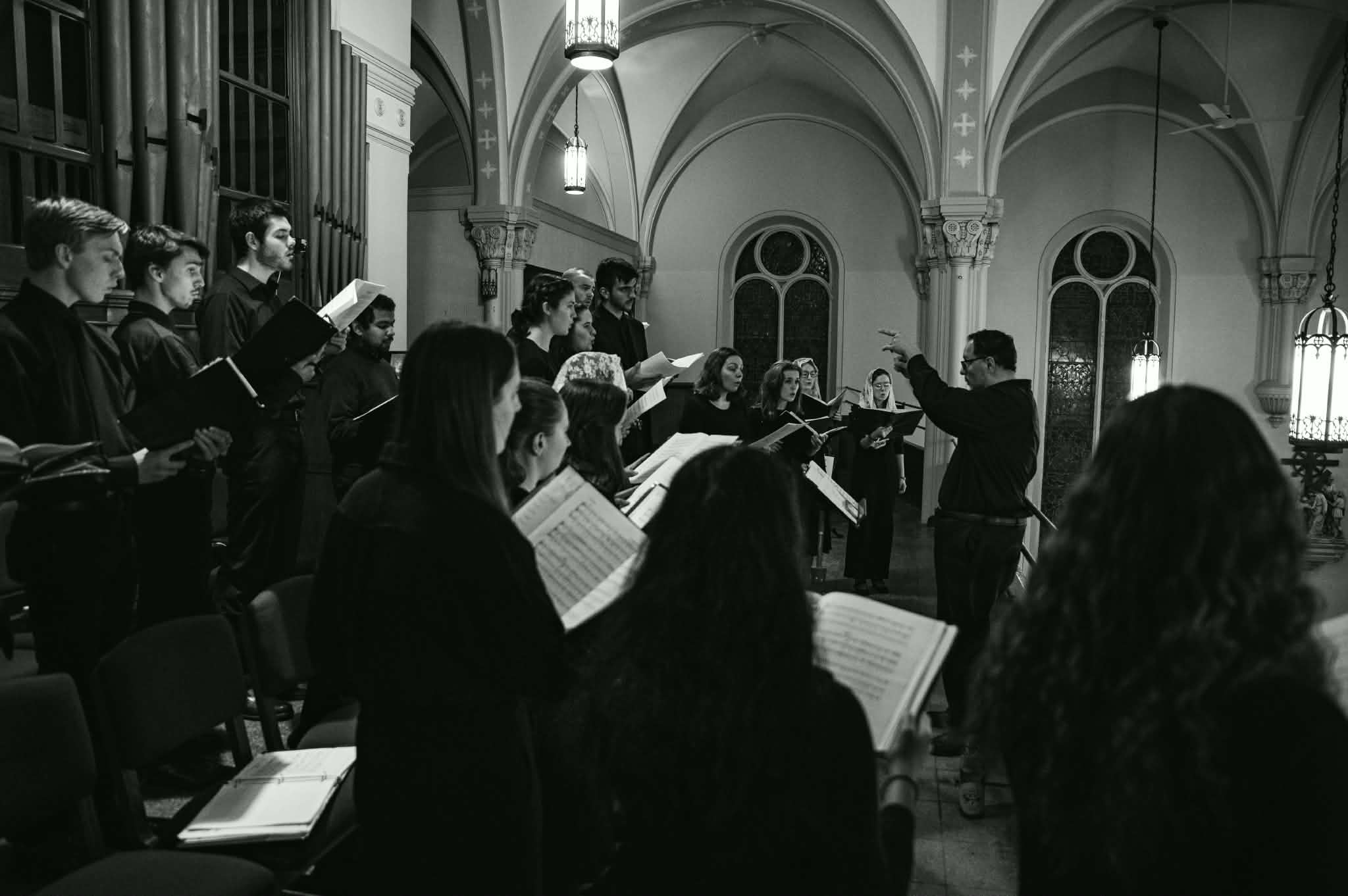
Above: photo by Allison Girone.
On November 22, the Church commemorates the martyr Saint Cecilia. According to a tradition, which some consider not entirely well-founded, she is said to have had some connection with the sound of musical instruments at the time of her martyrdom. For this reason, she subsequently came to be regarded as the patron saint of music and musicians. I will not discuss here whether the tradition linking Saint Cecilia to music is historically reliable or not. What is certain, however, is that, in any case, we can also draw inspiration from her when considering the role of liturgical singing in the celebration of Mass and the Divine Office.
Indeed, in my humble opinion, there is a beautiful symbolism that we can apply, drawing a parallel between the martyrdom of this young Roman woman and the task of a musician engaged in the liturgy.
The choice made by the young Cecilia was to remain faithful to her vow of purity rather than marry Valerian, who would later convert to Christianity. Purity was not chosen as an end in itself, but as a means of elevating not only her body, but above all her soul.
In the same way, the musician serving the liturgy must pursue a form of purity that does not imply hatred of the world, but rather the ability to put things into their proper perspective, distinguishing what is primary from what is secondary. Commercial music may well have a place in our lives, but it has no place in our liturgies, because the Mass calls for music that is proper to it, not music that is merely pleasant or catchy. It must possess holiness, one of the three characteristics identified by Saint Pius X in his fundamental Motu Proprio Tra le sollecitudinifor St. Cecilia’s day November 22, 1903.
Some believe that music in the liturgy should reflect the music of the world. Yet Saint Cecilia teaches us something that may seem counterintuitive, but is nevertheless authentically Christian: contemptus mundi. In other words, we must learn to despise the things of this world if we desire its salvation, because the idolatry of the world leads to perdition. Music for the liturgy, even though it obviously makes use of musical materials that may also circulate in other musical genres, must serve the liturgy, not use the liturgy for its own purposes.
It is a music of emotions, but not of emotionalism: a music that elevates our feelings towards the contemplation of supernatural realities, rather than merely keeping us anchored to this fleeting world, which passes in an instant. Sacred music must allow us to touch the ineffable depths of God; it must not become a celebration of ourselves and our own obsessions.
This principle certainly concerns more than simply rejecting commercial-style music (even when it has sacred texts) in the liturgy. I personally love symphonic music, but I would never dream of proposing a symphonic work during Mass. The Mass has its own requirements, and those who make music within it must learn to breathe in harmony with its rhythms and demands. In this sense, we can say that music and liturgy must be “symphonic”: they must know how to blend appropriately, rather than behaving like two strangers living under the same roof.
Saint Cecilia suffered martyrdom to defend her Christian faith. Likewise, the liturgical musician must be prepared to accept his or her own “little martyrdoms,” fortunately not bloody ones. The musician must remember that the ideal being pursued is among the highest of all: the glory due to God and the spiritual edification of His people.
Even though we live in times of profound spiritual turmoil, we must always be able to keep God on our horizon and rise again after every fall. How much suffering is endured by musicians who strive to preserve the dignity of their work! And if they are lay musicians, their suffering is doubled, because they do not enjoy the protections afforded to members of the clergy (if we are to be completely honest).
In a troubled post-conciliar period, which has also done so much damage to the perception of the indispensable role of the priest, one thing has remained as it was before, and has perhaps even been strengthened in a subtle way: clericalism, whereby certain consecrated individuals consider themselves members of a kind of privileged caste. But this is not the proper Catholic spirit.
Those who find themselves making music in the liturgy should also consider themselves fortunate, because they are engaged in an extraordinary mission: that of raising their own prayer, together with the prayer of the People of God, to Him, the original and originating Beauty.
Every hymn, when well composed and well performed, spreads a new reflection of that light whose source is the Creator of all things.