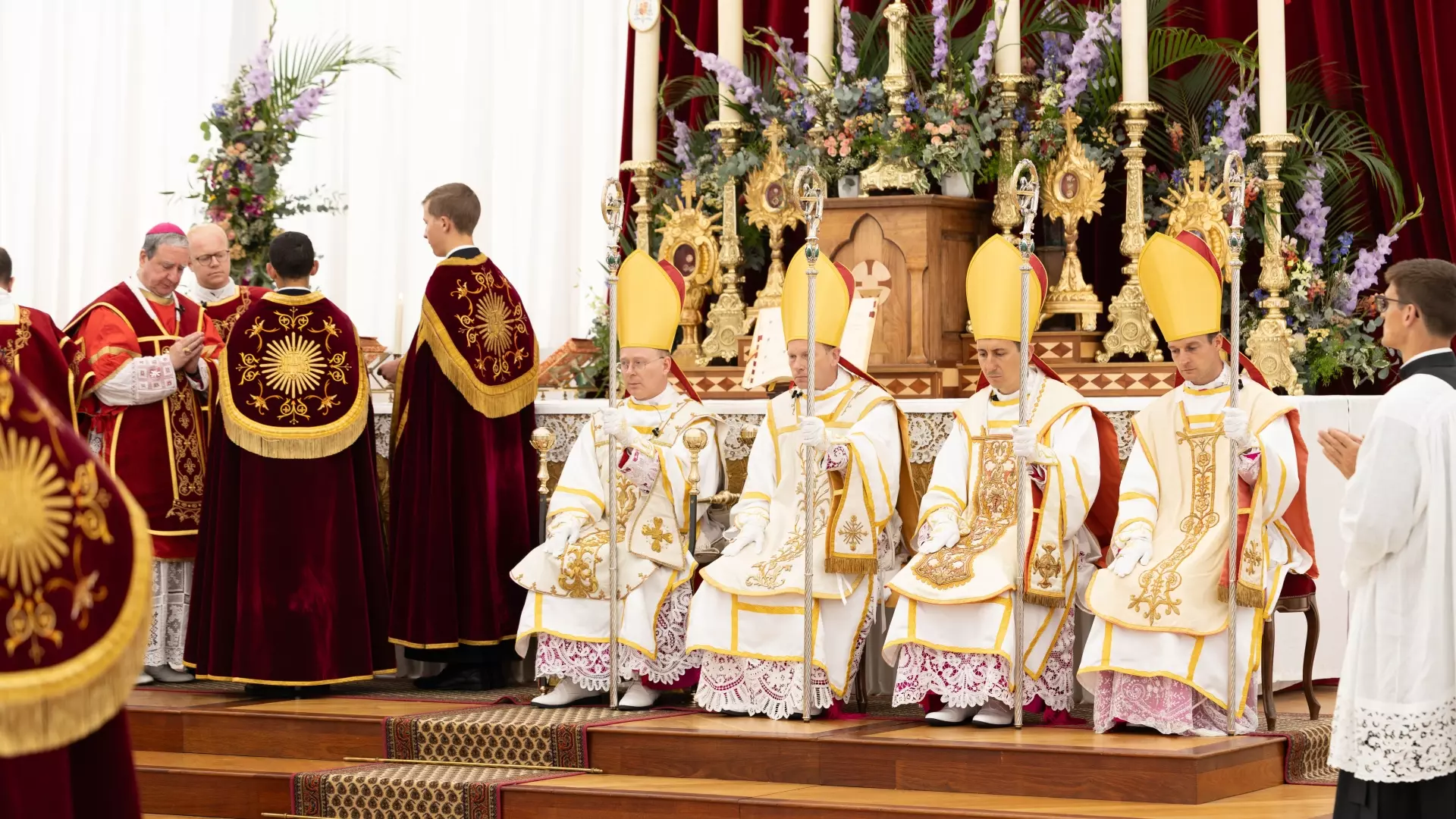
Above: the SSPX bishops and other clerics on July 1, 2026. Photo credit: SSPX.
Author’s note: Since July 2nd of this year I’ve been struggling to come to terms with the SSPX situation. It hit me hard and I’ve been very sad about it for weeks. In the months before the consecrations, I wrote a 300 page book rehashing all my research over the past five years on the topic, and analysing every aspect I could, while deeply struggling with it personally.
But since that time, I’ve come to a place of peace in my heart and mind. This essay is the first fruit of my prayer and reflection. I will try to apply these principles of Christian charity and truth to the editorial process at OnePeterFive in this period of the history of traditionalism after July 2nd, the year of Jesus Christ’s reign MMXXVI and beyond. Pray for me and please invoke our patrons. -TSF
Theotokos of Fatima, “In Thee Unity,” save us.
St. Maximilian Kolbe, model priest of Marian Militancy in Modernity, pray for us.
Bl. Emperor Karl and Empress Zita, model of lay nobility in Modernity, pray for us.
Sister Wilhelmina, model of all laity in Modernity, pray for us.
Understanding a Controversial Person – a Christian Approach
Archbishop Lefebvre has claimed since the 1970s that he’s never got his “day in court” as say in the States. Instead, his claim is that there has been a “smear campaign” against him among the French Bishops, causing his suspension, and then later his (and the other bishops’) excommunications.
This is the reason for Michael Davies’ three volume Apologia Pro Marcel Lefebvre. Mr. Davies believed that the Archbishop never got his day in court. This assertion is not unreasonable, but this does not seem to be the whole story. But more on that in due time.
The main point of this article is not to discuss the details, but to begin with first principles: what is a Christian response to a disputed figure?
Here we have two paths to follow, and it is clear which one is of Christ and which one is of Antichrist: the path of the Inquisition and the path of Soviet Marxist Liquidation. It is critically important that we are faithful to the Christian way, and reject the false way of the Marxists.
The Path of Soviet Liquidation
The Soviet Marxist Liquidation approach is easy to recognise. This path was not invented by the Soviets, but it is something that became their hallmark method of destroying a person and their ideas. It’s pretty simple:
- Falsely accuse an individual of some crime
- Find any shred of truth in this accusation, then exaggerate it as much as possible
- Whip up the “lynch mob” so that this individual’s character and reputation is assassinated.
- Label this person with a pejorative term so that all charity towards him is dissolved and he is “liquidated” – his memory is thrown down the “memory hole” and he is, for all intents and purposes – murdered but not martyred.
- He is then forgotten as if he never existed. After he is forgotten, the liquidation is complete.
Notice how the Soviets found a way to destroy martyrdom. Instead of giving these heroes a glorious martyrdom, they liquidated them with a show trial which turned public opinion against them.
Nowadays this Soviet Liquidation is called “cancel culture.” Crisis Magazine has several articles on this topic, but it’s the same old Soviet Liquidation, except this time it’s AI-assisted Soviet Liquidation.
It should be obvious to everyone that Soviet Liquidation is completely antichristian. Every Christian should oppose any treatment of any individual in this lying, merciless way – whether he is Hitler, Stalin or Mao – for Our Father in heaven loves every soul He has created – and we ourselves sin in treating them wickedly. In fact, we can except that the regime of Antichrist to use these tactics to destroy its enemies in the future, probably using advanced technology and psychological manipulation, which we can see is already happening.
Yet more importantly, Solzhenitsyn points out that the real cause of the Liquidation was the breakdown of charity among neighbours. The Soviet Liquidation society created “constant fear,” “servitude,” “secrecy and mistrust,” “betrayal as a form of existence,” and “universal ignorance”:
Hiding things from each other, and not trusting each other, we ourselves helped implement that absolute secrecy, absolute misinformation, among us which was the cause of causes of everything that took place—including both the millions of arrests and the mass approval of them also. Informing one another of nothing, neither shouting nor groaning, and learning nothing from one another, we were completely in the hands the newspapers and the official orators (emphasis in the original).[1]
Therefore let every Christian examine his heart if he has participated in any way with the online “lynch mobs” against the Pope, bishops, or anyone at all. I know I’m guilty. Lord Jesus have mercy on me.
Our Lady of Sorrows, Softener of evil hearts, save us.
The Christian Path of the Inquisition
Now as I said, the Soviets didn’t invent this methodology – they just helped perfect it. False accusations and “lynch mobs” have been going on for centuries. In fact, this methodology was exactly what happened to Our Lord Jesus Christ Himself.
Against this wickedness, the Church developed the Inquisition. The reason for this institution was that
- Heresy and other evils were a real problem
- Bad Christians were falsely accusing each other or following pagan methods of inquiry (like the “trial by ordeal”)
So the Church developed the institution known as the Inquisition. The term in Latin means to “investigate / ask questions.” The origins are already seen in Greco-Roman civilisation in the books of Acts:
It is not the custom of the Romans to condemn any man, before that he who is accused have his accusers present, and have liberty to make his answer, to clear himself of the things laid to his charge (Acts xxv. 16).
And so St. Paul appeals to Caesar, and this is the reason he came to Rome. (This apparently accords with the Orthodox Jewish tradition as well, but the Conspiracy against Christ in His false trial did not follow this.[2])
As Christopher Dawson notes, the birth of Christendom was also a long birth pain struggle with the power of the pagan civilisation north of the alps (those places which were never “civilised” by the Roman Empire).[3] In short, it took centuries for our “Christian” forefathers – from 476 AD to 1517 AD – to renounce all their pagan habits – from slavery, polygamy, violent brutality and everything else – and adopt Greco-Roman civilisation Christianised.
So this pagan “trial by ordeal” endured for some time, and later the Protestants began to employ the proto-Marxist form of propaganda to whip up their mobs (using the latest technology, like we see today). And against all this is the Greco-Roman Judeo-Christian model of the Inquisition. What is this methodology?
- Everyone is innocent until proven guilty[4]
- We should ask questions (“inquisitor” = questioner[5]) to determine the truth, instead of listening to rumours, hearsay and merely accusations.
- A man’s guilt or innocence should be established by rational, proven data which preserves the justice due to him and to the common good.
This is the path of the Inquisition, because it preserves charity and justice. (Not surprisingly, the institution of the Inquisition itself has been the victim of the Soviet Liquidation method, with the Anglican and Eastern Orthodox propaganda against it).[6]
Archbishop Lefebvre
Now on the one hand, it seems clear from the history that Archbishop Lefebvre was the victim of Soviet Liquidation. Many Neo-Modernists wanted to destroy him and his priests, and they used the Soviet Liquidation method to destroy his reputation.
Further, nowadays many Catholics seems to be merciless toward him and his society of priests he founded. Looking online it’s rather easy to find comments against the SSPX priests which seem to lack any mercy, charity, or rational judgement regarding Lefebvre and the SSPX priests.
On the other hand, is the Archbishop correct when he claims he never got his day in court? Did the Church authorities ever follow the Christian path of the Inquisition for him since Paul VI, John Paul II and now Leo XIV?
I’ve been asking myself that question for the past five years or so, trying to give Lefebvre and his society every benefit of a “fair trial,” knowing full well about the reality of corruption in the Vatican.
Shortly after July 1st of this year, I discovered the speech by Cardinal Ratzinger that he gave in July of 1988, shortly after the excommunications at that time. When I read that speech (that you, Rorate[7]), it seemed clear to me that the Catholics who were against the SSPX priests were not even following the path of the Inquisition. How many of these Catholics had patiently read the SSPX texts and listened to the SSPX and asked questions? And how many of them had followed the Soviet style liquidation?
Because Cardinal Joseph Ratzinger, more than anyone else in history (probably), was the ecclesiastical authority who acted as the Inquisitor for Archbishop Lefebvre. And what he says in that speech, after he excommunicated Lefebvre et al., is not what you hear from many who are against Lefebvre. But more on that in due time.
Separated Brethren
Here we should note that schism is a sin against charity. So first we need to say this: if we assume the SSPX priests are guilty of the worst schism, we need to be charitable to them. If we don’t, we are not Christians anymore. This is the Christian path of the Inquisition.
I have more to say on this point, but first, let us begin with a Christian stance: if the SSPX priests are indeed schismatics, then they are “separated brethren.” Because this is what the Orthodox are (and to a lesser extent, the Protestants). But the SSPX priests are much more Catholic than the best Orthodox Christian, and so in some sense the SSPX clerics would be “separated brethren” but yet more.
How many commentators on the SSPX question have treated the SSPX priests like separated brethren? This is the reason that the stance of the Vatican feels to many like hypocrisy – if the Orthodox and Protestants are treated like separated brethren, why are the SSPX clerics treated so harshly and mercilessly? Listen to Ratzinger in the aforementioned speech:
The problem raised by Lefebvre, however, does not end with the rupture of June 30th. It would be far too comfortable to surrender to a kind of triumphalism and to suppose that this problem has ceased to be one from the moment that Lefebvre’s movement has clearly separated itself from the Church. A Christian can neither rejoice in, nor ought he rejoice in, a disunity.[8]
Notice Ratzinger is rejecting the Soviet Liquidation of shoving the Archbishop and all the clerics with him down the “memory hole.” And he rejects any rejoicing or triumphalism as thoroughly antichristian.
So the first point is truth and charity – we must have charity or we are not Christians. Period.
Therefore if you agree that the SSPX clerics are indeed schismatics, then at worst, they are separated brethren. So they should be treated by the lay faithful like Christian, separated brethren.
As for the laity attached to the SSPX in any way, the Holy See itself does not label them schismatic “automatically,” so who are you to label these lay faithful more harshly than the Apostolate See? (“SSPX Bishops and Priests Excommunicated, Not (Necessarily) the Faithful who attend SSPX Masses” “Vatican: the Schism of Laity Attending the SSPX ‘is not to be presumed automatically‘”).
What does the Holy Spirit say?
Could anyone nourish anger against another
and expect healing from the LORD?
Could anyone refuse mercy to another like himself,
can he seek pardon for his own sins? (Sir. xxvii).
This was the First Reading in the Holy Mass celebrated by the Holy Father yesterday, and in the rite of Mass most common among those who mercilessly attack the SSPX priests and harden their hearts.
But this cuts both ways. How many on the SSPX side have done the same thing to their brethren partaking of the One Bread in the new rite? The commandment of mercy cuts every heart:
The merciless will be judged mercilessly (Ja. ii. 13).[9]
Yet in the end, this is a question of fatherhood.
To be continued tomorrow.
T. S. Flanders
Editor
Exaltation of the Holy Cross
[1] Aleksandr Solzhenitsyn, The Gulag Archipelago, trans. Whitney & Willets, abr. ed. (New York, NY: Harper Perennial, 2007), 322.
[2] According to one source I found secondarily: Aaron Kirschenbaum, Double Jeopardy and Entrapment in Jewish Law, 3 Israel Yearbook on Human Rights, Rts. 202 (1973), p. 211. I would appreciate any readers who have expertise in this area to email me for more information on this.
[3] “Hence it is no mere coincidence that the line of religious division after the Reformation follows so closely that of the old [Roman] imperial frontier. On the one hand the Teutonic lands outside the Empire—Scandinavia and Northern Germany—form a solid bloc of Lutheran territory. On the other, the Latin world as a whole remained faithful to Rome, and so also to a great extent did the Germanic provinces within the frontiers of the Empire, such as Flanders, Bavaria and the Austrian provinces.” Christopher Dawson, Progress and Religion (Washington, DC: Catholic University of America Press, 2001), 141-2.
[4] But this took centuries to take root in Christendom – King St. Louis IX abolished the trial by ordeal but this did not last. But St. Thomas establishes that “doubts should be interpreted favourably” (II-II q60 a4).
[5] The word comes from in + quaero, meaning “look, ask questions, strive for.”
[6] This was the calumny of Casiodoro de Reina (1520-1594) that the Spanish Inquisition was a tool of oppression, which was immortalised by Fyodor Dostoevsky in “The Grand Inquisitor” chapter in The Brothers Karamosov. For an accurate understanding of the Inquisition, see H. J. A. Sire, Phoenix from the Ashes (Angelico Press, 2015), 32-47; Steve Weidenkopf, The Real Story of Catholic History: Answering Twenty Centuries of Anti-Catholic Myths (Catholic Answers Press, 2017), 111-136; Henry Kamen,The Spanish Inquisition: A Historical Revision (Yale University Press, 2014), 86-91. Obviously every institution which includes humans will suffer from abuses and bad people.
[7] Joseph Ratzinger, “On the Attitude of the Holy See Regarding the Lefebvre Movement,” Wednesday, July 13, 1988.
[8] Ibid.
[9] KNOX.