
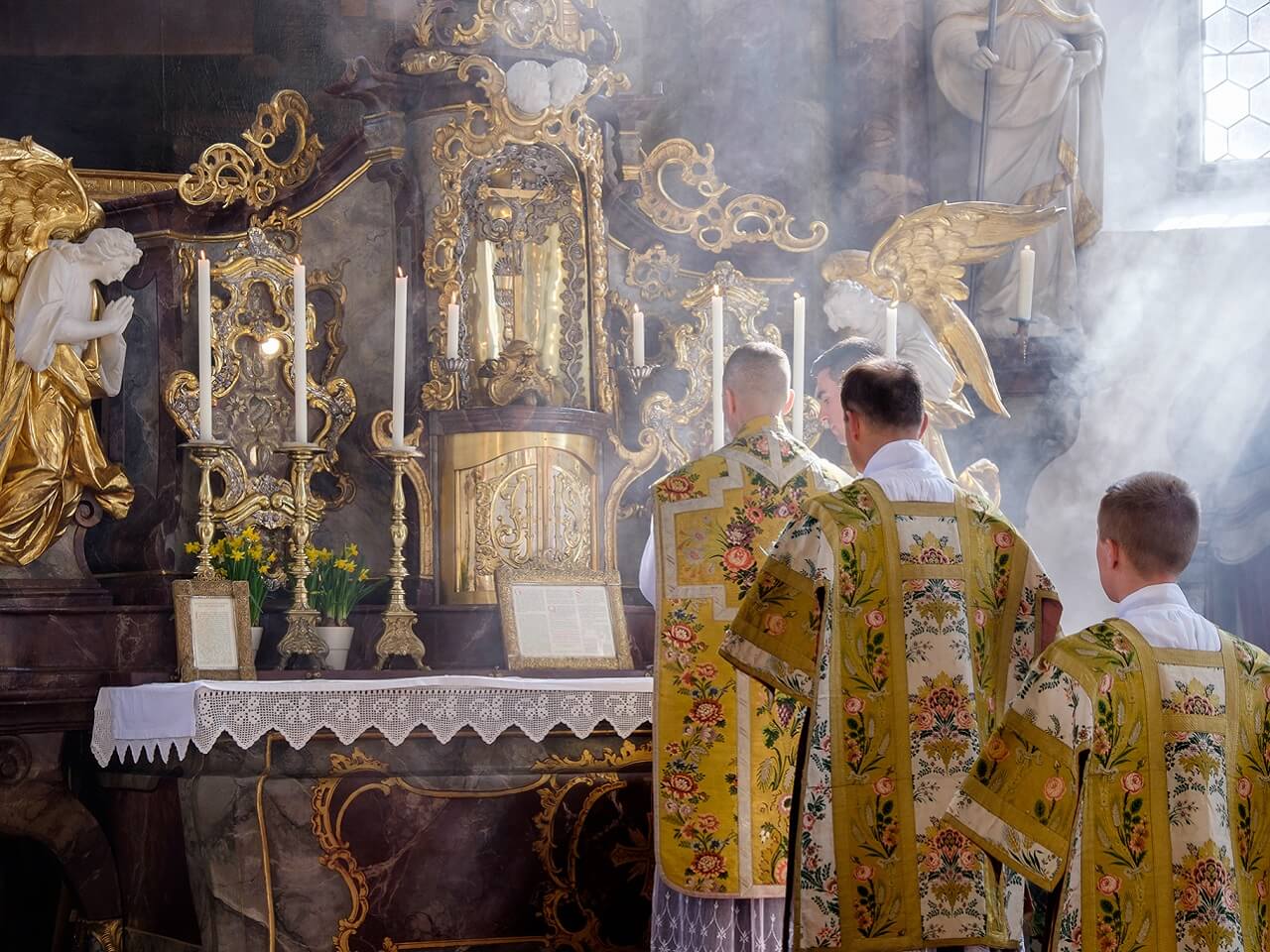
Over the past few decades, the “liturgical problem” has dragged on wearily, with the result that the standard of liturgy and liturgical music in our churches has continued to decline. Unfortunately, there are priests who have completely lost their sense of the beauty of the liturgy, and faithful who, having never experienced anything else, believe that certain careless, lacklustre and undignified celebrations are what the Church’s liturgy is supposed to be.
In reality, the Church’s liturgy is far more splendid than these counterfeits. Even the reformed liturgy, if celebrated with dignity and a profound sense of adoration, can certainly inspire the prayer of the People of God. Everyone understands that a dignified liturgy accompanied by genuinely liturgical music is, in any case, better than the mediocrity that prevails today.
But why are we unable to bring about a turning point in our liturgies? From what I have observed over these decades, the reason is that we lack the courage to admit that the reform has suffered some considerable failures. Instead, people prefer to create an enemy—the traditionalists—in order to avoid confronting the real problem within their own ranks. We should acknowledge that the post-Vatican II liturgical reform has failed in some very important respects, and that a genuine reform is necessary to recover the foundations of liturgical practice.
Unfortunately, the social climate of the 1960s, the decade in which Vatican II took place, did not help matters, since the Ecumenical Council became a pretext for pursuing progressive causes that were not infrequently at odds with a Christian vision of life. The liturgy became a vehicle for embracing some of these causes, which have completely distorted the message of Vatican II. Let us consider the question of participation, something that everyone can agree upon in principle, but which has been pushed to extremes that we can all witness in our own parishes. Vatican II itself put it well (Sacrosanctum Concilium, 19):
Pastors of souls must therefore zealously and patiently strive to provide liturgical instruction and also to promote the active participation of the faithful, both internal and external, according to their age, condition, way of life, and degree of religious culture. In this way they will be fulfilling one of the chief duties of a faithful dispenser of the mysteries of God; and in this matter they must lead their flock not only by word but also by example.
Participation is not merely a matter of “doing” something; it is also, and above all, an interior disposition. One participates first and foremost inwardly, by listening and experiencing the liturgy through the splendour of its forms of communication. All this becomes even clearer a little further on in the same document (Sacrosanctum Concilium, 29):
Servers, readers, commentators, and those who belong to the choir also exercise a genuine liturgical ministry. They ought, therefore, to discharge their office with the sincere devotion and decorum demanded by so exalted a ministry and rightly expected of them by God’s people. Consequently, they must all be deeply imbued with the spirit of the liturgy, each in his own measure, and they must be trained to perform their functions in a correct and orderly manner.
In other words, it is the People of God themselves who demand that the various liturgical ministries be carried out by people competent to fulfil their specific responsibilities, rather than simply assigning tasks to everyone in the name of an unhealthy conception of participation in the liturgy. Full and active participation means that each person participates fully according to their competence and their role within the People of God.
Full participation has certainly been one of the principal subjects of post-conciliar debate, but there are many other issues as well. This is precisely why we need the courage to acknowledge our failures and begin again on firmer foundations. After all, when we consult a doctor about a health problem, the first thing the doctor asks us to do is correct those habits that have probably contributed to it. We cannot simply pretend that nothing is wrong, as though mistakes could somehow correct themselves.
The Mass is the place where God and humanity encounter one another. Divo Barsotti explained this well in his book La Messa:
If the Mass possesses the highest degree of objectivity, it is precisely because it assures us of this encounter, this relationship between humanity and God, and between God and humanity. In the Mass, humanity and God meet; in the Mass, humanity and God enter into a relationship. The most essential thing of all is this relationship between humanity and God. We shall then see that within the human person lies the relationship of all human beings, that within the human person lies the relationship of all creation, both physical and spiritual, of angels and the elements. We shall then see what the relationship between humanity and God consists of; we shall then see that this God is Christ, who communicates himself to me; that he is the Father, to whom my adoration is directed; and that he is the Holy Spirit, through whom and in whom this relationship is realised. But first and foremost, this is a relationship with God, with the Divinity: it entails a relationship between two beings who are infinitely distant from one another, who have no relationship of their own apart from the absolute dependence of the human person upon God. Two infinitely distant realities meet in the Mass: God and humanity.
How can our liturgies today foster this encounter if they are celebrated carelessly and without dignity? Let us pray that those responsible will have the courage to begin again where we have failed.