
Above: Matera, Italy.
Three centuries ago, on April 6, 1726, Saint Gerard Majella was born—one of the most beloved and venerated saints of Southern Italy.
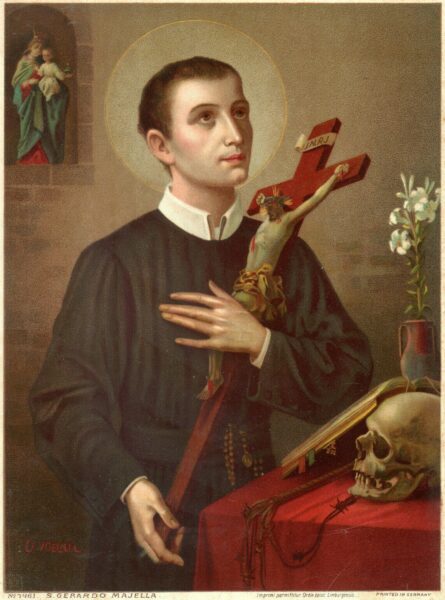
The son of a humble family, Gerard grew up in an environment marked by material poverty but rich in faith and spiritual sensitivity. From an early age, he exhibited an intense devotion that would lead him to consecrate his life entirely to God. In 1752, at the age of 26, he entered the Congregation of the Most Holy Redeemer (Redemptorists), founded by St. Alphonsus Maria de’ Liguori (†1787). Just three years later, on October 16, 1755, he died at only 29 years old in the convent of Materdomini in Caposele (Avellino), leaving behind a legacy of holiness that has deeply marked the life of the Church.
Canonized in 1904 by Pope Saint Pius X, Gerard is now revered as the patron saint of mothers, children, and his native region of Basilicata. But beyond his well-documented miracles and his reputation for sanctity, what makes his figure especially compelling is his mystical relationship with music—a theme often overlooked, yet deeply illuminating.
Gerard had no formal musical training and no knowledge of theory, yet for him, music was far more than art—it was a sacred language. It became a means of spiritual ascent, a source of consolation, and a path to intimate communion with God. Singing, for Gerard, was not merely an act of devotion but a profound immersion into the mystery of the divine.
From early childhood, he demonstrated an extraordinary musical sensitivity inseparably linked to his deep spirituality. At just six years old, he would sing hymns before sacred images, build miniature altars, and lead neighborhood children in processions and chants. He shunned worldly games, preferring to immerse himself in the liturgy—transforming music into a kind of gioco sacro, a sacred play that foreshadowed his future vocation.
Even after joining the Redemptorists and embracing the most humble of tasks, Gerard never abandoned his love for music. Every song he sang became an act of gratitude, a celebration of divine beauty, and a reflection of the Creator.
Numerous moments in Gerard’s life reveal music as a conduit of grace—bringing healing, joy, and spiritual transformation.
In Bisaccia, after miraculously healing Bartolomeo Melchionne, a gravely ill father, Gerard invited him to join in singing a hymn of thanksgiving. A simple gesture, yet rich in meaning: music became living praise.
One of the most extraordinary episodes took place at the convent of Materdomini, where a poor blind flutist, Filippo Falcone, was invited by Gerard to play the spiritual song Il tuo gusto e non il mio / amo solo in te mio Dio (’Tis Thy good pleasure, not my own, / in Thee my God, I love alone)—a composition by St. Alphonsus expressing the sweetness of surrender to God’s will. Overcome with divine fervor, Gerard began to dance and repeat the verses until he fell into ecstasy, levitating in front of multiple witnesses. The scene revealed music’s mystical power to unite body, soul, and the divine in a single spiritual act.
In Melfi, in 1753, Gerard brought comfort to a group of ailing priests by accompanying himself on the spinet (a small harpsichord) while singing verses by Pietro Metastasio (†1782): Se Dio veder tu vuoi / guardalo in ogni oggetto;/ cercalo nel tuo petto, / lo troverai con te (If you wish to behold God, / you may see Him in every object around; / search in your breast, / and you will find Him there).[1] The odd-numbered verses are from the oratorio Betulla liberata, the even-numbered ones are from La Passione di Gesù Cristo, both set to music by St. Alphonsus himself. Gerard’s singing was so infused with spiritual power that even Rev. Stefano Liguori began to dance in ecstasy, swept up by that santa gioia—a holy joy—that transforms pain into praise.
Another touching episode involved Rev. Domenico Sassi, long tormented by spiritual scruples and melancholy. Gerard, after blessing him, asked him to sing the Litanies of the Blessed Virgin Mary while playing the spinet. That simple, humble act became a moment of profound healing: Sassi found peace and was able to resume celebrating Mass.
Another remarkable miracle occurred when Gerard asked a young, musically untrained peasant to play the spinet in his cell. Under Gerard’s spiritual direction, the boy produced an astonishingly sweet and harmonious melody—as though touched by a heavenly hand. Those present were speechless. Music, in Gerard’s presence, became a visible sign of the invisible.
Although never formally trained, Gerard himself played the organ “rather well.” On one occasion, consumed with longing for the Eucharist, he sang Fiori felici, voi che notte e giorno (O flowers, O happy flowers, which day and night). This tender spiritual song by St. Alphonsus, addressed “to Jesus in the Blessed Sacrament enclosed in the Tabernacle,” is a delicate apostrophe to the flowers destined to adorn the altar that bears the Divine Presence. In Gerard’s voice, longing deepened into worship, and his song became adoration made flesh.
In one final luminous scene, the noblewoman Geltrude di Cecilia sang Gerard’s favorite verses by Metastasio (Se Dio veder tu vuoi). Gerard, overwhelmed by divine sweetness, was drawn into ecstatic rapture. In that moment, suspended between earth and eternity, music revealed itself as a threshold to the divine.
For St. Gerard Majella, music was not mere personal inclination—it was the very thread of his consecrated life. It was a form of evangelization, a source of healing, a bridge to communion, and a spark of ecstasy. From his earliest days to his final breath, every note he sang was an embodied prayer, a language of the soul, a hymn rising toward heaven.
In an age marked by noise, distraction, and disenchantment, Gerard’s witness invites us to rediscover music’s spiritual dimension. When rooted in love for God, music becomes more than sound—it becomes an instrument of holiness, a wellspring of grace, and an expression of a faith that not only speaks, but sings, consoles, and transforms.
Photo by Luca Micheli on Unsplash
[1] English translation as found in Beautiful Thoughts from French and Italian Authors (Liverpool, 1866), p. 518.