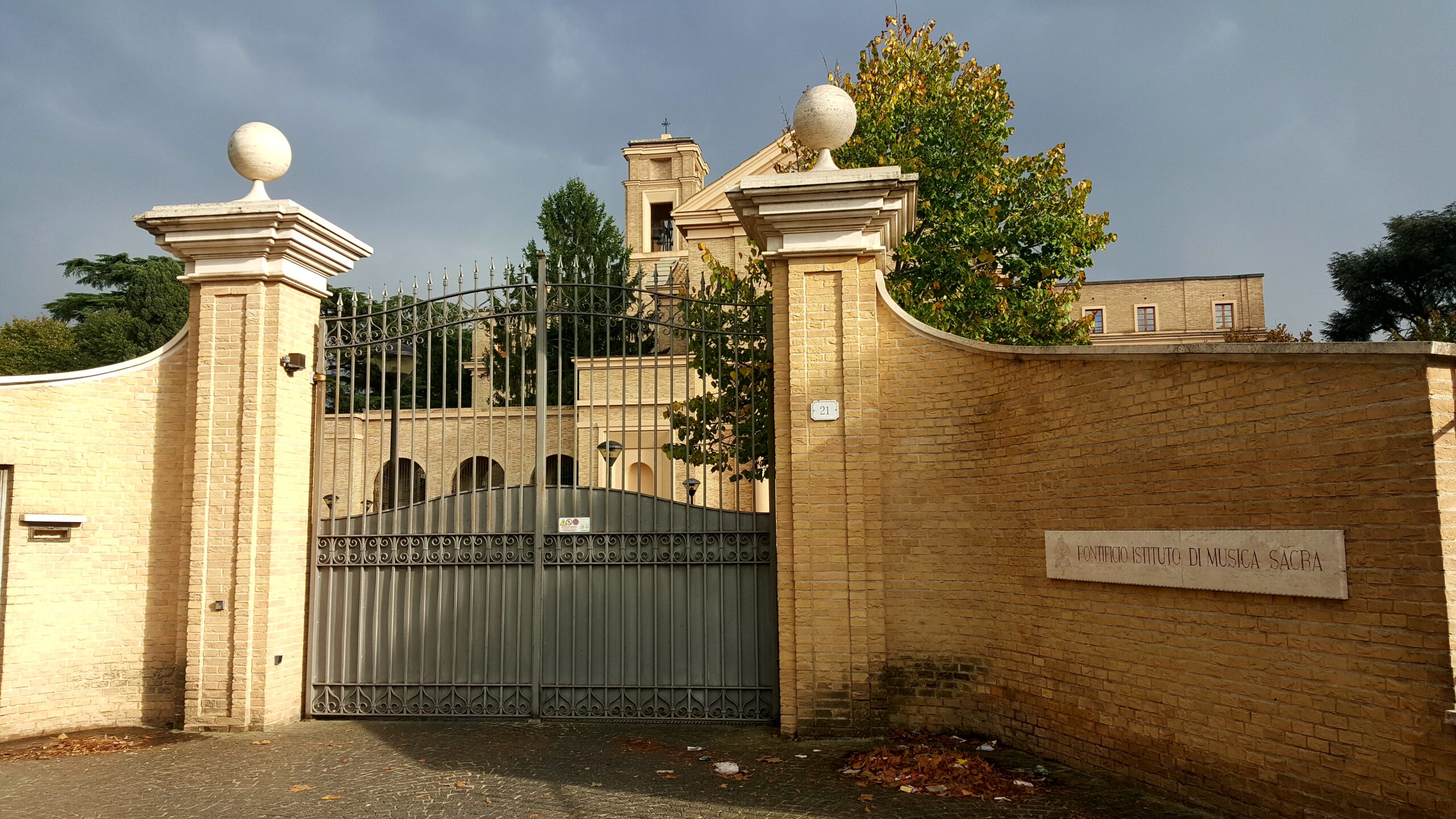
Above: Pontificio istituto di musica sacra in Rome.
Fifty years ago, on April 17, 1976—Holy Saturday—Monsignor Lavinio Virgili died in Rome at the age of 74. As noted in the 1974 award that crowned his career, he was recognized for “his outstanding gifts as a musician and his fruitful versatility as a composer, choirmaster, and liturgist.”
Born June 5, 1902, in Carassai (near Ascoli Piceno, central Italy), Virgili entered the seminary of Fermo early and was ordained on July 19, 1925. He studied Gregorian chant and sacred composition at the Pontifical School of Sacred Music in Rome, laying the foundation for a distinguished career. He later served as director of the Cathedral Choir of Fermo and the Lateran Choir, president of the Roman Commission for Sacred Music, and vice-president of the Italian Association of Saint Cecilia. His compositions include masses, motets, and psalms, and he contributed significantly to the publication of the Opera Omnia of Giovanni Pierluigi da Palestrina (†1594).
Rooted in Gregorian chant, Virgili responded to the post–Vatican II liturgical reforms with clarity and pastoral balance. His Latin Masses sought to engage the faithful through accessible yet reverent music, enabling ordinary parish choirs to elevate liturgical celebrations.
Beyond composing, Virgili was a devoted teacher and advocate for sacred music. He adapted works by 16th- and 17th-century polyphonists for modern use. Among his original works, the motet O salutaris hostia is particularly cherished.
Surprisingly, Virgili—like Domenico Bartolucci (†2013), director of the Sistine Chapel Choir—was excluded from the preparatory liturgical commission of the Second Vatican Council. Reflecting on this, Virgili later remarked:
People could not understand how such an ‘ostracism’ could be inflicted upon the Maestro of the Pontifical Chapel and the Director of the Lateran Musical Chapel, who was also President of the Roman Commission for Sacred Music […]. To be honest, we ourselves were surprised and disappointed by the omission. We later learned of authoritative interventions made on our behalf to those who had barred our entry into that Commission, and we came to understand the nature of the justifications given. One of these—too naïve to be convincing—was based on a ‘benevolent desire not to distract us from our professional obligations, which supposedly would not have allowed us to participate consistently in the Commission’s meetings and work’ […]. Another explanation—more blunt, but at least sincere—[was] that our presence on the Commission was unwelcome because we had ‘our own ideas,’ and the goal was to ensure unanimity of intent and purpose among its members. Given such circumstances, how could we have collaborated with those who had deliberately rejected our collaboration? […] If we had any concern, it was not about the substance of the Council’s decrees themselves but rather the manner in which they would be interpreted and imposed in practice—and the risk of excesses tending toward the suppression of the scholæ cantorum. We also feared that certain criteria, appropriate for liturgies in smaller churches, might be indiscriminately applied to the liturgies of larger churches (cathedrals, basilicas, major parishes), which possessed qualified and capable choirs.[1]
Virgili’s contribution must be viewed within the wider context of post-conciliar liturgical reform. A penetrating analysis of that era was offered by Benedict XVI on February 14, 2013, during what he called “a little chat” (una piccola chiacchierata) with the clergy of Rome. The Pope drew a sharp distinction between the real Council—rooted in faith and the Church’s tradition—and the media Council, a distorted version shaped by ideological and political filters.
This latter narrative portrayed the Second Vatican Council as a democratizing rupture within the Church, reducing the liturgy to a secularized communal gathering, stripped of its transcendent character. Over time, this “virtual Council” shaped public perception and contributed to a crisis in liturgy, a decline in vocations, and a reductive approach to Scripture.
It was in this charged atmosphere, between 1963 and 1967, that new forms of sacred music began to emerge, often influenced by jazz, folk, and beat music. These so-called “beat Masses” or “youth Masses” attempted to appeal to younger generations but sparked intense controversy. The first Italian case appeared in 1965; by April 27, 1966, the Messa Beat had drawn major media attention. A Gente magazine interview with Rev. Gabriele Sinaldi, O.P., a promoter of the genre, prompted a swift and forceful response.
On May 14, 1966, Monsignor Virgili—then president of the diocesan commission for sacred music of the Vicariate of Rome—issued a public condemnation. He described this musical trend as a “degenerate genre,” incompatible with the sacred character of Catholic worship. His critique was pointed and uncompromising:
The organizers should have at least seriously reflected on the impossibility of a union between music they themselves considered ‘the most typical expression of worldly profanity’ and the sentiments of a religiosity—even a ‘modern’ one. A judgment on such a genre of music is superfluous. It is inconceivable that it, so depressing for the spirit and at the same time exalting an ambiguous sensuality, could promote good education among youth. It is even more absurd to consider it valid for ‘the expression of mysticism’ or any form of ‘prayer.’ … The so-called ‘Youth Mass’ [was presented] in an almost sacred setting, so honored by the highest expressions of religious musical art. A repudiation—of both the event and of certain naïve appraisals by some ‘liturgists’ or pseudo-mystics—is obvious. … The ‘yè-yè Mass’ in question … is nothing more than a foolish and blasphemous mockery made with sounds, noises, hisses, and orgiastic shouts of sacred words, most of which are the ‘Word of God.’[2]
Half a century after his death, Monsignor Lavinio Virgili remains a figure of musical and ecclesial integrity. He united liturgical rigor with pastoral concern, embracing reform without rupture. In a time of upheaval, Virgili chose the harder path: to preserve the sacred, renew without discarding, and open without diluting.
His voice—measured yet unyielding—remains a point of reference for those who see sacred music not as a vehicle for sentiment or fashion, but as a true path to the Mystery, firmly rooted in the living tradition of the Church.
[1] L. Virgili, Una precisazione, in the quarterly Cappella Sistina, no. 8, Rome 1965, appendix on the fourth page; our translation.
[2] In A. Marguccio, Cantate al Signore, Aletti, Villanova di Guidonia, 2014; our translation.